



On 15 September 2026 XPENG Robotics put a paper on arXiv titled XPACE: Joint World and Action Modeling from Heterogeneous Experience. Sixteen authors are on it. The paper is the company’s own account of the model that drives its humanoid robot, IRON.
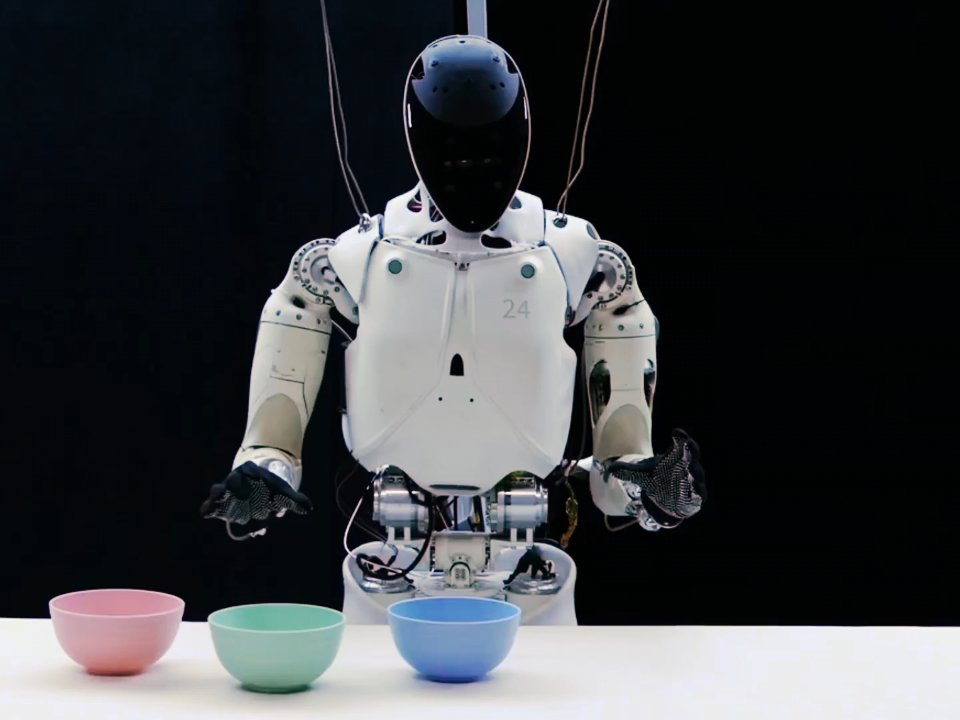
The model does two jobs out of one shared video component. In the first it takes what the camera sees and an instruction in text, then predicts the robot’s next movements together with the video those movements produce. In the second it takes the movements from outside and returns only the video: what will happen if the arms do this? That second job is the simulator, and without it the model cannot train on material it makes itself.
The material
5,000 hours of video in four layers. At the bottom, ordinary footage shot from a person’s own point of view, with nothing recorded about how the hands move. Above it, recordings that measure hand and wrist motion. Then footage staged so that the tasks and the surroundings resemble the robot’s workspace. At the top, IRON itself, with a person operating it remotely.
A fifth set holds attempts that went wrong. It trains the simulator only, and the robot never learns to copy those movements. Without it the simulator would draw successful outcomes even when the movements fed to it were wrong.
The simulator makes the mistakes itself
What is new in the paper is the use the simulator is put to. XPENG takes a movement performed correctly, pushes one of the robot’s hands away from the starting pose, and has the simulator draw both the deviation and the way back. A sequence that does not end close enough to the starting pose goes out; the measure is how closely its final frame resembles it. It joins the rest to the recorded continuation and fine-tunes a copy of the model on the result. The mix is 8 percent synthetic material against 92 percent of the material the model was already trained on.
XPENG measured on an IRON-R01-1.11, 20 trials per task. After the extra training the success rate rises from 61.7 to 86.7 percent, averaged over three tasks: putting a banana in a basket, pouring water, and handing a cola to a person. Pouring shows the largest change, from 50 to 95 percent.
The paper measures the human material separately. A model trained on robot footage alone completes 50 percent of the attempts when the banana is moved through five positions; with the full material, 80 percent. With objects in the scene that the robot has never seen, the same two figures are 30 and 50 percent.
The limits of the test
The paper enters a caveat of its own: the comparison is before against after the fine-tuning, and it does not separate the effect of the synthetic material from the extra training time. The robot stands in a laboratory, held in a rig, and the tasks happen on a table. Nothing here measures a robot working in a store.
XPENG said at CVPR in June that IRON goes into mass production by the end of 2026 and into its own stores from the first quarter of 2027. The paper says nothing about either date.
The link to the cars
At the G9L launch on 17 September XPENG said that the multilingual dialogue from IRON will reach the cars later, and that VLA and VLM from the cars are to be used in the robot. One AI foundation, two products, is the company’s own framing. XPENG has put no date on any of it, and nothing of the kind has reached Europe.
Images: XPENG
Sources
XPENG Robotics: XPACE, technical report on arXiv (15 September 2026)
XPENG Robotics: XPACE project page with the demonstration films