


Researchers from XPENG, Peking University, The University of Hong Kong and other universities have released GroundingPI, a model of about 4 billion parameters that finds objects in an image and says exactly where they are. XPENG announced the model on 4 November 2026. The code and weights are public, alongside the paper.
XPENG is careful about what it means. The release is not an announcement that the model will be integrated into XPENG’s products, and results from simulation and offline tests do not show it is ready for commercial use. The paper itself describes the work as academic research that does not represent XPENG’s official position.
GroundingPI is trained without robot movements
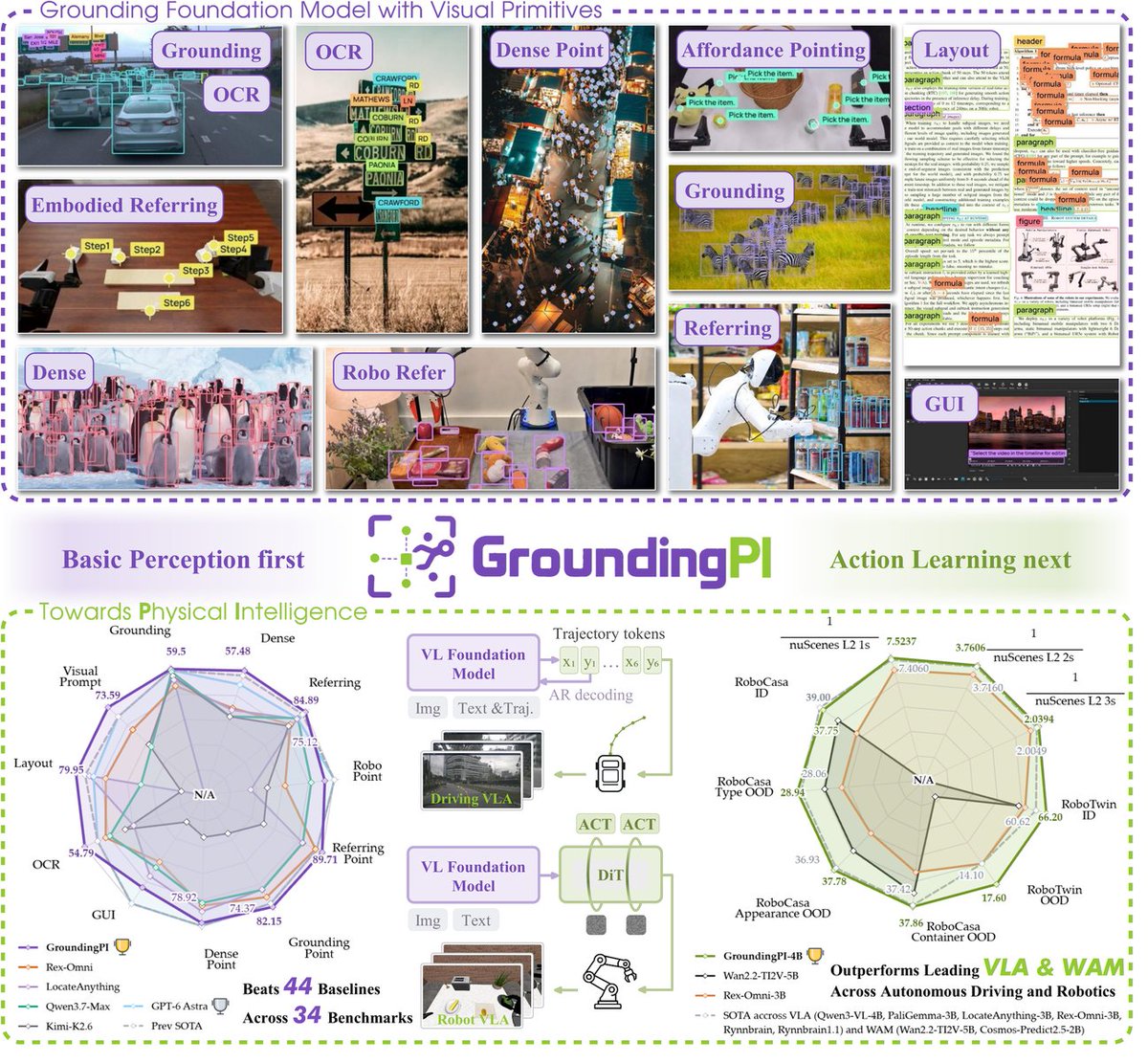
A robot can’t pick up a cup if it doesn’t know where the cup is in the picture. That is the idea behind GroundingPI, so the model was trained without any robot data carrying movements, only on data about seeing and locating. Its training data covers 11 categories, from object detection and text recognition (OCR) to on-screen buttons and where things sit in a robot’s workspace.
XPENG’s example is “the handle of the cup on the right”. The model has to point out both the right cup and its handle, with points or boxes; “there is a cup in the image” doesn’t count. “Grounding” is that link between words and a region of the image, and “PI” stands for Physical Intelligence.
In a robot, GroundingPI is meant to be the eyes of the fast system. What it sees goes to a separate model that learns the movements. Understanding and planning the task stay with a large general-purpose model.
GroundingPI beats GPT-6 Astra overall, but not in every category
The researchers compared GroundingPI with 44 other models on 34 public benchmarks. With the 11 categories weighted equally, GroundingPI scores 73.68 and OpenAI’s GPT-6 Astra 71.54. XPENG stresses that this measures perception only, not general intelligence or reasoning.
XPENG’s chart puts GroundingPI on top in eight of the 11 categories. In the other three another model leads: on-screen buttons and fields (92.58 to 78.92), points in crowded scenes (76.10 to 74.37) and points for robot tasks (81.08 to 75.12).
Fewer demonstrations in simulation
Everything else comes from simulation and recorded data. In RoboCasa-GR1, robot systems using GroundingPI for vision reached a higher success rate with 50% of the demonstration data than the comparison models did with 75%. In RoboTwin 2.0 it beat the usual vision backbones in four situations the robot had not been trained on. On nuScenes, a dataset recorded by self-driving cars, it predicted the car’s path ahead with an average error of 0.296 metres from the recorded path.
For an XPENG owner, GroundingPI changes nothing today. XPENG calls it an important building block of the group’s Physical AI, but names no car or robot it is meant for. How the driver-assistance model in the cars is built is covered in our article on VLA.

Images: XPENG
Sources
XPENG Global on X, 4 November 2026: GroundingPI beats GPT-6 Astra in aggregate perception benchmarks
The GroundingPI research team: the paper on arXiv
The GroundingPI research team: code and model weights on GitHub