


Roadmap for your XPENG
XOS 6, Google Maps, NGP and the new voice assistant: XPENG's announcements alongside my own hopes and expectations for European models.
XPENG has not published a complete roadmap for its European models. For more than two years, I have repeatedly suggested making its plans more visible to owners, but that has yet to happen. This article is therefore my cautious outlook on what the near future might bring, drawing on XPENG announcements, my own expectations and what I hope to see.
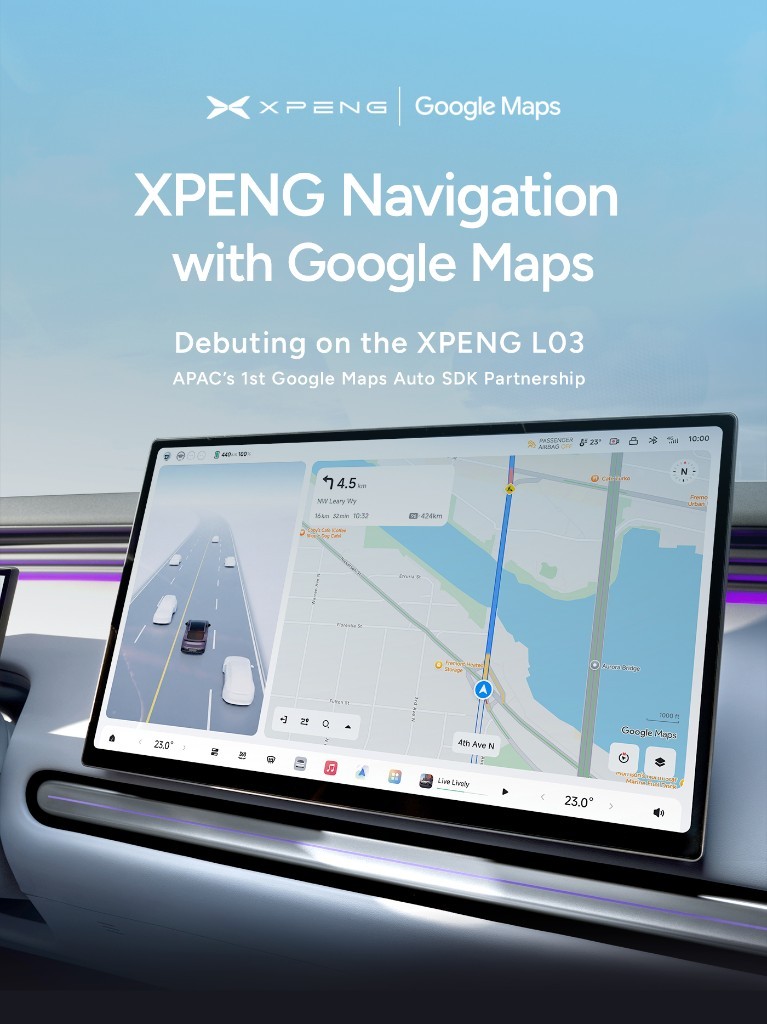
XPENG has announced XOS 6 and Google Maps for the L03, with NGP planned for Ultra from 2027. For existing cars, I hope every model from the MY23 G9 and P7 onwards gets some version of XOS 6. My concern is that XPENG may draw the line at the MY25 G6 and G9. I get the impression that XOS 6 and Turing are its priorities, so I expect cars from before the Turing generation to receive less attention.
Images: XPENG
Jump to: Overview · What XPENG has announced · What informs my assessments · Infotainment performance · Cabin AI: on board or in the cloud? · Development also takes people · Will hardware upgrades be offered? · What I expect from XOS 5 · Model by model · Sources
Each table cell distinguishes an XPENG announcement from my forecast or hope. Announced covers product announcements and plans; the feature may still require a future update. The voice column refers to the new language-model assistant.
Overview
| Model and model year | XOS 6 | Google Maps | NGP | New voice assistant |
|---|---|---|---|---|
| L03 Ultra | Announced | Announced | Announced plan: Q1 2027 | Announced; features via OTA |
| L03 without Ultra | Announced | Announced | No, per the equipment list | My take: cloud version possible |
| G9L in Denmark | XOS 6 | Google Maps | NGP / VLA 2.0: approval pending; 2 Turing chips | No separate cabin Turing chip listed |
| P7+ MY26 | My take: 2027 | My take: 2027 | My take: Lite, after L03 Ultra | My take: cloud version possible |
| X9 MY26 | My take: 2027 | My take: 2027 | My take: Lite, after L03 Ultra | My take: cloud version possible |
| G9 MY25 | Hope: yes | My take: uncertain | My take: no | My take: cloud version possible |
| G6 MY25 Long Range / Performance | Hope: yes | My take: uncertain | My take: no | My take: cloud version possible |
| G6 MY25 Standard Range | Hope: yes | My take: uncertain | My take: no | My take: cloud version possible |
| G9 MY23-MY24, G6 MY24 and P7 MY23 | Hope: an adapted version | My take: no | My take: no | My take: no |
| G3, G3i and the first P7 | Unknown | Unknown | Unknown | Unknown |
What XPENG has announced
XOS 6 has been announced for the international L03. For the other models, there are two hardware paths to consider. ADAS hardware sets the limits for driver assistance, including XPILOT, NGP and VLA. Infotainment hardware affects the screen experience, navigation and cabin AI functions.
A car may be better equipped for new features on one side than on the other. Sharing an XOS version number therefore need not mean sharing every capability. Hardware is only part of the picture: software adaptation and XPENG priorities also matter, while driver assistance depends on the relevant approvals.
Google Maps is a separate development from the Google search data added to navigation in XOS 5.9.5. The new navigation uses Google’s Auto SDK within XPENG’s own interface, with the L03 announced as the first model outside China to receive it. The Google Maps article covers the distinction.
NGP is driver assistance that follows a navigation route. In July, XPENG described an ambition to begin its international rollout in early 2027, through gradual OTA updates in markets that meet the legal requirements. Its August results then set a target of European VLA approval in the first half of 2027. Europe is part of the plan; regulatory approval and an update reaching your car remain separate steps. The VLA article explains the technology behind the new NGP.
XOS 5.4 voice control was announced in January 2025 with English, French, German, Cantonese and Thai. A month earlier, XPENG Denmark had said more local languages would follow. The new L03 voice assistant is based on a language model, with capabilities announced for later updates. Those announcements give no date for Danish on the new assistant.
What informs my assessments
For each model, I consider both the ADAS and infotainment hardware. The chip is only part of that picture: Memory, sensors and the rest of the vehicle electronics may also impose limits. I also consider whether a feature needs to run inside the car or could use the cloud for part of the work.
The underlying software may also matter. I have not found official documentation identifying the Android version beneath XOS for each model. That leaves me unable to assess whether differences here require extra adaptation or limit particular new features.
Software then needs adapting and testing across models, languages and markets. Local approvals, data requirements and agreements with service providers may affect delivery too. Even a technically feasible feature needs people and funding.
That leads me to consider how much XPENG can reuse from its Chinese development, how many cars would benefit from an update and how new launches might affect priorities. In my view, supporting existing owners and retaining their trust should carry weight as well.
I do not know XPENG’s internal priorities or every technical constraint. These are the considerations I weigh as best I can when making the predictions below. They can pull in different directions: New hardware may simplify development, while a large population of existing cars can give XPENG a reason to keep developing for older hardware.
Infotainment performance
The 8155, 8295 and MT8676 run infotainment in the models discussed here. AnTuTu results offer a useful indication of the gap between generations, combining CPU, graphics, memory and user-experience tests. They do not test driver assistance or establish whether a car can run XOS 6.
In L03 Ultra, MT8676 remains the infotainment processor. A cabin Turing chip adds AI compute alongside it, with two further Turing chips assigned to driver assistance. Ultra therefore adds hardware rather than replacing MT8676. The Danish L03 configurator lists both cabin processors for Ultra.
Highest recorded score for each chip
| Chip | Test RAM / storage | Total score | Index: 8155 = 100 |
|---|---|---|---|
| Snapdragon 8155 | 12 / 128 GB | 525,686 | 100 |
| MediaTek MT8676 | 16 / 128 GB | 1,026,462 | 195 |
| Snapdragon 8295 (QNX + Android) | 16 / 128 GB | 1,223,060 | 233 |
AnTuTu chip ranking, checked 26 September 2026. This list uses the highest recorded total for each chip, from mainland China only. The index is calculated from those scores and rounded. These are different configurations, not a measurement of how much faster menus respond in a European XPENG.
How the same chip performs in different cars
| Car in the Chinese ranking | Chip | CPU score | Graphics score | Total score |
|---|---|---|---|---|
| XPENG G9 | 8155 | 133,851 | 154,628 | 447,573 |
| XPENG G6 | 8155 | 156,640 | 130,692 | 485,981 |
| XPENG P7i | 8155 | 159,065 | 174,905 | 525,686 |
| XPENG X9 | 8295 | 318,533 | 327,445 | 965,631 |
AnTuTu car ranking, checked 26 September 2026. No model year is given for these entries. These are Chinese cars, not a specification list for European models. AnTuTu notes that system design affects the resources available to the Android environment.
AnTuTu reported the MT8676 result on 22 April 2024, from an unidentified vehicle configuration with 16 GB RAM, 128 GB storage and Android 14. It scored 293,832 for CPU and 382,425 for graphics. That puts it in the same broad performance class as the 8295 in these tests, without establishing how the European G6 Standard Range is optimised.
The spread between the 8155-equipped G9, G6 and P7i shows why a chip name cannot describe the entire experience. Memory and software matter too. None of these scores measures language-model performance or defines a minimum hardware requirement for XOS 6.
My take
These results give my concern about older cars a more concrete basis. Newer infotainment chips have a clear lead in these tests, and I can imagine XPENG prioritising new features for hardware with more capacity to spare. That fits my impression that XOS 6 and Turing receive most of the attention, although benchmarks cannot tell us how XPENG allocates development work.
I still hope MY23 cars receive XOS 6 with a selection of features. The scores do not rule that out. I would not expect the same version number to mean identical capabilities in every car.
The MT8676 result gives me no reason to consider a cloud voice assistant less plausible on the MY25 G6 Standard Range than on Long Range and Performance. It still depends on XPENG’s implementation and priorities. Driver-assistance hardware needs to be assessed separately.
Cabin AI: on board or in the cloud?
An on-board language model needs both compute capacity and memory. TOPS describes capacity for particular calculations, but cannot by itself tell us how quickly an assistant will answer. Memory bandwidth and how the model and software use the chip also matter. NVIDIA explains these compute and memory limits in its AI performance guide.
Reported AI compute capacity (TOPS)
| Chip | Reported capacity | Scope of the figure |
|---|---|---|
| Snapdragon 8155 | 8 TOPS | GWM: NPU in its Coffee OS 1/2 platform |
| MediaTek MT8676 | 20 / 23 TOPS | Autolink AL-M2: 20; CVTE P39: 23 |
| Snapdragon 8295 | 30 TOPS | GWM: NPU in its Coffee OS 3 platform |
| XPENG Turing | 750 effective TOPS | XPENG's official Turing figure |
Sources: GWM (March 2025). Autolink, CVTE and XPENG.
These are manufacturer figures and may use different measurement methods. The infotainment figures describe other manufacturers’ platforms using these chips, not measurements in European XPENG cars. The MT8676 figures are two separate supplier claims, not a measured range. XPENG describes its Turing figure as effective computing power. This table does not establish that an assistant runs 25 times faster on Turing than on 8295.
My take
I expect the additional cabin Turing chip in L03 Ultra to support more demanding local AI functions while MT8676 continues to handle infotainment. Some AI features could become less dependent on an internet connection. The processor combination alone does not establish how much of the assistant runs locally or how quickly menus and navigation respond.
MediaTek and Snapdragon also have AI capability, so I would not rule out local AI features on those chips. My prediction is that a cloud or hybrid implementation could let XPENG offer parts of the new assistant on other cars. We do not know the requirements of the specific model, and XPENG has not confirmed such a solution. In my view, some cabin functions can tolerate more delay than the continuous calculations needed for driver assistance. That makes cloud processing seem a plausible option for part of the work, although it would need an internet connection. This is entirely my own prediction; I have heard no official announcement of such a cloud version.
Development also takes people
When I visited the ADAS team in Guangzhou in November 2025, we discussed the difference in staffing between Chinese and international development. My travel diary recorded more than 1,200 people working on ADAS overall, with around 100 dedicated to the international version. Some worked across both programmes to share knowledge and solutions.
Those figures describe what I learned on that visit. I do not know how the allocation has changed since then. They concern ADAS, not staffing across XOS and infotainment development.
The hardware combinations in China are changing too. The Chinese MY26 G9 specification still lists an 8295 for infotainment, paired with Turing for driver assistance. The European MY25 G9 uses an 8295 with Orin-X. A chip can therefore remain in use while the hardware around it changes. The current Chinese G9 specification establishes that distinction; it does not establish whether dealers still hold older configurations in stock.
My take
I think the number of developers also affects how many software branches XPENG can maintain and improve at once. Even where the hardware can support a feature, people still need to adapt it and test it for the cars and markets that will receive it.
My expectation is that upcoming models, and hardware also used in the current Chinese range, will naturally take priority. I worry that older European combinations may need more separate development work and consequently receive fewer new features. That is my interpretation of a possible priority, not a decision XPENG has confirmed.
This also explains why I do not expect VLA for European cars with a single Orin-X. NVIDIA specifies up to 254 INT8 TOPS, numerically about a third of the 750 effective TOPS quoted for Turing. That is not a measured speed difference on the same VLA model. I think both the lower compute capacity and the work of developing a separate version count against it. I also assume this configuration represents a relatively small share of the overall audience for XPENG’s future VLA development; I do not have an exact figure. In my view, that makes it less likely to receive priority, but does not prove a smaller model is technically impossible.
The collaboration between markets also gives me hope that improvements can reach existing cars. I would like XPENG to make clear which models it continues to develop new features for and which it mainly maintains.
Will hardware upgrades be offered?
At AI Day in 2024, XPENG announced a chip-upgrade programme for existing customers. That announcement does not itself constitute a European offer. Work on earlier hardware continues in China too: in September 2026, XPENG described an adapted VLA model for two Orin-X chips undergoing internal testing. That configuration differs from a single Orin-X and offers no update guarantee for European cars.
My take
Unfortunately, I no longer expect a hardware-upgrade offer in Europe. XPENG has talked about it, but I haven’t heard anything further for roughly a year. My impression is that it has been set aside.
What I expect from XOS 5
At a minimum, I expect a new 5.12 beta soon. My guess is that it will be smaller than usual and probably the last 5.x update of 2026.
I still hope for 5.x updates in 2027, unless every model on 5.x moves to some version of 6.x.
Model by model
L03
L03 has the clearest announcements: XOS 6 and Google Maps are confirmed, and the Danish equipment list schedules NGP with VLA 2.0 for the first quarter of 2027 on Ultra. Other trims list it as unavailable, as they do the VLM language-model assistant. Ultra retains MT8676 alongside a cabin Turing chip, with two additional Turing chips for driver assistance. The L03 page covers the trim differences.
My take
I expect XOS 6 and Google Maps at delivery. For NGP on Ultra, my estimate is Q2 2027, a little later than the equipment list suggests. I expect the other trims to retain XPILOT.
My expectation is that Ultra gets the new voice assistant first. A cloud version might follow for the other trims. I think Danish will arrive after the major languages.
G9L
G9L launched in Europe on 12 October. China’s Max, Ultra SE and Ultra have different Turing configurations; the Danish Ultra name does not imply the three chips of China’s Ultra.
XPENG identifies Qualcomm Snapdragon 8295 as the processor for infotainment and the XOS 6.0 cockpit in the European G9L in its German launch release of 12 October 2026.
My take
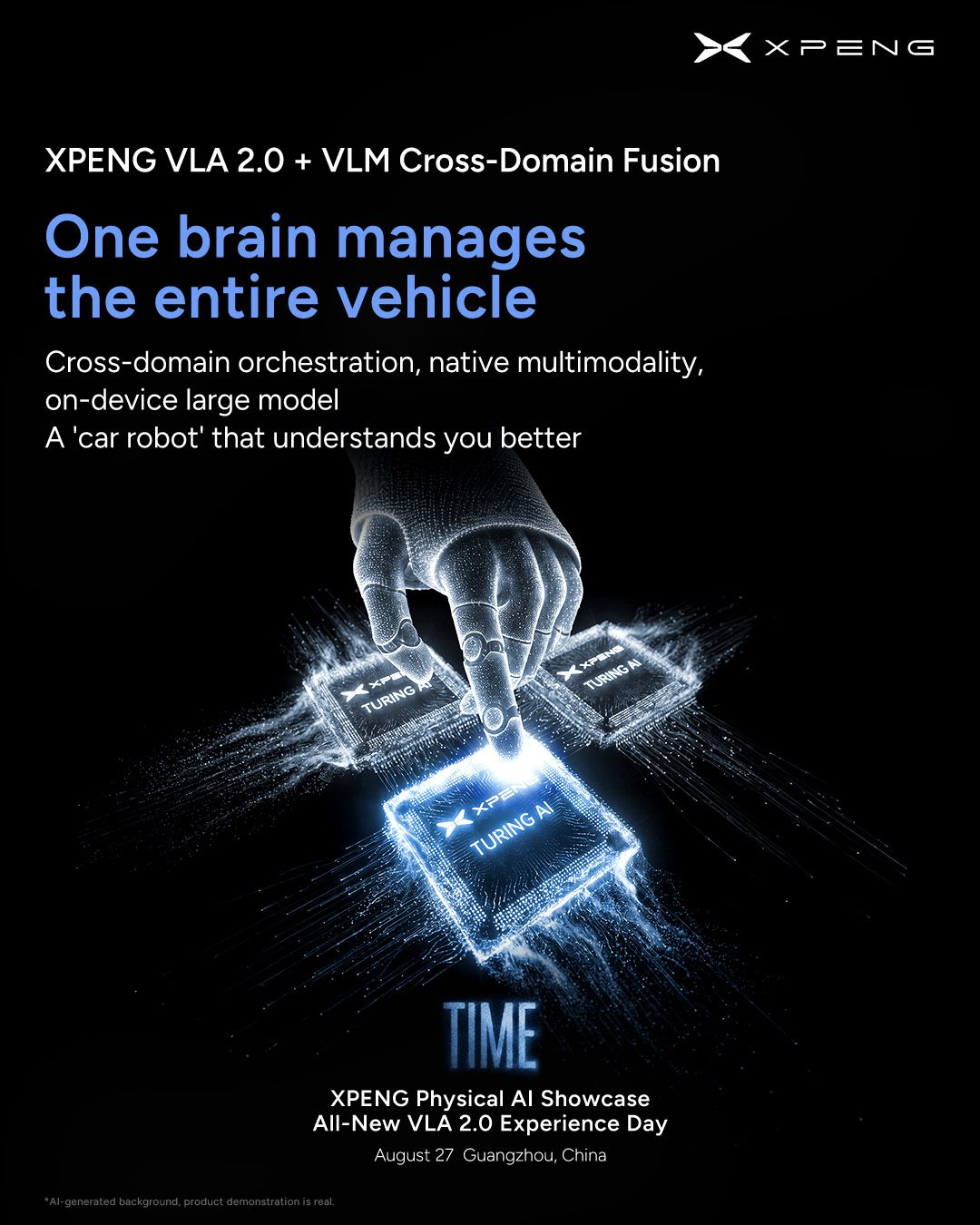
All three Danish G9L Ultra trims list two Turing AI chips under driver-assistance hardware. NGP and Full-Scenario VLA 2.0 await regulatory approval; the equipment list does not confirm activation at delivery. The Danish G9L configurator lists two Turing chips under driver assistance. It does not list an additional cabin AI Turing chip as on the L03 Ultra. The Danish specifications do not establish whether cabin AI uses the cloud or why XPENG would have chosen that approach.
P7+ MY26
The Danish P7+ configurator lists MediaTek MT8676 for infotainment and one Turing XP5 chip for driver assistance.
My take
I expect XOS 6 during 2027 and think Google Maps will come with it. I also expect VLA 2.0 Lite, later than NGP on the L03 Ultra. A cloud-based voice assistant seems possible to me.
X9 MY26
XPENG’s German X9 configurator lists Turing XP5 among the car’s equipment.
My take
My outlook is similar to the P7+: XOS 6 and Google Maps in 2027, VLA 2.0 Lite after the L03 Ultra, and possibly a cloud version of the voice assistant.
G9 MY25
XPENG’s European New G9 announcement specifies Snapdragon 8295 for the cockpit and Orin-X for driver assistance. This puts it on a different hardware combination from both the earlier G9 and the new Turing models.
My take
I hope it gets XOS 6, though both that upgrade and Google Maps remain uncertain in my view. I expect it to keep XPILOT rather than gain NGP. A cloud version of the new voice assistant is something I can imagine.
G6 MY25
Trim matters here. Denmark’s configurator lists MediaTek MT8676 for Standard Range and Snapdragon 8295 for Long Range and Performance. It also explicitly excludes the other trims’ Orin-X chip from Standard Range. Long Range hardware therefore cannot stand in for every MY25 G6.
My take
My hope for XOS 6 includes all three trims. I’m still uncertain about Google Maps, and I expect driver assistance to remain XPILOT. I see a cloud version of the new voice assistant as a possibility for Standard Range as well as Long Range and Performance.
G9 MY23-MY24, G6 MY24 and P7 MY23
This generation uses Snapdragon 8155 for the cockpit. XPENG lists it in the 2024 Danish G6 specification sheet and in European equipment lists for the earlier G9 and P7. The G6 sheet also specifies Orin-X for XPILOT. These cars therefore belong to a different hardware generation from the new Turing models. The cited XPENG announcements do not yet provide a European XOS 6 schedule for them.
My take
I hope these cars get some form of XOS 6 too. My worry is that XPENG limits the upgrade to MY25 and newer. That is my concern, not a cutoff the company has announced.
My forecast for Google Maps, NGP and the new voice assistant on this generation is still no. I have more hope for a new operating system than I have expectation of receiving every new feature.
G3, G3i and the first P7
The G3, G3i and pre-MY23 P7 belong to XPENG’s early launches in Norway. In 2022, XPENG described the P7 then on sale as available in China and Norway; the G3i also launched in Norway that year. I have limited information about future software development for these European versions, so I cannot say whether any of the four features will reach them.
Sources
XPENG’s Danish G9L configurator, checked on 12 October 2026 - two Turing AI chips under driver-assistance hardware on all three Ultra trims; NGP and VLA 2.0 await regulatory approval.
These are my own assessments as of 26 September 2026. I have sought answers from XPENG to the open questions, but they remain unresolved. If XPENG confirms or rules out anything discussed here, I will update the article.
- XPENG UK L03 launch, 22 July 2026 - XOS 6 and the new L03 assistant
- XPENG Google Maps partnership, 15 July 2026 - L03 first with the navigation
- XPENG Denmark OTA 5.9.5, 30 June 2026 - Google search data, without a model list
- Global NGP launch plans, 17 July 2026 - early-2027 ambition and gradual OTA subject to local law
- XPENG Q2 results, 25 August 2026 - H1 2027 target for European VLA approval
- XOS 5.4 voice languages, 2 January 2025 - the five announced languages
- XPENG Denmark local language outlook, 14 December 2024 - plans for more local languages
- L03 Danish configurator, checked 26 September 2026 - Ultra equipment and Q1 2027 NGP plan
- XPENG Germany IFA, 27 August 2026 - three Turing chips on Ultra
- XPENG VLA event release 5591, 1 September 2026 - announced XOS 6.3 and Lite debut
- P7+ Danish configurator, checked 26 September 2026 - MT8676 and one Turing chip
- X9 German configurator, checked 26 September 2026 - Turing XP5
- European New G6 and G9 launch, 11 July 2025 - New G9 with 8295 and Orin-X
- G6 Danish configurator, checked 26 September 2026 - G6 hardware differences by trim
- Danish G6 specification sheet (2024), checked 26 September 2026 - 8155 and Orin-X on the original G6
- German earlier G9 configurator, checked 26 September 2026 - 8155 cockpit hardware
- Dutch P7 configurator, checked 26 September 2026 - 8155 cockpit hardware
- XPENG AI Day 2024, 6 November 2024 - announced chip-upgrade programme
- Liu Xianming on XOS 6.3.0, release 5593, 15 September 2026 - internal testing on dual Orin-X
Changes to this page (2)
- Added Snapdragon 8295 as the European G9L infotainment processor.
- Replaced G9L hardware forecasts with Danish specifications: two Turing chips and NGP awaiting approval.