


X-World: XPENG’s world model
X-World is XPENG's simulator for the driver-assistance system. Version 1.6 builds on real places where 1.0 generated everything from scratch, and XPENG has published its own figures for how close it comes to reality.
X-World is the simulator in which XPENG trains and tests the driving model behind NGP. On 23 November 2026 XPENG described version 1.6, which it calls the simulator’s first major upgrade.
Version 1.0 generated every scene from scratch. Version 1.6 takes the road and the buildings from a real place and generates only what moves, along with weather and light. It has also become fast enough for an engineer to drive in it with a steering wheel and pedals.
Nothing changes in your car with X-World 1.6. The simulator is a development tool, and NGP is not yet available to customers in Europe. The figures in this article are XPENG’s own, and they measure the simulator, not the car. The driving model itself is covered in the VLA article.
Images: XPENG
Jump to: X-World and the driving model · Version 1.0 · Version 1.6 · Virtual City · Training data · Real-time driving · Measurements · Europe · Not stated · Q&A · Sources
X-World simulates the road for the driving model
The driving model, VLA 2.0, decides what the car does. A world model predicts what the cameras see as a result: brake, and the car ahead comes closer more slowly; turn, and the cameras face another part of the street. X-World is XPENG’s world model. The VLA article and the CVPR story explain how the two differ.
A simulator is needed because the situations a driving model handles worst are rare on the road and too dangerous to provoke. XPENG writes that X-World does three jobs in the development of the driving model:
- Closed-loop simulation. The driving model’s action decides the next frame, so a mistake has consequences for the rest of the run. An ordinary recording plays on whatever the model would have done.
- Reinforcement learning. The model tries an action, the result is scored, and the model adjusts to the score.
- Data generation. The simulator produces video the driving model can be trained on.
Closed-loop simulation lets XPENG test a finished version of the driving model in recorded scenes, reproduce a particular behaviour and trace a failure to its cause. The same test can then be run on the next version to see whether it has got worse at something its predecessor could do.
XPENG’s project page gives one example of what the training changes. During a lane change to the right, a car cuts in from behind. After reinforcement learning in the simulator, VLA 2.0 lets that car pass and then completes the lane change.
X-World is a development tool that runs on GPUs in the cloud. It is not software in the car. The hardware in the cars themselves is covered in the assistance-hardware guide.
Version 1.0 generated everything from scratch
The first version was purely generative: it made the whole scene itself, with no real place as its starting point. In its article of 23 November 2026, XPENG describes the problems that caused:
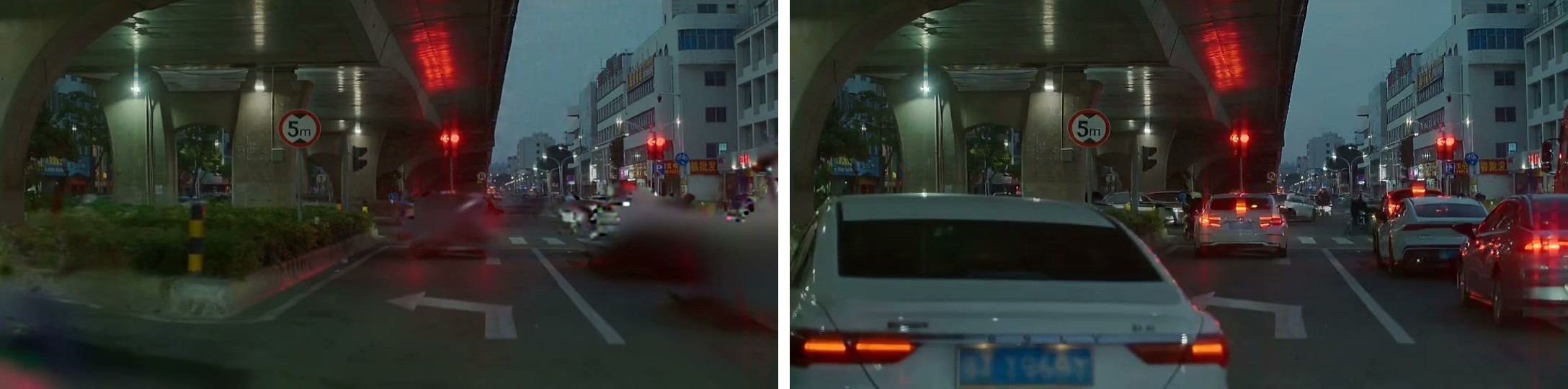
- A pillar at an underpass intersection on Beijing’s 4th Ring Road stood in a different place the second time the model drove through.
- When only the weather was meant to change, the traffic lights moved as well, and the green-light timing changed.
- Narrow village lanes were hard to generate.

Development suffered. A scene that could not be reproduced could not be used to compare two versions of the driving model on equal terms. XPENG’s conclusion is that a simulator for driving models has to reconstruct the real world and build on it. Generating scenes from nothing is not enough.
Version 1.6 keeps the place fixed and generates the traffic
Version 1.6 separates what stands still from what moves. Buildings, roads and guardrails are anchored in material from a real place, so the pillar in the underpass is in the same spot on every run. The rest is generated: other road users and their paths, the weather and the light. That work is done by a DiT model, a type of generative model also used for images and video.
A place can be anchored in three ways
- 3D Gaussian Splatting (3DGS). The place is stored as a very large number of small coloured 3D elements that can be rendered from any angle.
- Point cloud. Measured points in space show where the surfaces of the road and the buildings are.
- Images or video of the same place, recorded at other times or by other cameras.
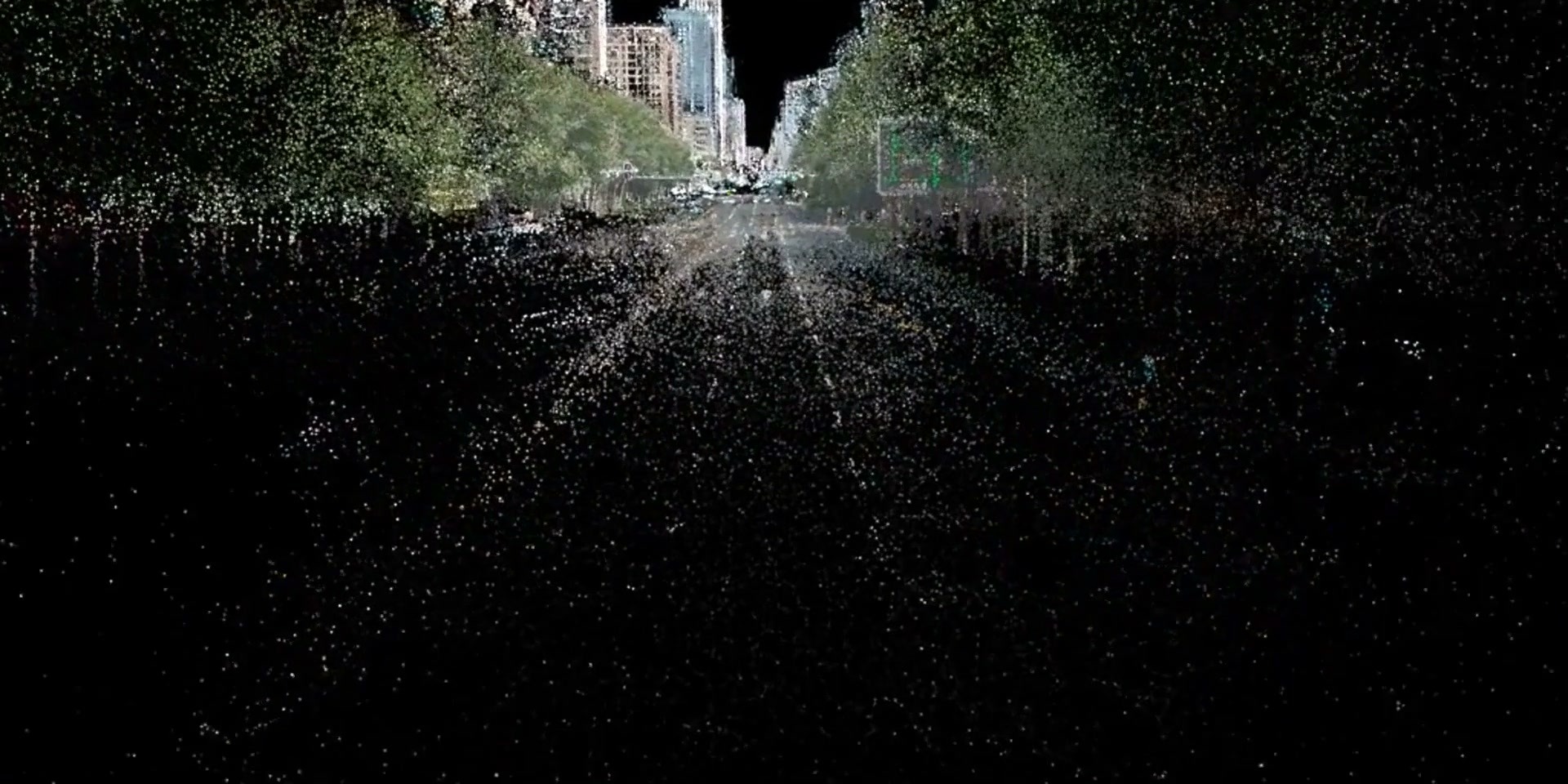
The model outputs seven synchronized camera views: front narrow, front fisheye, front left and right, rear left and right, and rear. XPENG says the seven views agree better with each other geometrically than in version 1.0. From a single street-view image, according to XPENG, the model can produce all seven video streams and predict how the scene develops.
Lane lines, arrows and traffic lights can be set
The engineer decides what is painted on the road and what the traffic light shows. The project page shows one road scene twice, with a white solid line and with a yellow dashed line.
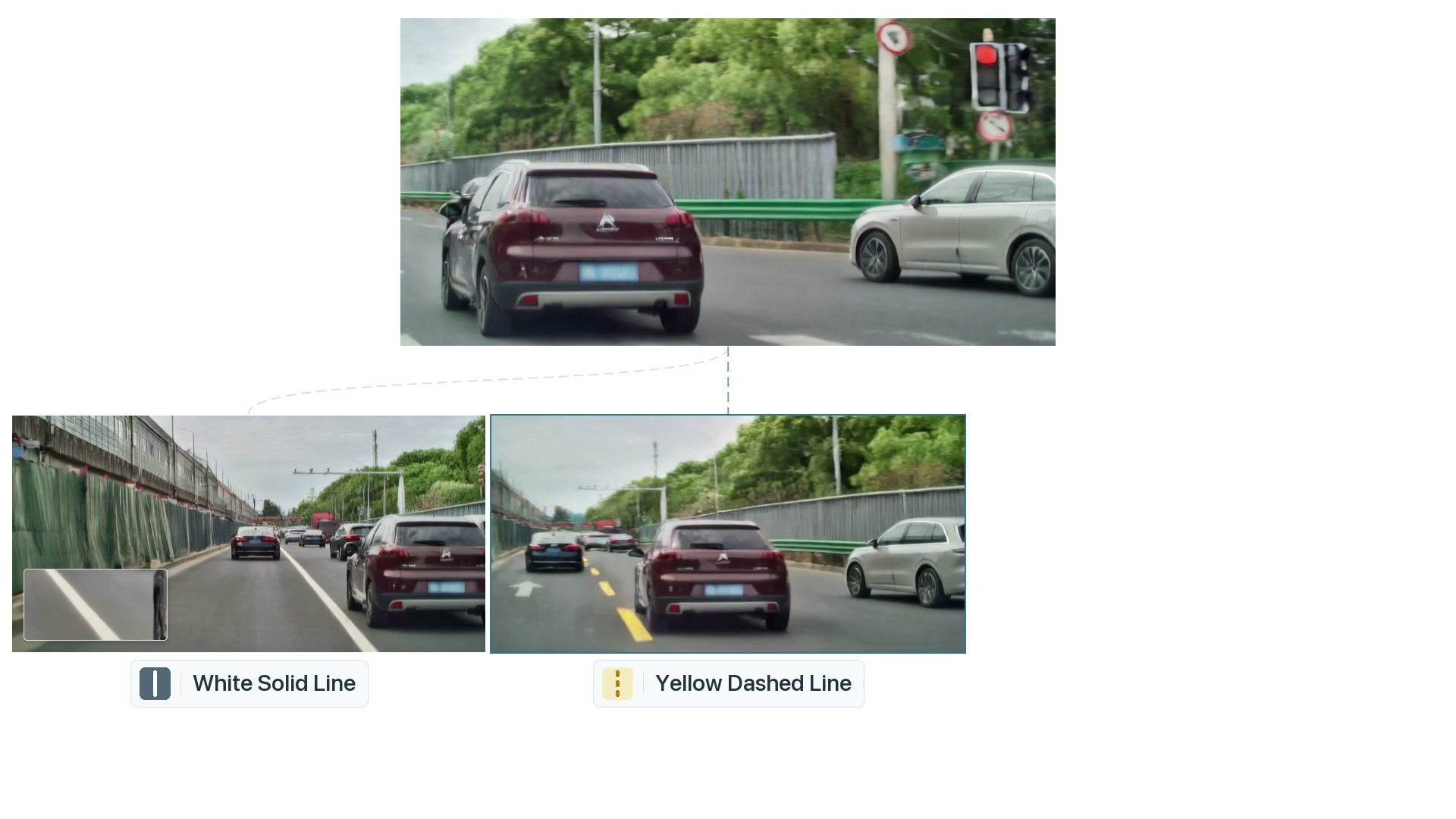
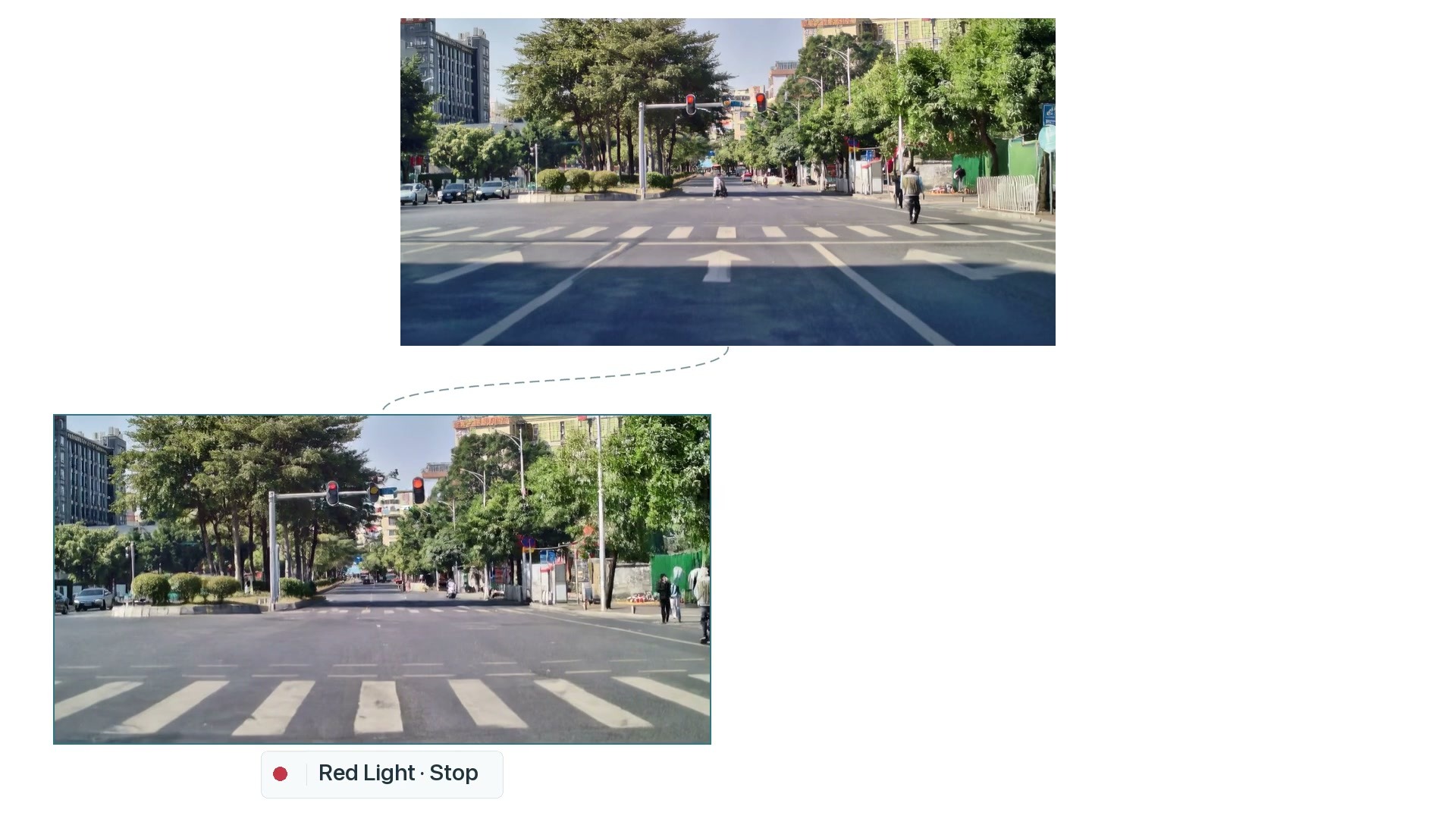
A straight-ahead arrow on the lane can likewise be swapped for a U-turn arrow, and a traffic light can be set to red. Control of arrows and traffic lights is new compared with version 1.0.
According to XPENG, version 1.6 also holds its quality over longer sequences than its predecessor.
Virtual City keeps real places over time
Virtual City is XPENG’s name for what the anchoring is used for. The article of 23 November says the model can build digital twins of cities in the cloud, in which a place is stored as it looked at different points in time. The material, in XPENG’s words, is “videos uploaded by users”. XPENG does not say who those users are; see what has not been stated.
XPENG itself lists four things this lets its engineers do:
- A stretch of road that was under construction for six months can be visited before, during and after the roadworks.
- The driving model can be run again at exactly the same place and moment.
- A situation the previous version of the driving model struggled with can be tried again with the new one.
- Several different courses of events can be started from exactly the same place and moment, so the results of reinforcement learning can be compared.
Identical conditions are what XPENG stresses. When every test starts at the same place and the same moment, two versions of the driving model can be compared directly, even when the tests run in large numbers.
XPENG says the idea came out of internal discussions during the development of XPENG Robotaxi, where driving models can be tested in a virtual copy of the taxi’s operating area. XPENG expects the reconstruction to become more accurate as more is stored from each city. It gives no figure for that.
XPENG screens a larger pool of recordings more strictly
For version 1.6, XPENG had four times as many recordings to choose from as for version 1.0, and the selected training data is twice as large. The recordings carry more than 150 tags, covering quality and driving behaviour among other things.
The screening removes recordings with flicker, stripes, a blocked lens or faulty exposure, and it tells a faulty recording from bad weather or low light. Among the usable ones it favours those where something happens: turns, merges, sharp curves and full stops over routine cruising.
For anchoring with 3DGS, XPENG has produced about one million pairs. A pair is a rendering of the place from the reconstruction and the video the model has to learn to make from it.
The project page describes a second source too: single-camera dashcam videos collected from the internet. X-World expands them into seven synchronized camera views, and the result is used to train VLA 2.0.
What XPENG writes about data from markets outside China is under Europe.
Engineers drive in the simulator themselves
In X-World’s real-time driving mode an engineer with a steering wheel and pedals takes the driving model’s place. A vehicle model turns the wheel and pedal inputs into a path, and the world model generates the seven camera views that go with it.
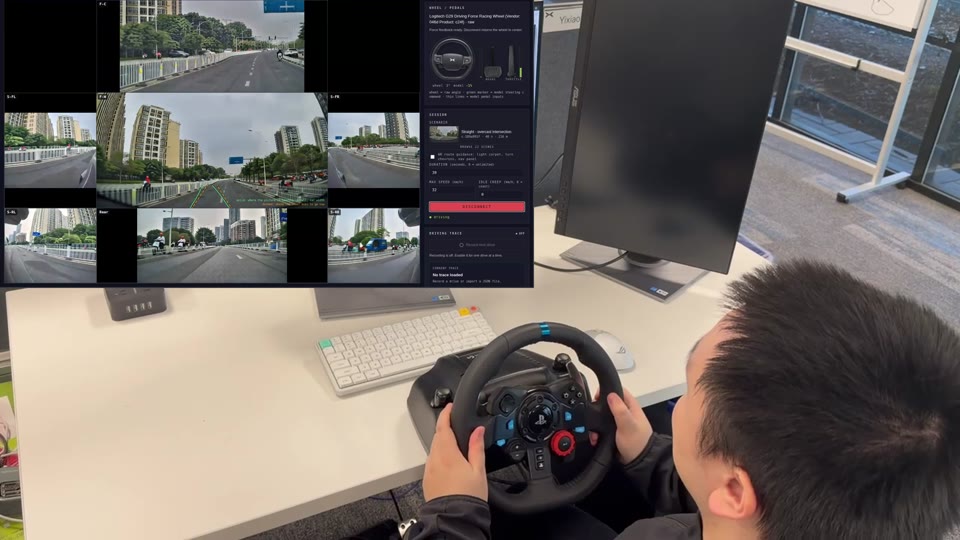
The purpose is to test corner cases, meaning rare exceptions, on purpose. When the driving model drives in the simulator, its manoeuvres are smooth and stay within common traffic situations. A person can brake hard or turn sharply in between other cars, and it shows at once whether the simulator responds coherently to something it was not trained on. That is why XPENG also calls the rig a tool for checking the quality of the world model.
The technique is described in a blog from XPENG’s AI Infra team, last updated on 28 October 2026. The blog is about X-World 1.5, not 1.6. XPENG’s article of 23 November repeats the same latency of 426 ms in its account of the upgrade.
X-World 1.5 in real time: 12 frames per second on four GPUs
- The seven camera views add up to about 2.3 million pixels per frame, 2.5 times one 720p video stream.
- Three GPUs run the generative model, and the fourth turns the result into images.
- 12 frames per second is also the frame rate of the training data.
- The median time from the engineer moving the wheel or a pedal to the finished frame is 426 ms, network not included.
- Before optimization the figures were 5,311 ms and 3.61 frames per second.
- The wheel and pedals are read every two frames, about every 167 ms.
- Over a public internet connection with a 158 ms round trip, the median is 613 ms to all seven views.
XPENG also has a cost reason to make the simulator faster. Many reinforcement-learning runs in parallel are sensitive to latency, the company says, and slow generation keeps the price of testing and data generation high.
Along the way the team found pauses of up to 674 ms in Python’s garbage collection and cut them to 18.7 ms. An AI agent helped find the cause, and the blog names the next step as handing more of the optimization to AI agents under strict verification.
How XPENG measures the simulator’s quality
Generated video has defects, and somebody has to find them. XPENG has trained a vision-language model to mark the defects in advance in all seven camera views, with the type of defect and where it is in the frame. People then check the result. On 150 generated videos, with the same five annotators, the work took one day where it had taken two.
The trained model has also been tested on picking the better of two videos of the same scene. It agreed with the human reviewers in 71.4 percent of cases, against 21.4 percent for the untrained base model. The sample is small: 30 pairs, and in 2 of them the humans had no preference, so the figure covers 20 of 28. XPENG itself gives a 95 percent confidence interval of 53.6-88.5 percent. A rule that always picks version 1.6 would score 60.7 percent, which lies inside that interval. On these 28 pairs it has therefore not been shown that the model beats the simple rule.
The second measure is how close the simulator comes to reality. XPENG has the driving model plan a path on the simulated video and on the real video of the same scene, and measures how far apart the two paths end. With version 1.6 that distance is on average 20.9 percent smaller than with version 1.0. The share of cases where it is under 1, 2 and 5 metres rose by 5.6, 9.4 and 10.6 percentage points. In a paired review of whether the intended behaviour was reproduced, version 1.6 was better in 19 percent of cases, comparable in 77.4 percent and worse in 3.6 percent. XPENG adds the caveat itself: the figures show how faithfully the simulator reproduces recorded situations. They do not show that the driving model has improved, and they are not a success rate.
All of these figures are XPENG’s own. They measure the simulator and the model that grades it, not the car.
The simulator supplies data for regions where XPENG has too little
In its article of 23 November, XPENG writes that X-World supplements data generation in regions outside China that are short of data. It says no more than that: XPENG does not name the regions, and it does not say that European roads are in Virtual City. For a car in Europe this changes nothing today.
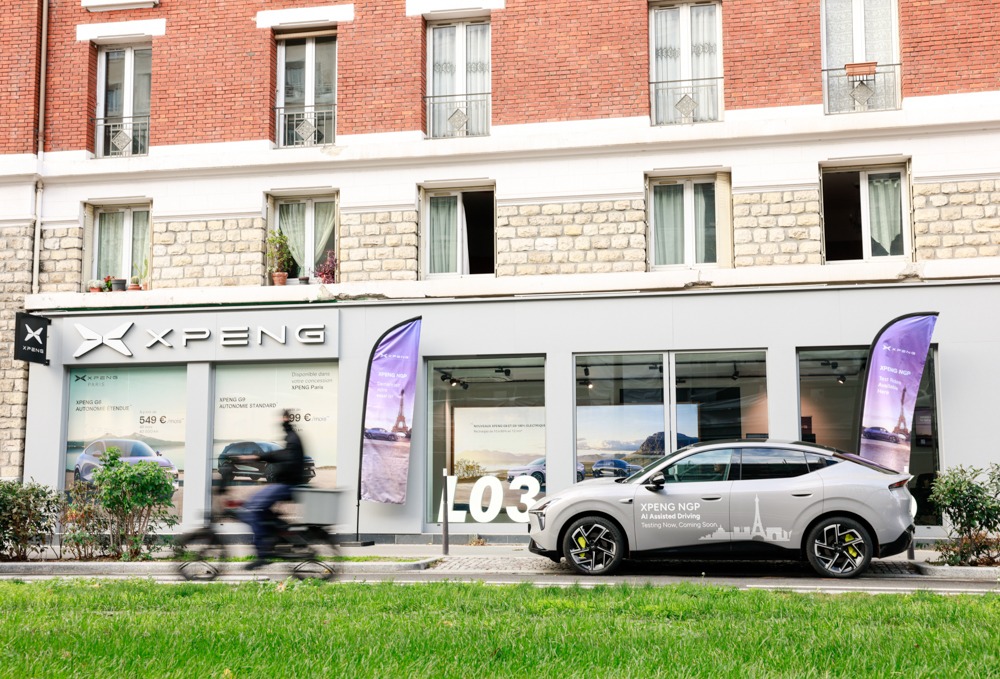
The same article describes the spread of NGP outside China. L03 launched globally in July, and within three months, XPENG says, NGP passed local testing and acceptance in Germany, the Netherlands and France. In Paris XPENG now offers public test rides. The rollout outside China is planned for 2027 and needs approval. Local testing is not type approval; the VLA article describes the approval route.
XPENG’s material leaves six questions open
- Whose videos Virtual City is built from, which cars and markets they come from, and on what terms they are used.
- Where the dashcam videos from the internet come from, and under what licence they are used.
- Whether any European road is in Virtual City, and how much of the work for Germany, the Netherlands and France was done in simulation.
- How much data there is. XPENG gives only the ratio to version 1.0.
- How large the deviations are in metres, and how many test cases lie behind the figures for how close the simulator comes to reality.
- Whether anyone outside XPENG has checked the measurements. Every figure in this article comes from XPENG itself.
Q&A
Sources
Show 4 sourcesHide sources
- XPENG Global: article on the X-World upgrade, on X, 23 November 2026 - the faults of version 1.0, Virtual City, real-time driving and the tests in Germany, the Netherlands and France
- XPENG: project page for X-World 1.6, read 23 November 2026 - control of lane lines, arrows and traffic lights, training data and measurements
- XPENG: technical report on X-World 1.6, arXiv 2611.00596, 31 October 2026
- XPENG’s AI Infra team: blog on real-time driving, updated 28 October 2026 - X-World 1.5 with steering wheel and pedals
Related: VLA 2.0 · Assistance hardware · The world model at CVPR · NGP test rides in Paris · NGP goes global in 2027