


Driver assistance: hardware and software
Bosch, NVIDIA Orin-X or XPENG's own Turing: what hardware and software does your car have, and what separates the European models from the Chinese ones?
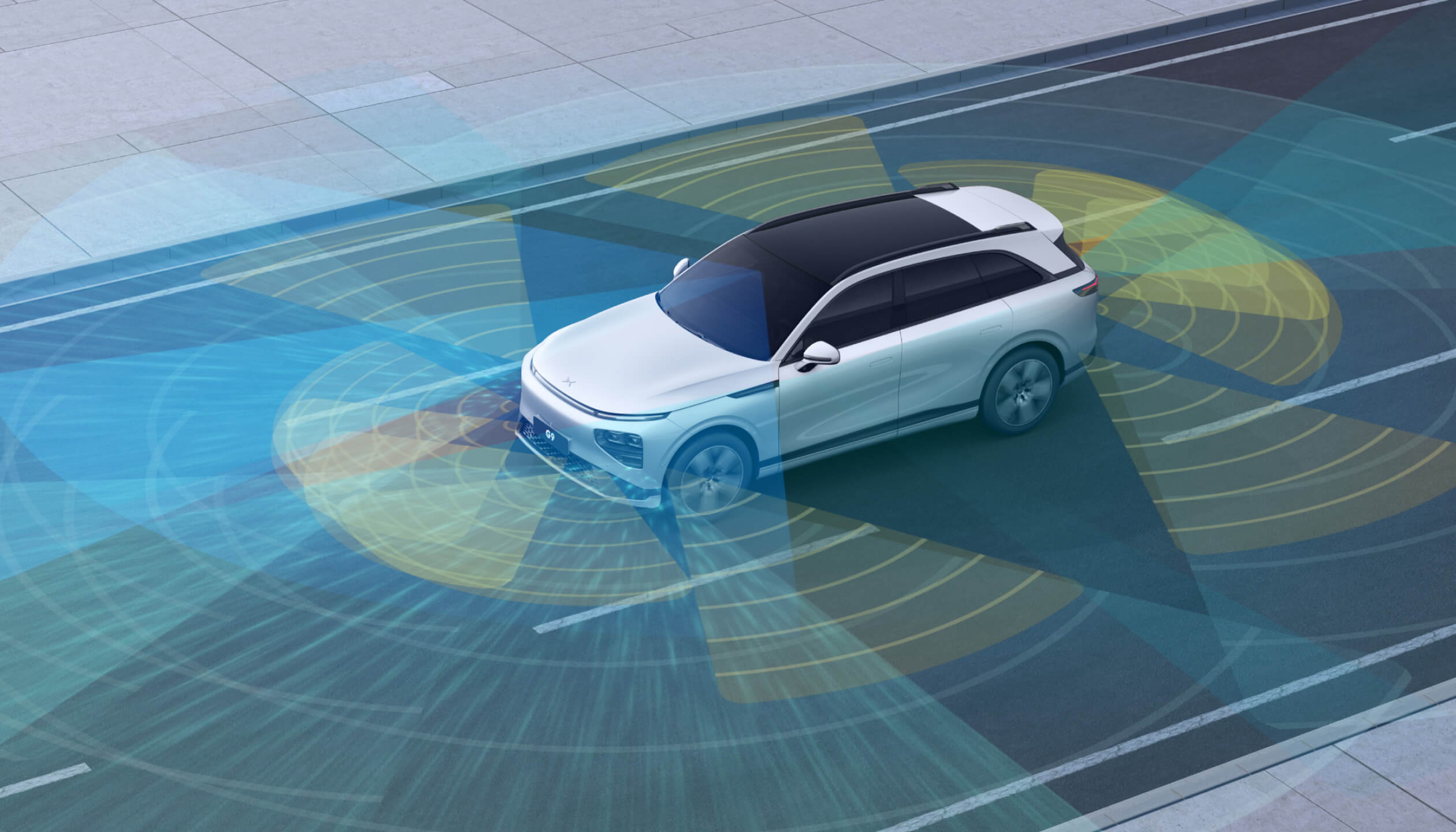
Driver assistance in XPENG’s European models runs on one of three hardware platforms. Bosch supplies a camera module, NVIDIA an Orin-X chip, and XPENG developed the Turing chip itself. Which one your car has depends on model, trim and model year, and it decides which features you can get.
This page is the reference half of the subject: what the hardware is, what the software is called, and where the European cars part company with the Chinese ones. How the systems behave on the road, and the habits that make them useful, sit in the practice guide, which follows later. Written August 2026, with XOS 5.9.5 as the current international software.
Images: XPENG
Jump to: Three platforms · Bosch · NVIDIA Orin-X · XPENG Turing · Platform by model · The software on top · VLA and the hardware · China and Europe are converging · Q&A · Sources
The three platforms
XPENG buys the assistance hardware from Bosch on the cheaper cars, from NVIDIA for the G9, the P7 and most G6s, and for the newest models makes it in-house. The split runs straight through the middle of two model ranges. Two G6s in the same Danish showroom can be on different platforms (Bosch or Orin-X), and so can two L03s (Bosch or Turing), which is why an equipment list is worth more than a badge when you are working out what a car can do. The three are not the whole story: the Norwegian G3 of 2020 and the original P7, on sale in Norway from October 2021, both predate them and run on different hardware.
Bosch: the front camera module
It sits in the G6 MY25 Standard Range / Air, and on the L03 in every trim except the Ultra: Standard Range, Long Range and AWD Performance, the PowerX Long Range included. The European price lists describe the hardware in one line, a front-integrated Bosch camera system for ACC and LCC, and leave it at that.
The German L03 equipment list runs to twenty named functions on Bosch hardware: adaptive cruise (ACC), lane centering (LCC), speed assist, sign recognition, automatic parking, remote park, remote forward/back, emergency braking, fatigue monitoring, forward collision warning, front-cross-traffic warning, blind-spot detection, door-open warning, the four lane-safety functions, rear collision warning, rear-cross-traffic warning and intelligent high beam. Everything the EU requires of a new car is there, and most of what an owner uses daily.
The limit shows at the top of the stack. XPENG’s own 5.9.5 release note says custom APA parking is not available on the G6 MY25 Standard Range / Air, and gives the reason directly: that variant has neither an NVIDIA Orin-X nor an XPENG Turing chip. XPEDAL with full stop is another function that varies by car. Beyond those two, the difference is undocumented. XPENG has never published a Bosch part number, a compute figure, or a function-by-function comparison, so any complete list of what a Bosch car misses would be guesswork.
XPENG counts Bosch among its long-term European suppliers. The company stood on the partner wall at Brand Day in Munich on 16 July 2026, one of twenty-three names alongside NXP, Infineon, ZF, Valeo and Michelin. Why this particular part is bought in when XPENG makes its own chips, the company has never explained. Two reasons suggest themselves: XPENG’s own Turing chips are a scarce resource that goes to the cars meant to run NGP, and an entry trim has a price to hit. The pattern fits either: Bosch sits under the cheapest trims, XPENG’s own or NVIDIA’s silicon above them.
NVIDIA Orin-X: the platform from 2022
One Orin-X drives assistance in the G9 through every model year Europe has had, MY23 to MY25, in the P7 from the 2023 facelift, in every trim of the original G6 (MY24), and in the G6 MY25 Long Range and Performance. The newest car on the platform is a 2025 model; everything from 2026 runs Bosch or Turing - the L03, the P7+ and the X9. That makes Orin-X the outgoing one of the three - still in cars you can buy new today, but not in the ones XPENG is drawing now. Bosch and Turing are both live choices, one for the cheaper trims and one for the top.
The NVIDIA relationship is older than the export push. The China P7 of April 2020 was the world’s first production car on NVIDIA DRIVE AGX Xavier - 30 TOPS at 30 watts - and the in-house ADAS story XPENG now tells through Turing starts on that chip. When the G9 launched at home in September 2022, its top versions paired two Orin-X chips - 508 TOPS - with dual LiDAR and 31 sensors for XNGP, while the export car that later reached Denmark kept one chip and no LiDAR.
The sensor set around it is the largest XPENG has fitted in Europe: five millimetre-wave radars, twelve ultrasonic sensors, four surround cameras, seven high-perception cameras and a cabin camera. XPENG Denmark’s xDIVE explainer of December 2024 adds the detail the price lists skip: the forward view is an 8-megapixel binocular camera pair, the high-perception cameras run at up to 3 megapixels, and the cabin camera reads the driver in infrared. The P7 Wing Edition carries fourteen ultrasonic sensors instead of twelve.
No European configurator prints a TOPS figure for these cars, but NVIDIA publishes one for the chip: 254 TOPS, which its developer material states as INT8 across the GPU’s tensor cores and the deep-learning accelerators. Orin-X is NVIDIA’s own name for the part, not an importer’s shorthand. The same documentation puts the platform on ISO 26262, the functional-safety standard XPENG’s cars are homologated against, with a dedicated safety area on the chip that NVIDIA calls a safety island.
The obvious sum does not work, though. XPENG quotes its Turing chips as effective compute and has never named a datatype for the 750 TOPS, so one Orin-X against one Turing sets a measured number beside an unspecified one.
The hardware has aged well. A G9 delivered in 2023 shipped on XOS 4.x, was documented under a manual describing that software, and drives on 5.9.5 today. From 4.x to 5.x on one chip, with the assistance functions growing across all of it.
XPENG Turing: the chip they developed themselves
The Turing chip reached European cars with the P7+ and the X9 in 2026; the price lists write it as Turing XP5.
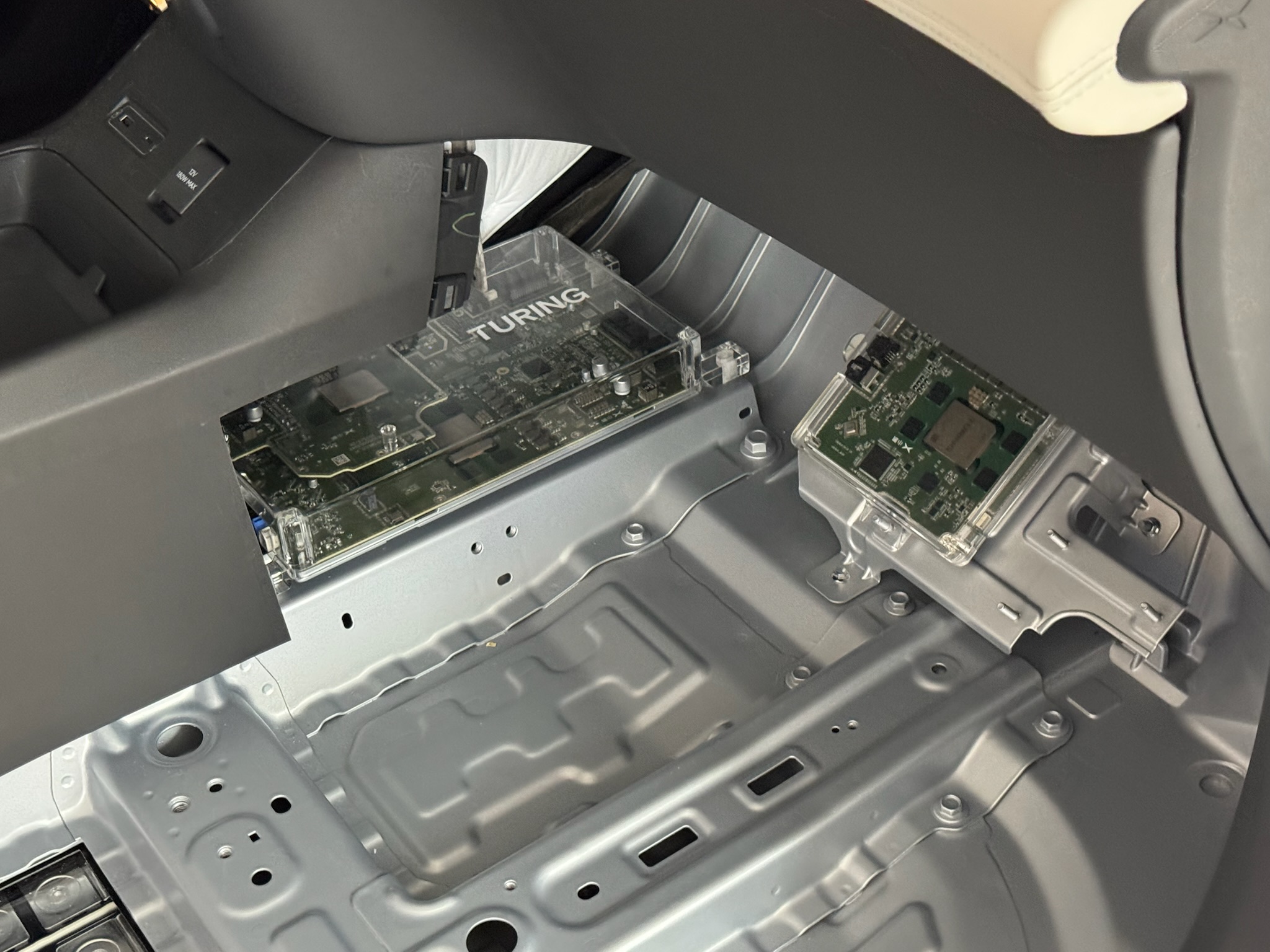
Turing is the chip XPENG is betting on. The tape-out, when the finished design goes to the foundry, came on 23 August 2024, and at AI Day that November the company described a 40-core processor on a domain-specific architecture for neural networks, running models of up to 30 billion parameters and delivering, in its own words, the power of three high-performance chips in one. Its own chip pages fill in the anatomy: two in-house NPUs, two independent image processors for darkness and backlight, and an integrated safety island certified to ISO 26262 ASIL-D and AEC-Q100 Grade 2. The 750 TOPS in the configurators is the retail version of the compute claim; no independent benchmark of the chip has been published. How the chip fits into XPENG’s Physical AI, with inputs from both car and robot, is drawn in the VLA article.
The name is used twice. Turing is the chip, and Turing is also the label on XPENG’s model family. The Munich stage slide read “XPENG TURING VLA 2.0 Model”, and the vision encoder is called TuringViT. When a source says Turing, it is worth checking whether it means the hardware or the AI model.
The P7+ and X9 each have one Turing chip; L03 Ultra has three. Two of the L03 Ultra chips provide 1,500 TOPS for driver assistance. Its cabin Turing chip works alongside MediaTek MT8676, the infotainment processor retained across the Danish L03 range. The Danish configurator lists both processors under Ultra infotainment. Of the advertised 2,250 TOPS from the three Turing chips, 750 belongs to the cabin. Chinese GX and G9L trims have one, two or three Turing chips, while the GX-based Robotaxi has four and up to 3,000 TOPS. The documented L03 allocation does not establish how other models divide their processing tasks.
XPENG identifies Qualcomm Snapdragon 8295 as the processor for infotainment and the XOS 6.0 cockpit in the European G9L in its German launch release of 12 October 2026.
The sensor set shrank as the compute grew. A Turing car runs three millimetre-wave radars instead of five, twelve ultrasonic sensors, and eleven cameras on the P7+ or twelve on the X9. And, as on every export XPENG, no LiDAR.
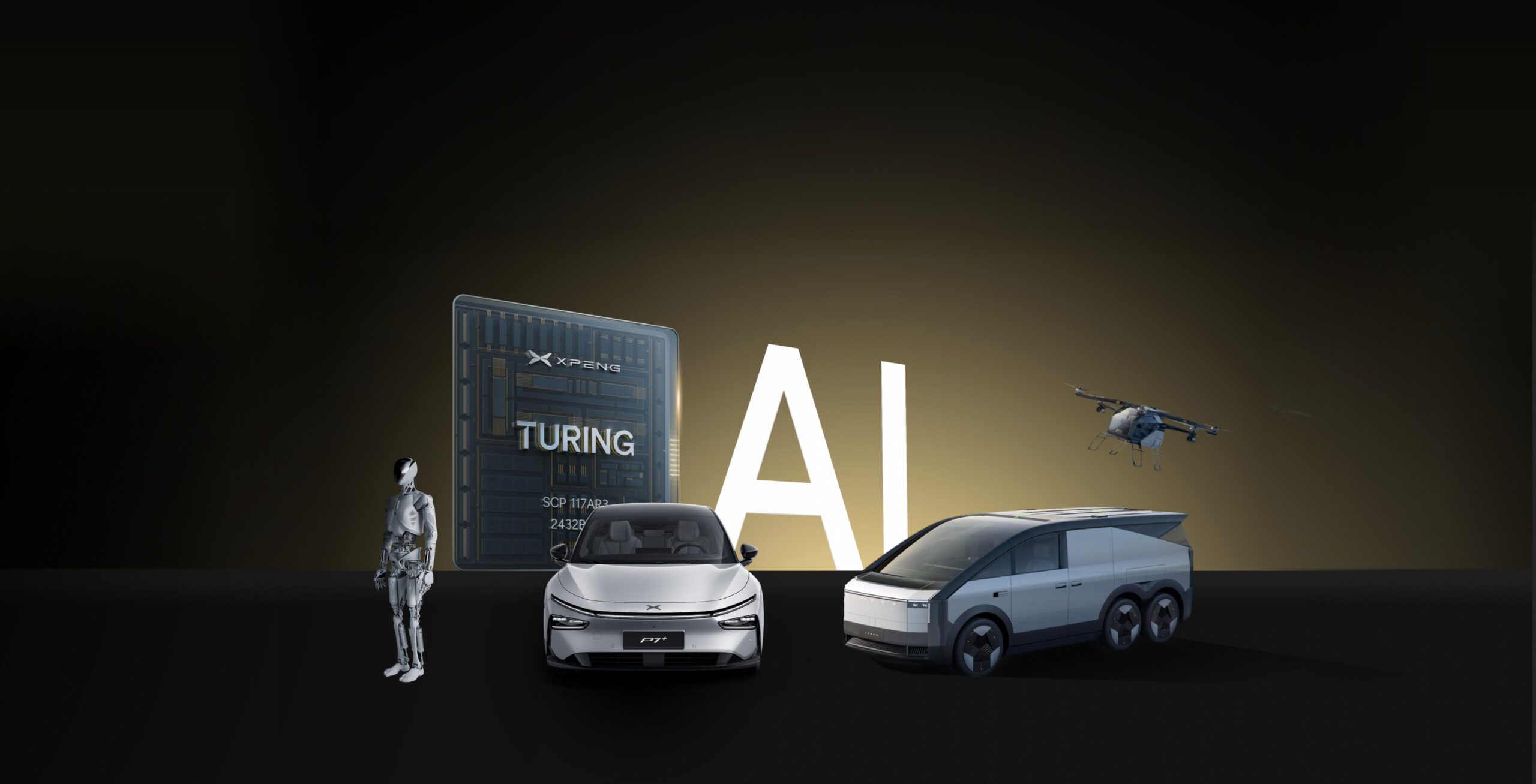
The same silicon runs in three product lines. At Brand Day in Munich XPENG presented AI cars, flying cars and humanoid robots. The flying vehicles belong to its subsidiary Aridge. The IRON humanoid robot runs on three Turing chips delivering 2,250 TOPS, allowing it to run the physical AI model locally on-device without teleoperation; it is scheduled for global release in 2027. The chip has its first outside customer too: at AI Day in November 2025 XPENG named Volkswagen the launch customer for VLA 2.0, with the Turing chip nominated for the group’s cars.
Platform by model
European trims, from the Danish and German price lists captured in July 2026.
| Car | Hardware | Sensors | Software layer |
|---|---|---|---|
| G9 MY23-MY25 | 1 x NVIDIA Orin-X | 5 radar · 12 ultrasonic · 4 surround + 7 high-perception cameras · 1 cabin | XPILOT ASSIST 2.5 |
| P7 facelift 2023 · MY24 | 1 x NVIDIA Orin-X | Same set; Wing Edition has 14 ultrasonic | XPILOT ASSIST 2.5 |
| G6 MY25 Long Range · Performance | 1 x NVIDIA Orin-X | Not itemised | XPILOT ASSIST 2.5 |
| G6 MY25 Standard Range / Air | Bosch front camera module | Not itemised | XPILOT ASSIST 2.5 |
| L03 MY26 SR · LR · AWD Performance | Bosch front camera module | Not itemised | XPILOT ASSIST 2.5 |
| L03 MY26 Ultra | 3 x Turing; 2 for driving = 1,500 TOPS | Not itemised | XPILOT ASSIST 2.5 · NGP / VLA 2.0 planned Q1 2027 |
| P7+ MY26 | 1 x Turing XP5 | 3 radar · 12 ultrasonic · 11 cameras | XPILOT ASSIST 2.5 |
| X9 MY26 | 1 x Turing XP5 | 3 radar · 12 ultrasonic · 12 cameras | XPILOT ASSIST 2.5 |
The software on top
XPILOT ASSIST is a marketing name, not one system. The Bosch trims run the supplier’s own system, while the Orin-X and Turing cars run XPENG’s. The name is the same while everything under it varies. The G6, G9, P7, P7+, X9 and L03 carry exactly the same label in the Danish, Dutch, Norwegian and Swedish stores: three different hardware platforms, model years 2023 to 2026, one number. It marks neither a software release nor a hardware generation. The software under it has moved a whole generation on, and 2.5 has not budged. The number is a leftover. 2.5, 3.0 and 3.5 belonged to one car each in the G3i, P7 and P5 generation, and 3.5 reached the P5 in 2021. XPENG’s model pages today say XPILOT ASSIST with no number at all. Only the price lists still carry 2.5, and there it sits on everything from a Bosch camera module to three Turing chips.
NGP sits above XPILOT ASSIST. L03 Ultra lists VLA 2.0 NGP from Q1 2027. The Danish G9L Ultra trims also list NGP, pending regulatory approval.
A version number can mean two things. XOS is the cockpit and vehicle software, with its own version numbers from 1.0 in 2018 to the 6.x generation now shipping in China; the XOS version history lists them all. The driving stack rides along inside those releases without sharing their numbering, which is why an OTA can change assistance behaviour while no assistance version changes name. The oldest name in the family is XPILOT 3.0, tied to XOS 3.0 in China in 2021 and never sold outside it.
VLA and the hardware
VLA stands for vision-language-action: one model that takes camera images and instructions and decides what the car does, in place of a chain of separate modules. What the model is, what the second generation adds, and the research behind it, TuringViT, X-World and X-Mind, are in the VLA article. This section is about which chips can run it.
L03 Ultra has two Turing chips for driver assistance and a third for cabin AI. All three Danish G9L Ultra trims list two Turing AI chips under driver-assistance hardware. NGP and Full-Scenario VLA 2.0 await regulatory approval; the equipment list does not confirm activation at delivery. P7+ and X9 each have one Turing chip; XPENG has not confirmed NGP for them in Europe. China has VLA 2.0 Lite for single-chip cars, introduced on G9L Max.

China and Europe are converging
The Chinese and the European cars come off the same engineering, which has never meant they could do the same things. The gap between a Chinese XPENG and a European one has been wide, and it is closing one difference at a time. I started following XPENG at the end of 2023, while I was weighing up a G9, and I drive one myself today. The gap has narrowed along the way. Two still separate them, and the first is settled the day the car is built.
Hardware. China sells chip count as a trim step, from one Turing to three, and prices it accordingly. Europe gets one chip on the P7+ and X9, two driving chips on a single L03 trim, and Bosch or Orin-X on everything else. That decides what a car can ever run, whatever arrives by OTA
Regulation. China and Europe do not run the same rules, and they are unlikely to. XPENG names UN Regulation No. 171 on Driver Control Assistance Systems as the route for NGP and VLA 2.0 in Europe; how far the approval has come is in the VLA article. The groundwork is older than the plan. XPENG joined the UN’s ADAS taskforce in 2023, and in February 2026 officials from the EU, the UK, the US, Japan and Canada rode through Shanghai in an XPENG running XNGP while the WP.29 automated-driving working group was meeting
LiDAR used to set the Chinese cars apart. The Chinese G9 of 2022 carried two units, and no export car has ever carried one. The cars on second-generation VLA carry none at all: neither the G9L, the GX nor the P7N runs LiDAR, and the Robotaxi programme is built on pure vision, without LiDAR and without HD maps.
The map has moved the same way. NGP leaned on map data at the start, and maps are not equally detailed everywhere. The car now reads mainly what the cameras see, so the quality of the map matters less for what it can do. The difference is still there, but it has moved from the driving to the screen: China runs Amap / AutoNavi (高德), because Google does not exist in the country, while the international cars have run TomTom and now get Google Maps on the L03, the G9L and later models.
Training data is the third difference closing. The kilometres behind VLA 2.0 are Chinese, and European cars do not supply them in that volume; the share is in the VLA article. Two things pull the other way: the China-trained model’s result on German city roads, which sits in the same place, and the X-World simulation engine, which generates new driving scenarios backed by over 100 million video clips per model training run, so a growing share of training was never a real drive.
The Chinese configurators split NGP into two line items, highway and city, and the Max trims get only the highway one. Under highway NGP sits a function on its way to the European cars: cabin vision and capacitive sensors notice a driver who has stopped responding, and the car pulls over and calls for help. It is on the L03 Ultra’s equipment list as part of VLA 2.0 NGP, so the first quarter of 2027 at the earliest.
The software reaches China first, and it reaches it more often. Staffing is one reason: at a meeting with XPENG’s ADAS team in Guangzhou in November 2025 I was told that at least ten times as many people work on the Chinese ADAS software as on the international one. Translation is another. An export build has to come out in every language the software carries and be adapted to each market in turn, work the home market never has to do. Then it has to be approved: when the 5.8.0 assistance regression needed a repair, the fix waited half a year on EU approval and reached European cars as 5.8.7 in March 2026. On the cockpit side China now runs XOS 5.x and 6.x in parallel while European customer cars stay on the 5.x train for now. The software is in Europe already, though: the L03 display cars run an unreleased build of XOS 6, and Google Maps appears to travel with it. The XOS version history lists every version.
XPENG Denmark put it plainly in a December 2024 xDIVE post: the European systems were not yet at the level of Guangzhou and Shanghai. Since then the G9L has launched as a global car with 64 markets named on day one.
Q&A
Sources
Show 17 sourcesHide sources
XPENG’s Danish G9L configurator, checked on 12 October 2026 - two Turing AI chips under driver-assistance hardware on all three Ultra trims; NGP and VLA 2.0 await regulatory approval.
- XPENG’s XPILOT overview pages and the model comparison, retrieved 30 August 2026 - the 2.5 / 3.0 / 3.5 version numbers tied to the G3i, P7 Premium and P5, and the P7’s NVIDIA DRIVE Xavier
- CNBC, 24 October 2021 - XPILOT 3.5 launched for the P5
- XPENG online stores and price lists, Denmark, Germany and France, captured July 2026 - hardware lines, sensor counts and function lists per trim. The XPILOT label, and the L03 listing’s pairing of two Turing chips with VLA 2.0, re-checked on 29 August 2026 in the Danish, Dutch, Norwegian and Swedish stores
- XPENG owner’s manuals - P7+ MY26, New G9 MY25, G6 MY25, G9 MY23 and the X9 2026 international edition
- Release notes - XOS 5.9.5 for the custom APA hardware condition
- XPENG Brand Day, Munich, 16 July 2026 - Turing across cars, flying cars and robots; the VLA 2.0 share of kilometres driven in China; the European partner list
- XPENG press releases - the P7 launch of 27 April 2020 (first production car on NVIDIA DRIVE AGX Xavier), the G9 launch of 21 September 2022 with NVIDIA’s companion post (dual Orin-X, 508 TOPS, XNGP), the tape-out announcement of August 2024 and AI Day of November 2024 (the Turing chip’s 40 cores and 30-billion-parameter capacity)
- XPENG’s Turing chip pages - the English insight “One Chip, Triple the Power” and the Chinese chip page at xiaopeng.com - the NPU and ISP anatomy, the safety island and its certifications
- XPENG Denmark’s xDIVE series - the 17 December 2024 XPILOT hardware explainer: the sensor anatomy, and where the European systems stood against the Chinese cities
- XPENG newsroom - AI Day, 5 November 2025 (the 72-billion-parameter cloud model; Volkswagen as launch customer), the WP.29 demonstration post of 13 February 2026, and the X-World technical-report release of 29 April 2026
- XPENG launch material for the GX and the G9L, August 2026, with the company’s Weibo and @XPENG_Global posts of 26-27 August - chip counts per trim, VLA 6.3.0, Infini-VLA, X-Foresight, Master Agent and the UN R171 approval route
- XPENG official corporate release on second-generation VLA, 27 August 2026 (published 1 September 2026) - the 4D spatiotemporal model, Infini-VLA (30 s), X-Foresight (6 s), Streaming Inference (+300%), Master Agent, Turing VLA 2.0 Lite on G9L Max, local validation testing in Germany and the IRON robot’s 3 Turing chips (2,250 TOPS)
- XPENG’s Weibo post of 29 August 2026 with the clip of He Xiaopeng’s talk - second-generation VLA Lite: the HybridViT slide with the 67% cut in image tokens, the rollout from September and the promise to dual Orin-X owners. The post’s own text mentions only the distillation and September; the rest is from the clip
- XPENG’s Weibo post of 22 September 2026 - the XOS 6.3.0 rollout and the Lite model for Max versions with one Turing chip
- Meeting with XPENG’s ADAS team in Guangzhou around AI Day, 5 November 2025 - the headcount on the Chinese ADAS software against the international one, told on site. The trip is written up in Visiting XPENG
- NVIDIA DRIVE AGX Orin and NVIDIA’s DRIVE AGX developer documentation - the 254 TOPS figure, the INT8 basis and the ISO 26262 safety island. XPENG has published no compute figure for these cars
Last reviewed: August 2026
Changes to this page (6)
- Added Snapdragon 8295 as the European G9L infotainment processor.
- Added the Danish G9L’s two Turing chips and NGP/VLA 2.0 pending regulatory approval.
- VLA 2.0 Lite: rollout to single-Turing Max versions from 22 September 2026, with source.
- The VLA sections now point to the new VLA article; this guide keeps the hardware side, which chips can run the model.
- Second-generation VLA: VLA Lite is in series production, the twentyfold safety figure now has XPENG's own definition, and the section says where the model's capabilities travel.
- Second-generation VLA Lite in China: how it was cut down to one Turing chip, who gets it from September, and the promise to dual Orin-X owners.