



Charging your XPENG
The technology behind XPENG's high charging speeds, with practical guidance for charging at home, on a journey and when something goes wrong.
Fast charging is one of XPENG’s defining technologies. The latest G6, G9 and P7+ quote 10-80% in 12 minutes, while every model sold in Denmark is limited to 11 kW on AC. Those figures describe two very different jobs, and neither guarantees the number that will appear on the charging screen.
This guide starts with the electrical basics, then explains the controls inside an XPENG. It covers charging at home and on a journey, battery temperature, charge limits, V2L and the faults owners most often encounter.
Images: XPENG
Jump to: AC, DC, kW and kWh · XPENG charging speeds · Charging at home · Battery temperature · Charging on a journey · LFP and 100% · V2L · When charging goes wrong · Questions and answers · Sources
AC, DC, kW and kWh in two minutes
Home charging normally uses alternating current, or AC. The car’s onboard charger converts it before the battery stores the energy. A DC fast charger performs that conversion outside the car and feeds direct current to the cells, which is why it can deliver far more power.
kW measures power at a point in time. An 11 kW wallbox running for one hour supplies roughly 11 kWh before losses. kWh measures energy. An 80 kWh battery therefore holds about as much energy as that wallbox supplies in just over seven hours, although conversion losses and temperature control extend the real session.
A loose Type 2 cable connects the car to an untethered AC post or wallbox. European DC stations use a tethered CCS2 connector. Its upper section follows the Type 2 shape, with two larger DC pins below it.
High DC power is the XPENG difference
The G6 and G9 were among the first production cars in Denmark with an 800 V system. Their latest versions use 5C batteries and carry a manufacturer time of 12 minutes from 10 to 80%. The P7+ has the same quoted time. L03 pairs a 400 V system with a 3C battery and quotes 20 minutes. The variant figures are in the table below.
Higher voltage allows the car to transfer more power without a matching rise in current. In broad terms, power is voltage multiplied by current: 800 V at 600 A is about 480 kW, while 400 V at 600 A is about 240 kW. Pack voltage moves throughout a session, so this illustrates the principle rather than predicting an exact charger reading.
A peak is only the highest point the car reaches. The time spent at the charger depends on the complete curve and the average power across the useful charging window. Pack temperature, the station’s capability and the state of charge can all impose a lower ceiling.
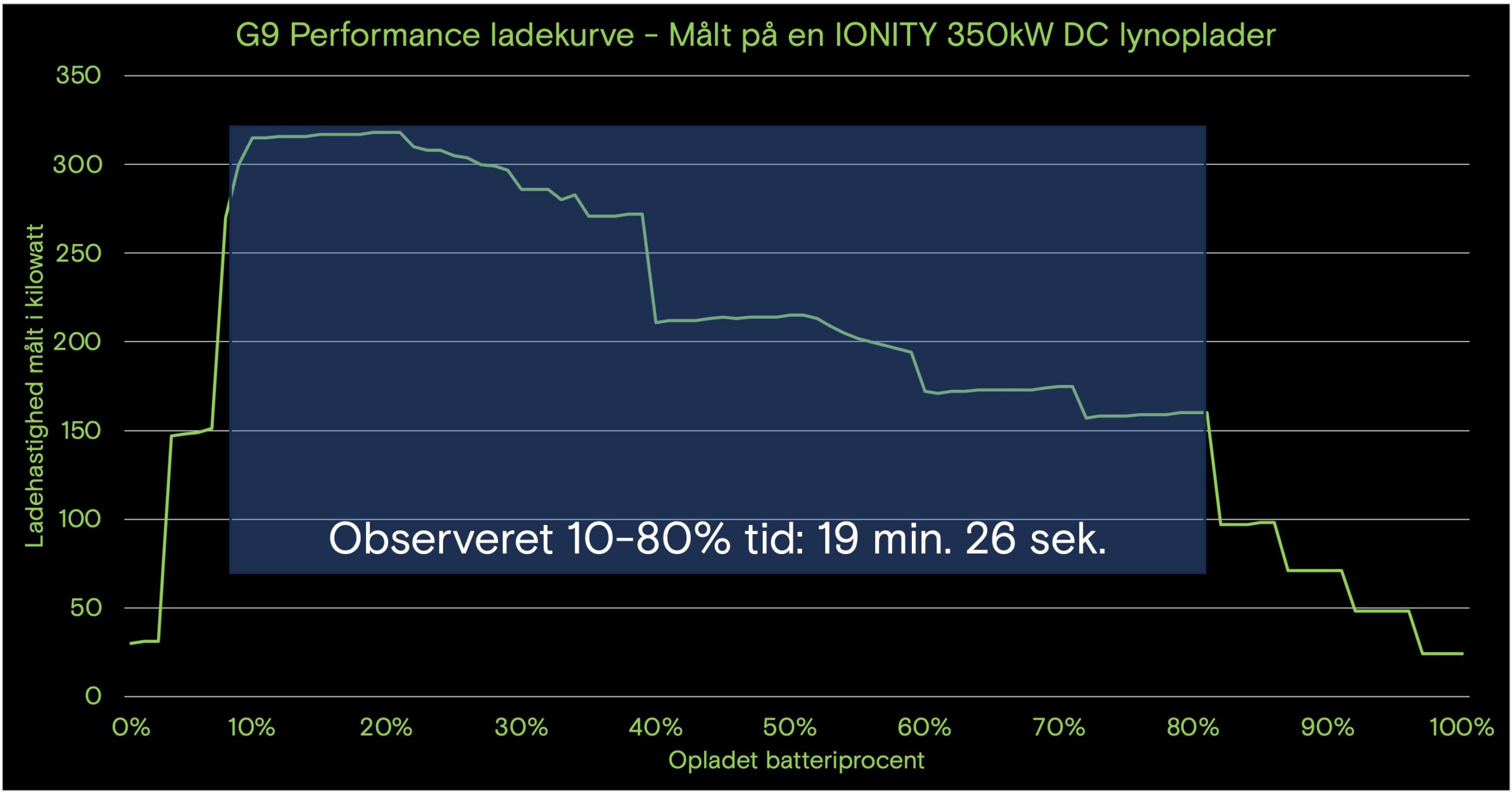
Charging curve for a G9 Performance MY23 with a 3C battery at an IONITY 350 kW post - the official 10-80% time is 20 minutes. XPENG Denmark’s measurement took 19 minutes 26 seconds and peaked just above 300 kW.
The first-generation G9 Performance held more than 270 kW until roughly 40% and completed the 10-80% window in 19 minutes 26 seconds. Its data sheet says 20 minutes. At Clever’s Rødovre site, an XPENG employee later recorded 11 minutes 30 seconds in a New G6 AWD Performance. That outlet could supply 600 A, the current the newer 5C packs need. See the Rødovre curve and test conditions.
| Model in Denmark | System | Battery | Peak DC | 10-80% | V2L |
|---|---|---|---|---|---|
| New G6 Standard Range | 800 V | 68.5 kWh LFP | 382 kW | 12 min | 3.3 kW |
| New G6 Long Range / AWD Performance | 800 V | 80.8 kWh LFP | 451 kW | 12 min | 6 kW |
| New G9 Standard Range | 800 V | 79 kWh LFP | 445 kW | 12 min | 6 kW |
| New G9 Long Range / AWD Performance | 800 V | 93.1 kWh LFP | 525 kW | 12 min | 6 kW |
| G9 2023-24 Standard Range | 800 V | 78.2 kWh LFP | 260 kW | 20 min | 3.3 kW |
| G9 2023-24 Long Range / AWD Performance | 800 V | 98 kWh NMC | 300 kW | 20 min | 3.3 kW |
| P7+ Long Range / AWD Performance | 800 V | 74.9 kWh LFP | 446 kW | 12 min | 6 kW |
| P7 | 400 V | 86.2 kWh NMC | 175 kW | 29 min | 3.3 kW |
| L03 Standard Range | 400 V | 58.3 kWh LFP | 193 kW | 20 min | Not stated |
| L03 Long Range / AWD Performance | 400 V | 71.2 kWh LFP | 236 kW | 20 min | Not stated |
| L03 AWD Performance Ultra | 400 V | 71.2 kWh LFP | 236 kW | 20 min | 6 kW |
Battery capacities are gross. Peak DC power and 10-80% times are XPENG’s official maximum figures. The original 2024 G6 is not in this table; its figures remain on the G6 page. The complete field-by-trim matrix is under Compare specs.
EV Database adds calculated real-world range and charging times for different charger types to the official figures. EVKX provides charging curves, average power and timings for individual variants. These are third-party data, and EVKX labels some curves as estimated rather than measured.
Charging at home: 11 kW and the 32 A setting
Every XPENG currently sold in Denmark has an onboard AC charger rated at up to 11 kW. On a three-phase supply, that means 16 A. The data sheets give a little over seven hours from 5 to 100% for a New G6 Standard Range, eight and a half for a P7+, and ten and a half for a New G9 Long Range.
On my own Zaptec Go, power normally sits around 10.2 kW at 16 A. That is within the expected range: 11 kW is the nominal maximum, while actual power also depends on the supply voltage and the wallbox’s regulation.
The current limit sits under Charging and discharging → Charging → Slow charging settings. It runs to 32 A because the same software is used in markets where 32 A single-phase charging is common. That does not turn the Danish onboard charger into a 22 kW unit. On a three-phase installation, 16 A is the setting for up to 11 kW.
A lower value caps what the car requests from the wallbox and may be needed on a restricted installation. Dynamic load balancing normally handles this at the box by watching the rest of the house, allowing the vehicle limit to remain at 16 A.
Put the charging schedule in one place
Scheduled slow charging lets the car start and stop within a chosen window. A connected wallbox can often run its own schedule. Only one should be active. If the car and a charging service both control the start time, one may wait while the other assumes the session has already begun.
If charging starts immediately despite a schedule, first identify which system owns the timer. In Monta, SmartCharge or an older setup can also take control of the session. The exact remedy depends on the wallbox and the service linked to it.
Cabin heat and two kinds of battery preheating
Three XPENG functions are easily confused. One heats the cabin. The other two prepare the battery at different points in a journey.
- Cabin preheating is under A/C in the app. It can run immediately or on a schedule. A warm interior says nothing about whether the pack is ready to fast-charge.
- Low-temperature battery preheating runs before departure with the AC cable connected. It appears under Charging and discharging → Charging and under More functions in the app. The selected time is when the pack should be ready. When the outside temperature is above the vehicle’s threshold, it skips preheating even if the schedule is active. The exact threshold is not stated.
- Temperature control before fast charging heats or cools the battery on the way to a DC station. With the feature enabled, the car starts it when navigation is set to a recognised fast charger. XOS 5.4.5 also added a manual start in the Charging menu.
XPENG Denmark recommends allowing 15-35 minutes before the stop. It gives 25-30 °C as the pack’s best charging range and puts the energy use at 0.15-0.2 kWh for each degree of temperature change. A message saying preheating is unnecessary normally means the pack is already within the target range.
Charging on a journey
For a long journey, the useful details are connector type, station power and the payment service you intend to use. Route planning can add stops, but a second option nearby helps when the chosen site is busy or out of service. A slower destination charger may remove the need for another motorway stop.
I do not recommend particular charging operators or apps in this guide. Coverage, prices, subscriptions and individual needs vary with location and driving pattern, so the right solution for one owner may be unnecessarily expensive or impractical for another.
I charge at home for everyday driving and mainly use public DC stations on longer journeys. As my need for public charging is limited, I chose the charging service in the XPENG app, which uses the Plugsurfing network and also offers a physical charging card. I use Monta Charge for home charging and occasionally while travelling. This is my arrangement, not a general recommendation.
- Select the charging station in the car’s navigation so temperature control can run if needed.
- Check the price in the payment service you will use. The operator and a roaming service may quote different prices for the same post.
- Follow the sequence shown at the charger. Some sessions authenticate before connection; others start after the cable is plugged in.
- Confirm that the station and the car both show an active session. Initial power can be low when the pack is cold or already near full.
- End the session through the service that started it. Wait for confirmation before removing the connector.
Why an 800 V XPENG can be slow at a Tesla site
Older Superchargers deliver around 400 V. An 800 V G6 or G9 must raise that voltage inside the car, and the converter imposes a much lower ceiling than the vehicle’s normal DC peak. Newer Tesla sites may use different hardware, so the location and cabinet generation matter more than the Tesla name alone.
My 2023 G9 Standard Range received 74-78 kW at the Fredericia Supercharger in 2024 against a 260 kW data-sheet peak. Active temperature control before fast charging had not been used, but the battery was at operating temperature after almost 200 km of motorway driving. Several owners have reported similar charging power at older Superchargers. These are owner observations, not a systematic measurement of the whole network. P7 and L03 use 400 V packs and do not require the same voltage conversion.
LFP, 100% and the charging limit
Most newer XPENGs in Denmark use LFP batteries. The exceptions in the table are the 2023-24 G9 Long Range and Performance, plus the P7, which use NMC. The original G6 from 2024 is not shown in the table: Standard Range uses LFP, while Long Range and AWD Performance use NMC. An LFP pack needs a regular full charge so the car can calibrate its state-of-charge reading.
The XOS 5.2.5 release notes set the interval at 14 days or 1,000 km without a complete charge. The car may then show “Battery status needs calibration”. AC or DC can be used, although some fast chargers stop at about 95%, which does not count as full.
This periodic trip to 100% is separate from the everyday charging limit. The limit is set under Charging. With Battery health protection enabled, it returns to the vehicle default at the next power-on. The L03 manual states 100% for LFP and 90% for NMC.
V2L: using the car as a 230 V supply
A V2L adapter turns the AC charge port into a 230 V outlet. XPENG sells the adapter separately. Output depends on the model: 3.3 kW on the first G9 and P7, and up to 6 kW on newer G6 and G9 variants and the P7+. For L03, 6 kW is documented for Performance Ultra. The other Danish variants are therefore marked as unstated in the table.
Power limit sits under Charging and discharging → Power supply. The default is 20%, and the vehicle cuts the output when the battery reaches that point. End the power supply on the screen before unplugging the adapter. The manual warns that reversing this order can damage the car.

The V2L adapter connects to the AC charge port - available output depends on model and variant.
G9, G6 and P7+ also have a 180 W 12 V outlet in the boot. Delayed power-off under Power supply can keep a cool box running after the car shuts down. Equipment above 180 W belongs on the V2L adapter.
The Chinese-market G9L has been shown with a different solution: a 220 V AC outlet rated at up to 2.2 kW in the second row, under the front passenger seat beside the fridge. XPENG has not yet said whether the outlet will be included in international versions.
When charging goes wrong
The session will not start
First match the charger number in the app to the connector plugged into the car and check that payment was accepted. Cancel any pending attempt, disconnect and begin again in the order shown on the station. If another post at the site works, the first post or its communication with the car was probably the problem. An actual charging fault message in the car is different: the manual says to stop and contact XPENG.
Power is lower than expected
For AC, check the vehicle’s current limit and the power reported by the wallbox. At a DC station, the usual constraints are a cold pack, a high state of charge or hardware that cannot supply the voltage and current the car requests. Power also drops near the end to protect the cells. A data-sheet peak is never the expected figure for the complete session.
Some public DC chargers share their available power between two connectors, while other sites share power across several posts. When there is a choice, a completely unused charger may therefore deliver more than one whose other connector is already in use. Power allocation depends on the site’s hardware.
The connector will not release
End the session and unlock the car again. This normally releases the connector. For AC, the screen offers an emergency unlock under Charging and discharging, or under Help on G9. The button only appears with the flap open and an AC connector inserted. A locked DC connector requires help from the charging operator or an XPENG service centre.
The AC port also has a mechanical release ring behind a service cover in the boot. It is used only after charging has ended and the screen has left the charging or heating view. This is an emergency device; repeated use can damage the ring or the port.
Cable, charge port and light show
Danish XPENG cars come with a Type 2 cable in a bag. The cable supplied with my 2023 G9 is five metres long. DC stations have their own tethered cable.
The startup light show can be disabled under Lights → Light signals while charging. The setting follows the user profile signed in to the car and must therefore be changed for each user.
Questions and answers
Sources
- XPENG user manuals - New G9 MY25, New G6 MY25, P7+ MY26 and L03 MY26: AC and DC charging, limits, scheduling, battery preheating, emergency release, V2L and LFP calibration
- XPENG Denmark, xDIVE: Charging (9 December 2024) - G9 Performance curve, battery temperature and energy used by temperature control
- XPENG Denmark, xDIVE: What is V2L? (3 December 2024) and xDIVE: Battery technology (8 December 2024) - the V2L limit, LFP and NMC, and battery capacity
- The Danish configurator and XPENG data sheets (July to September 2026) - model table; Compare specs contains the full field set
- Release notes - XOS 5.2.5 for the full-charge interval and LFP reminder, and XOS 5.4.5 for manual temperature control before fast charging
- A G6 charged from 10 to 80% in 11½ minutes in Rødovre (September 2026) - Clever’s 600 A outlet and XPENG’s measurement
- Owner experience: my 2023 G9 Standard Range, the Fredericia Supercharger in 2024 and daily home charging
Hub: Software · Related: XOS settings · XPENG app · Compare specs
Last reviewed: September 2026