



XPENG G9L
The G9L is XPENG's new flagship above the G9, with its European premiere in Paris this October. Here is everything we know about it.
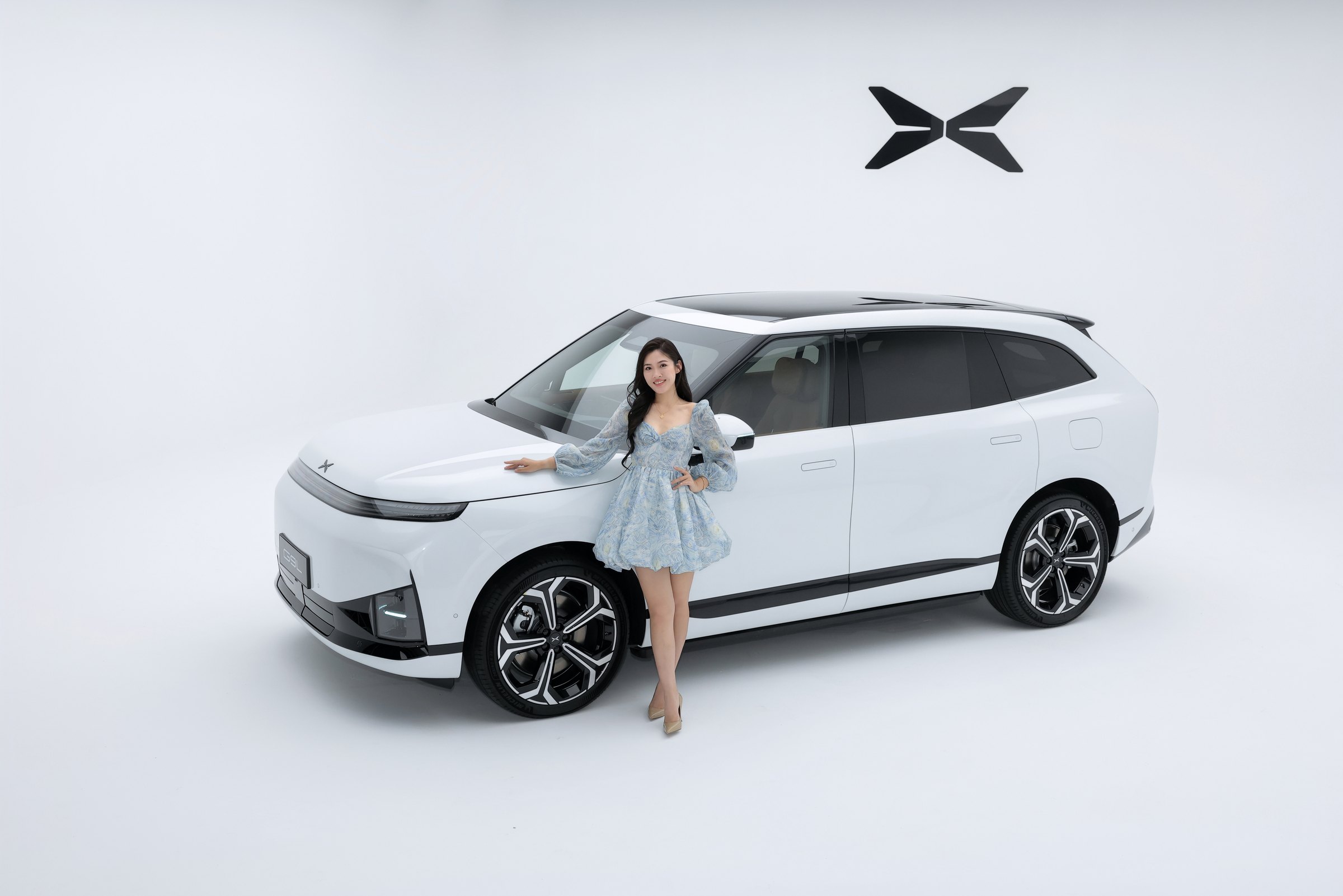
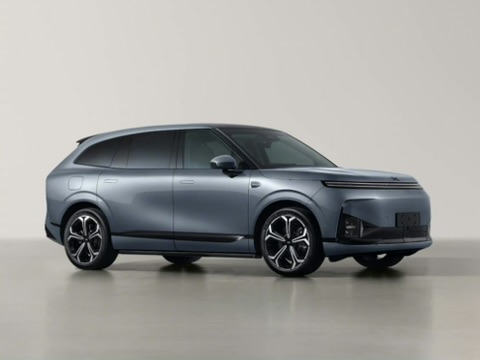
XPENG G9L (the “L” is for Luxury) is a large SUV over five metres long, positioned above the current G9 as the new top model in the SUV range in Europe. Six- and seven-seat versions are confirmed for the European market.
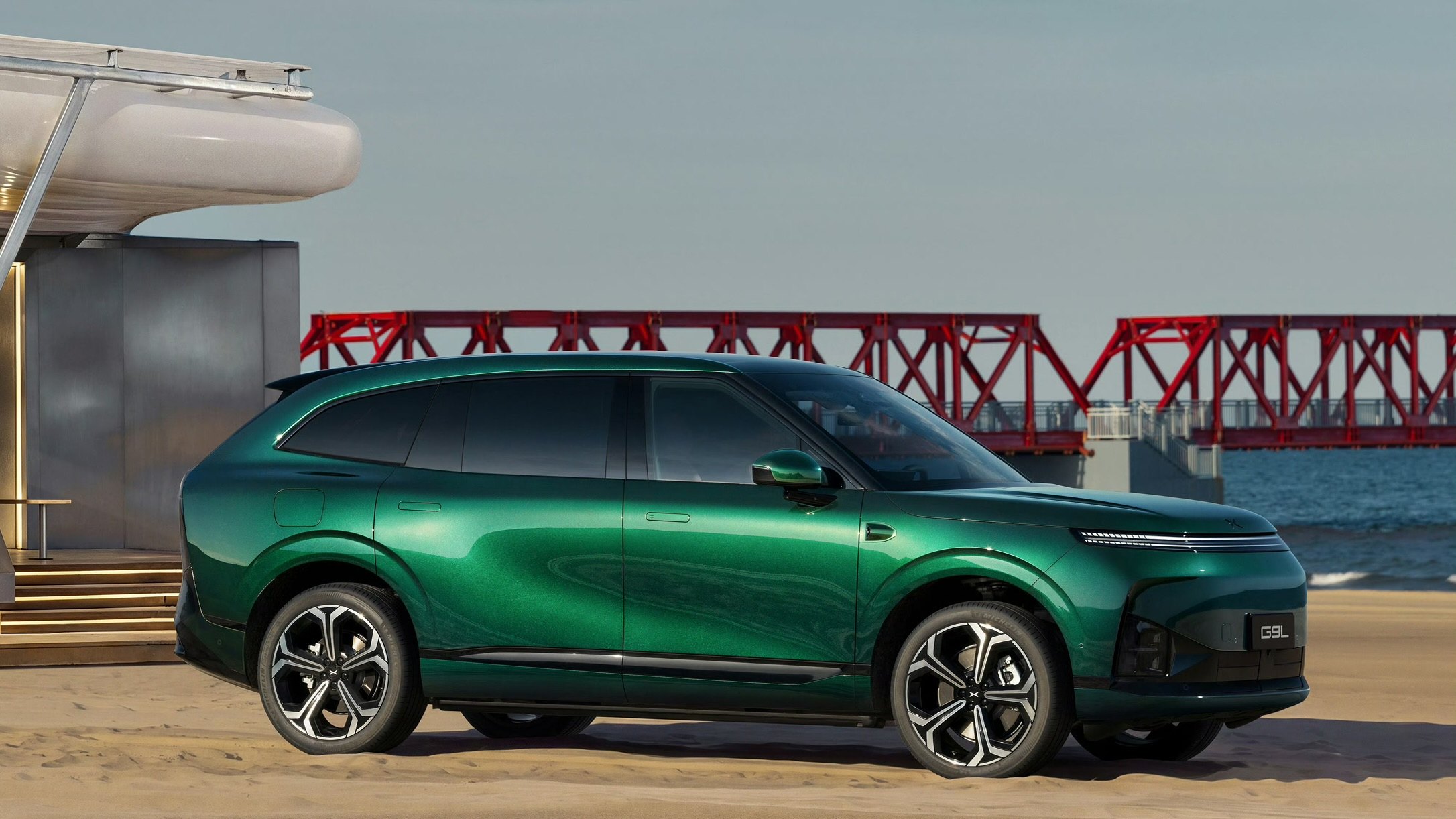
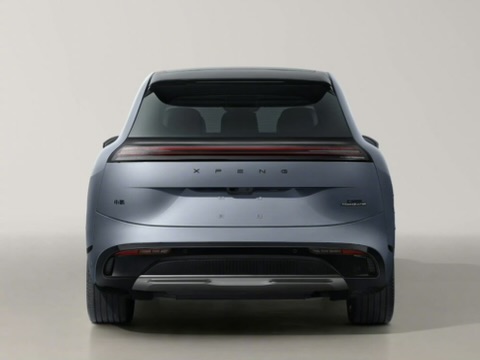
Images: XPENG
The G9L was first mentioned officially on 3 August 2026, in China and internationally at the same time.
The European premiere is at the Paris Motor Show, 12-18 October 2026.
The Chinese version was presented in Guangzhou on 11 August 2026, and pre-sale opened the same day. The car launched in Beijing on 17 September 2026, where all six trims got a price: CN¥ 241,800 to CN¥ 319,800. See Launch trims and Timeline.
Everything on this page that is not explicitly about the international version comes from XPENG’s Chinese material. Specifications for the other markets are not published yet - the biggest open points sit under Open questions before Paris.
Jump to: From conversation to test drive · G9L, G9 and GX · Europe & Denmark · The Chinese version · Launch trims · Black Gold Edition · Powertrains · Exterior · Interior · Seats and bed modes · Audio · Boot · Platform & chassis · Safety · Assisted driving · Timeline · Q&A · Gallery · Videos · Related · Sources
XPENG Guru: From conversation to test drive
My own G9L story starts before the car existed publicly. In the summer of 2024, shortly after my own G9 arrived, I met Ye Zhiming (then on the G9 team, today G9L Overseas Product Expert) at XPENG in Copenhagen. He first of all wanted my feedback on the G9, and then how I pictured a future large SUV from XPENG; he also sketched some of the directions the team was weighing. I answered from daily life in my own car on Danish roads, and my personal views on cars of that type.
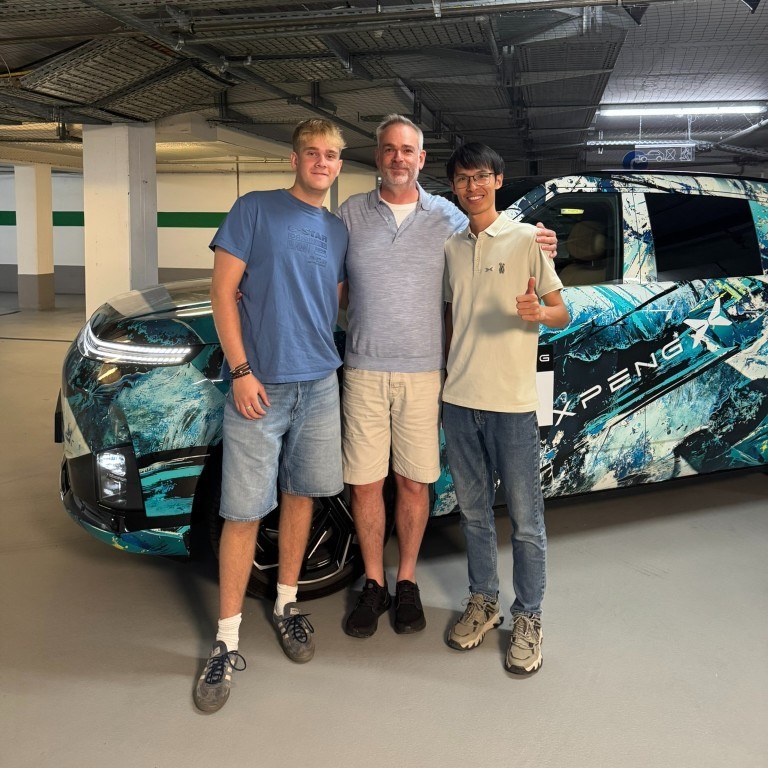
When I visited Guangzhou in November 2025 and met him again, G02 (the internal codename) was described as a new model in its own right, not a direct successor to the current G9. Publicly the car did not exist yet: the first spy shots came three months later, in February 2026 (timeline). He Xiaopeng has since dated the model’s start to around 2023, which puts the Copenhagen conversation about a year into the programme. Whether an owner’s wishlist from that summer influenced the finished car, I have no idea. I had not seen the car myself, only heard it described and answered the questions I was asked about it.
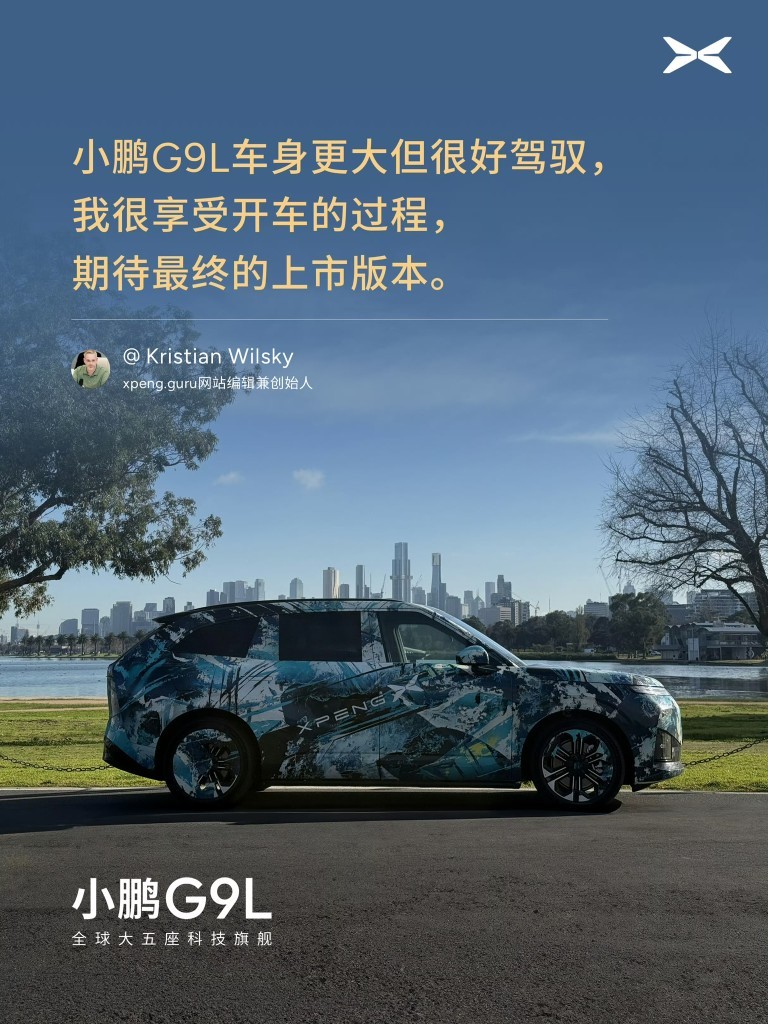
Since then it has become two viewings and drives in pre-production cars. The first - very briefly - in the range-extended (EREV) model in Denmark on 25 June, the second in the pure electric (BEV) version in Munich during the L03 launch event. Both cars are camouflaged as shown below. I am not a journalist or a car reviewer. For me, drives like these are about building knowledge and insight into the car and its software - to share here on the site and in online communities, and to give feedback to XPENG. Like the journalists and reviewers, I am under a strict embargo and cannot yet share impressions or details from those drives; more on tech and specifications will follow once the embargo lifts.
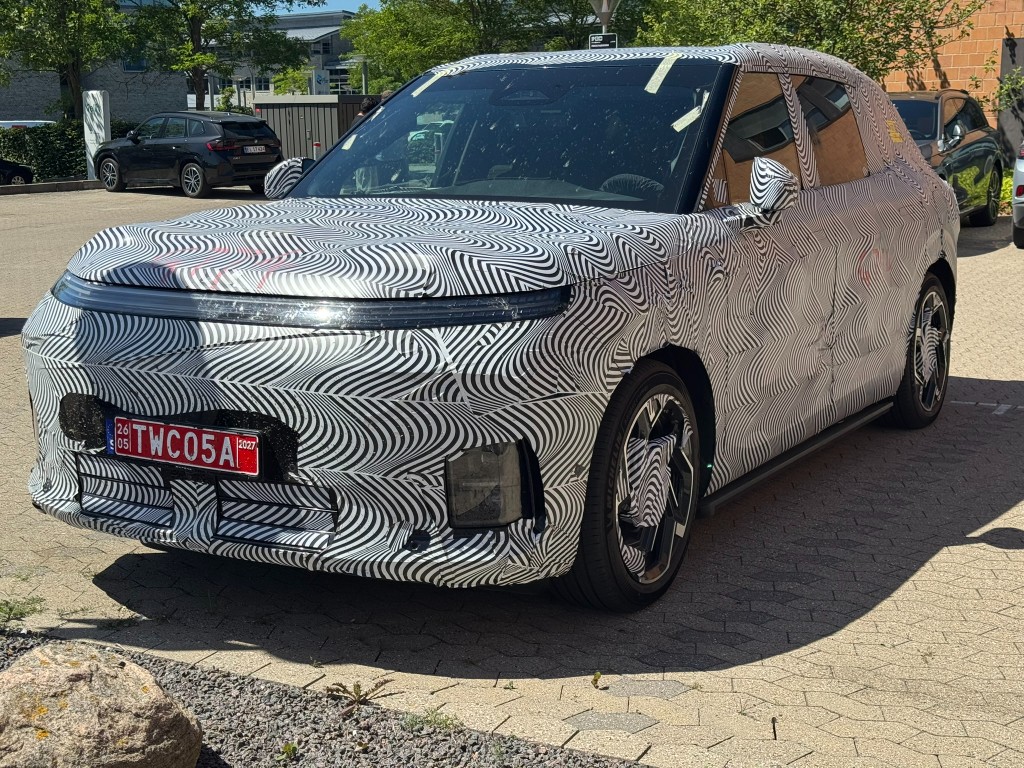
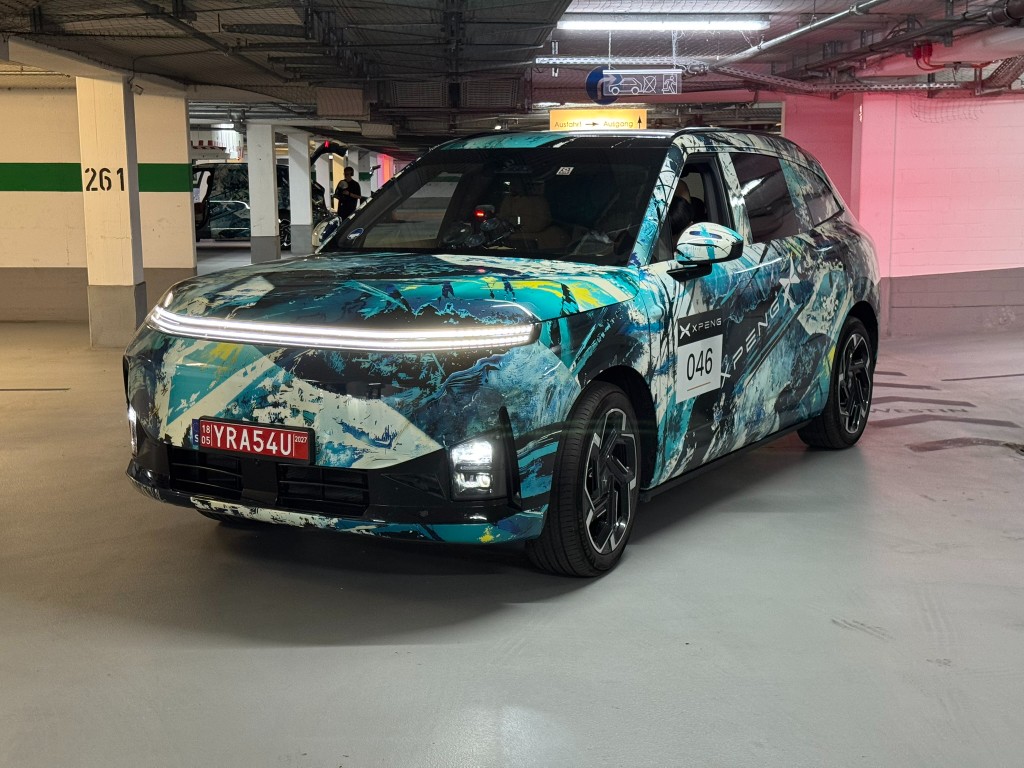
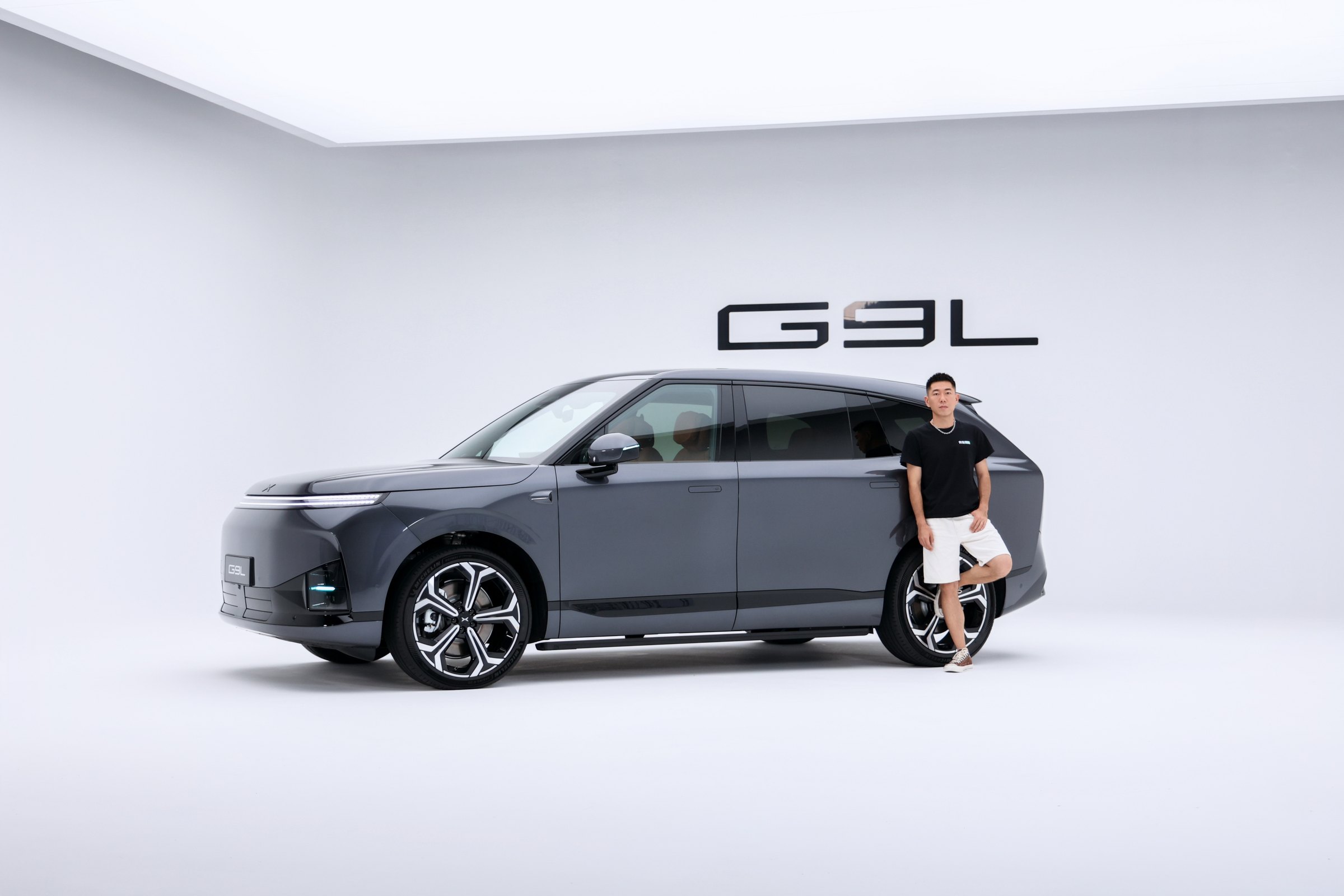
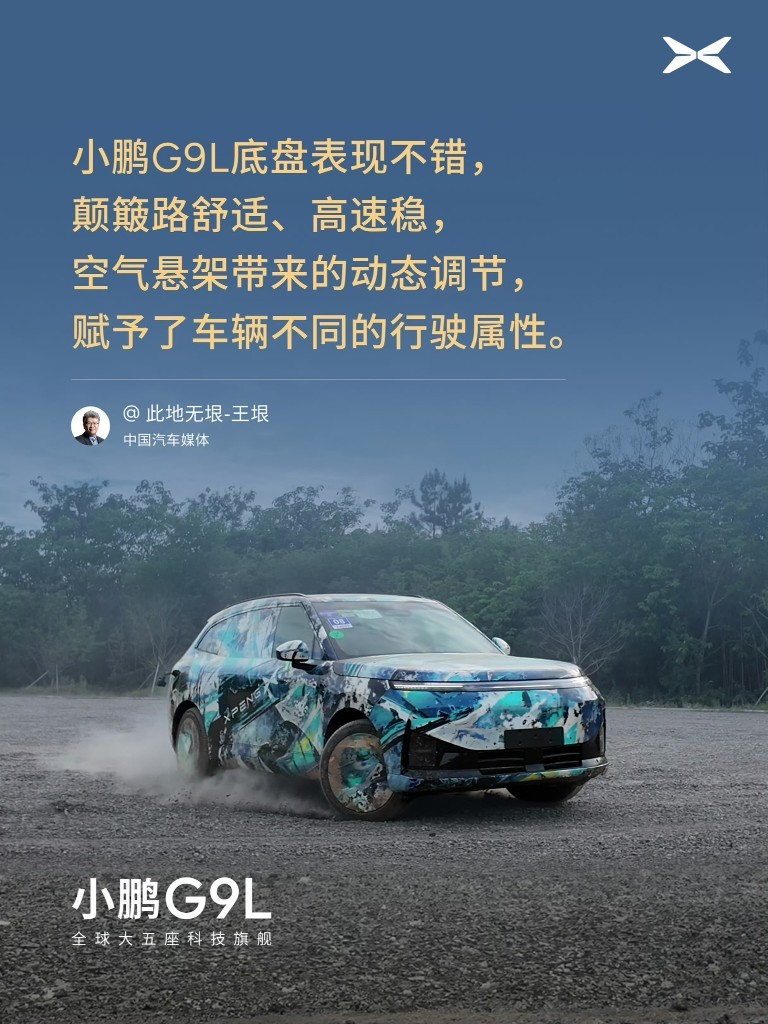
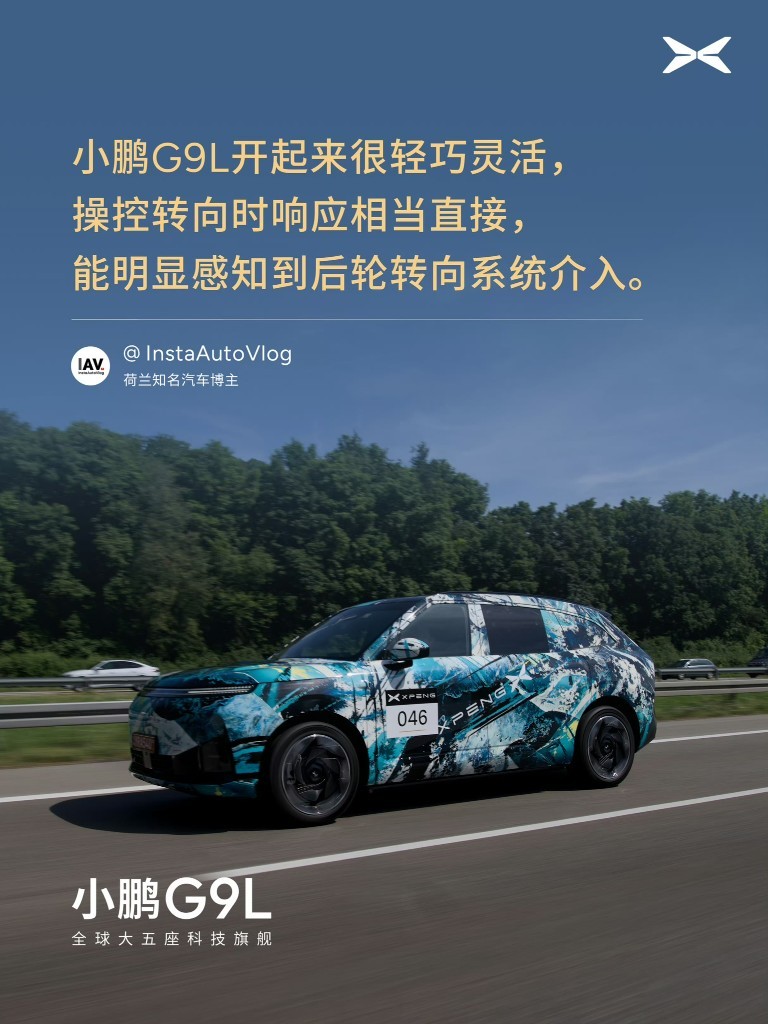
The Munich drive was on 17 July 2026, the day after XPENG’s Brand Day in the city, and it later became part of the global road test XPENG published in August on Chinese social media. My son and I appear in three of XPENG’s films from the trip: the international media film, where I am one of the invited drivers and interviewees, He Xiaopeng’s own film and the montage from that post. My comment on the car became one of the four quote posters XPENG shared afterwards. The role in front of the camera was new to me; I normally stand behind it and write the trip up afterwards.
G9L, G9 and GX
The G9L draws heavily on the design and technology of the China flagship GX, but it is a separate, slightly smaller car. Early coverage sometimes mixed the two; they are two programmes with their own internal codes, G02 and G01.
The name suggests a stretched G9, and many guessed the “L” stood for Long or Large. XPENG itself says Luxury, which gives the model something to live up to. Technically the G9L is very much its own car: the international G9 is built on SEPA 2.0, the G9L on the newer SEPA 3.0. In Europe and Denmark the G9 stays on sale alongside the G9L.
| XPENG G9 (EU) | XPENG G9L | XPENG GX | |
|---|---|---|---|
| Internal code | - | G02 | G01 |
| Platform | SEPA 2.0 | SEPA 3.0 | SEPA 3.0 |
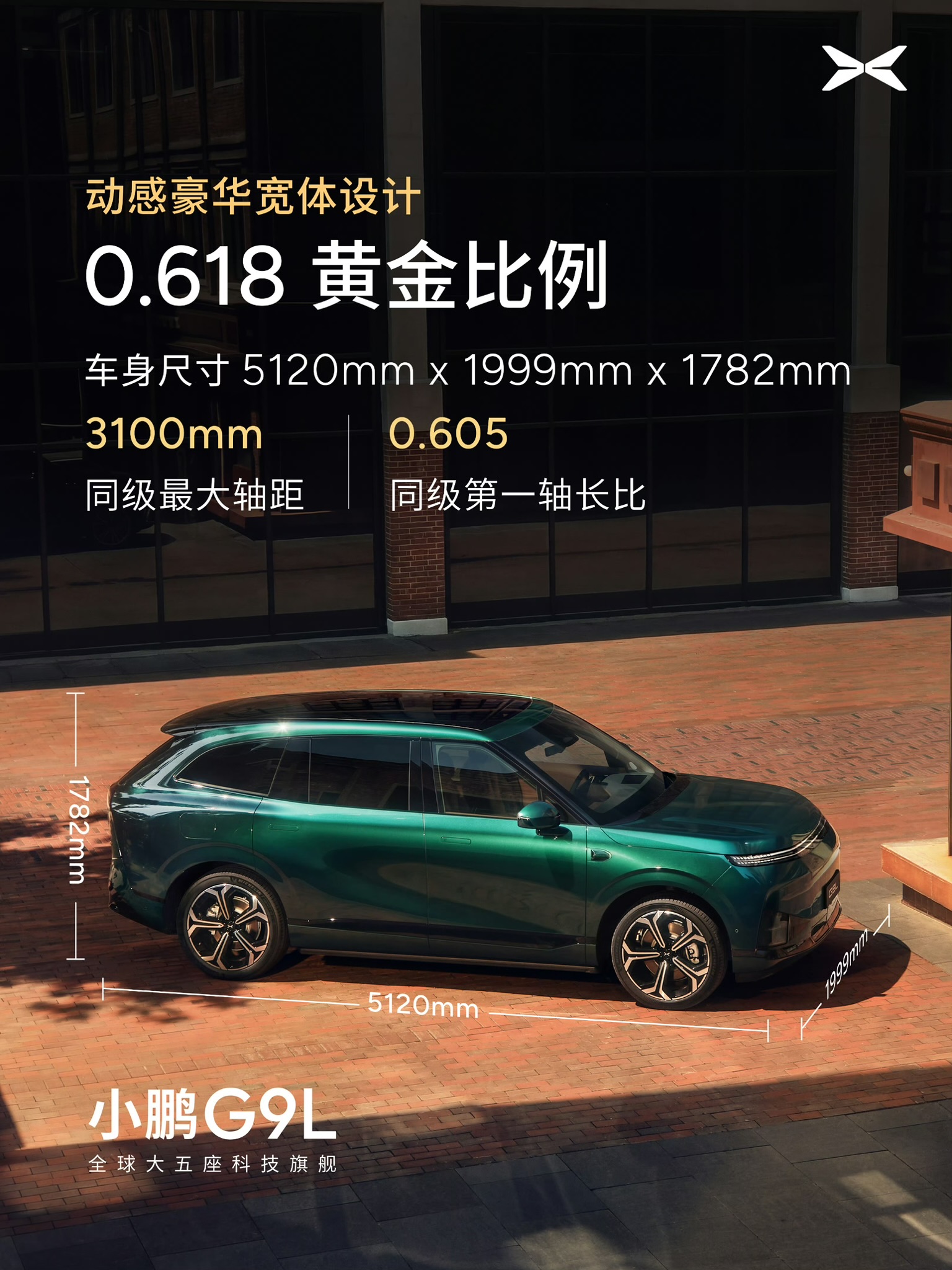
| Length | 4,891 mm | 5,120 mm | 5,265 mm |
| Width | 1,937 mm | 1,999 mm | 1,999 mm |
| Height | 1,680 mm (Perf. 1,670) | 1,782 / 1,788 / 1,795 mm | 1,800 mm |
| Wheelbase | 2,998 mm | 3,100 mm | 3,115 mm |
| Seats | 5 | 5 (CN filing) · 6- and 7-seater confirmed for Europe (see Europe) | 6 (2+2+2) |
| Markets | China, Europe and several other markets | China (pre-sale from 11 August 2026; launch in Beijing 17 September 2026) · Europe premiere in Paris, Oct 2026 | Chinese market (+ UAE / Australia) |
G9 figures: European specifications. The three G9L heights vary by configuration. G9L / GX lengths and wheelbases from MIIT filings (batch 407 / batch 404).
Europe & Denmark
XPENG Guru covers the car from a European and Danish perspective. It is engineered for launch across 64 markets - a board at the Guangzhou debut display lists them by continent (see the board in the gallery). Whether the other international markets get the same version is not known yet.
The European 6- and 7-seaters
Europe gets different seating configurations from China. While XPENG launched a five-seater in its domestic market, XPENG Norway has confirmed that the G9L will be delivered exclusively as six- or seven-seat versions in the Nordic and European markets ahead of its European premiere in Paris. One of the few other technical details XPENG has confirmed for the European car so far is the four-wheel steering: ±7.5° of steering angle and a 5.4 m turning radius - the same figures as on the Chinese version.
Where it is built
The G9L is built in two places. At the Beijing launch XPENG confirmed it comes from Guangzhou and from the XPENG Magna plant in Graz, Austria, with production running in parallel in China and Europe. Graz has been building the P7+ for the European market this year, and the G9L will share the line with it. When the first European cars come off it, the company did not say.
Open questions before Paris
XPENG publishes the European specification at Porte de Versailles on 12 October 2026, and these are the gaps until then:
- Prices, WLTP range and the European powertrain line-up - no official details are known yet
- Seat configurations in detail - 6- and 7-seat models are confirmed by XPENG Norway; the exact 2nd- and 3rd-row layout (captain’s chairs vs. bench) will be presented in Paris
- Boot and frunk volumes for the 6- and 7-seaters - the China five-seater’s 1,152 L belongs to a two-row car. How much space do the three-row versions offer?
- Standard against optional equipment - the AI seats, the 33-speaker audio, the fridge, the power doors and the AI projection headlights are all shown on China cars, and on the GX the projection headlights are an option. How much of that equipment reaches the international versions?
- Assisted driving in Europe - hardware, software version, and how much Next Generation Pilot (NGP) is allowed to do here. XPENG now says it has run local acceptance testing of VLA 2.0 in Germany, with the China-trained model close to the domestic result on little extra local data. Regulatory approval is still aimed at the first half of 2027, then delivery to overseas customers (same window as the Q2 call). Whether the first cars here land with that stack, or with an L2 system that gains it later, is open - see Assisted driving
- The chassis - does the European car keep the same air suspension and adaptive dampers as the Chinese one?
- AC charging - every XPENG on sale today has an 11 kW onboard charger, 16 A across three phases. The Chinese specifications carry no AC figure at all, for the G9L or the GX. Home charging in China runs mostly on one phase and public charging on DC, so the figure matters little there. Does the G9L follow the range at 11 kW, or arrive with 22 kW? XPENG has said nothing about its onboard charger, and SEPA 3.0 does not settle it: the platform is about 800 V and DC charging, while the AC charger is a separate component. Paris is the first place the figure can appear
- The software version - expected to be XOS 6 with Google Maps in the navigation and an assistant based on second-generation VLA (see Assisted driving)
- European delivery start - FDM expects around the turn of the year
The Chinese version
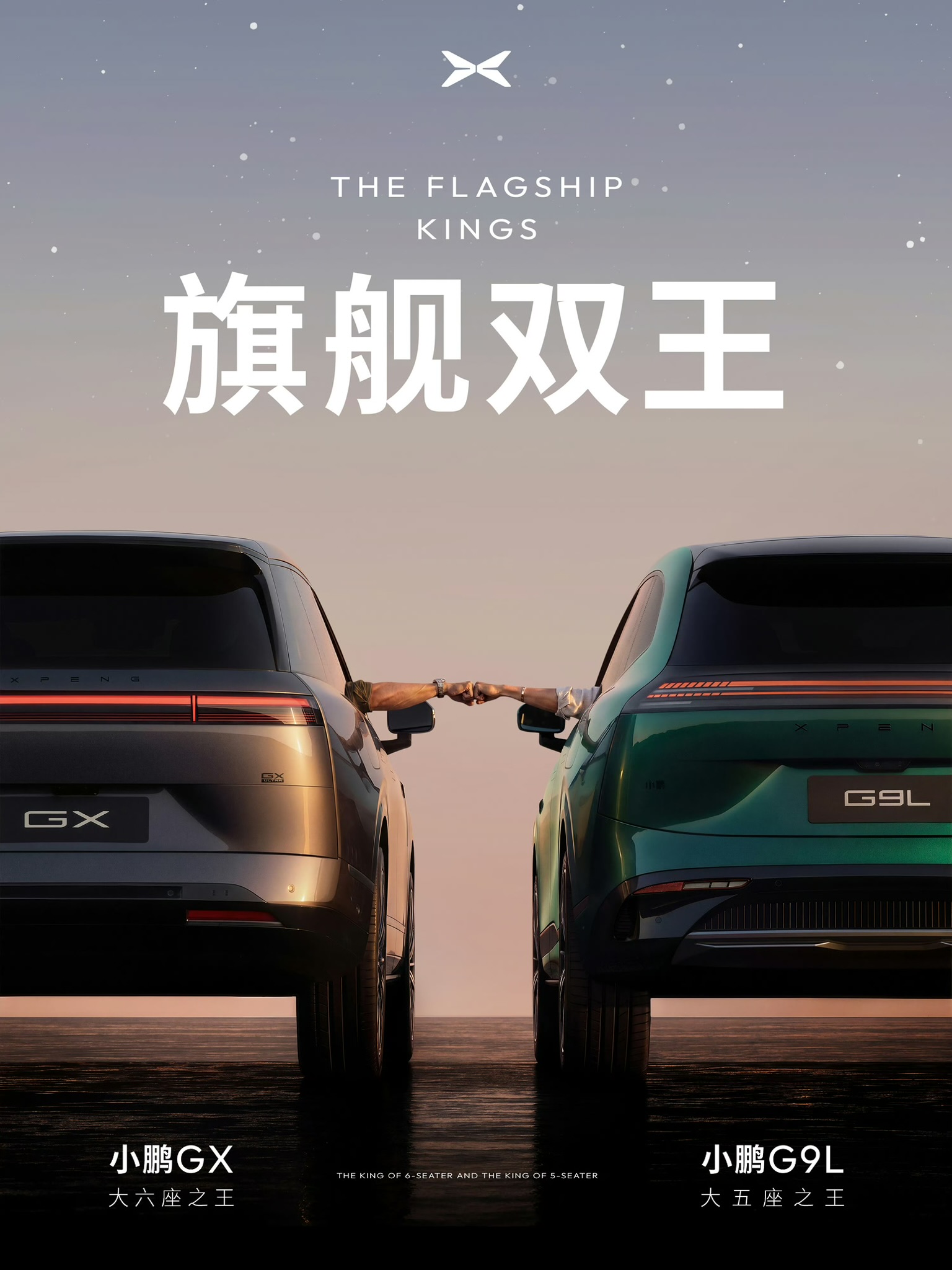
Everything from here down to the Timeline describes the version sold in China today. In China, XPENG markets the GX and G9L together as “Flagship Kings” - the GX as the king of large six-seat SUVs, the G9L as the king of large five-seat SUVs. What is standard on which trim, XPENG often does not say.
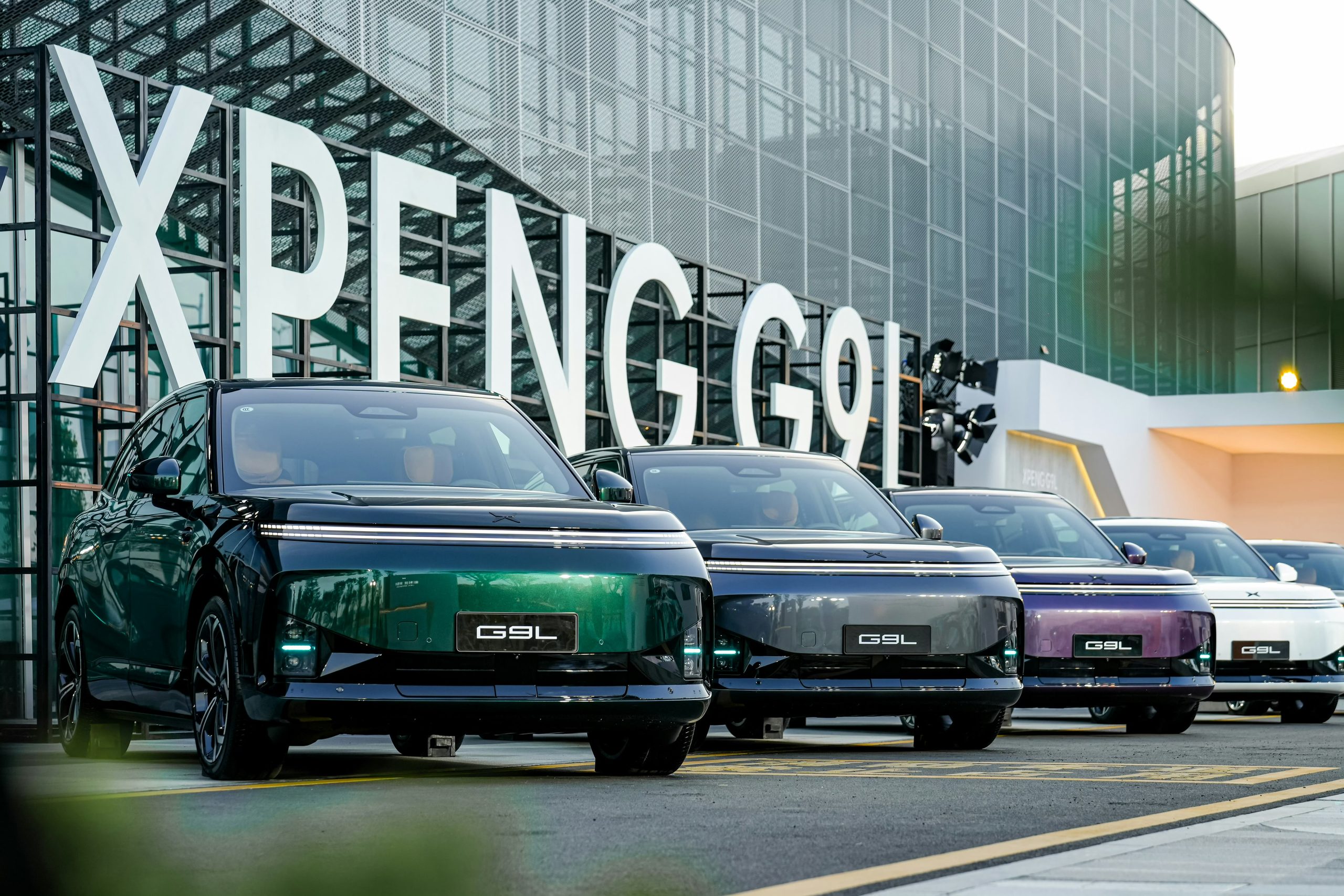
Launch trims
Six trims, two powertrains, and the prices were announced in Beijing on 17 September 2026. The 702 Max opens the range at CN¥ 241,800, the 755 Ultra Flagship closes it at CN¥ 319,800. At the top the range extender undercuts the battery car by CN¥ 10,000; on Ultra SE the two powertrains cost the same. Ranges are measured on the CLTC cycle.
| Trim | Powertrains and range (CLTC) | Guidance price |
|---|---|---|
| Max | 702 km BEV RWD | CN¥ 241,800 |
| Ultra SE | 660 km BEV AWD · 1,602 km EREV AWD | CN¥ 259,800 (either) |
| Ultra | 660 km BEV AWD | CN¥ 289,800 |
| Ultra Flagship (旗舰) | 755 km BEV AWD · 1,602 km EREV AWD | CN¥ 319,800 BEV · 309,800 EREV |
All six were shown with an introductory offer of CN¥ 10,000 in cash. XPENG’s own trim sheet from the launch prints the reduced price on every line, so each guidance price in the table above is CN¥ 10,000 lower under the offer, and the entry price becomes CN¥ 231,800.
The configurator opened a fresh set of option offers the same evening, running to 15 November 2026: Fjord Grey paint and the Sahara Orange cabin free (guidance CN¥ 6,000 and 3,000), Toscana Green and Provence Purple at CN¥ 3,600 against a guidance price of 6,000, the 22″ Petal sports wheels at CN¥ 6,000 against 12,000, the front AI seats at CN¥ 5,000 against 20,000, the Black Gold package at CN¥ 10,000 against 15,000, the 21″ Vortex wheels at CN¥ 3,000 against 10,000, and the 21.4″ rear screen thrown in at a guidance value of CN¥ 10,000. The offers need a CN¥ 5,000 deposit paid before midnight on 15 November, and the buyer takes either a finance deal or 40,000 points in XPENG’s store. China only.
All six trims are in Compare specs - the specifications come from the Chinese pre-sale page. Open the G9L next to the GX with Flagship vs Flagship.
Black Gold Edition
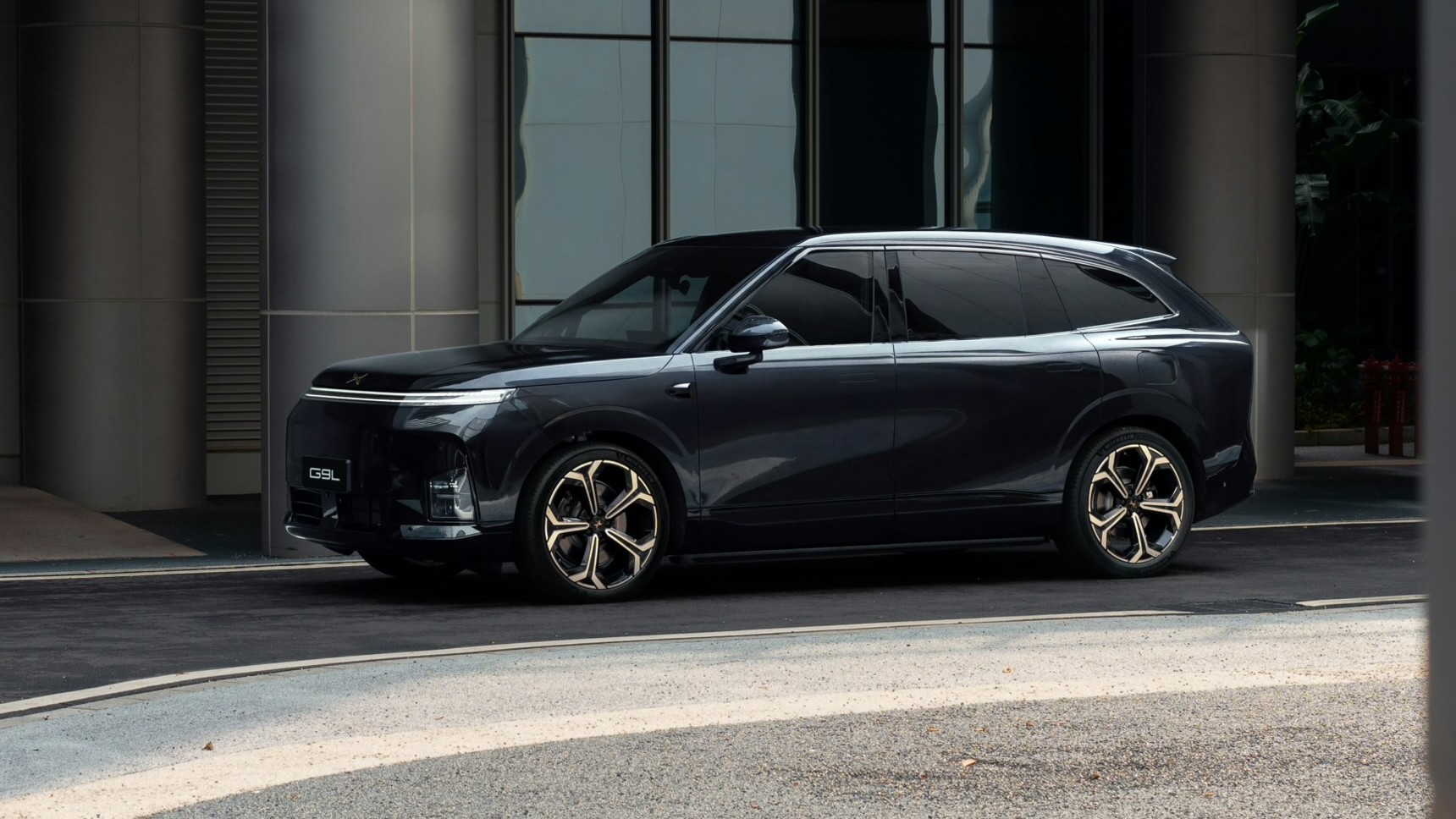
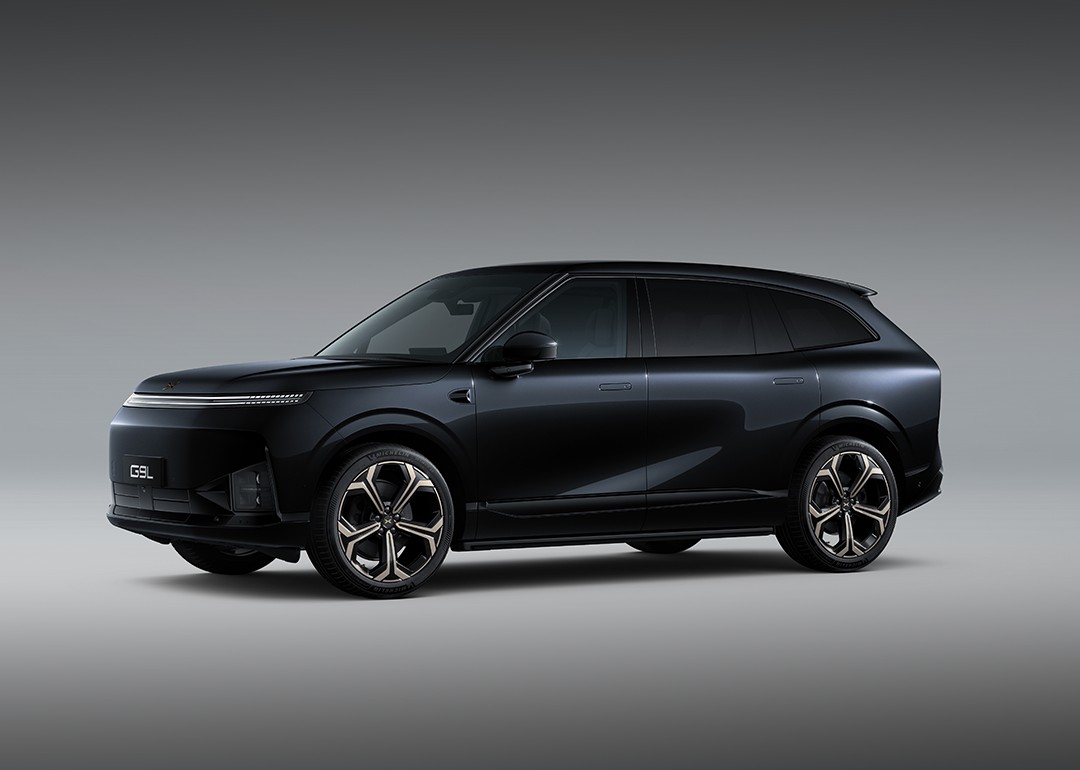
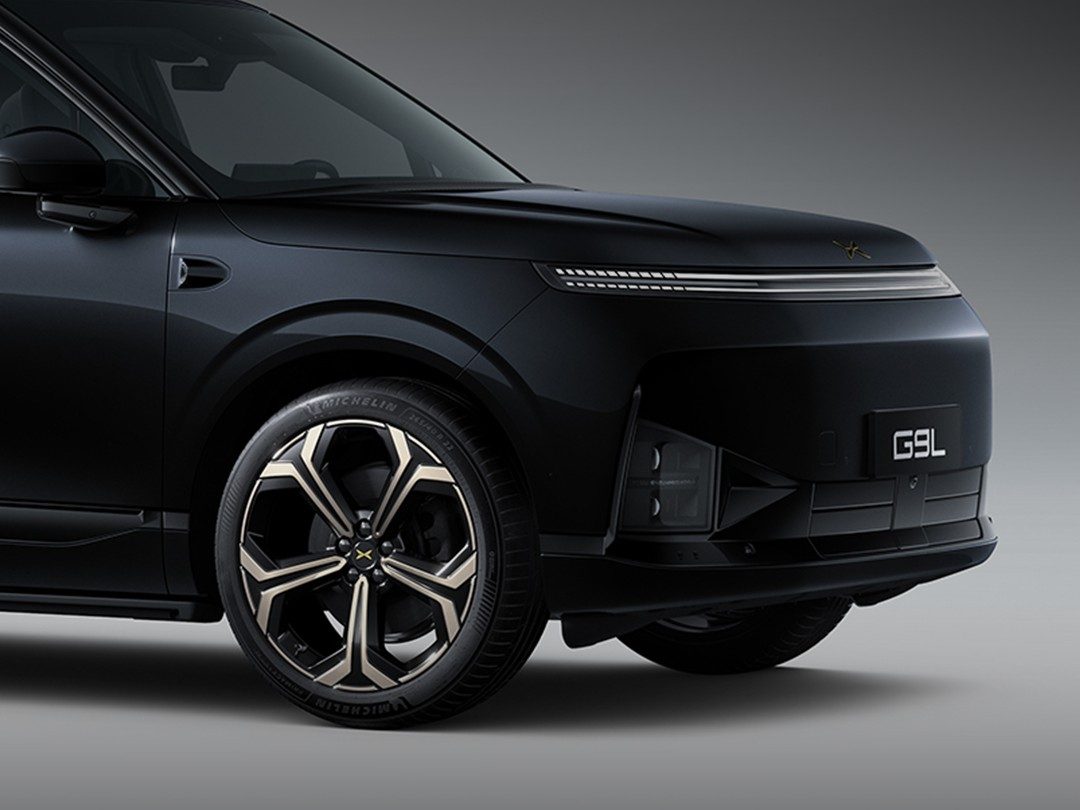
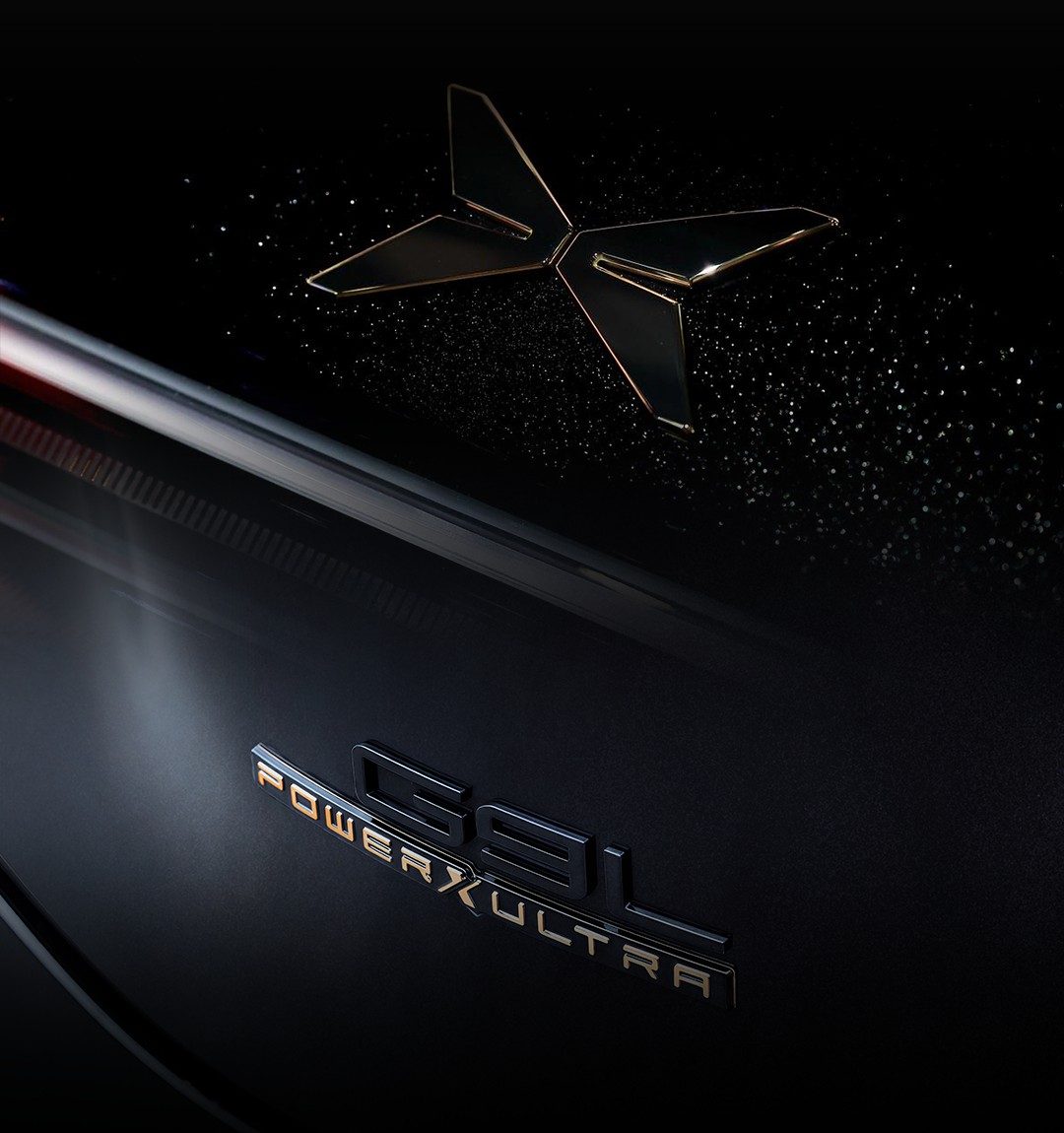
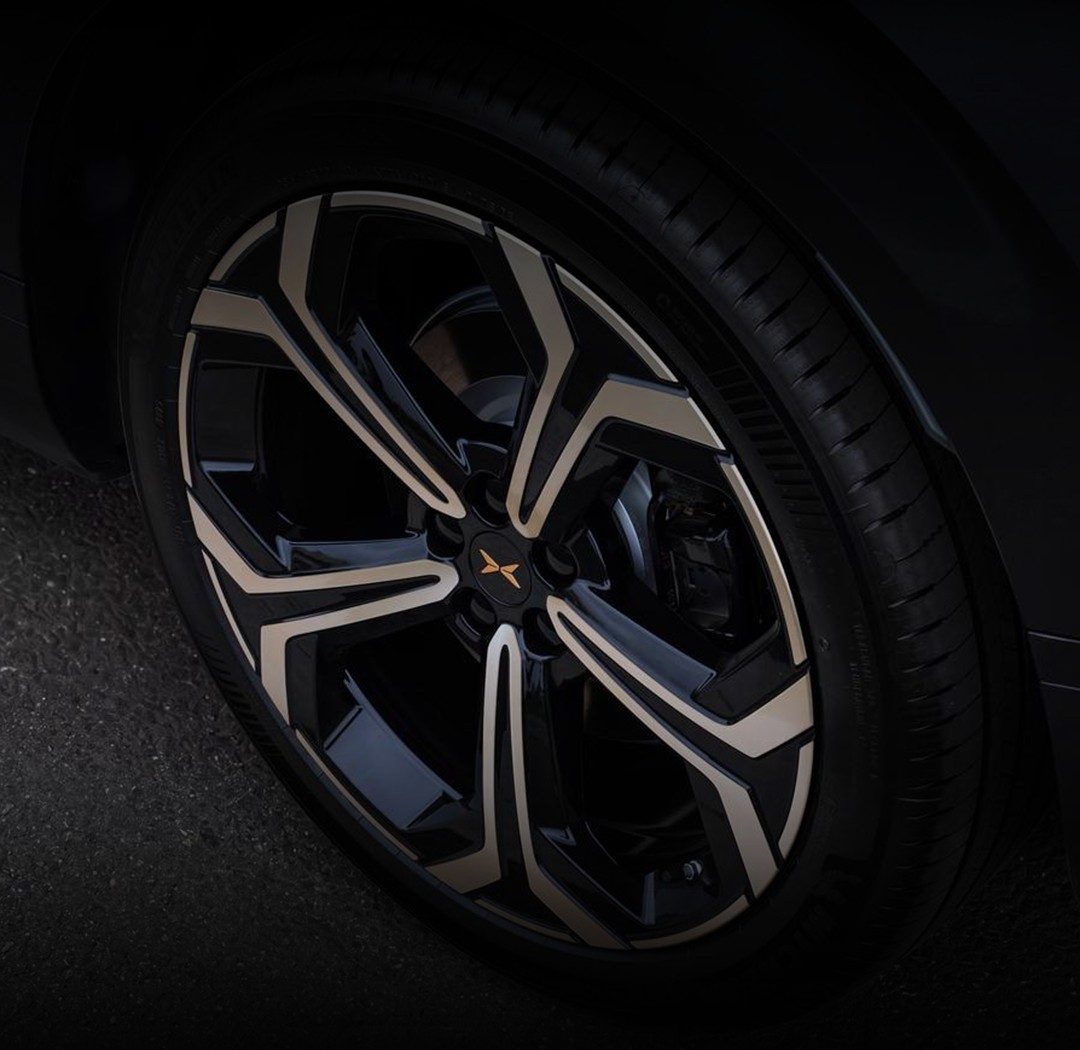
The kit premiered at the Chengdu Auto Show on 21 August 2026 and can be added to every variant. Guide price CN¥ 15,000; offered at CN¥ 10,000 for a limited time at launch. It has three parts:
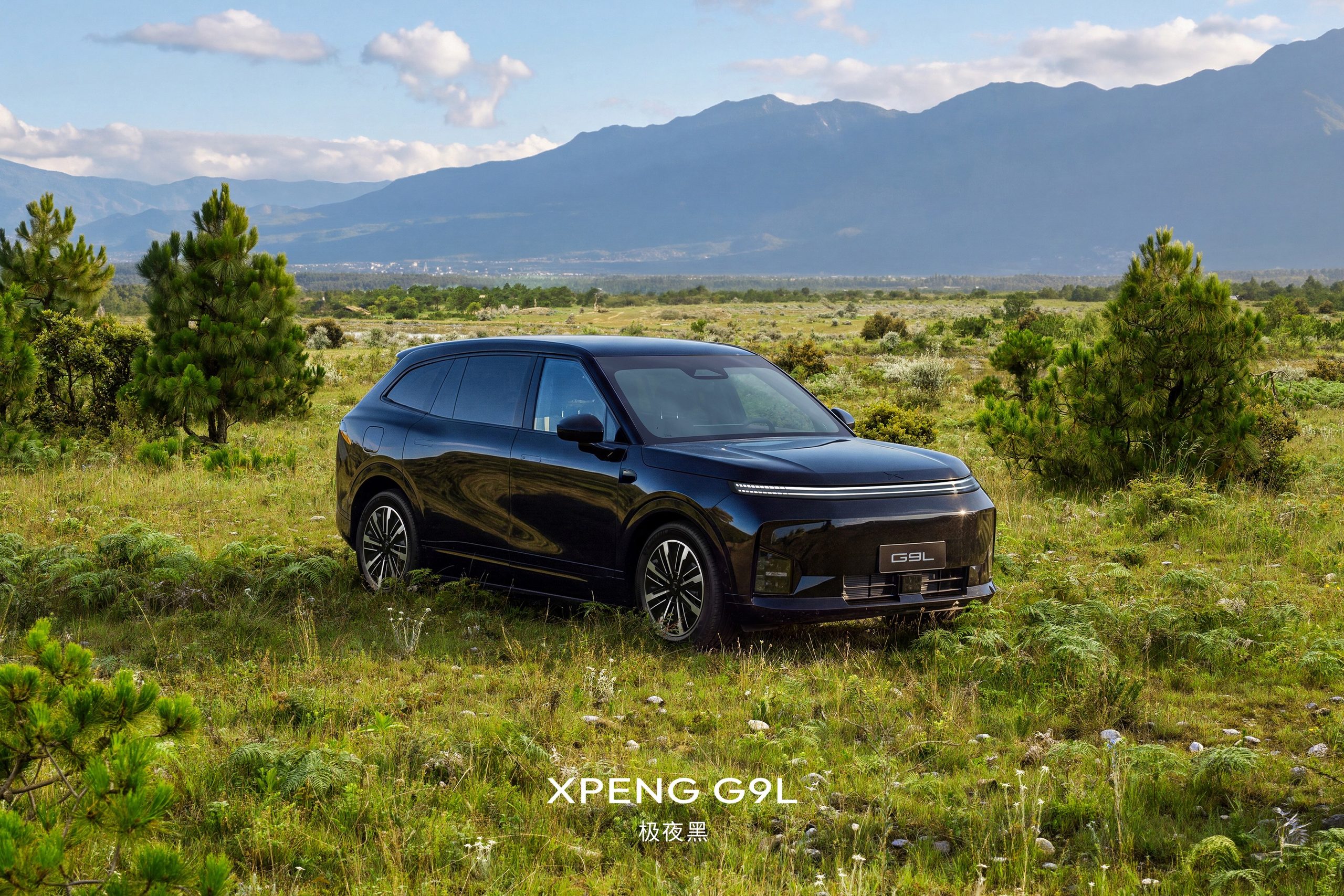
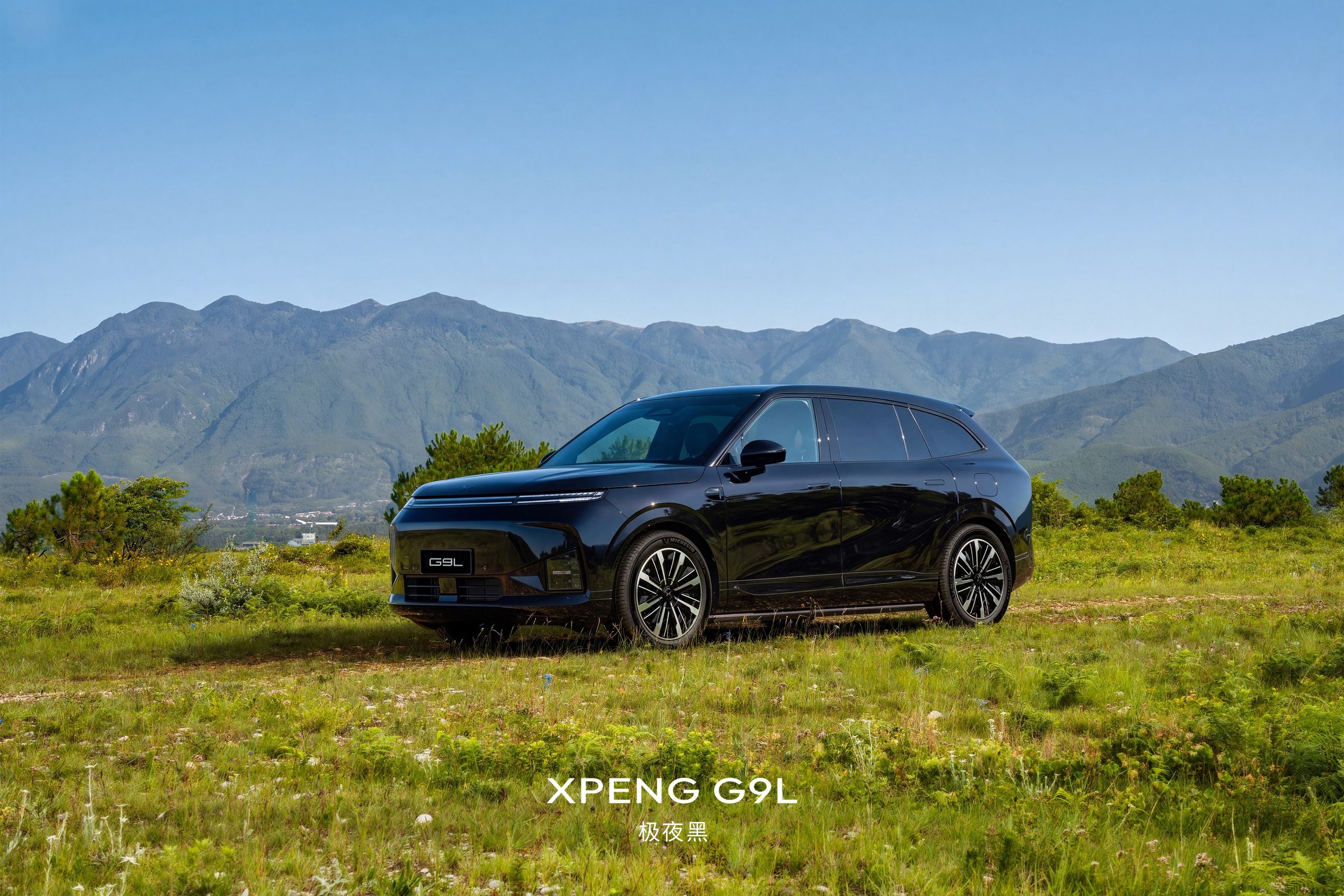
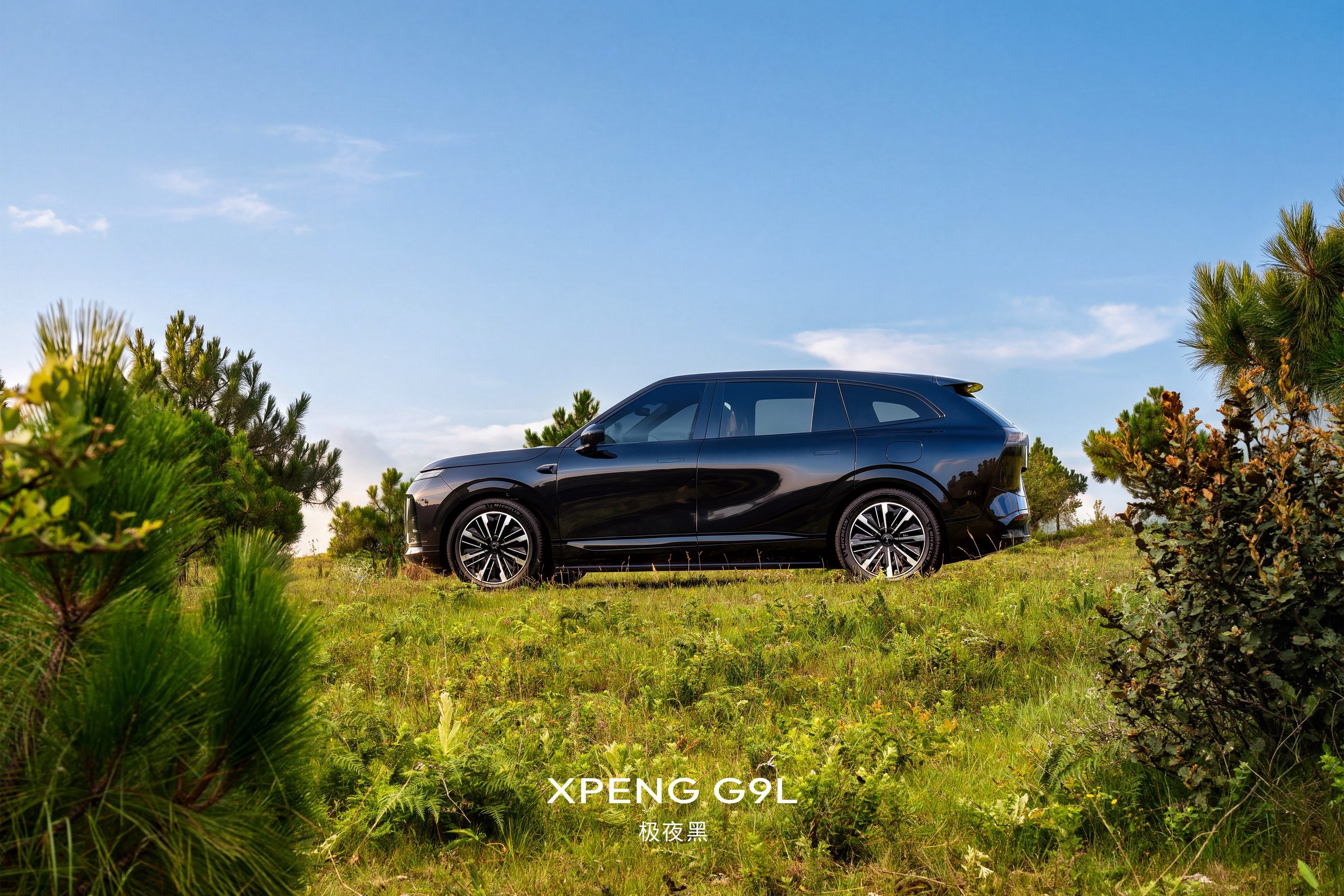
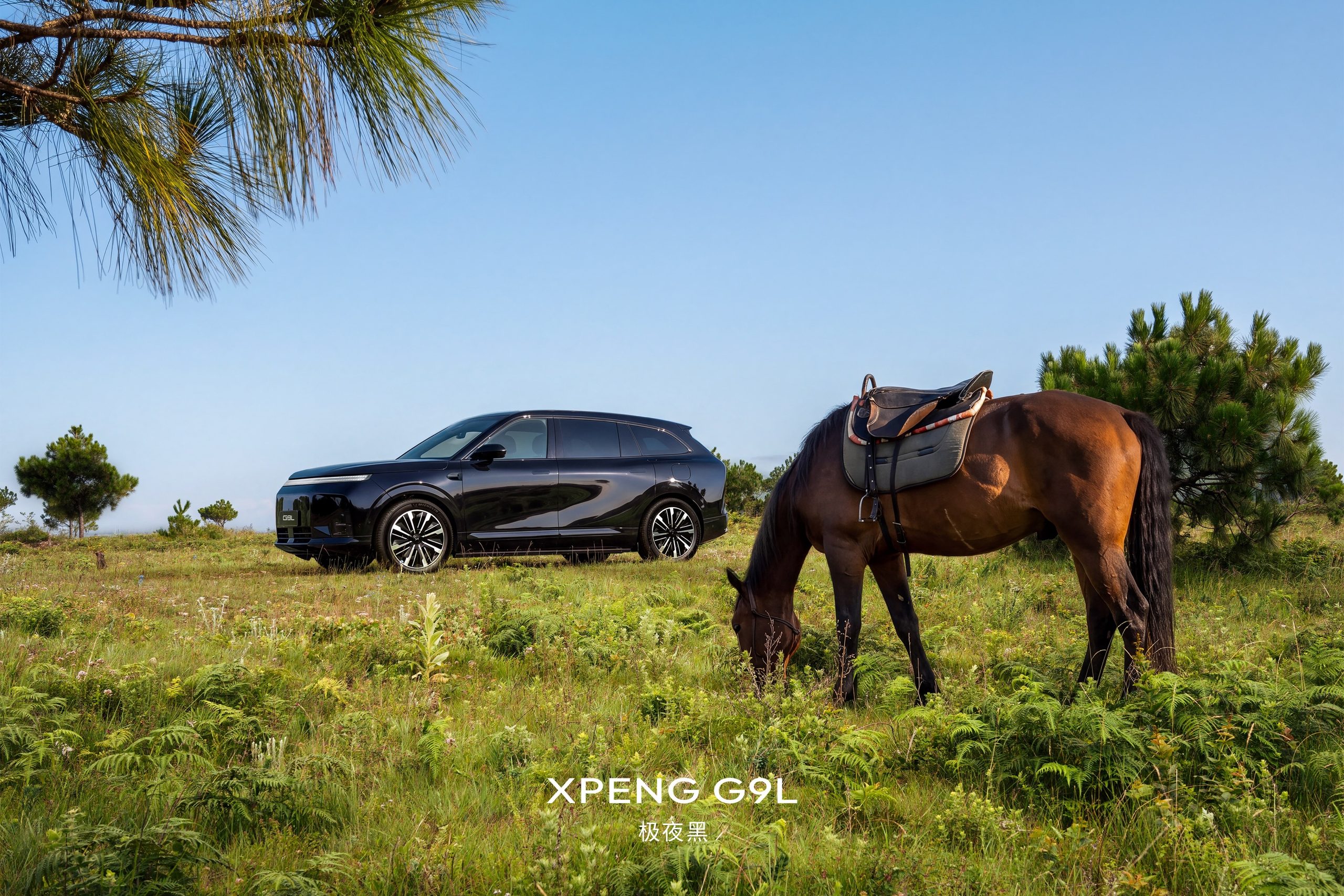
- Polar Night Black paint (极夜黑)
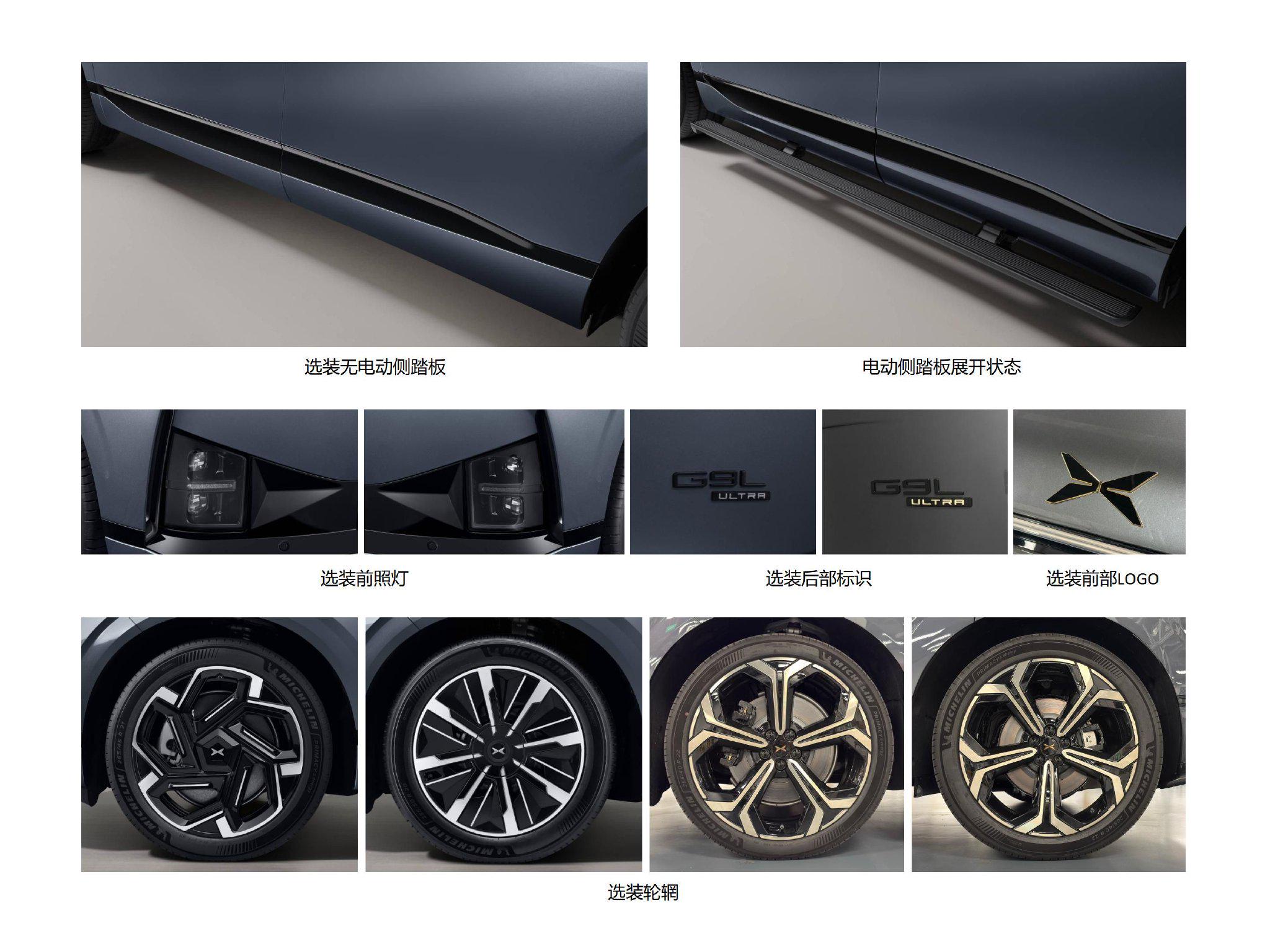
- Two badges plated in real 24-karat gold: the front badge in space ceramic with an anti-fingerprint nano coating, the G9L POWER X ULTRA tail badge in black gold
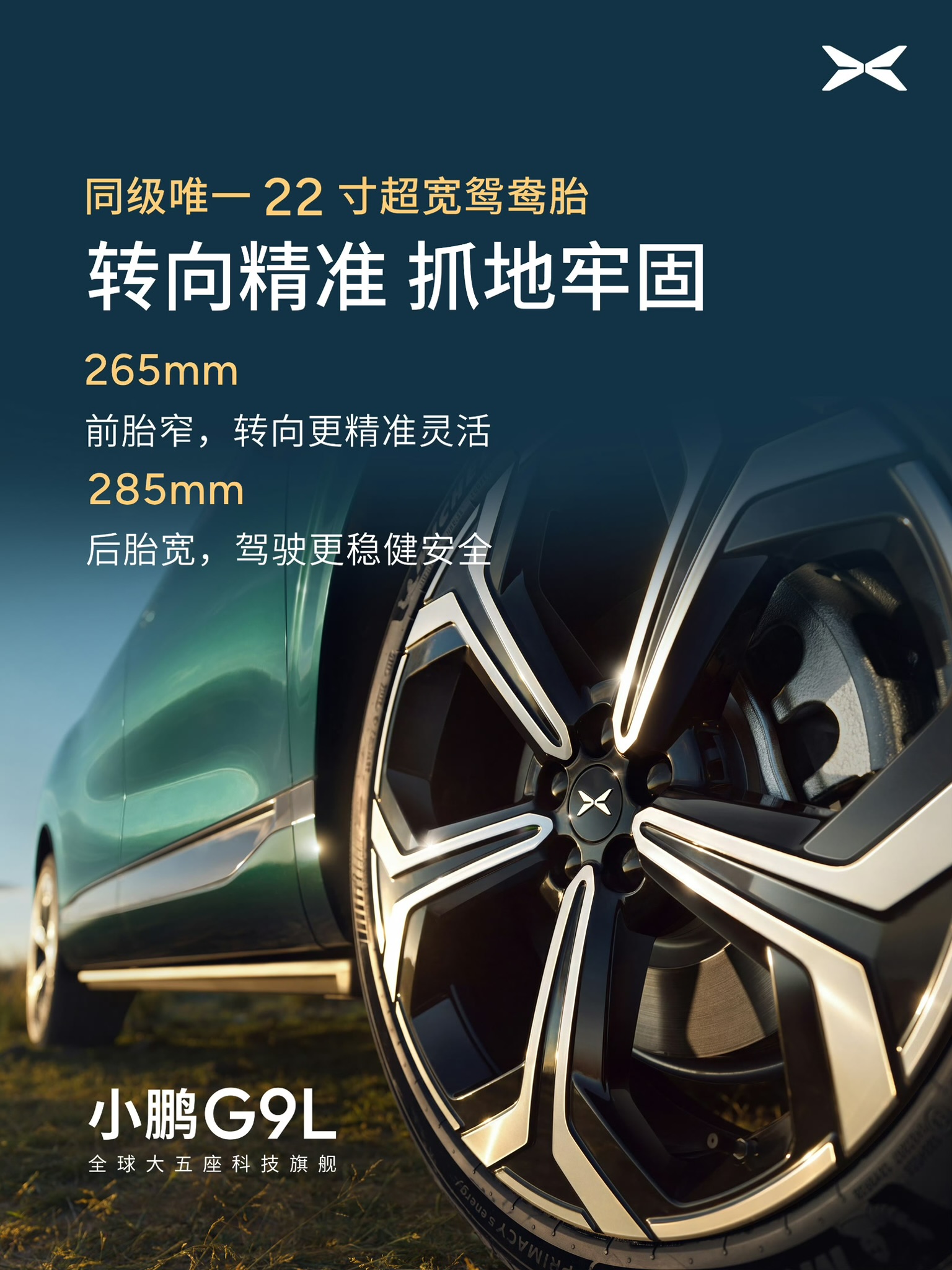
- 22″ black-gold wheels with the staggered 265/285 Michelin Primacy 5e tyres and black brake calipers
Powertrains
China gets the G9L as a BEV or an EREV, each with RWD or AWD. Outputs and battery packs are below; range per variant sits under Launch trims.
BEV
| RWD | AWD | |
|---|---|---|
| Peak power | 270 kW (rear) | 430 kW (160 + 270 kW) |
| Battery | 91.9 kWh LFP or 110 kWh NMC (chemistry per the pre-sale configurator) | |
EREV
| RWD | AWD | |
|---|---|---|
| Generator | 1.5T (DAM15NTE) · ~110 kW | |
| Drive motors | 210 kW | 370 kW (160 + 210 kW) |
| Battery | 63.3 kWh LFP | |
- EV-only range - up to 435 km (CLTC) for the EREV AWD
- Hybrid silicon-carbide power electronics - inverter up to 98.7%, e-drive 93.5% CLTC efficiency; the unit takes 53 L and weighs 84.5 kg, where XPENG quotes 92% / 63 L / 92 kg as typical for the class
- Depleted-battery fuel use - the configurator quotes 6.16 L/100 km, measured on WLTC (not CLTC), and a 10-80% charge in 10.7 minutes
- The range extender is specified for RON 92 petrol (XPENG launch material)
- The Lop Nur crossing - 1,403.8 km through the desert on a full tank and charge without refuelling, 95.11% of the quoted range (XPENG’s Chengdu keynote)
- Range in practice - the outlet MotorGogo drove a 702 Max 823.3 km at 11 kWh/100 km in 30-39 °C heat, a run XPENG shared itself; the test car sat on the optional 21″ wheels showing 672 km CLTC, so the run equals 122.5%
- Fast charging - the configurator quotes up to 530 km of range after 12 minutes on the 755 Ultra Flagship, 490 km on the two 660 trims, 520 km on the 702 Max and 322 km on the EREV. The figures are lab numbers on XPENG’s own S5 charger, and XPENG revised each down by 5-10 km at the launch
- Consumption - the EREV is quoted at 16.7 kWh/100 km on CLTC alongside the 6.16 L/100 km it uses once the battery is depleted
- Battery life - XPENG fast-charged a pack through a test equivalent to 300,000 km and measured over 80% remaining capacity afterwards; the programme covered 130 cars and 21 million km
When the pre-sale configurator opened on 19 August 2026, the battery packs were settled: the 110 kWh pack is reserved for the 755 Flagship, the rest is in the tables above. The MIIT filing also holds an RWD with the 110 kWh pack; it is not part of the launch, but it is why Chinese coverage still quotes up to 805 km. Fast charging is quoted as “km in 9 minutes”: up to 450 km for BEV and about 300 km for EREV. On 14 September 2026 XPENG published a measured charging test: peak power 619.6 kW, with the 800V platform and the 5C large battery given as standard across the range. The post does not say which trim the test ran on. Figures for each variant sit in Compare specs.
On 15 September 2026 XPENG collected eight Chinese outlets’ range tests of the same car: a 755 Ultra with all-wheel drive on optional 22″ wheels, showing 725 km. The percentages are how much of the displayed range the car actually covered. Only one of the eight came in under 100 percent in town. Load, temperature and route vary from test to test and are listed in XPENG’s own table. The displayed range rests on the Chinese CLTC cycle, so the figures do not carry over to a European car quoted on WLTP.
| Outlet | City | Highway |
|---|---|---|
| Outlet 1 (30 秒懂车) | 117 % | 108 % |
| Outlet 2 (新车评) | 110 % | 90.4 % |
| Outlet 3 (智能车研究所) | 107 % | 91 % |
| Outlet 4 (登斯基) | 106.8 % | 87.6 % |
| Outlet 5 (一辆) | 104 % | 110.5 % |
| Outlet 6 (锋潮科技) | 102 % | 93.3 % |
| Outlet 7 (电动汽车观察家) | 100 % | 92 % |
| Outlet 8 (新渠道·李霸天) | 90 % | 89 % |
Exterior
Aero
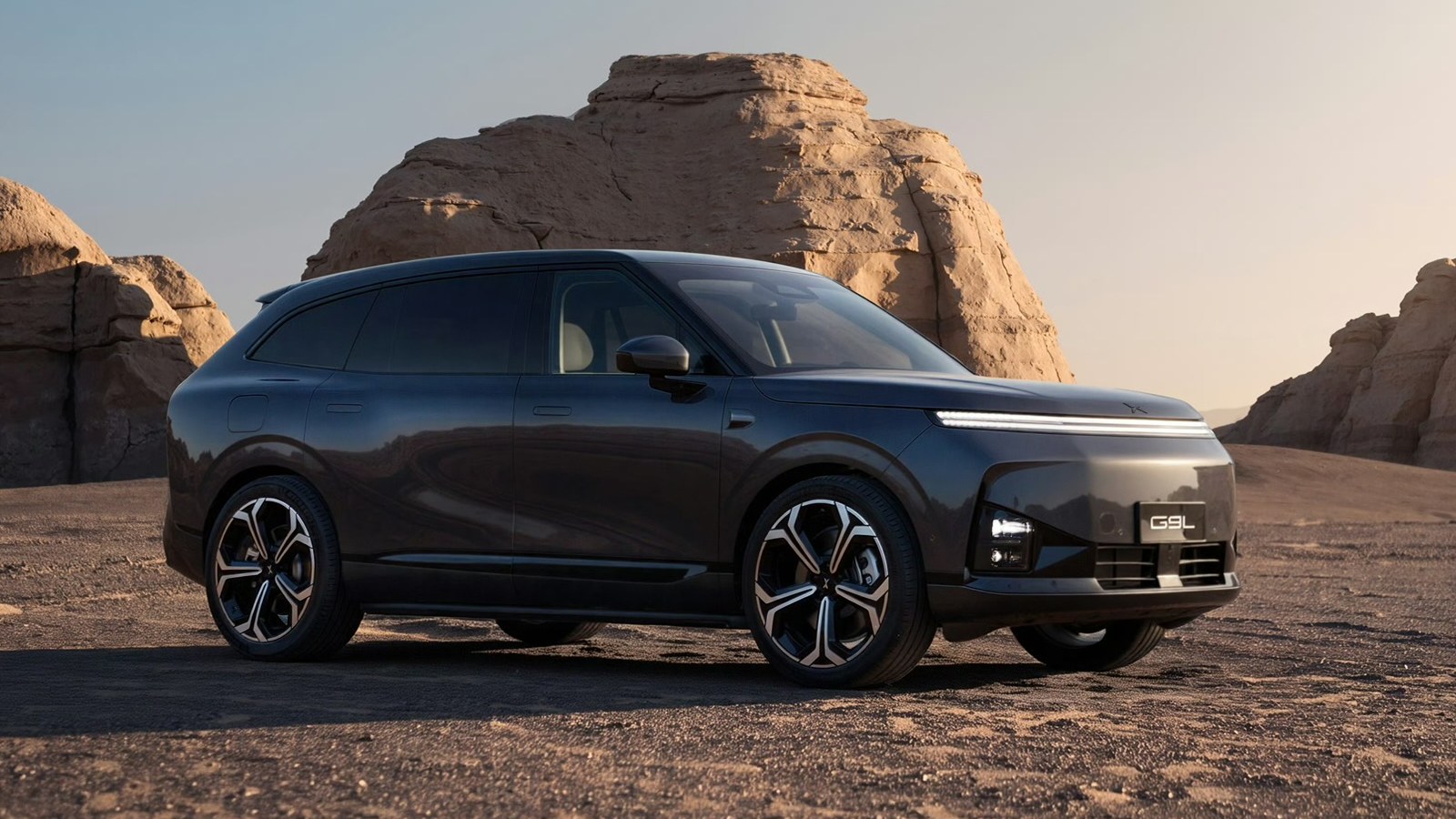
- The wheelbase makes up 0.605 of the car’s length - class-best according to XPENG. The design slogan plays on the golden ratio, 0.618
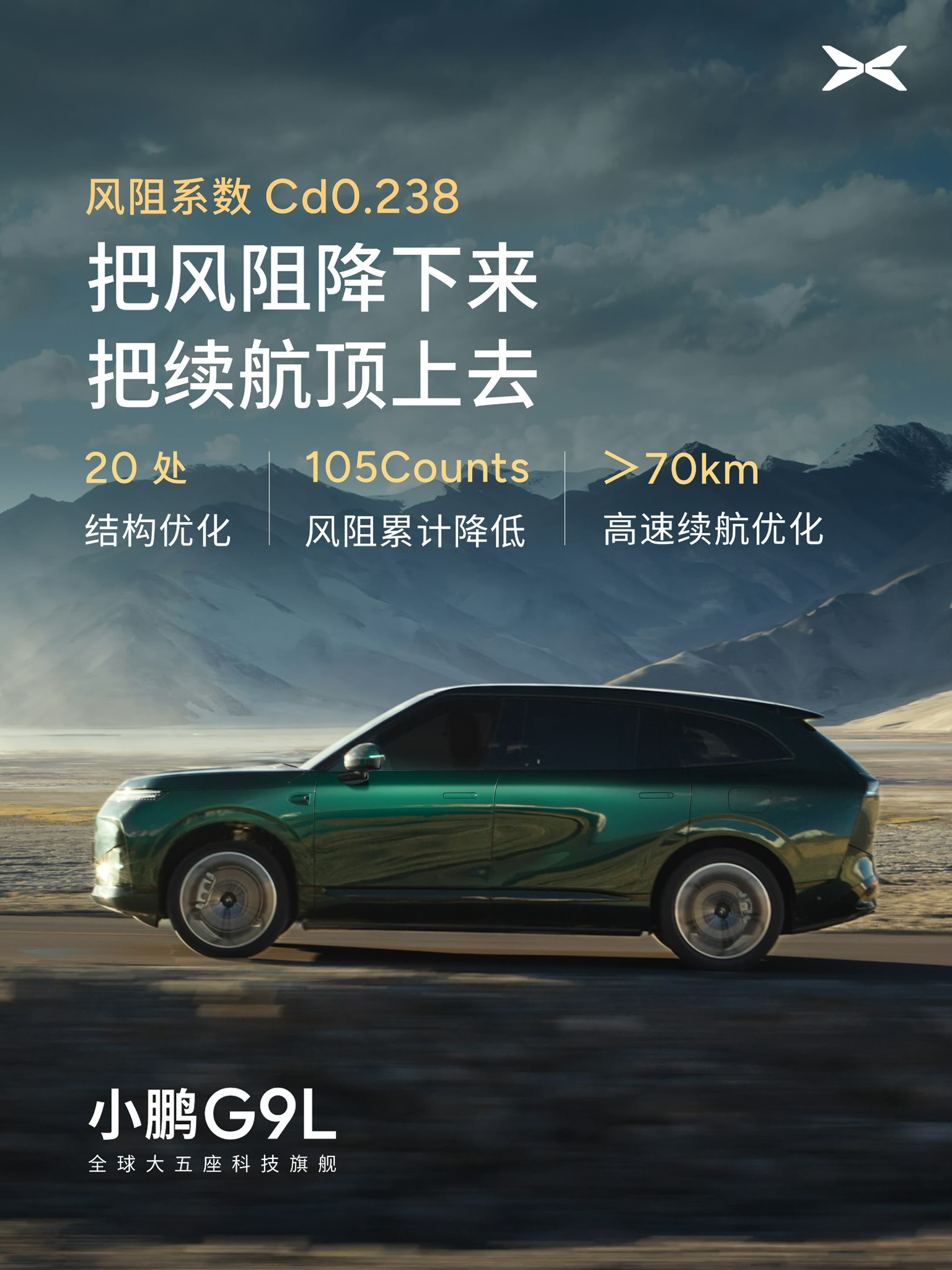
- Drag: Cd 0.238. XPENG cites 20 structural changes, a total reduction of 105 counts (0.0105 in Cd), and over 70 km of extra high-speed range
Exterior colours
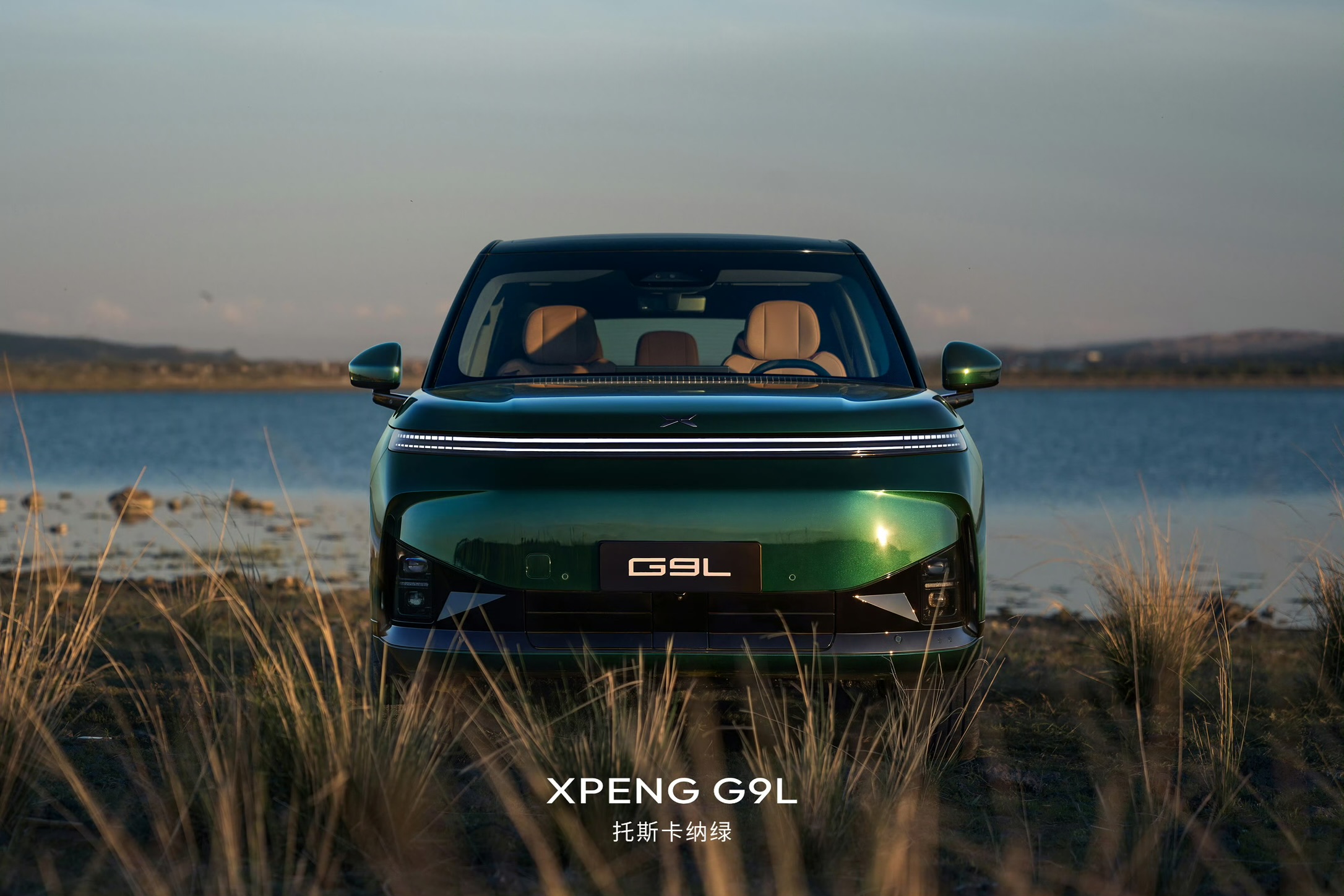
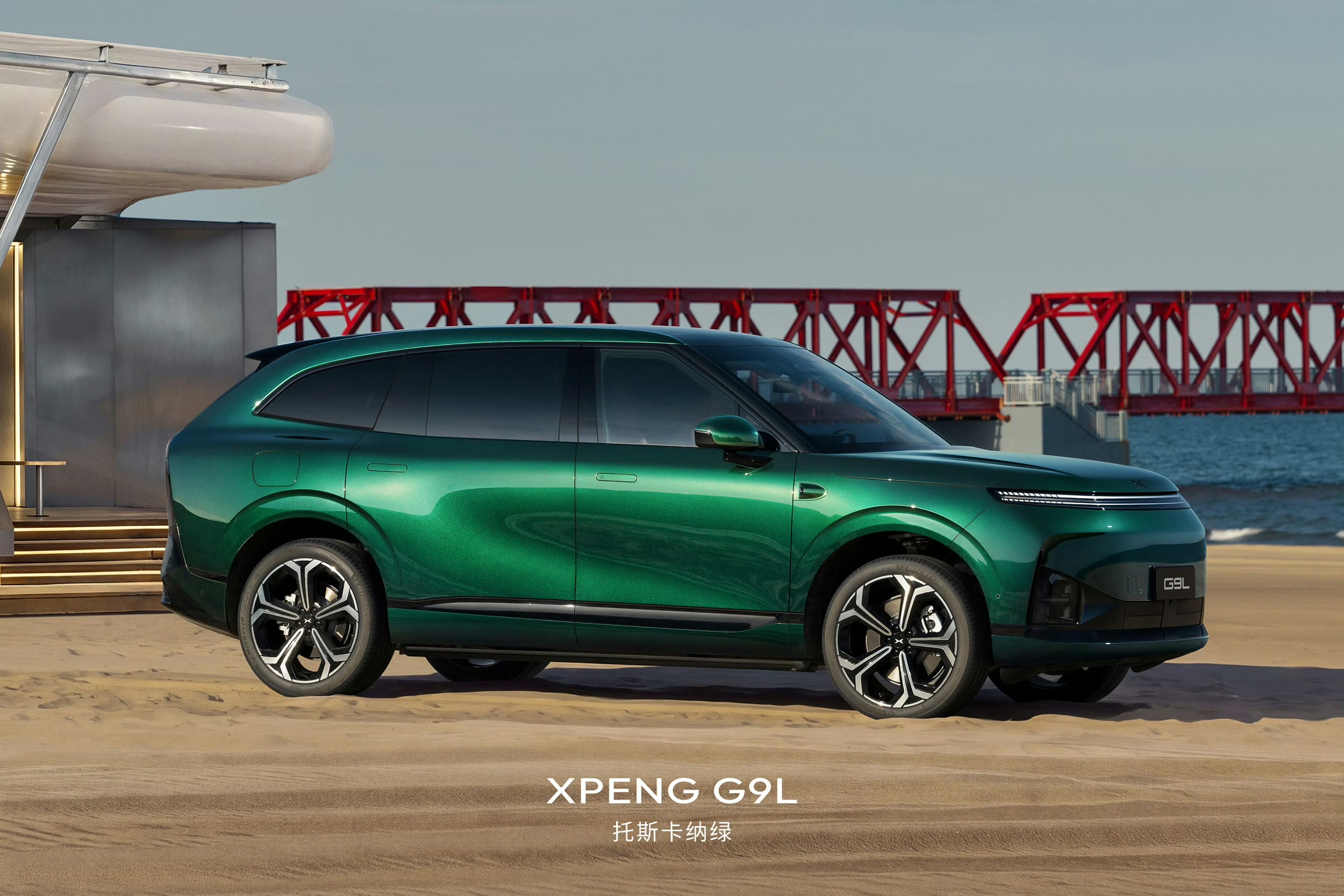
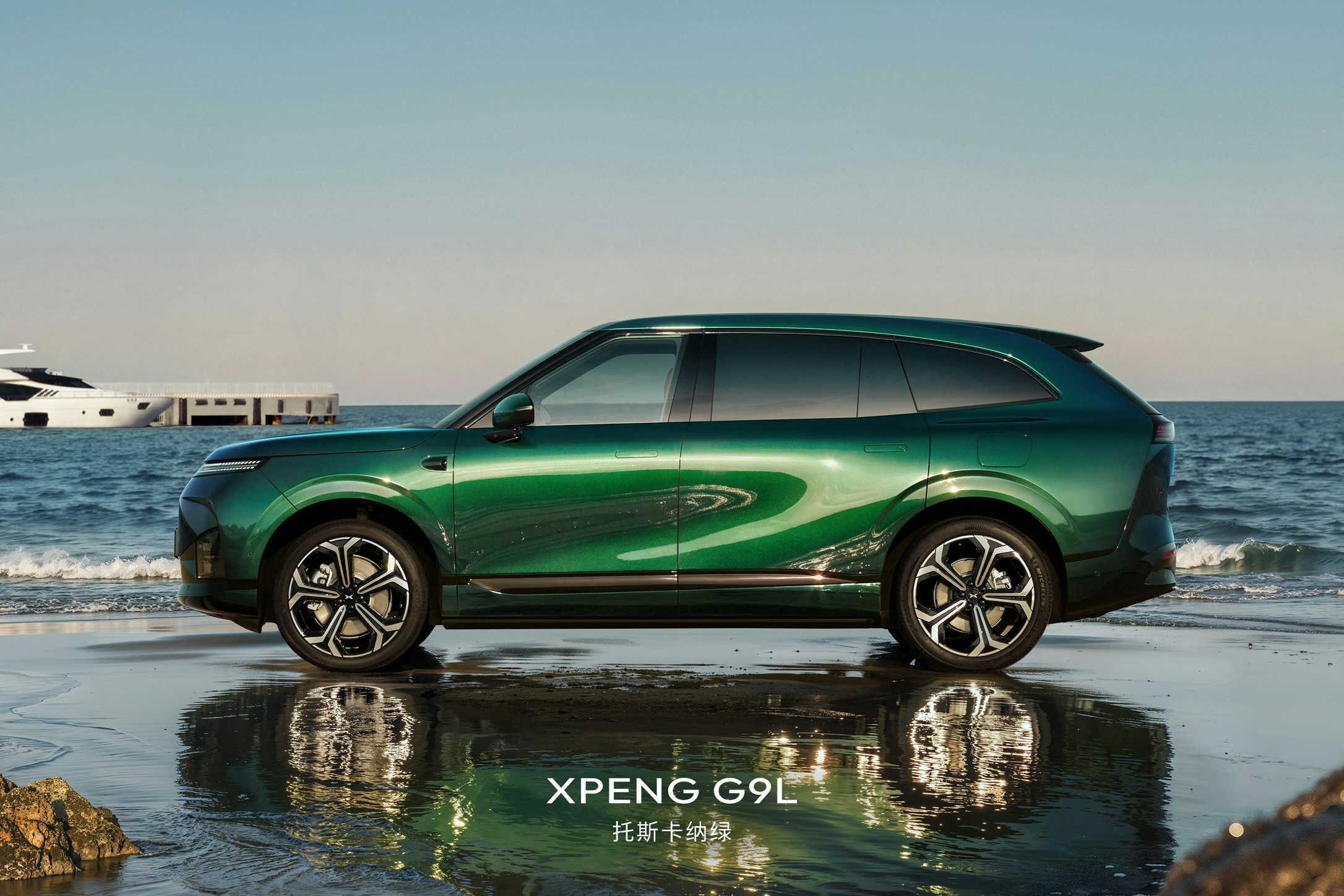
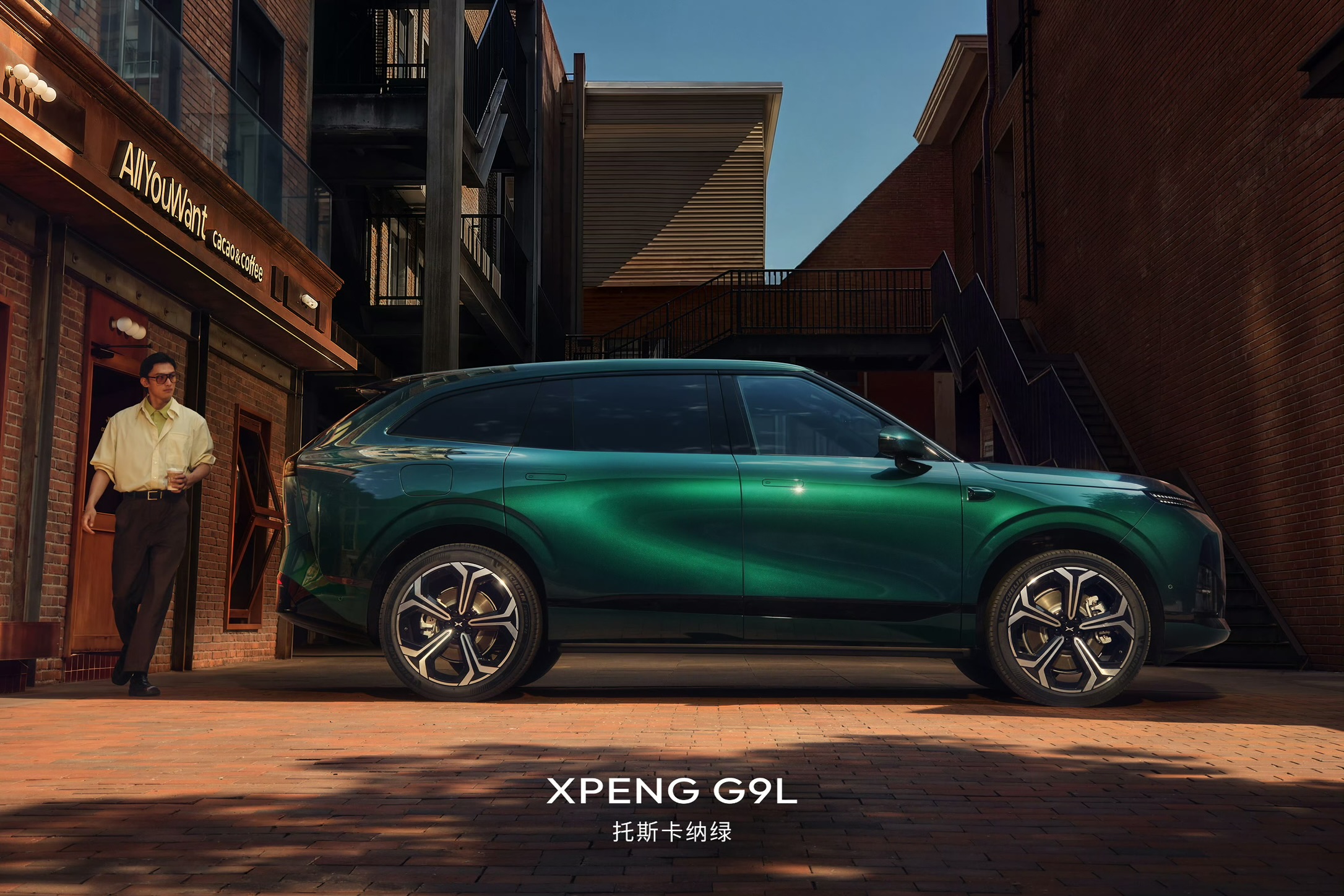
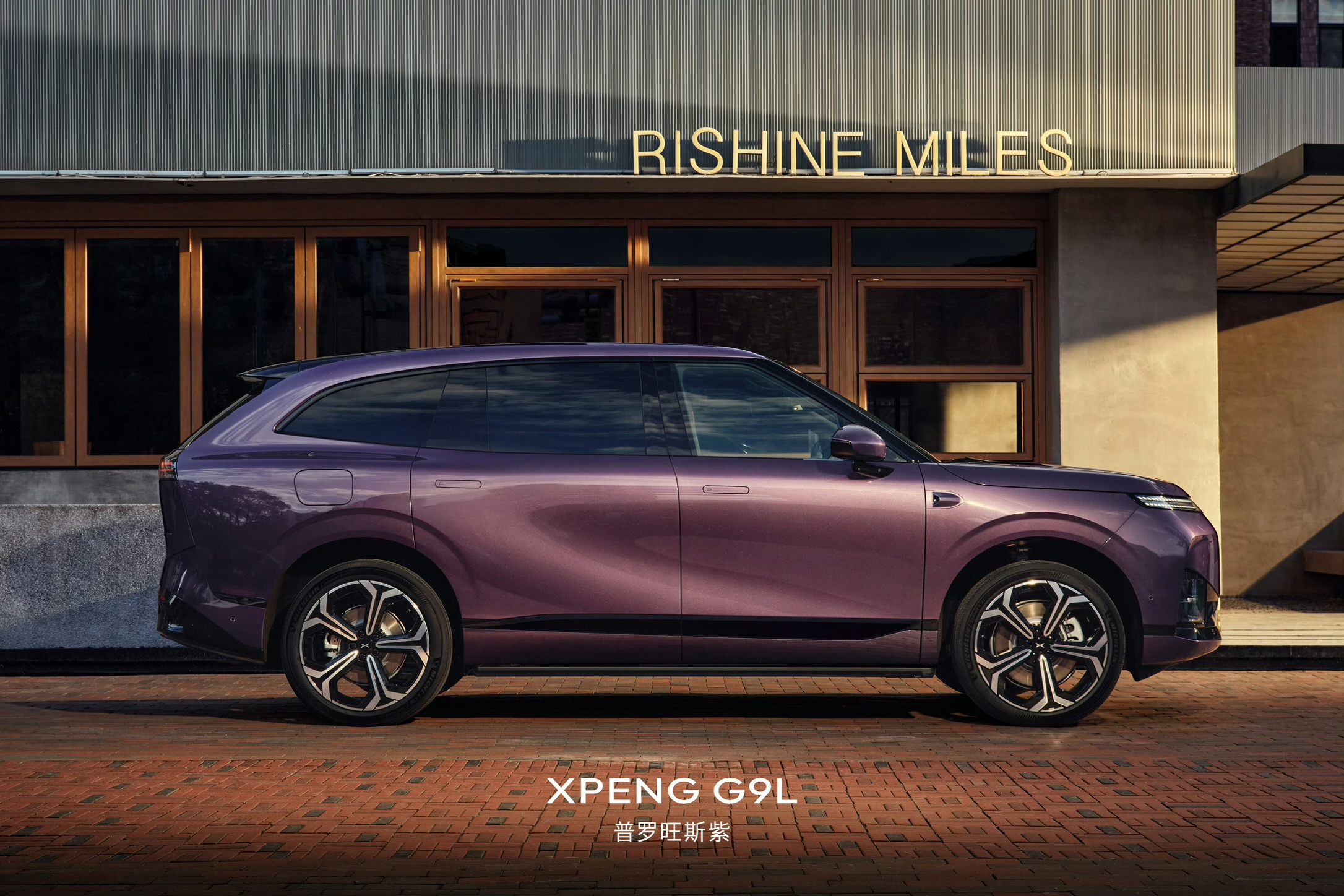
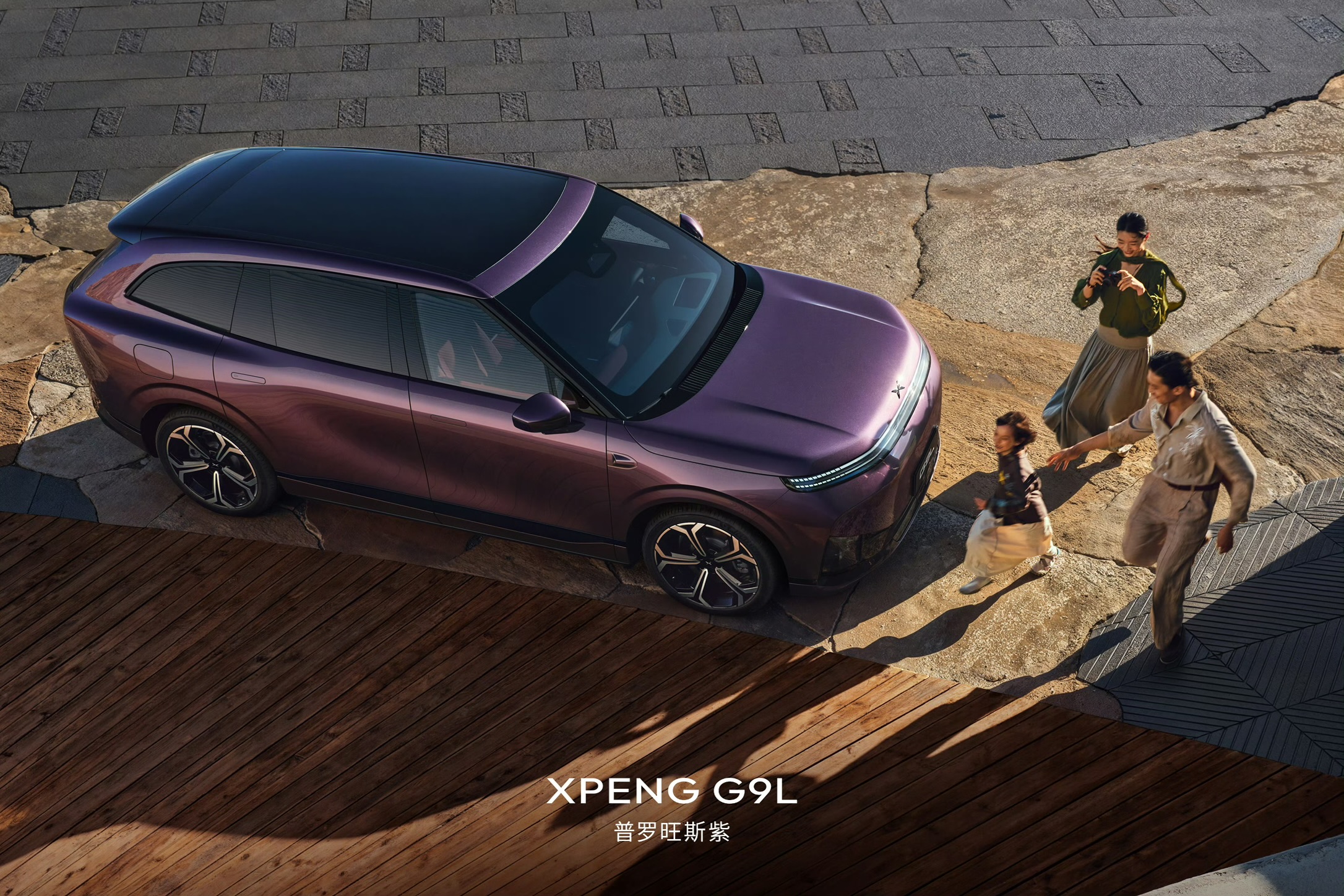
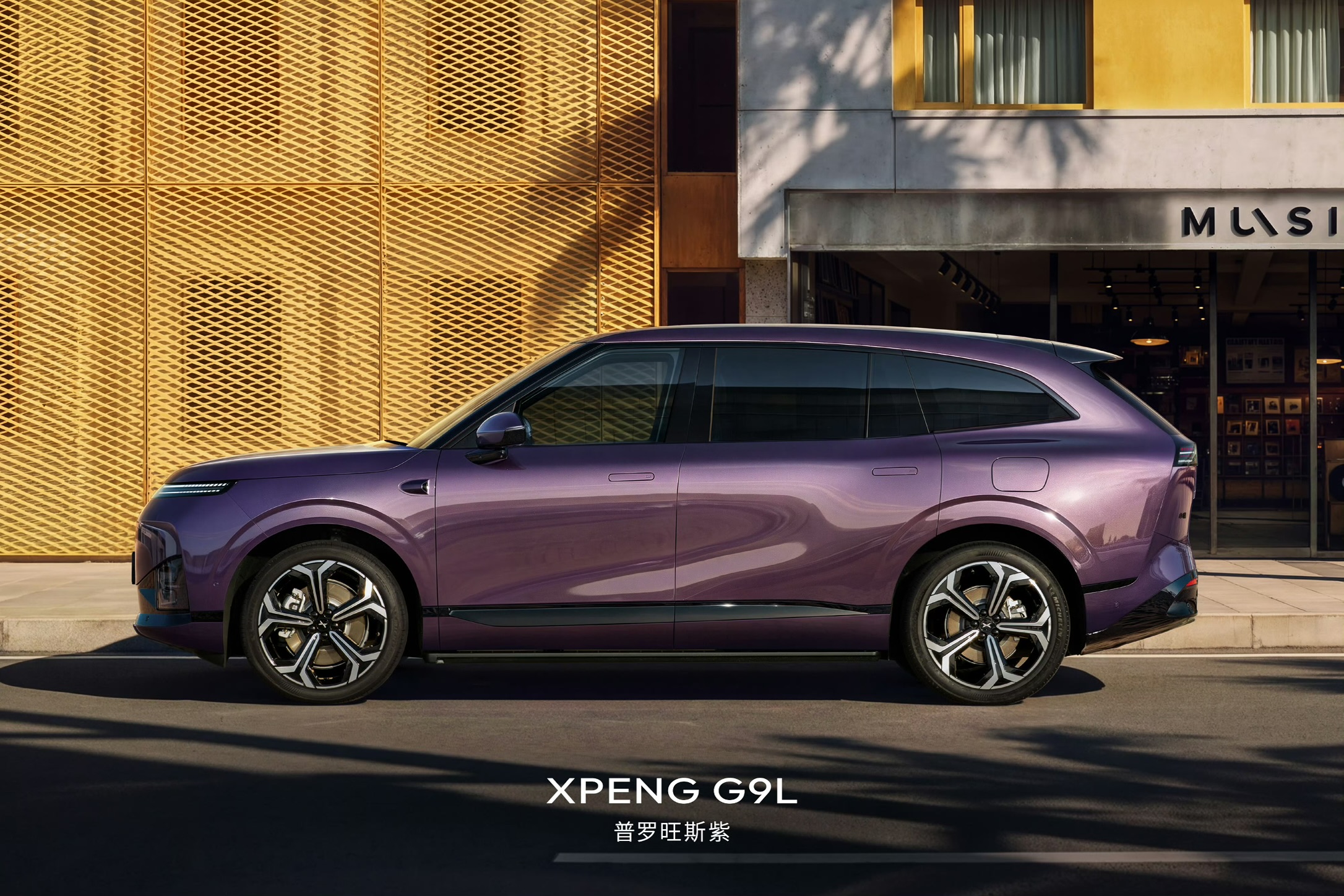
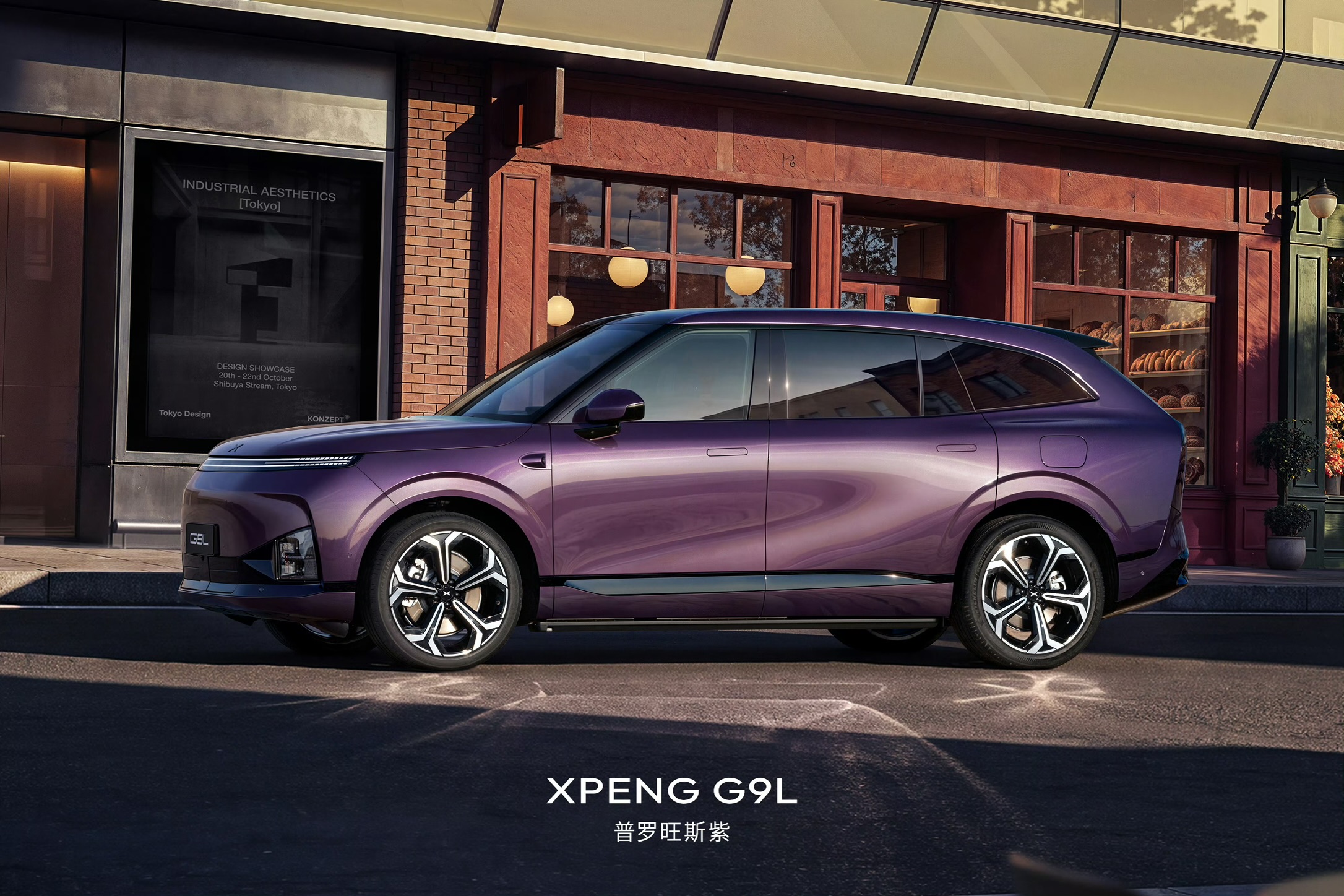
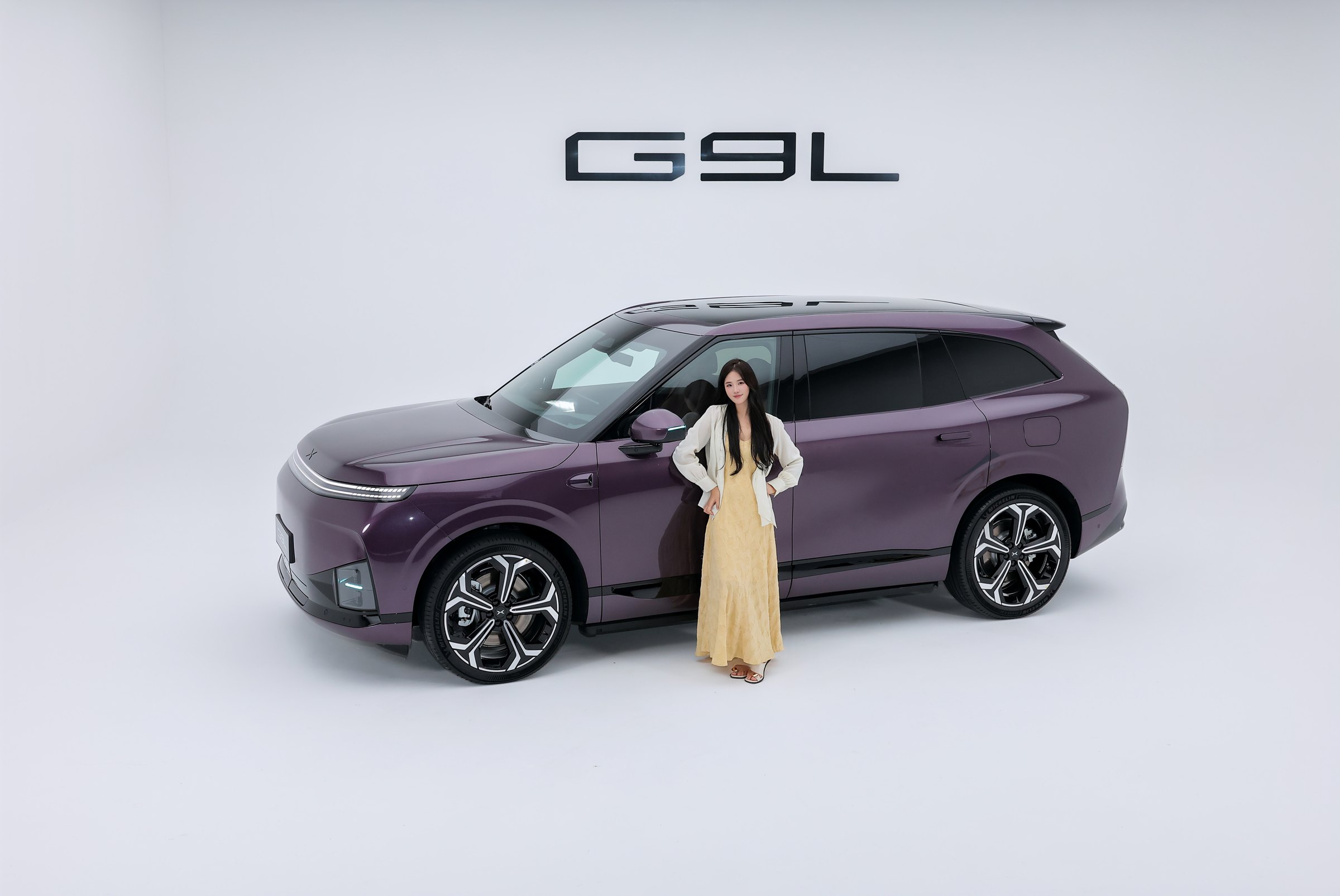
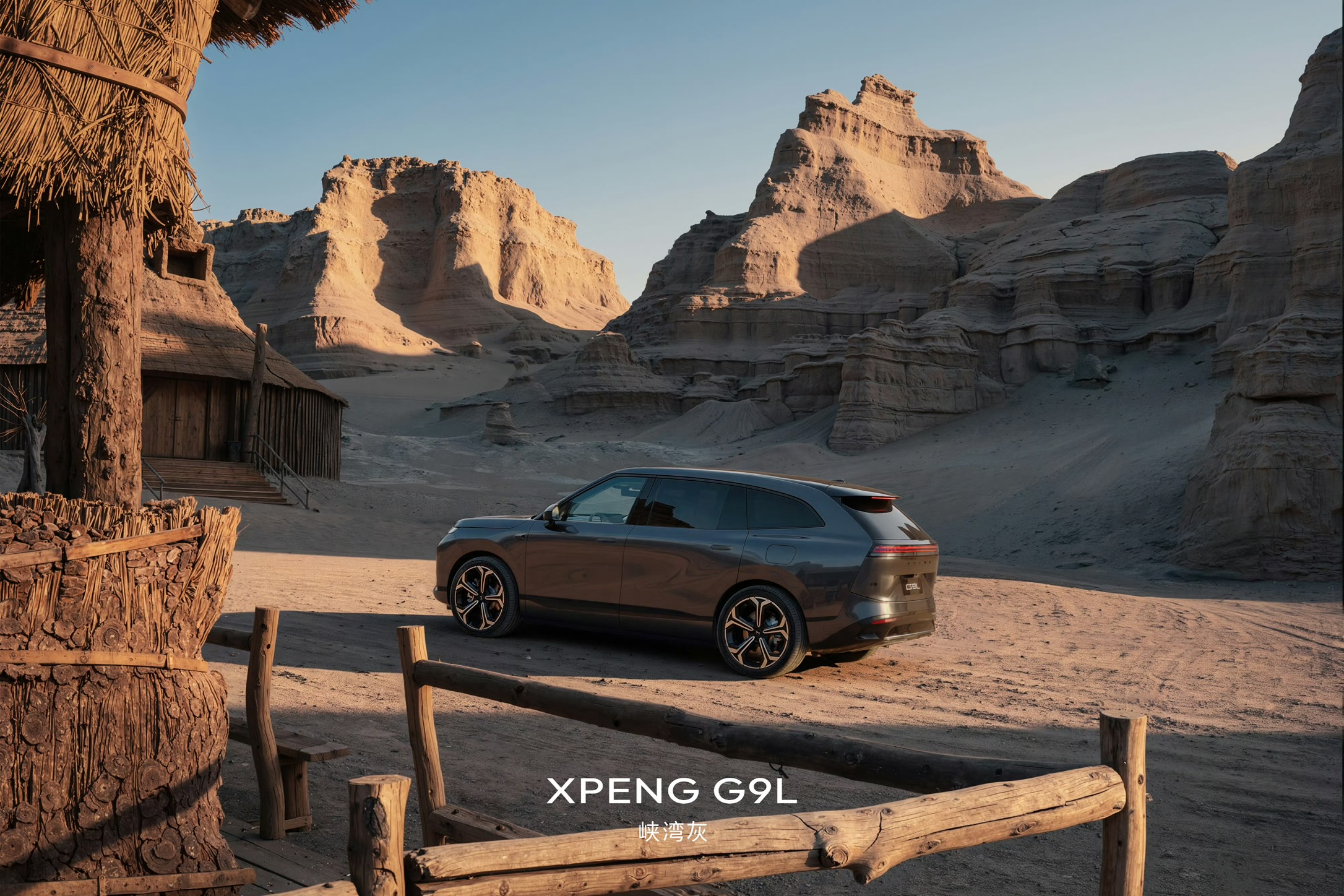
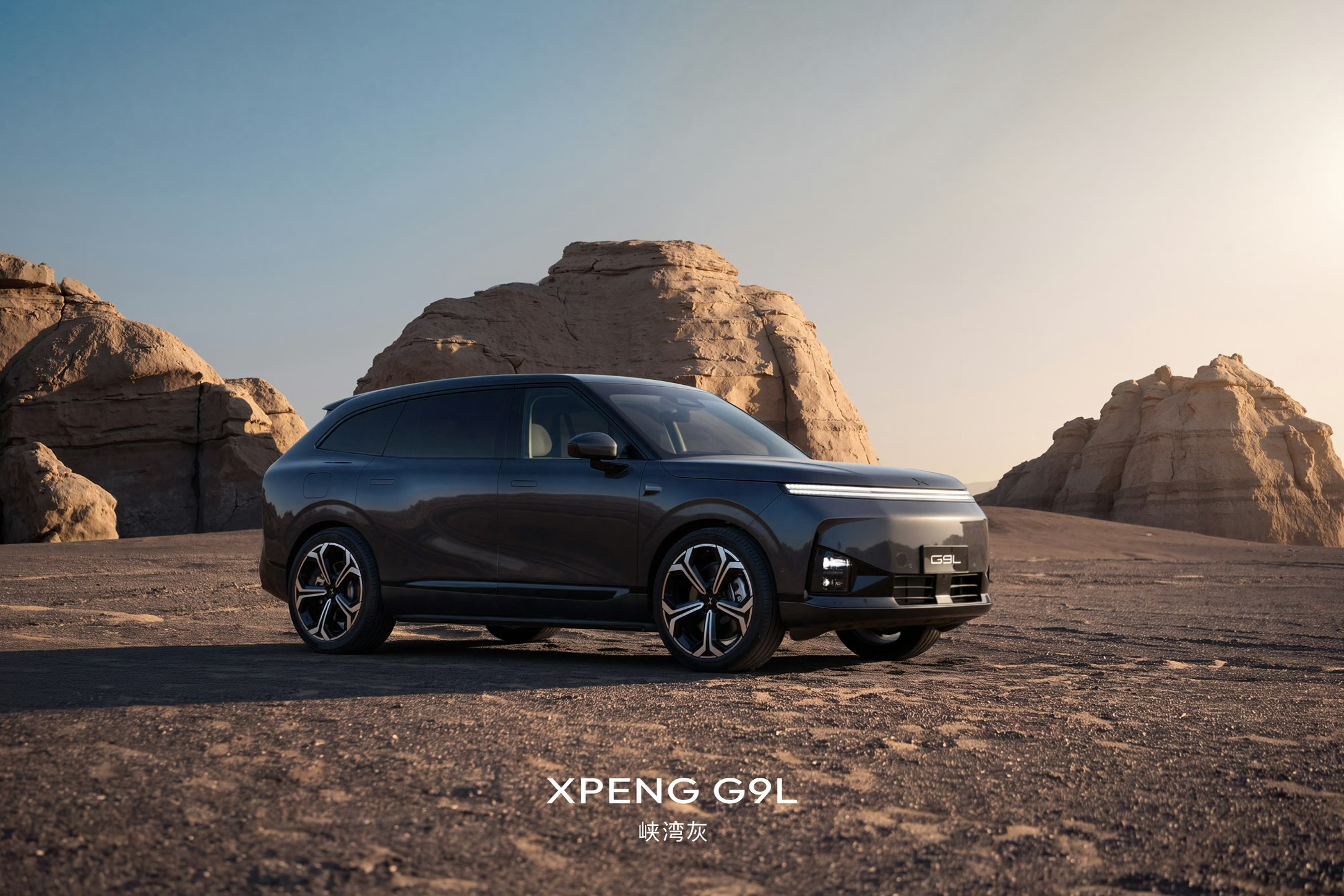
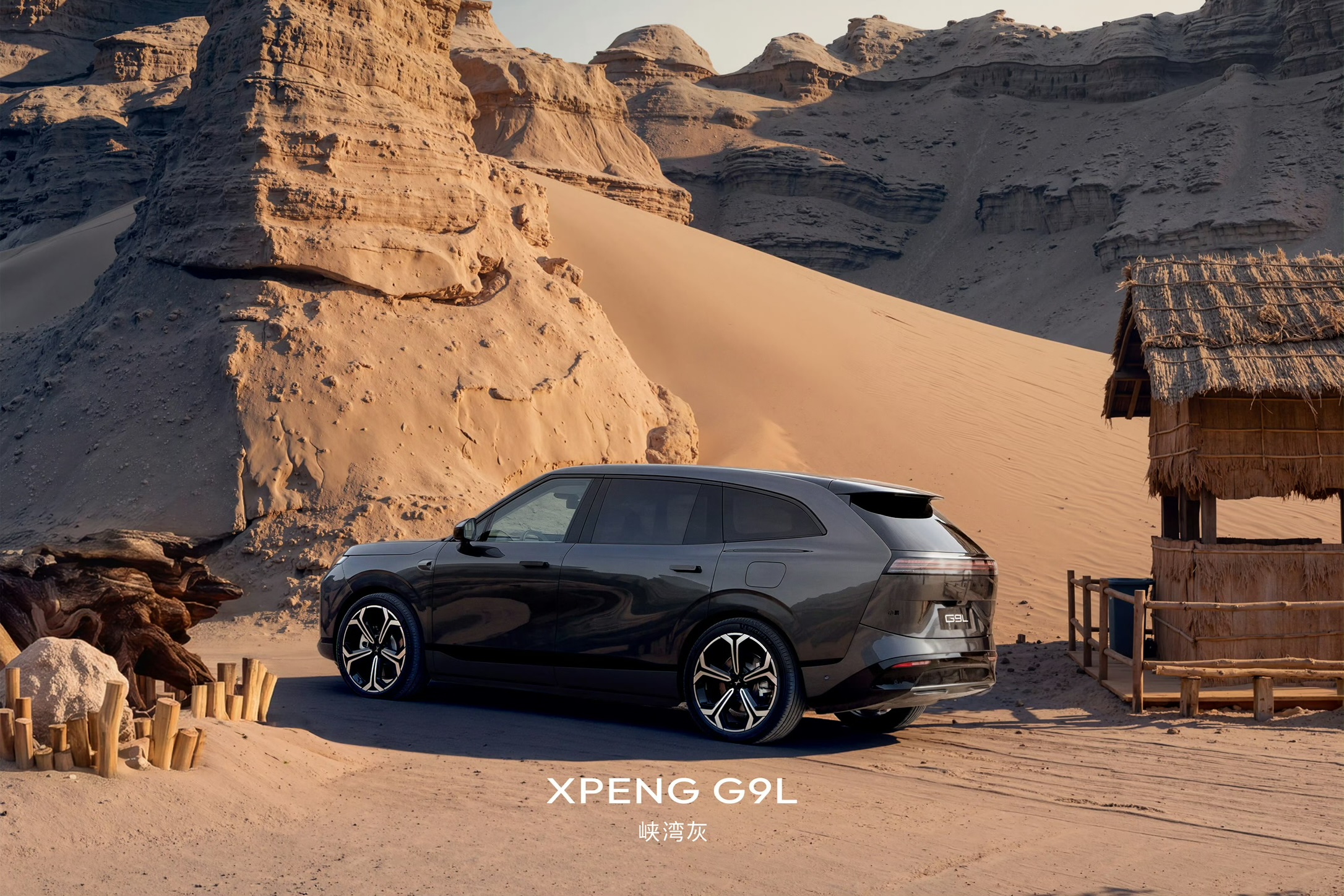
The colours from the China configurator. More can follow. Photos of the car in the individual colours sit in the gallery.
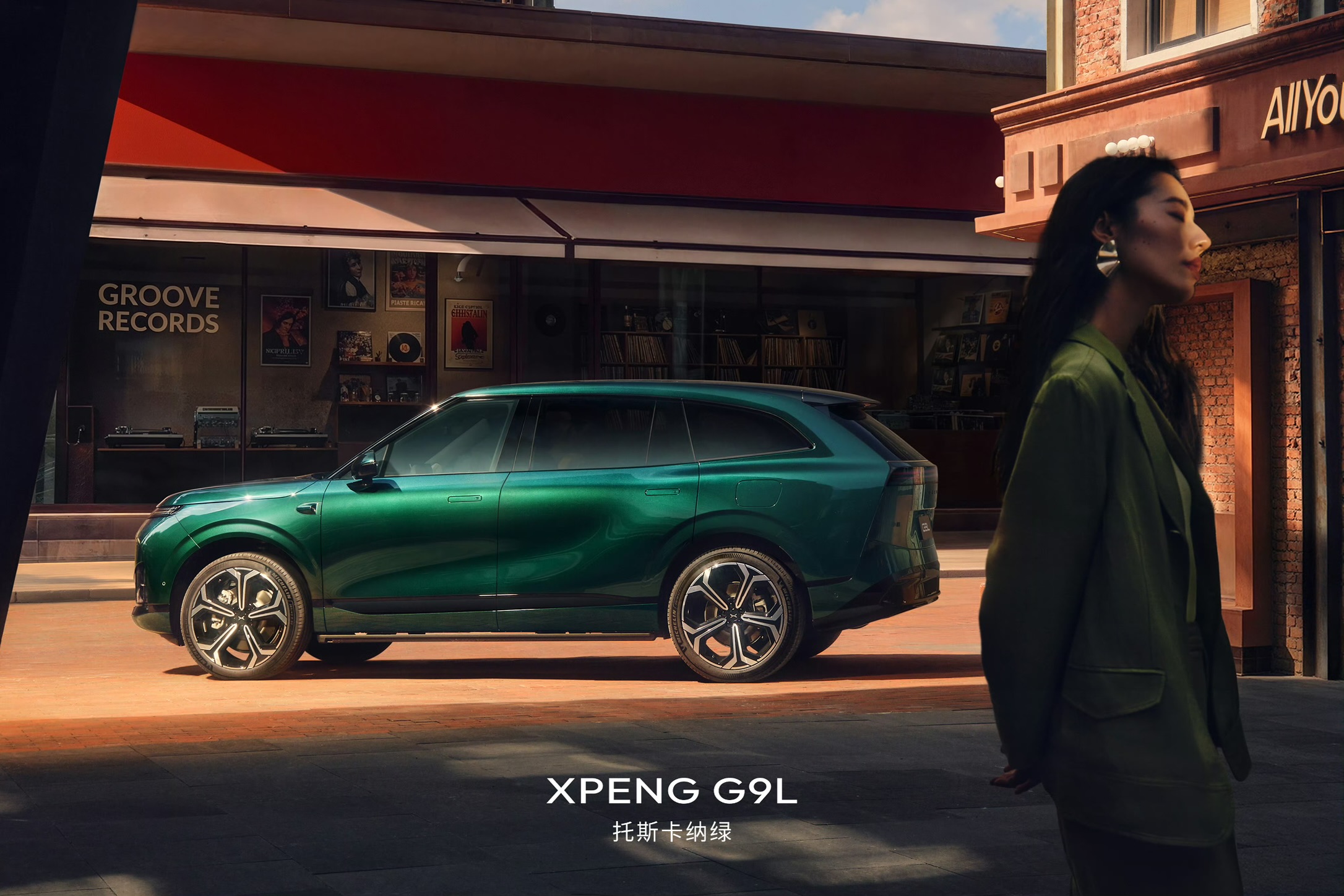
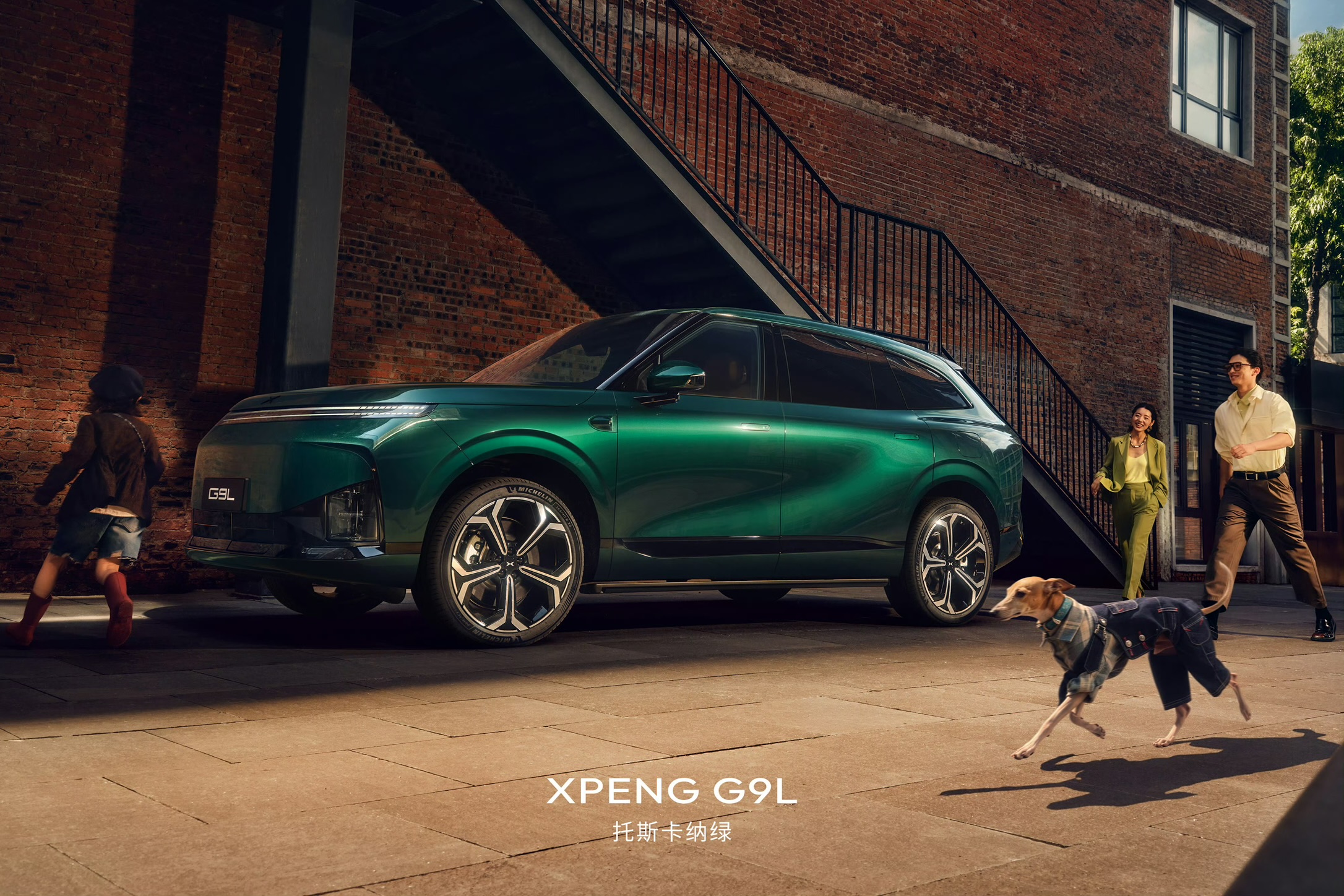
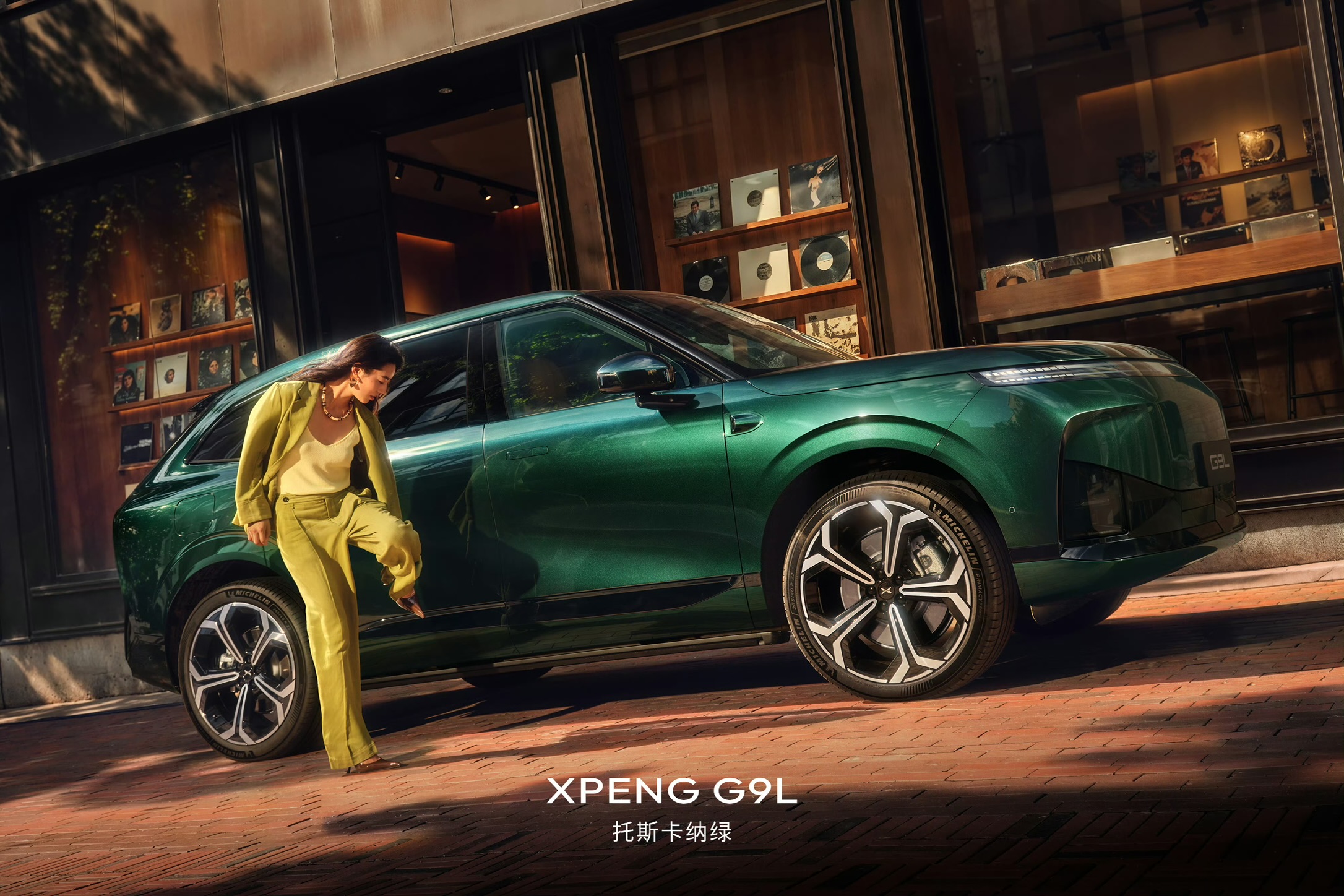
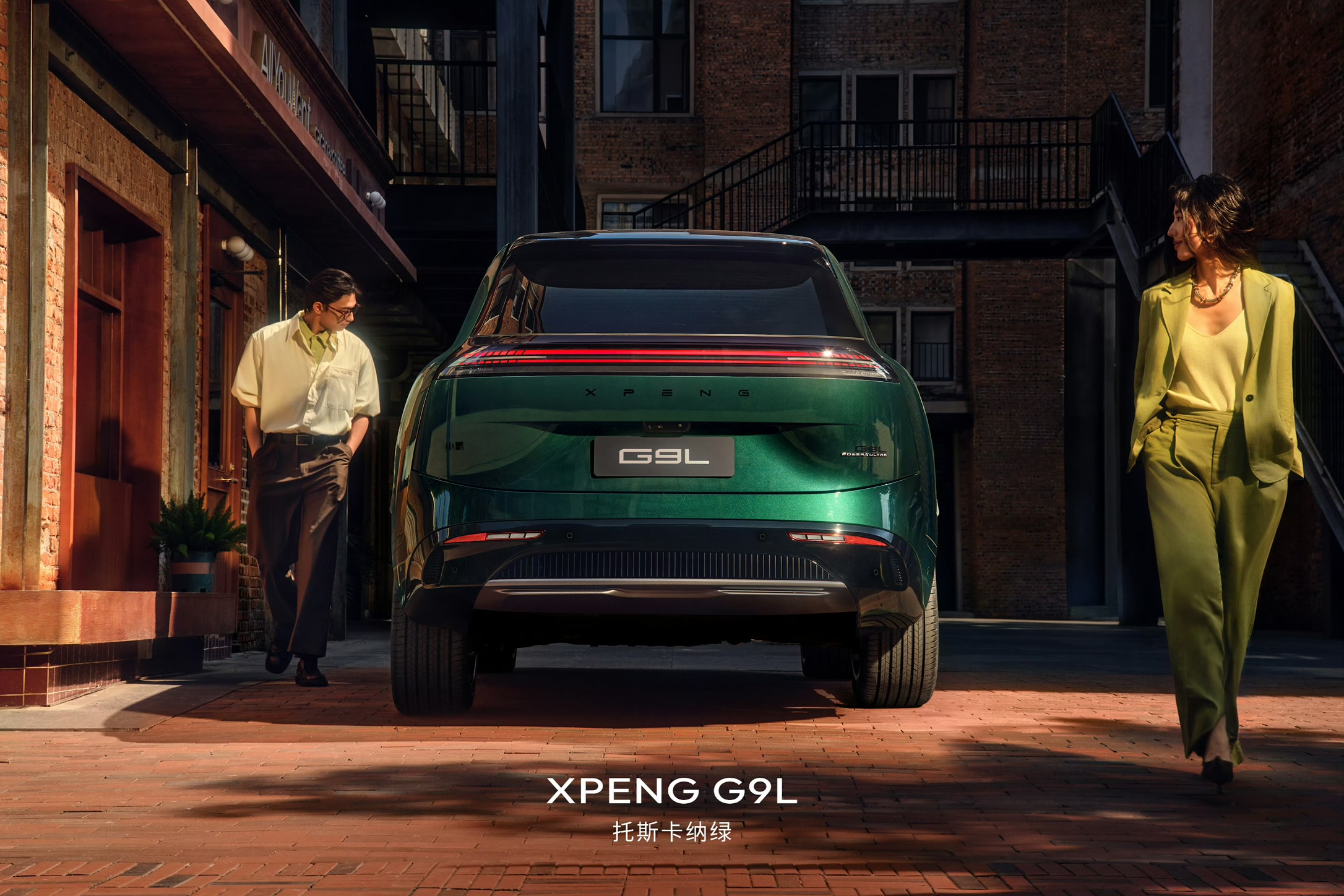
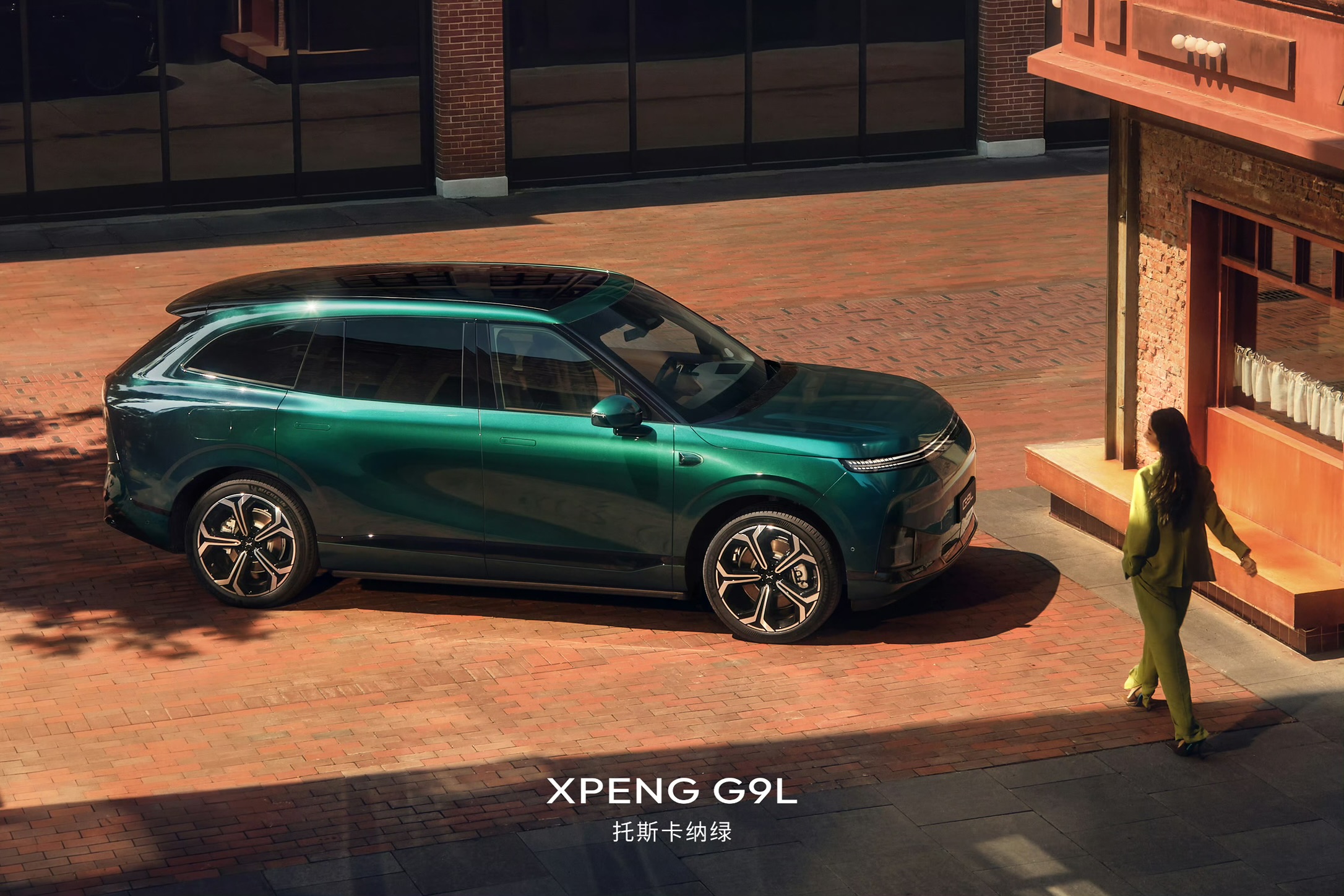
 Toscana Green (托斯卡纳绿)
 Provence Purple (普罗旺斯紫)
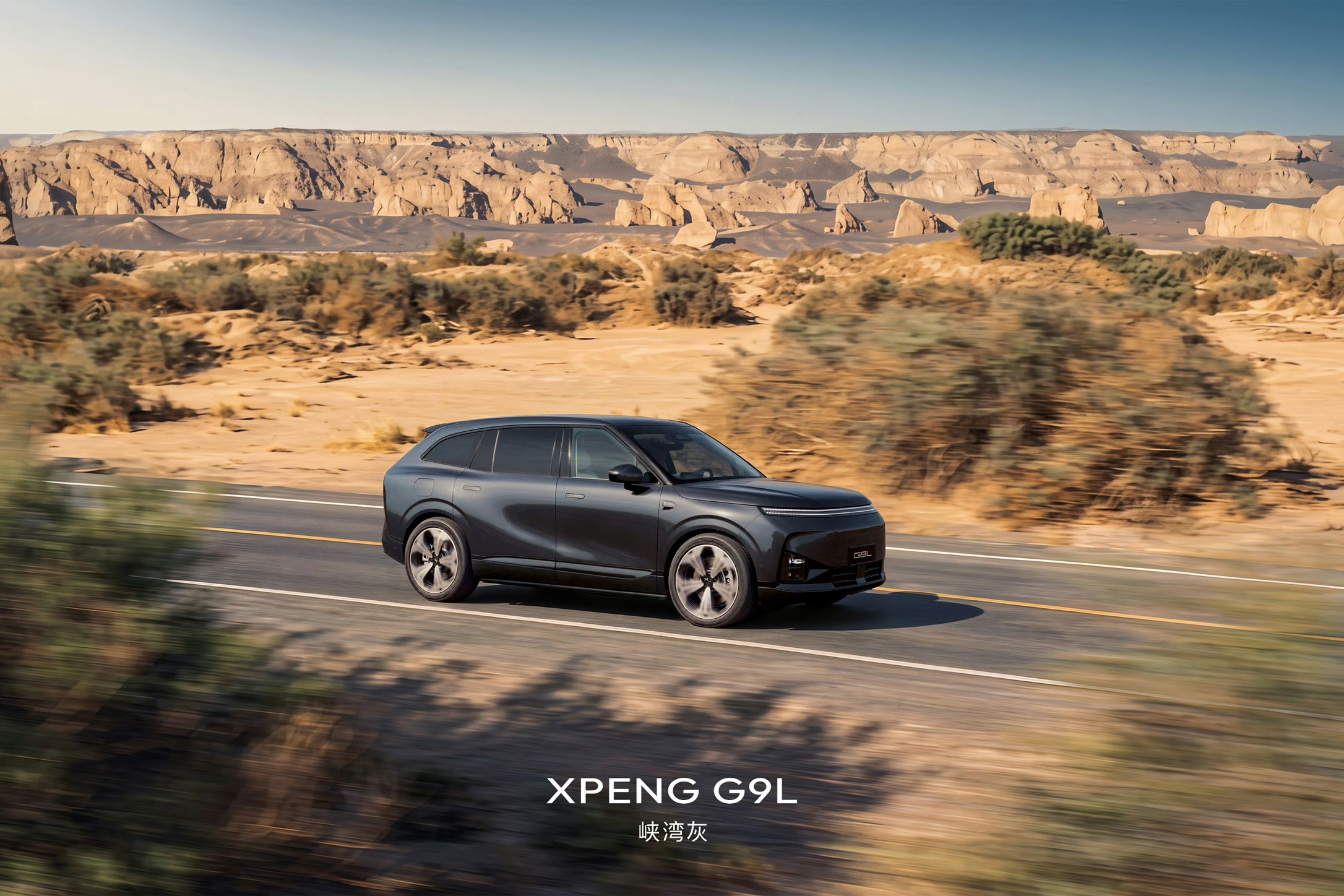
 Fjord Grey (峡湾灰)
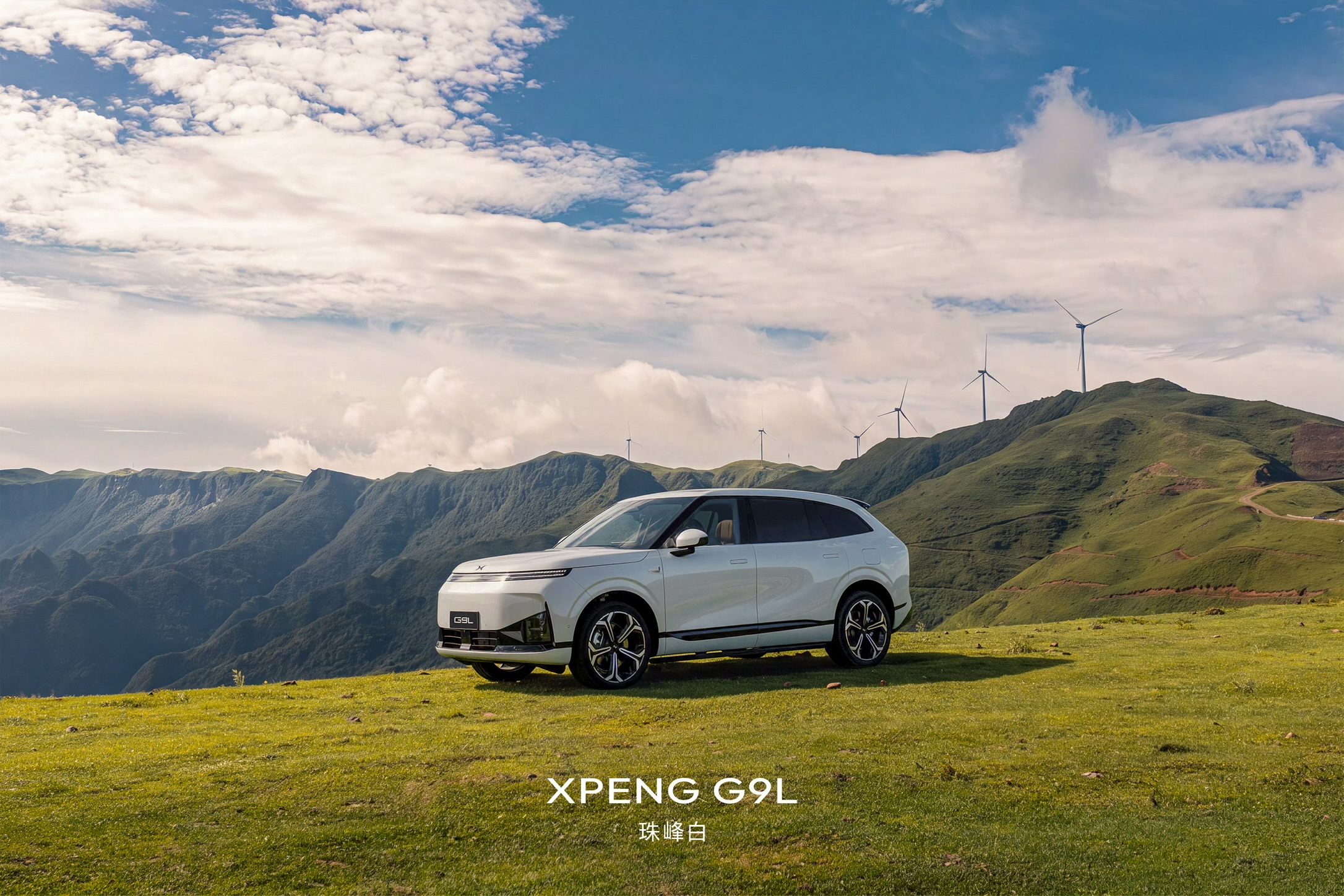
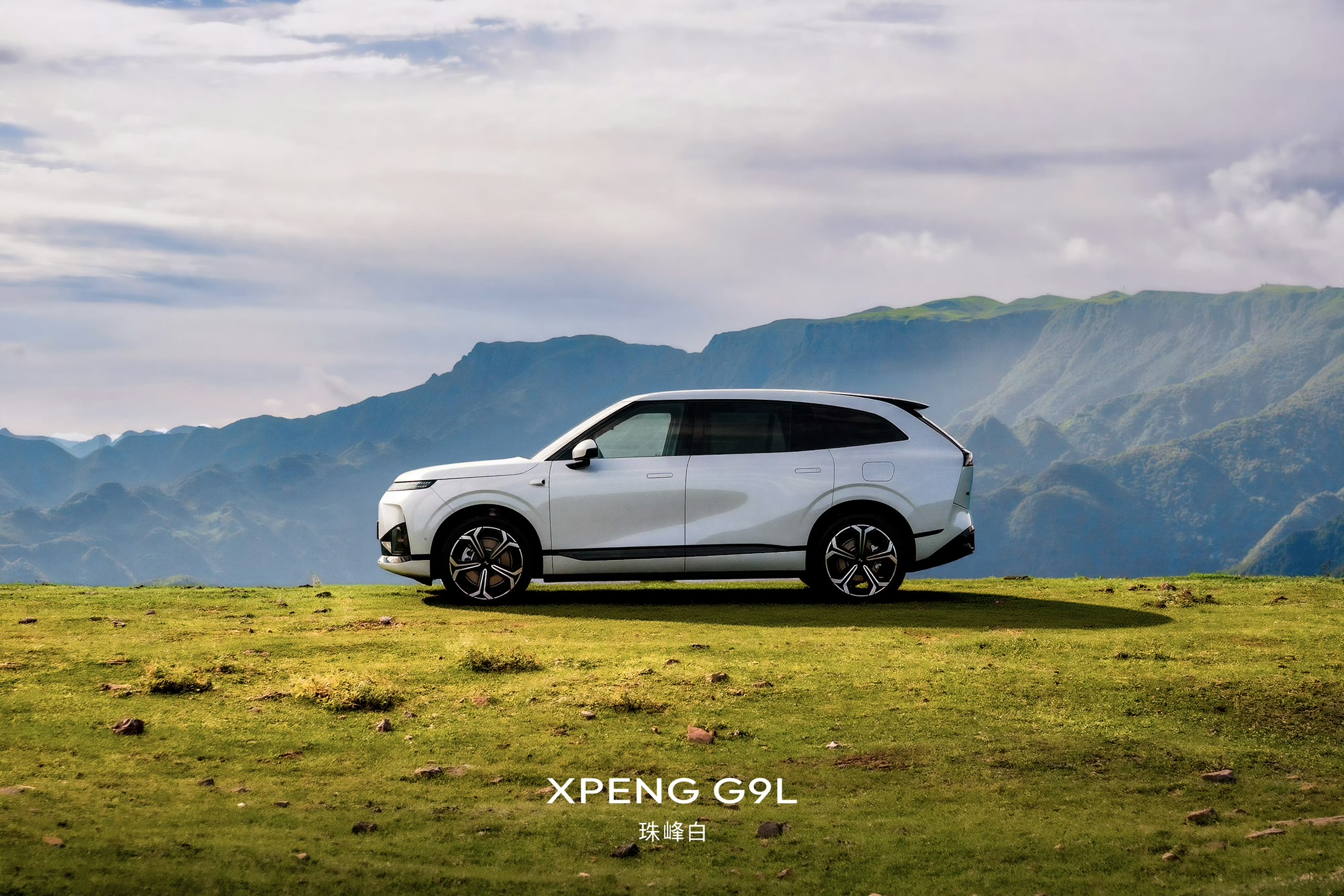
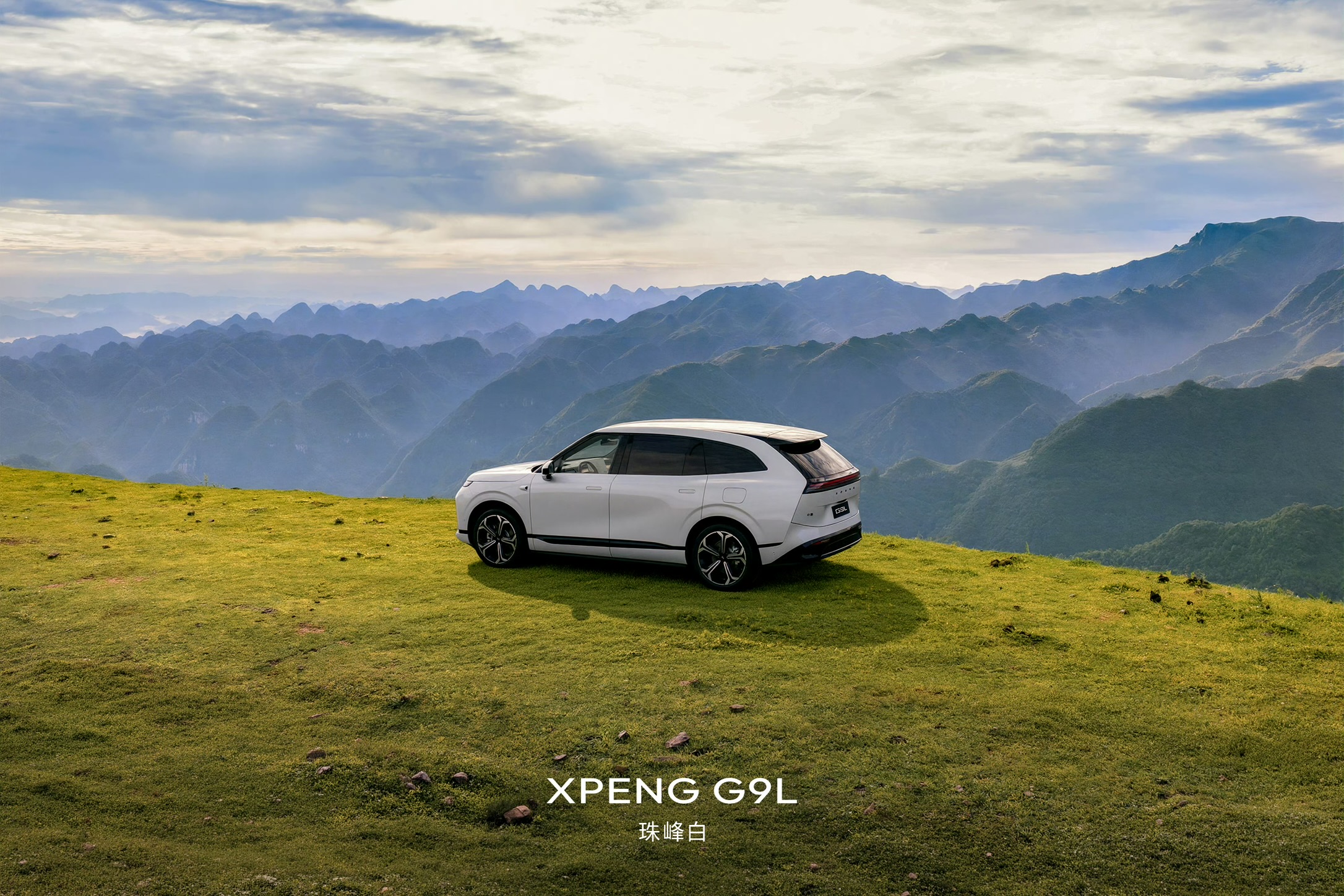
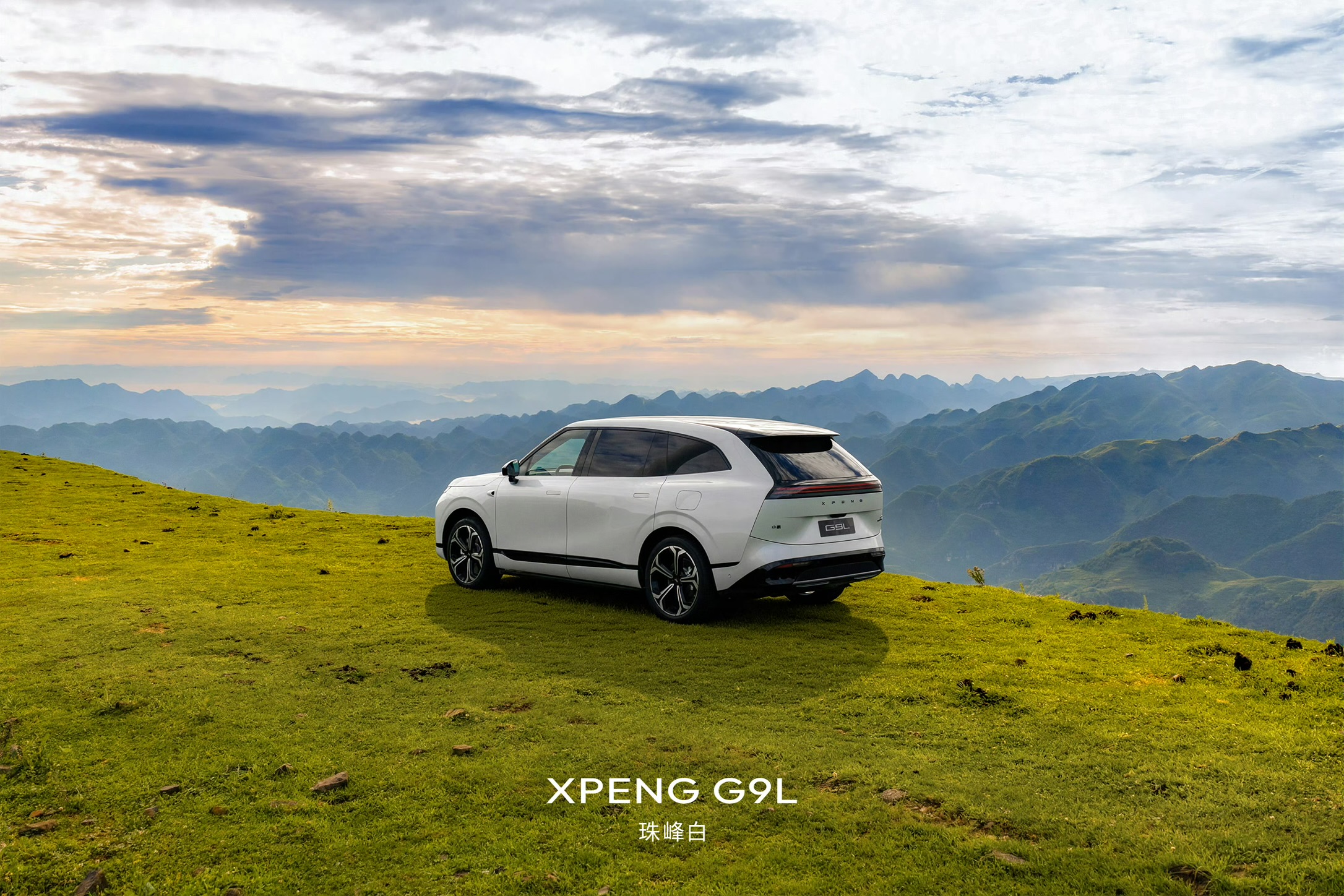
 Everest White (珠峰白)
 Polar Night Black (极夜黑)
Exterior features
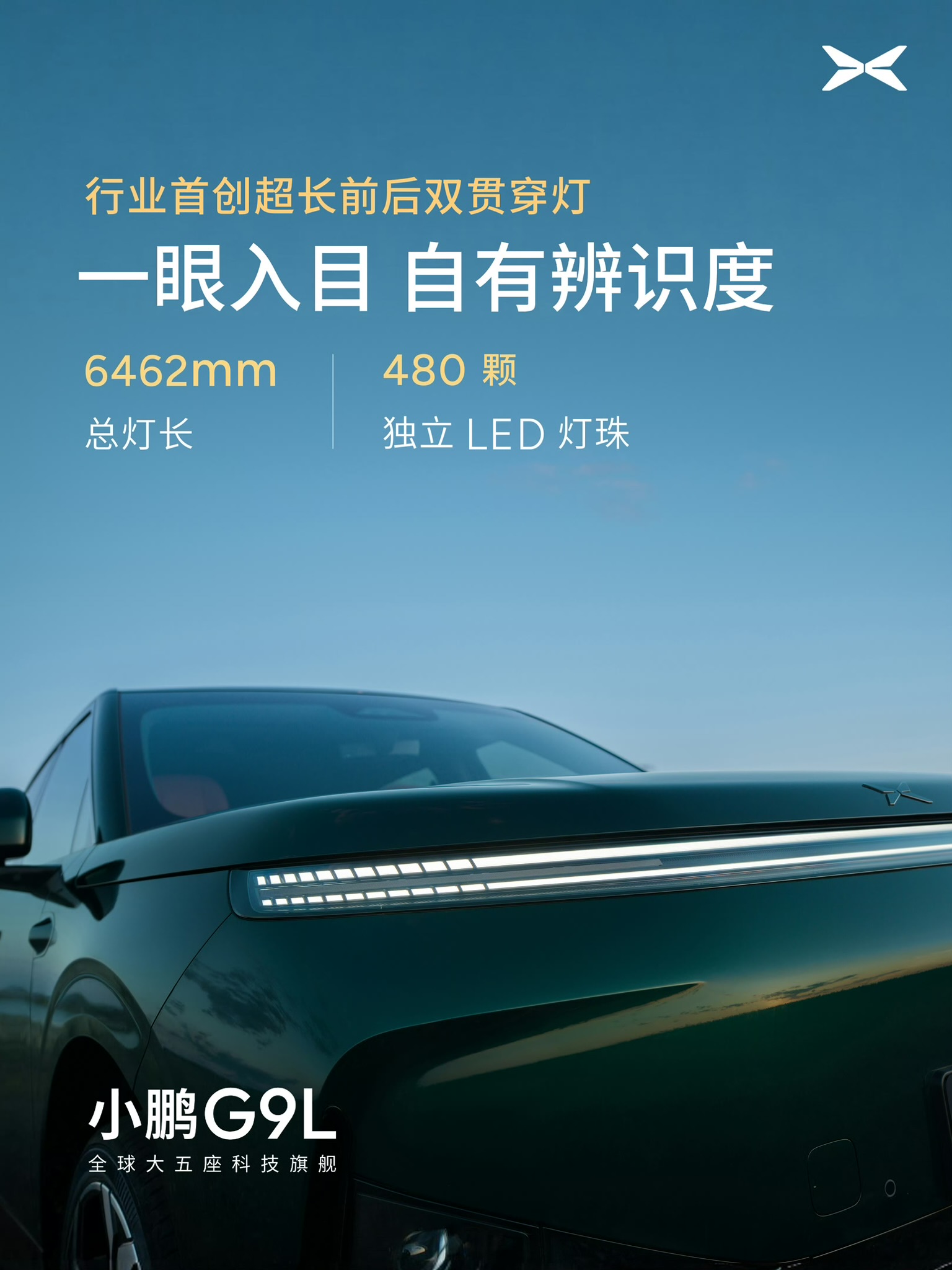
- Ultra-long front + rear light bars: total length 6,462 mm, 480 LEDs (“industry-first” dual through-lights)
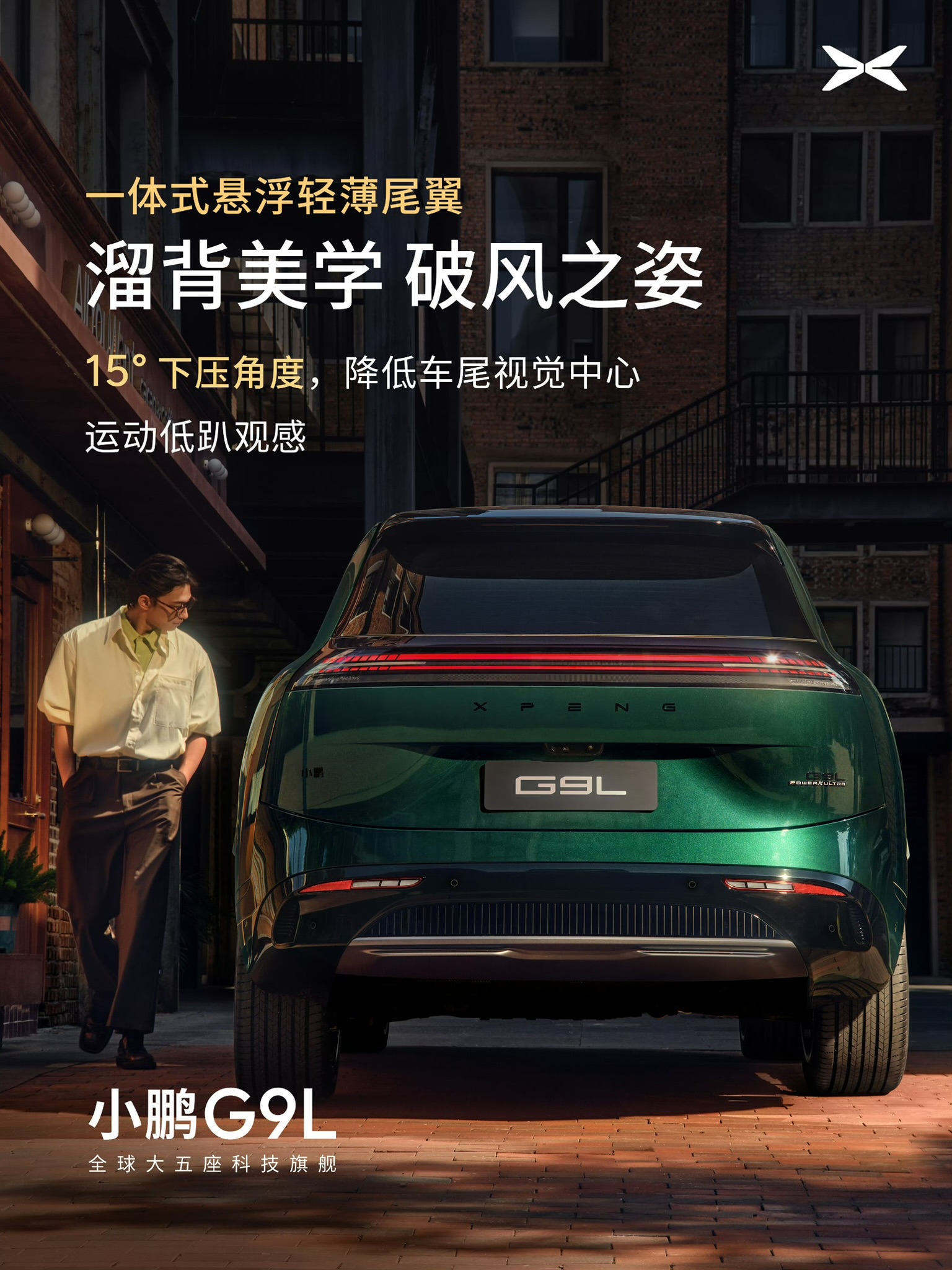
- Floating thin rear spoiler; ~15° down-angle for a lower visual centre
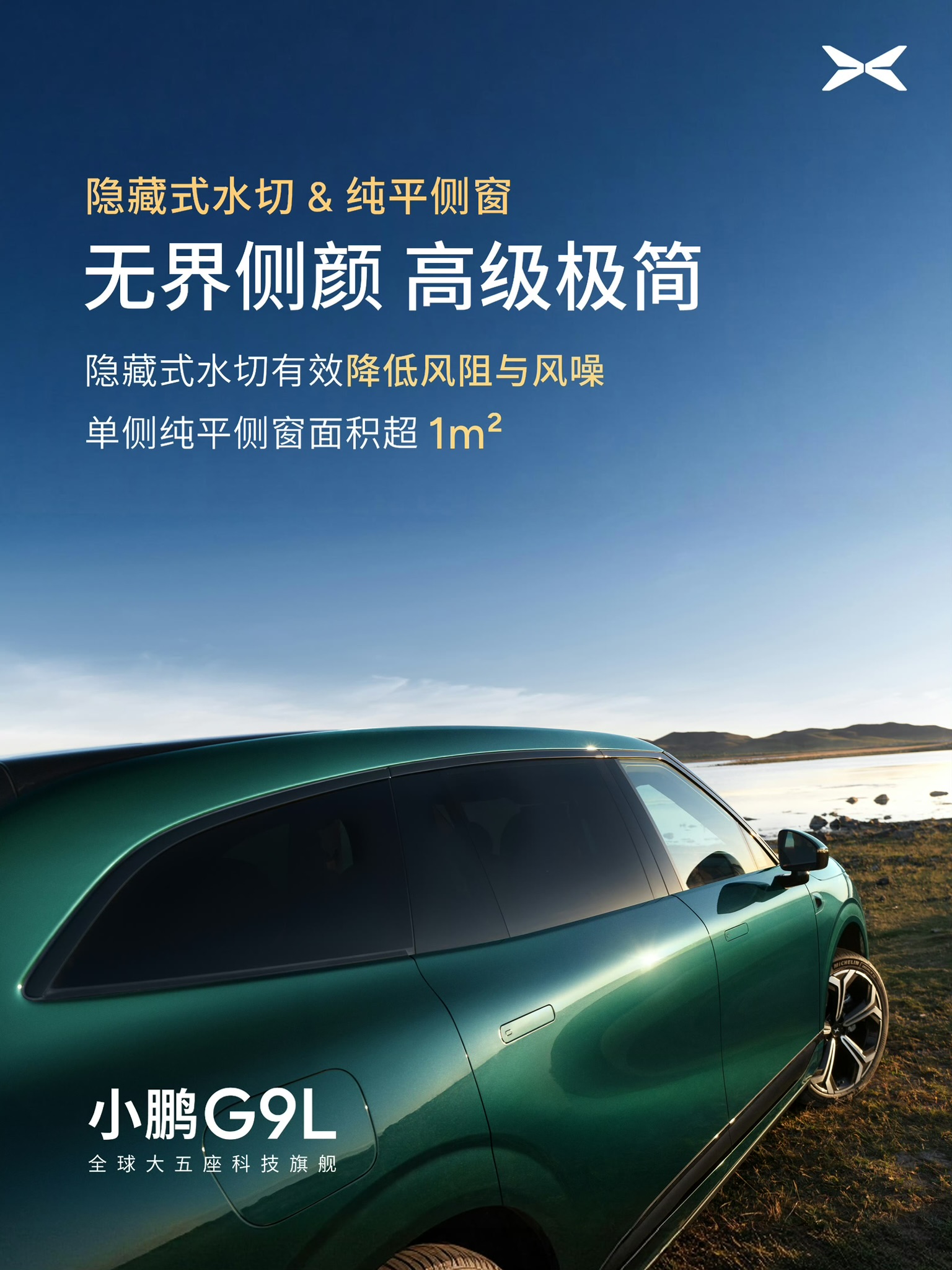
- Frameless door glass with hidden water channels - over 1 m² of flush glass per side
- Rear door windows that lower fully
- Frameless side mirrors - in the style of the L03 and other recent XPENG models
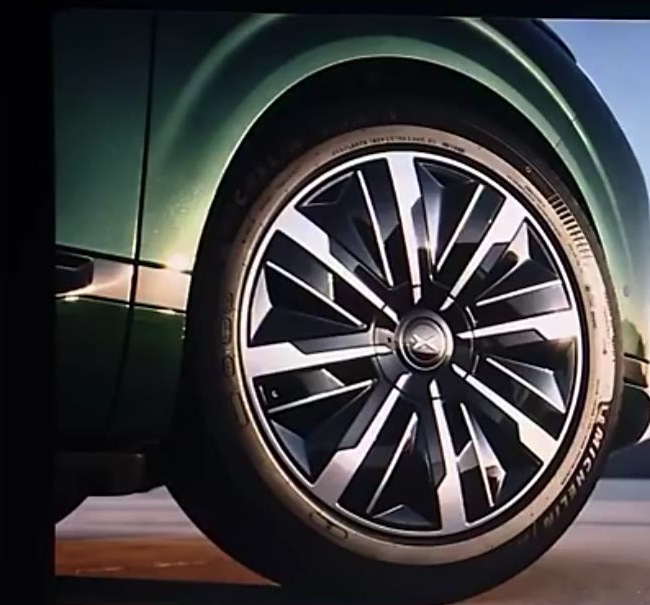
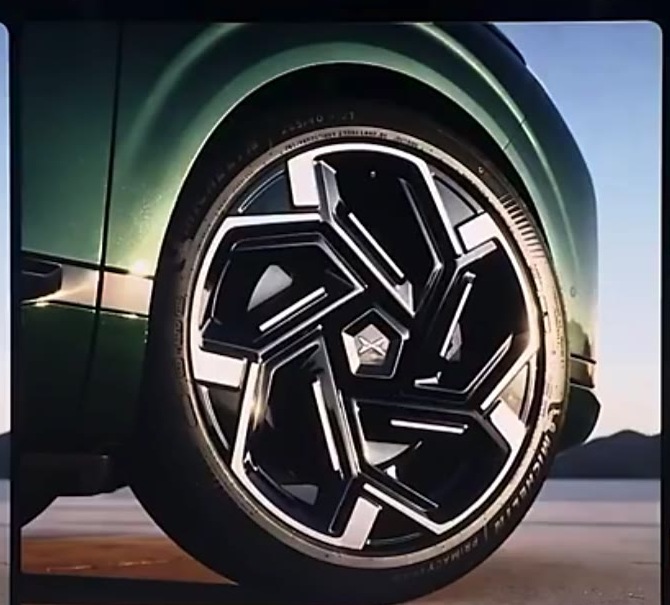
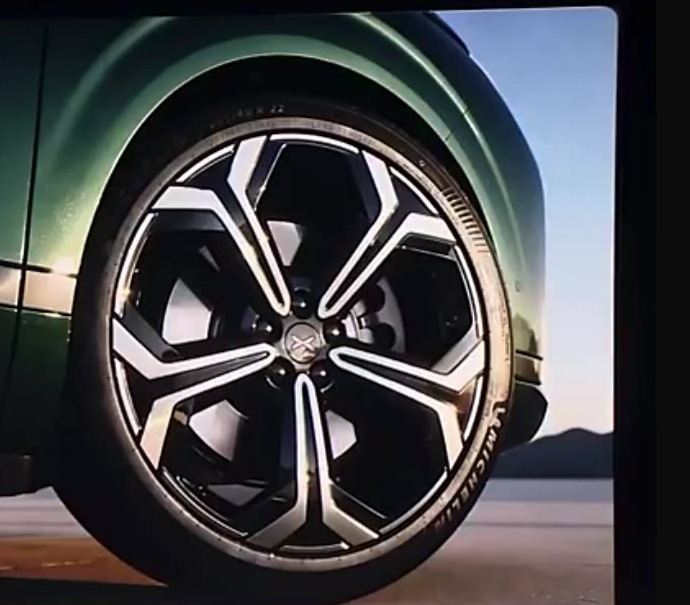
- Three wheel designs (Michelin Primacy 5e): 20″ low-drag aero (低风阻轮毂) · 21″ Vortex (旋涡轮毂) · 22″ Petal sports (花瓣运动轮毂) - see Gallery → Wheel designs
- The 22″ wheels run staggered tyre widths: 265 mm front, 285 mm rear
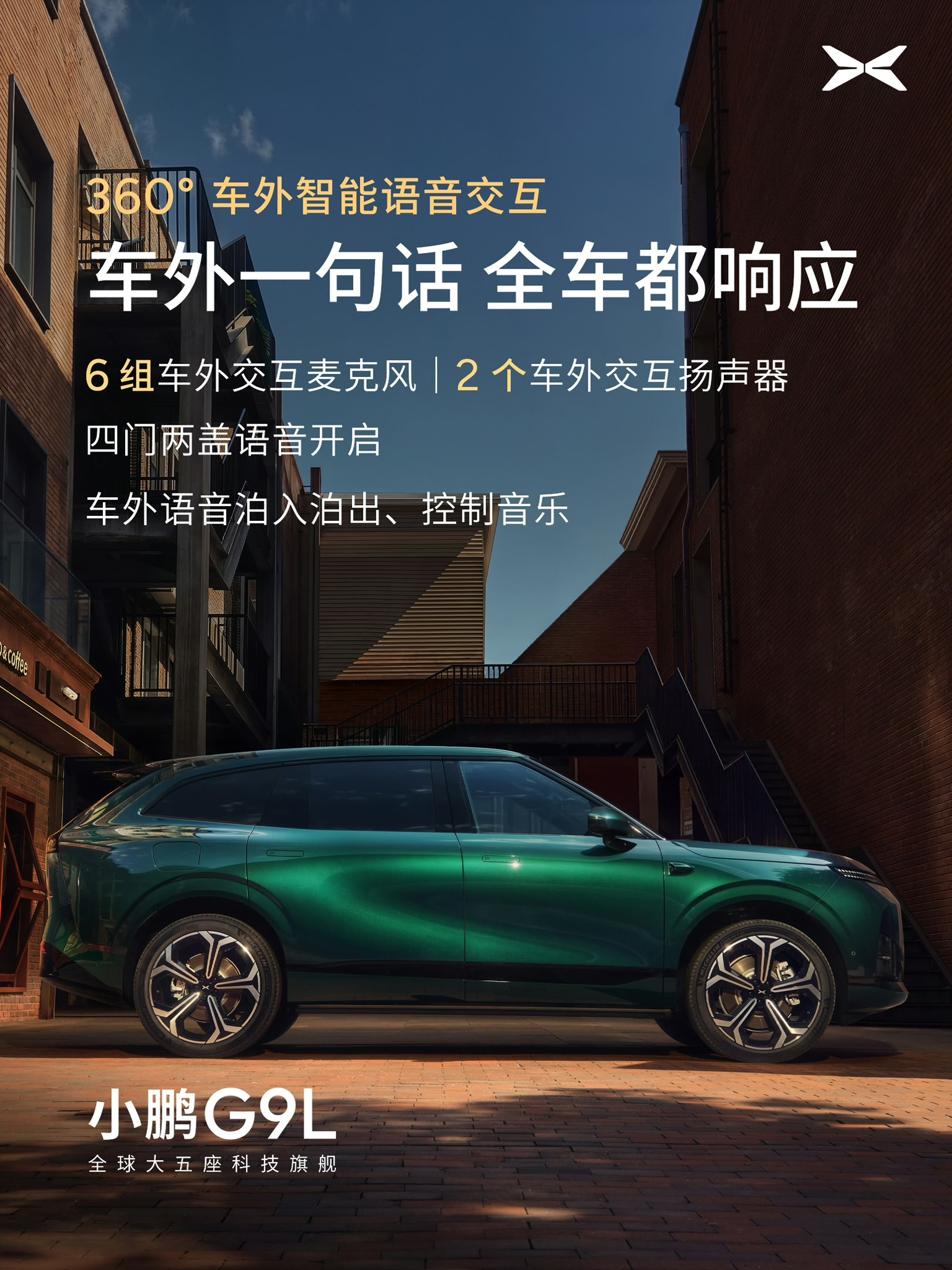
- Exterior voice: 6 mics + 2 speakers; voice open for the four doors, frunk and tailgate; park-in/out and music
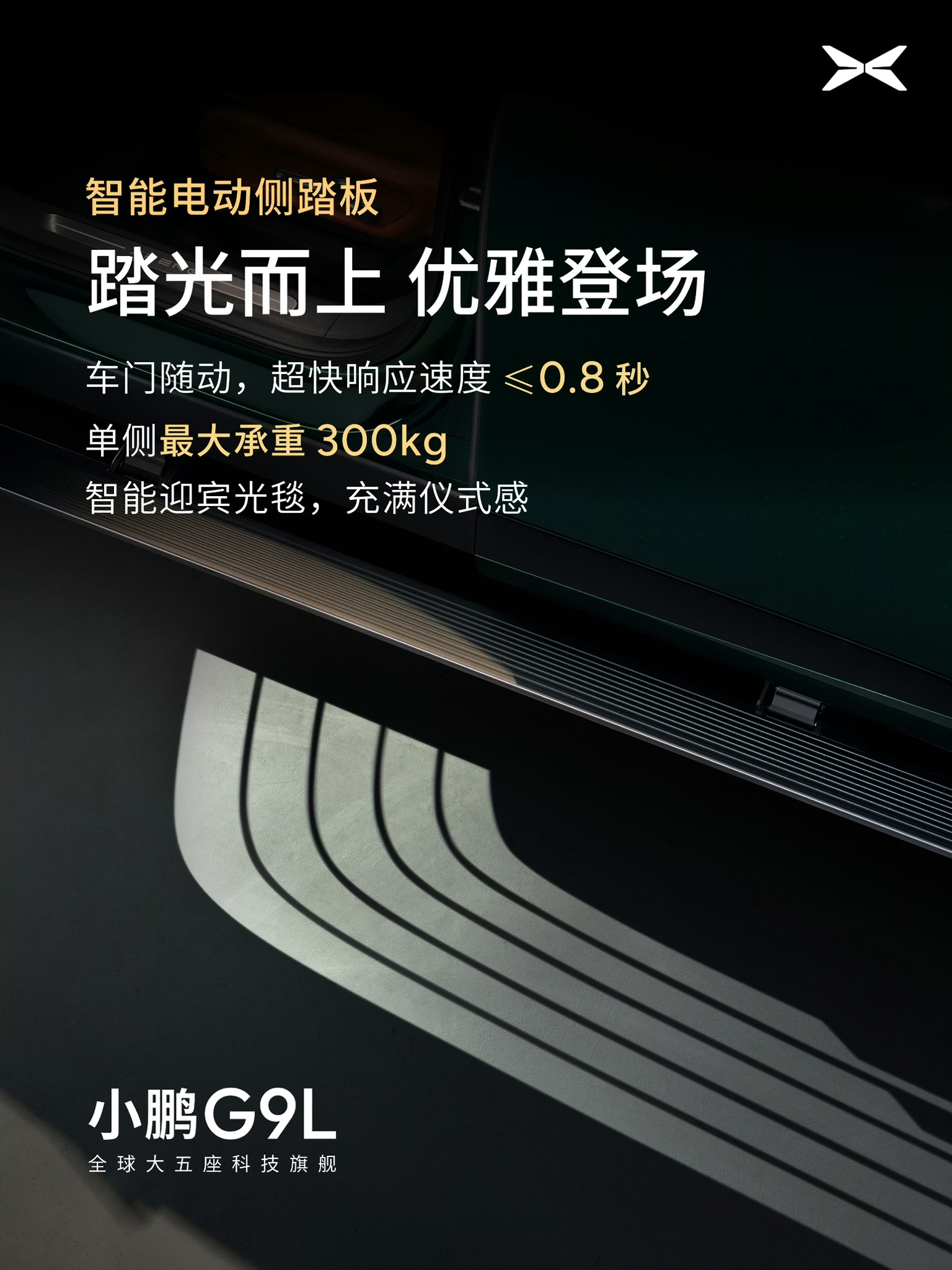
- Electric side steps - a CN¥ 6,000 option in the configurator. Door sync <0.8 s; up to 300 kg per side; welcome light carpet
- Dual-chamber air suspension drops about 30 mm when opening a door for easier boarding
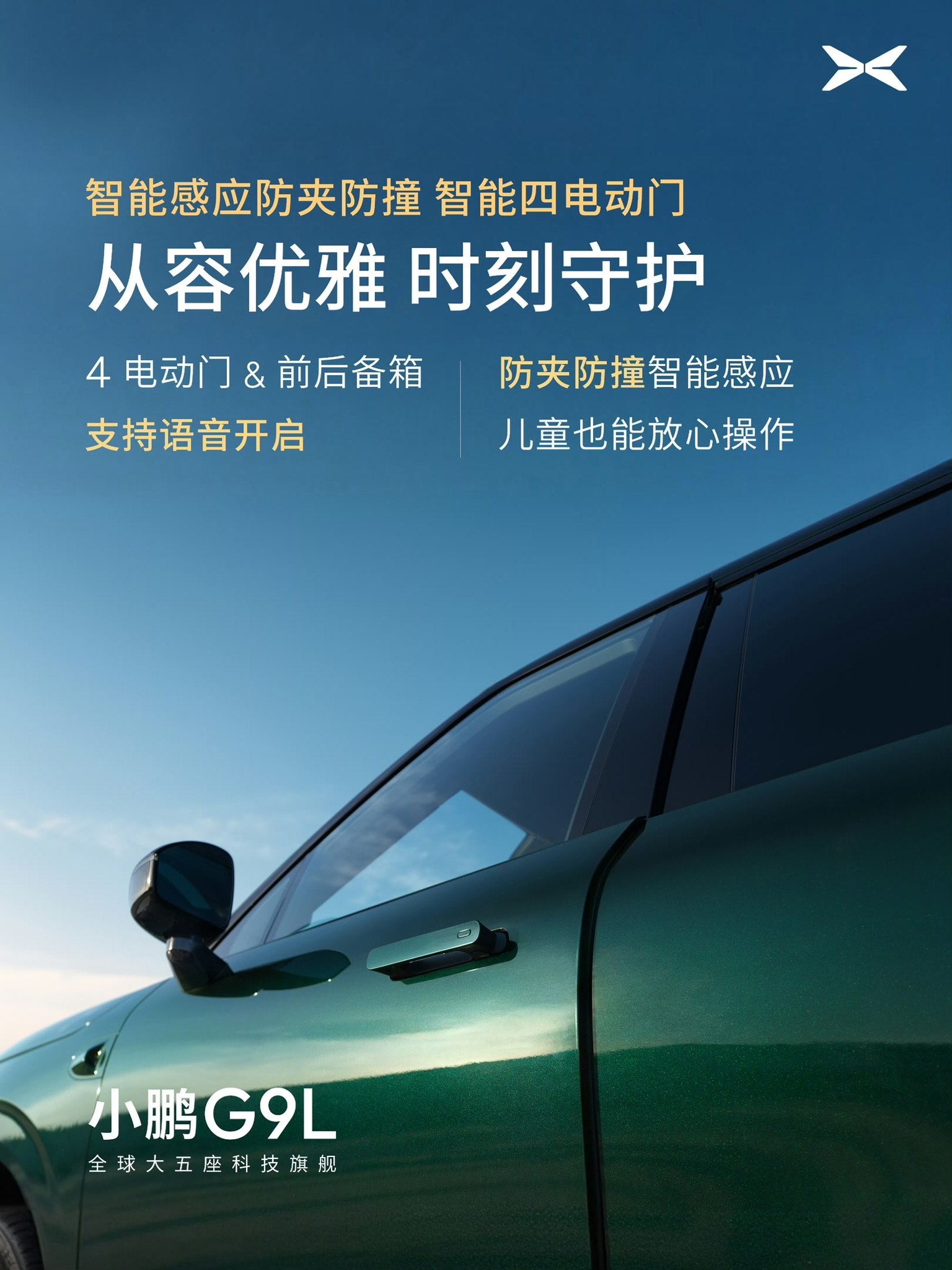
- Four power doors with soft-close plus powered frunk and tailgate with anti-pinch/collision sensing; XPENG lists ten opening methods. Voice open; driver door closes when the brake pedal is pressed
- AI digital projection headlights, developed with Huawei XPIXEL: high-precision ADB (about 1.3 million pixels, night reach about 600 m, glare shielding and follow-distance warning) and outdoor DLP projection up to about 98″. In the Chinese configurator they are standard on the Ultra Flagship
Interior
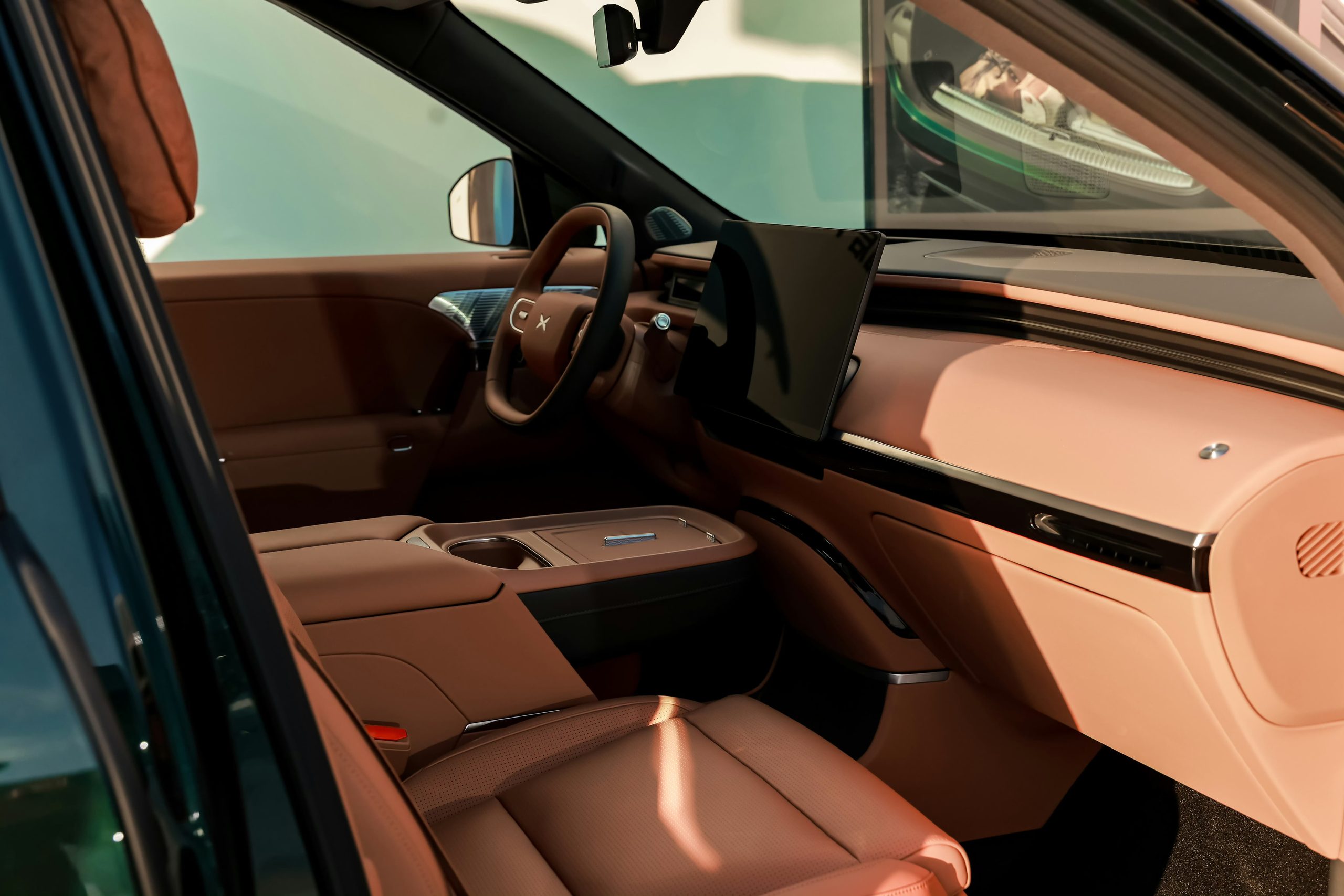
Interior colours
Four cabin colours in the configurator - more can follow. Drag the image to look around, and switch between the front and rear row. Stills of the cabin sit in the gallery.
Drag to look around
Cabin and HMI
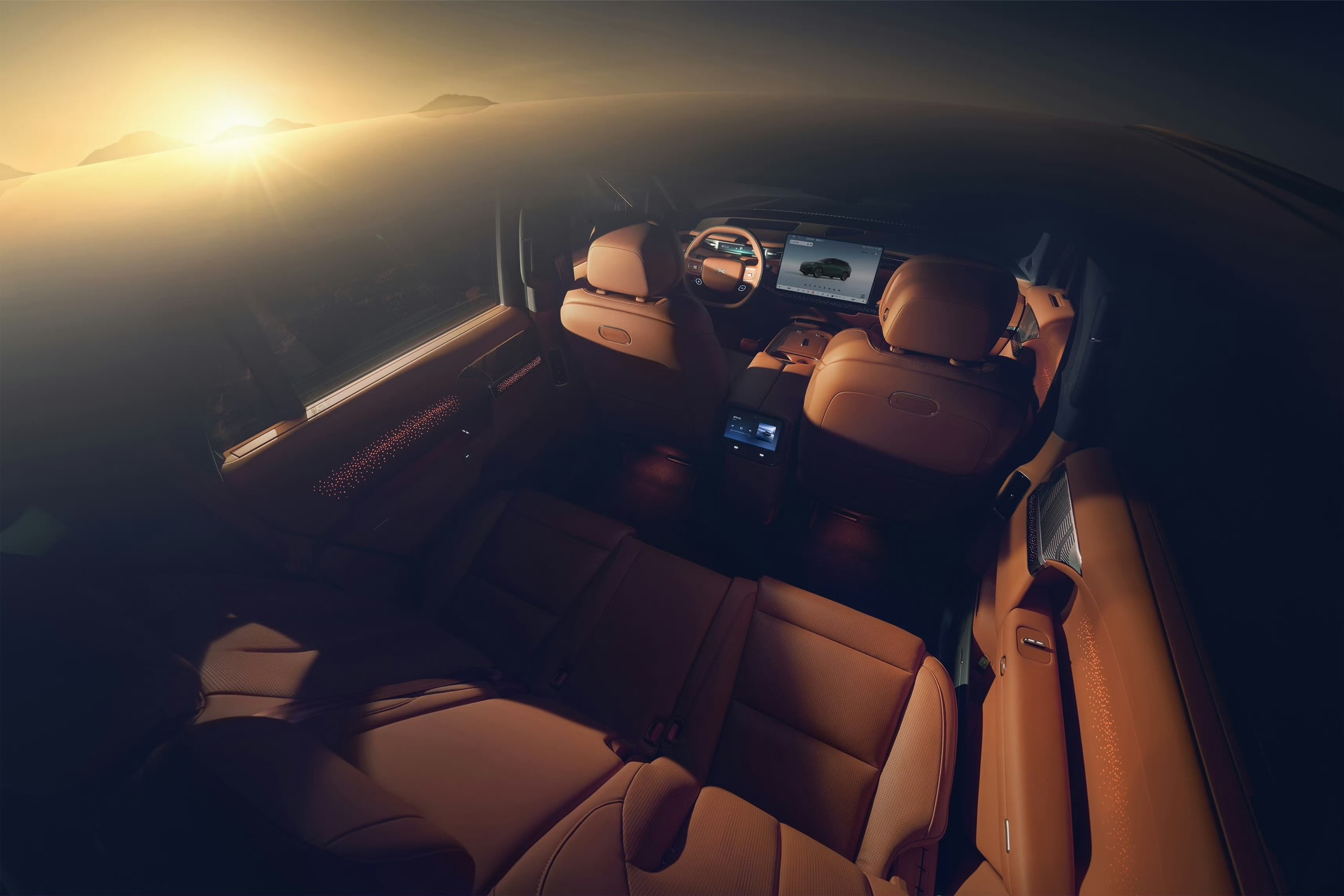
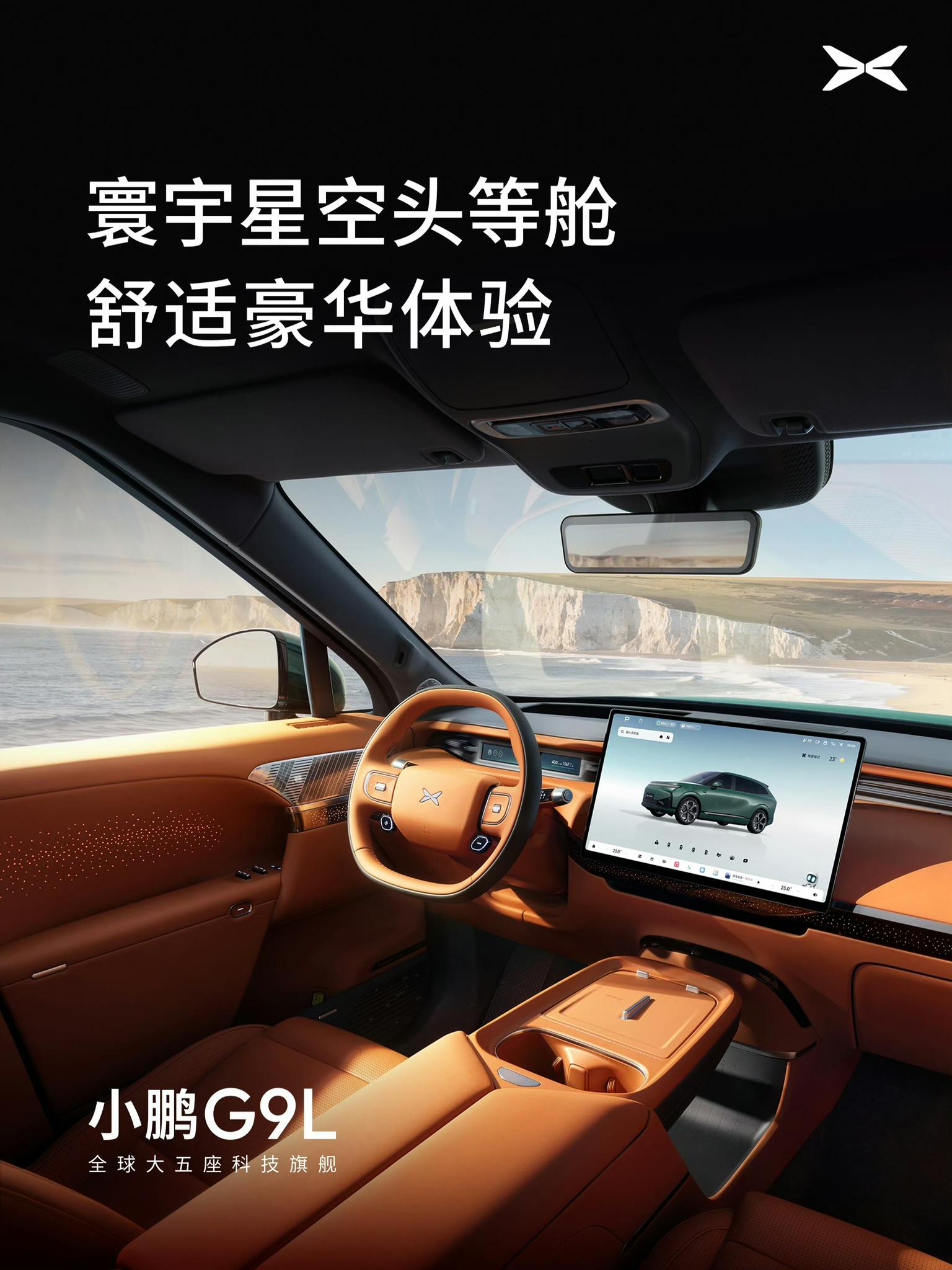
- XPENG calls the cabin theme Cosmic Starry Sky First-Class (寰宇星空头等舱) and the seat leather Star Soft translucent leather (星柔透光皮革) - both names are XPENG’s own, from the launch material and the configurator
- Cabin “living area” of 5.1 m² - over 1 m² per person
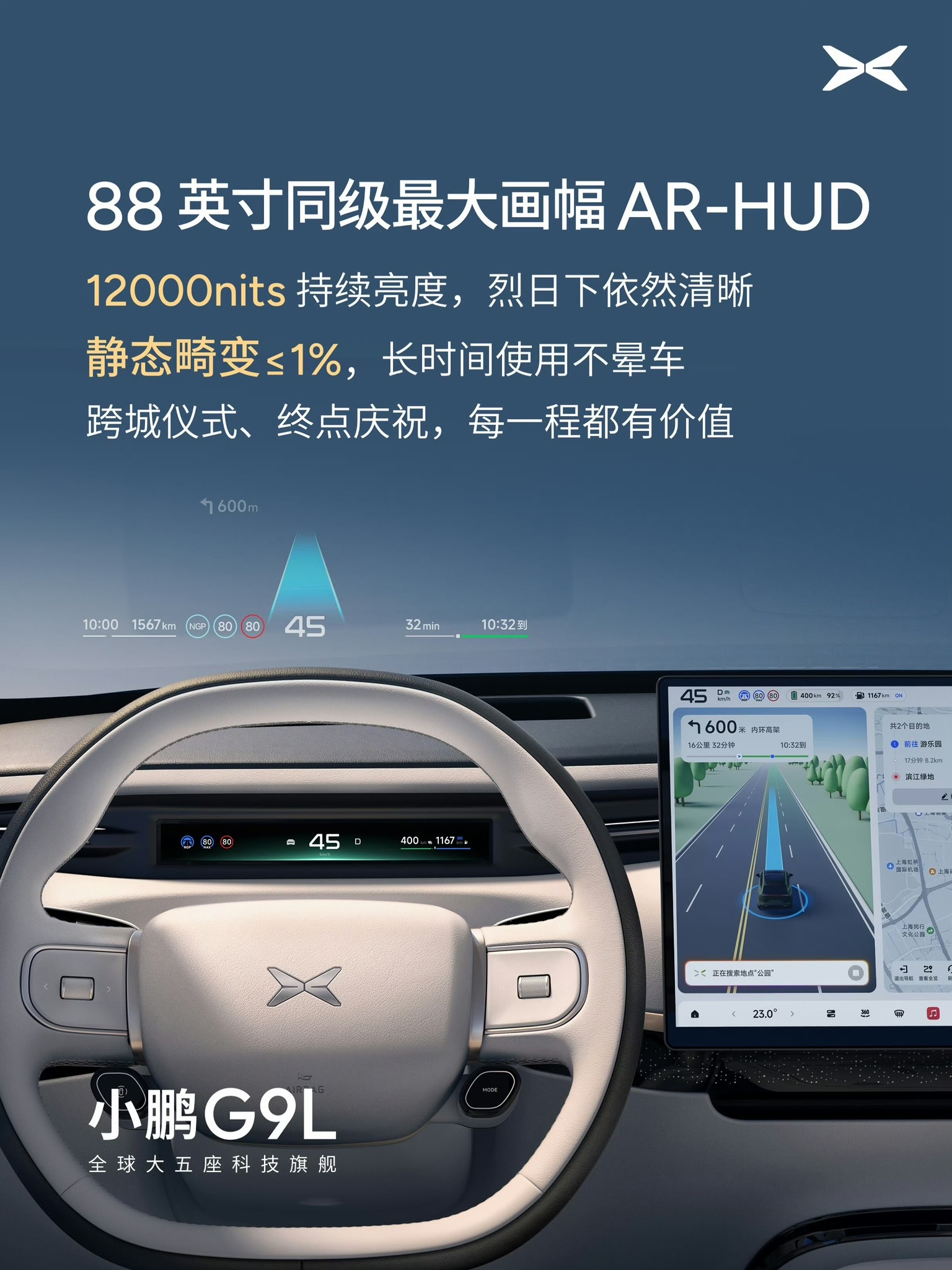
- AR-HUD: 88″ field of view - the largest in class according to XPENG; up to 12,000 nits and 1800:1 contrast; static distortion <1%
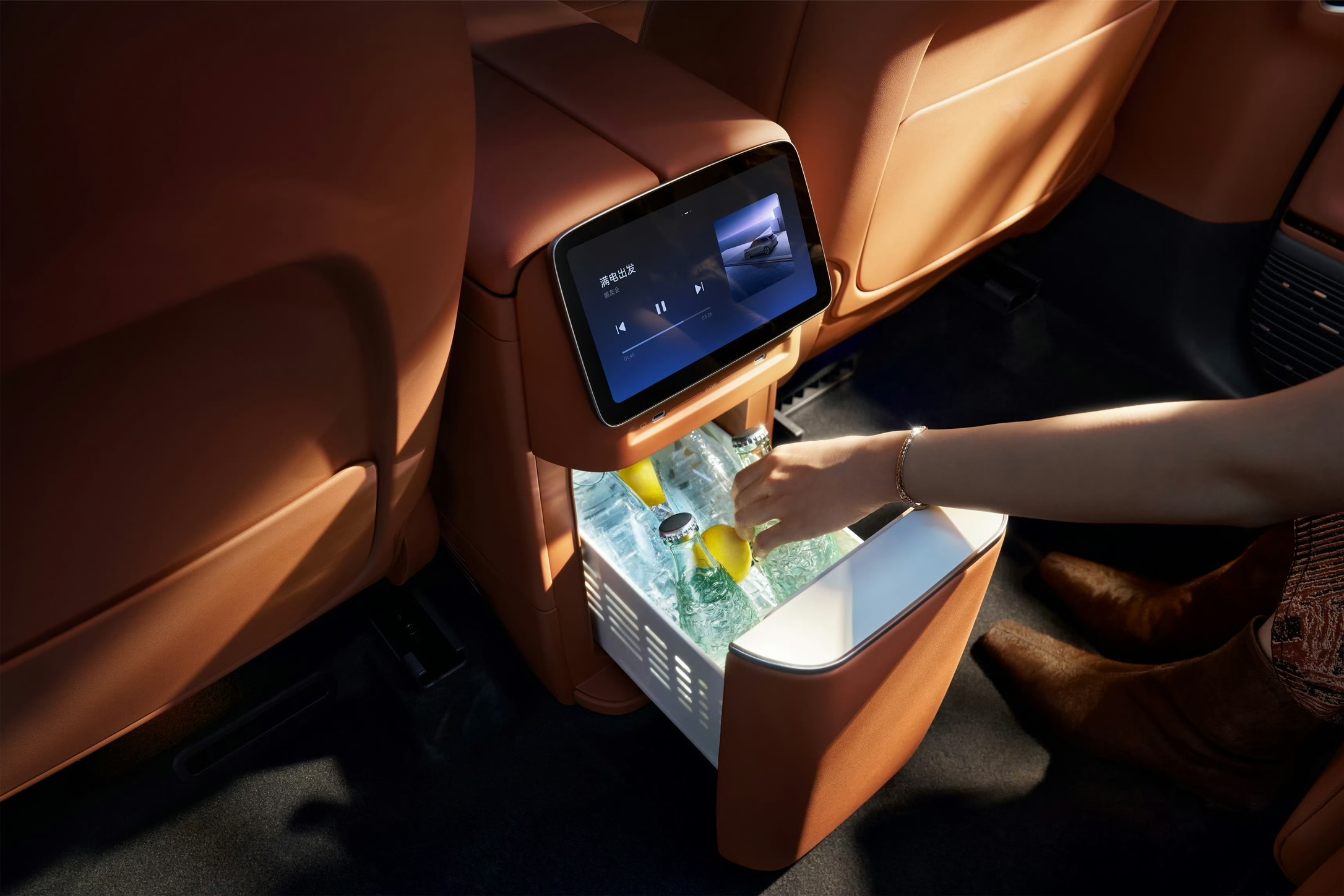
- 8.8″ instrument cluster, 17.3″ 2.5K centre screen and an 8″ rear control screen (launch material)
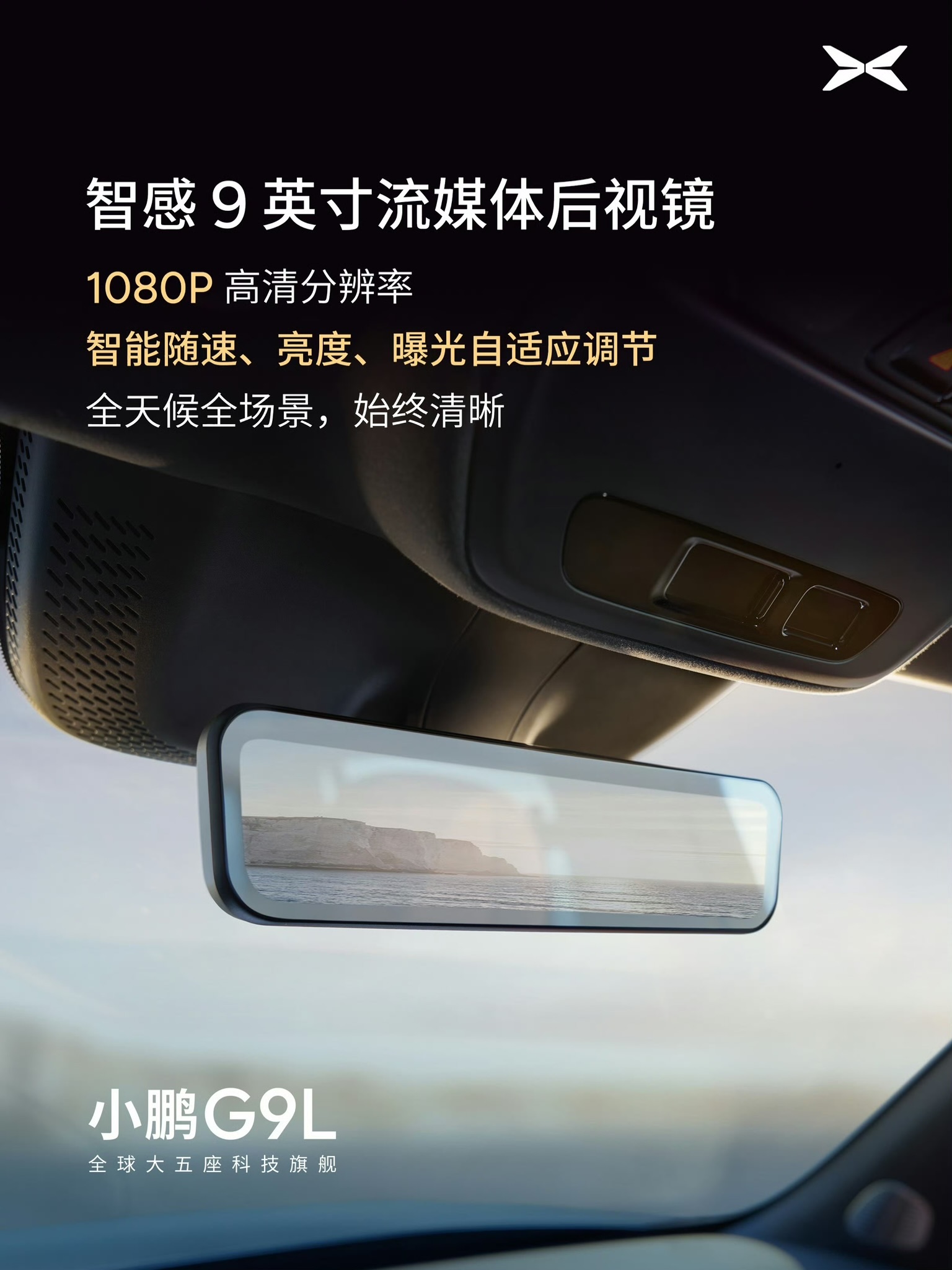
- Smart 9″ streaming mirror, 1080p, adaptive brightness/exposure
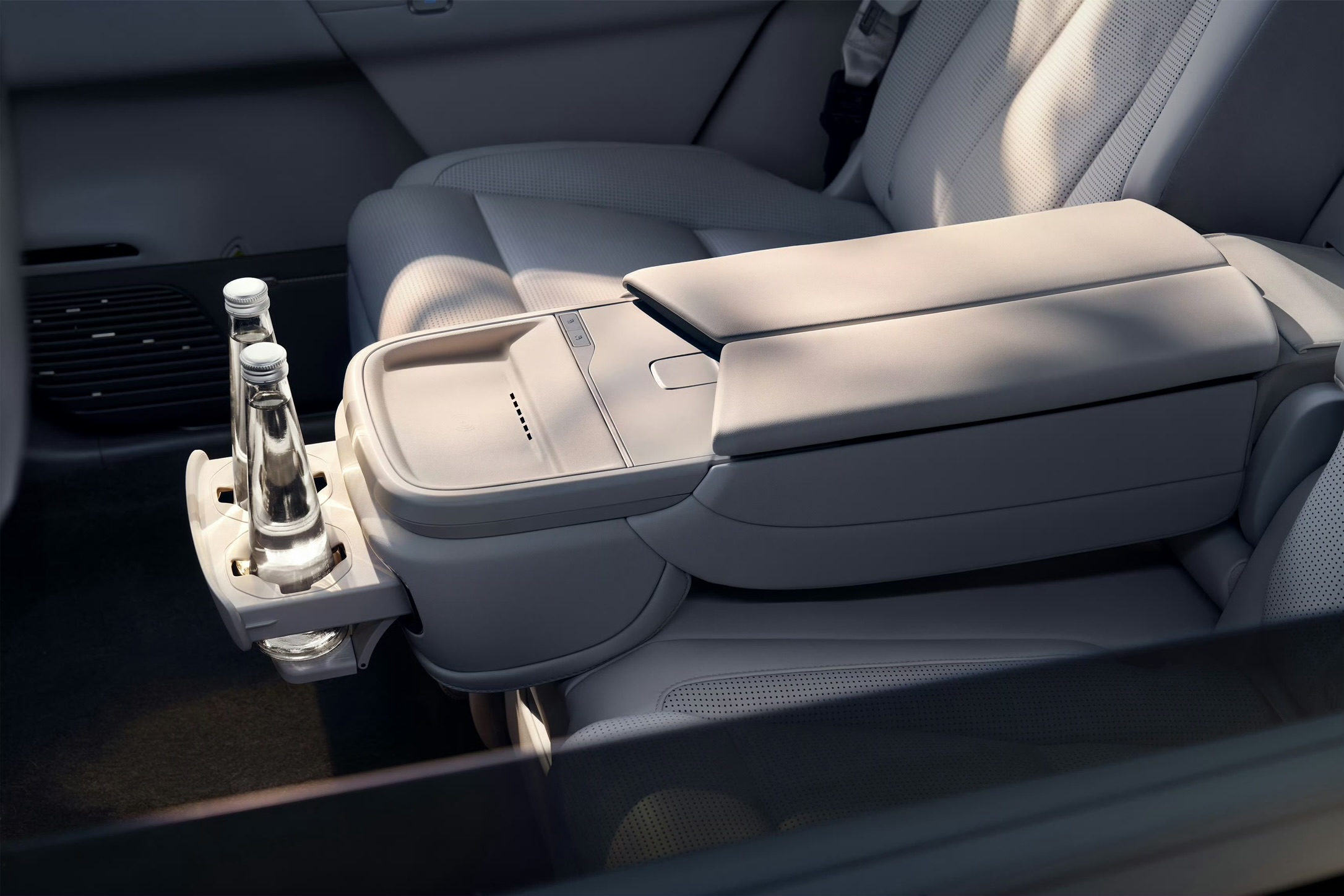
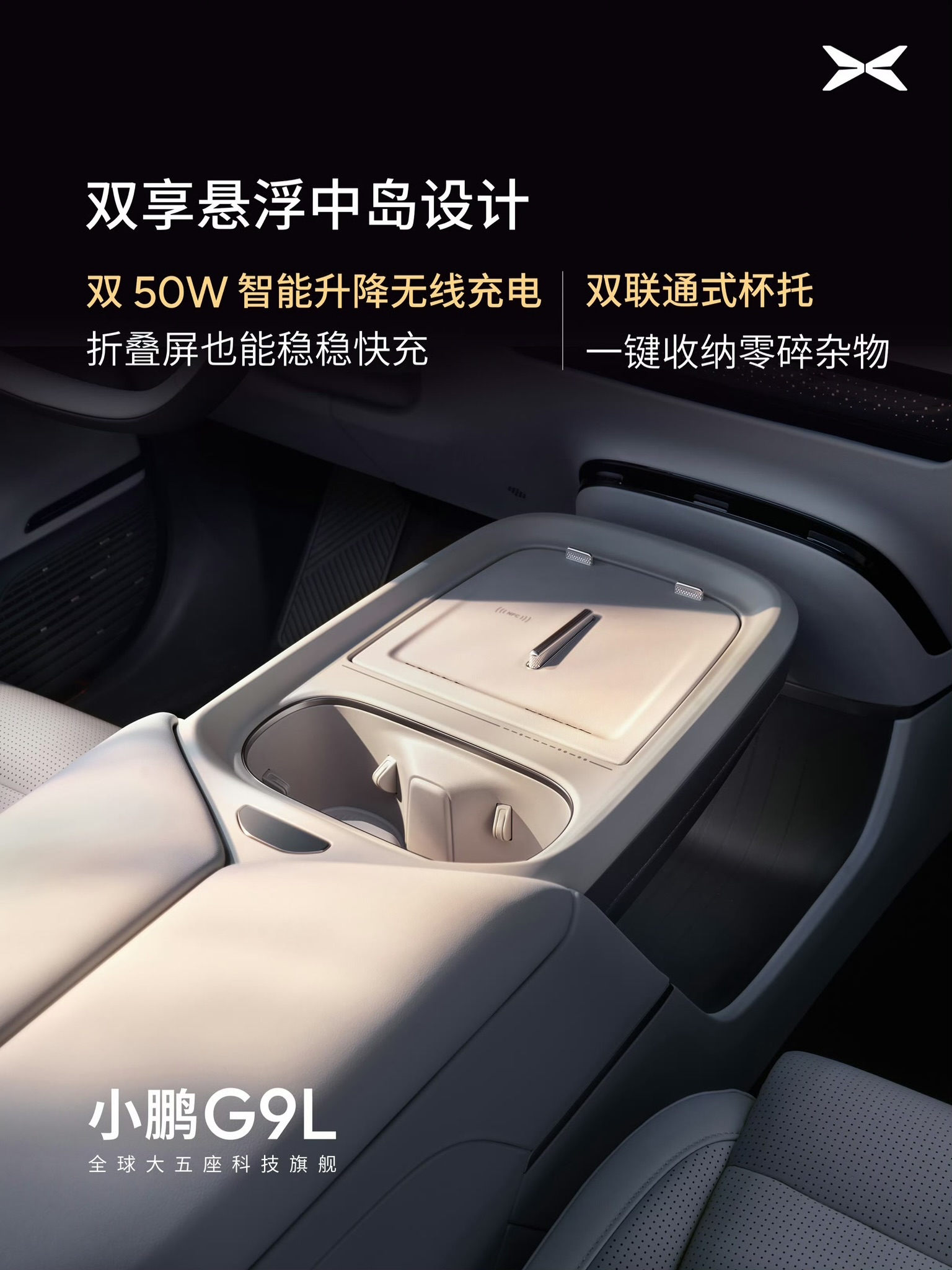
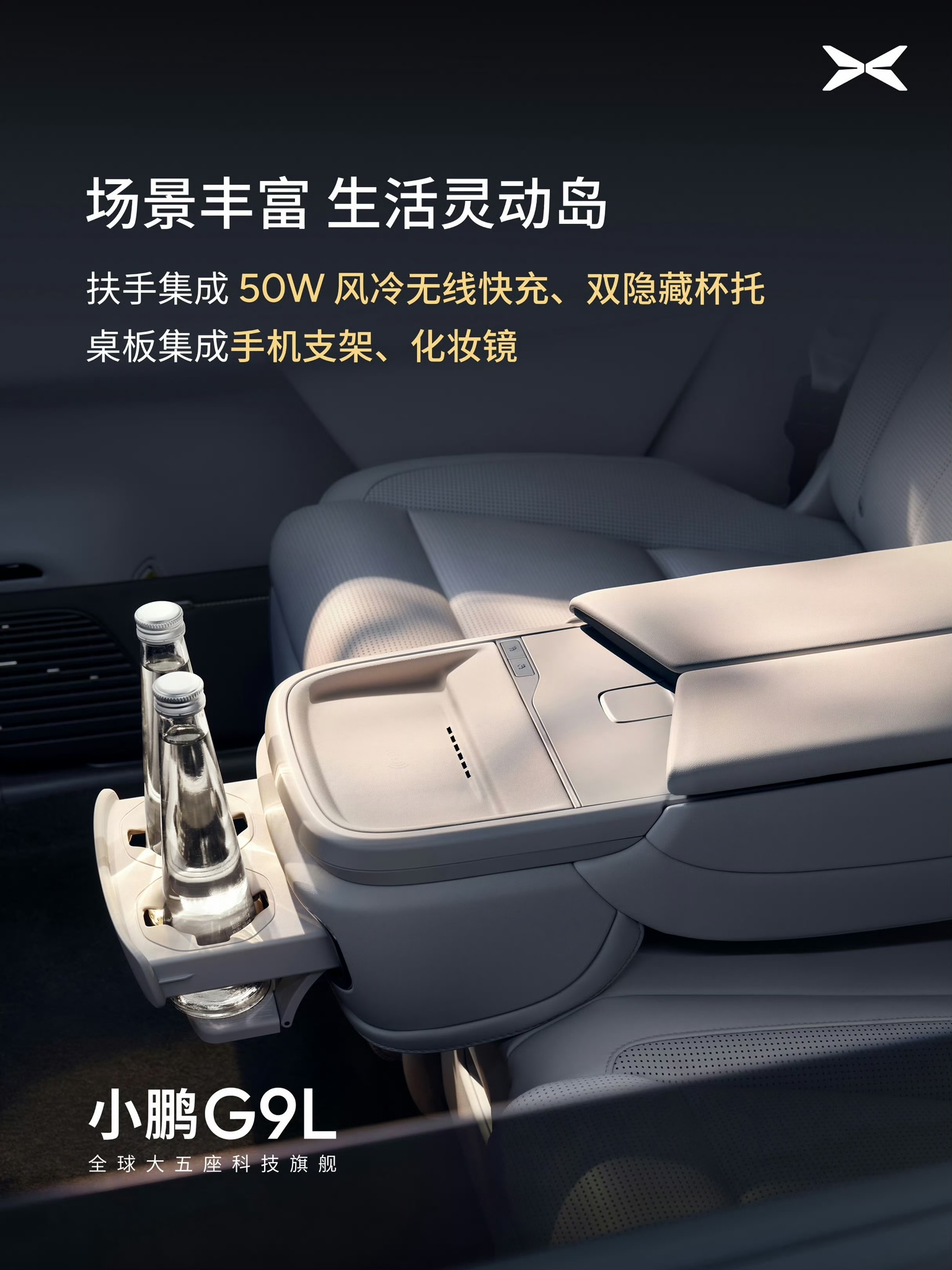
- Floating centre console: dual linked cup holders; dual 50 W height-adjust wireless chargers (foldables); 12V · 180 W outlet under the front centre console
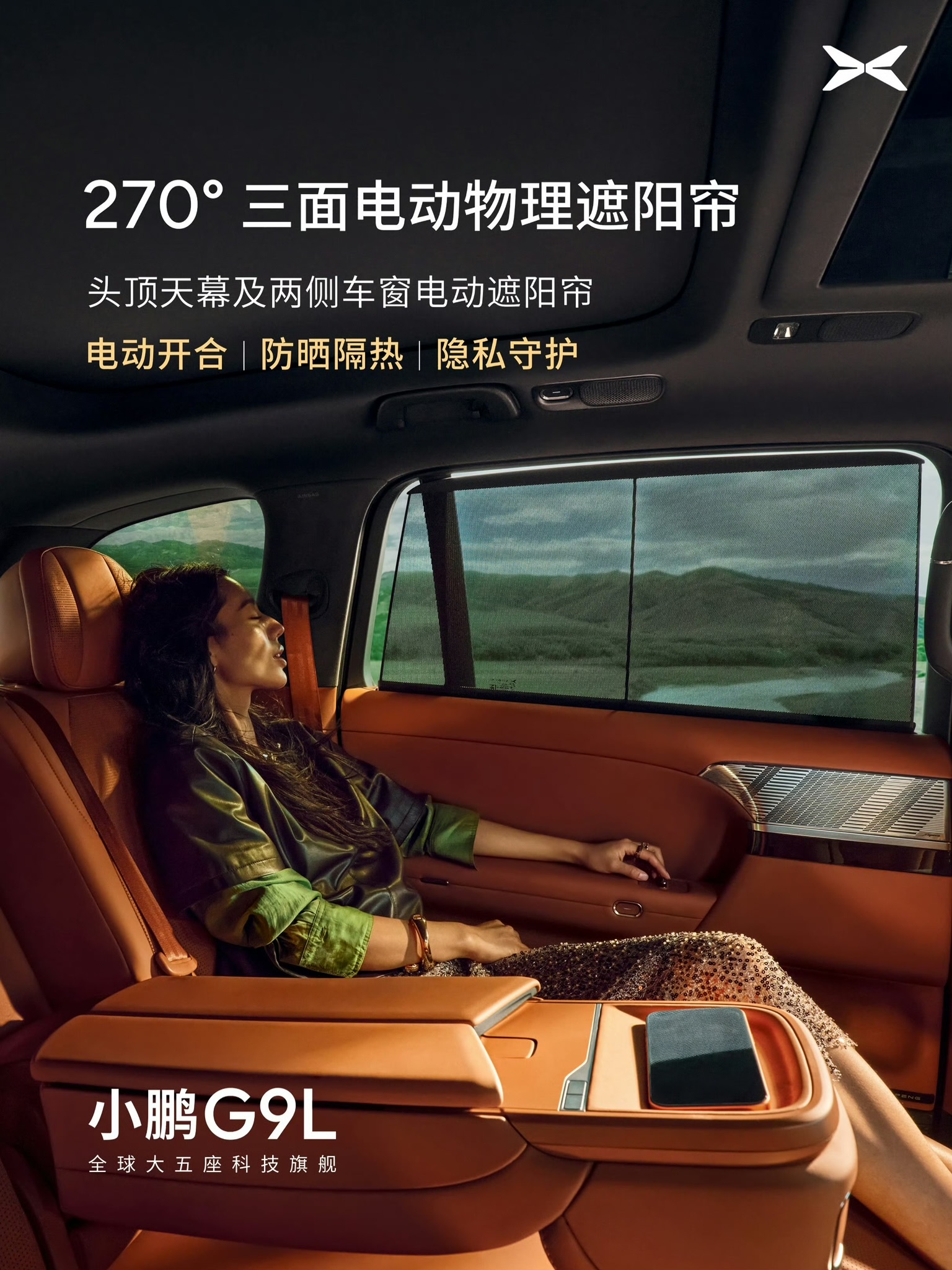
- Panoramic glass roof measuring over 2 m² in fixed 4.96 mm dual-laminated glass (does not open / no traditional sunroof functionality); UV blocking above 99.9% and infrared above 95%; three-sided electric physical sunshades (roof + side windows) with 270° coverage and 95.6% blockout.
- 21.4″ 3K ceiling eye-care touch screen; 7.4 mm bezels; ~92% screen ratio; TÜV Rheinland-certified low blue light; anti-pinch; touch / Bluetooth / voice
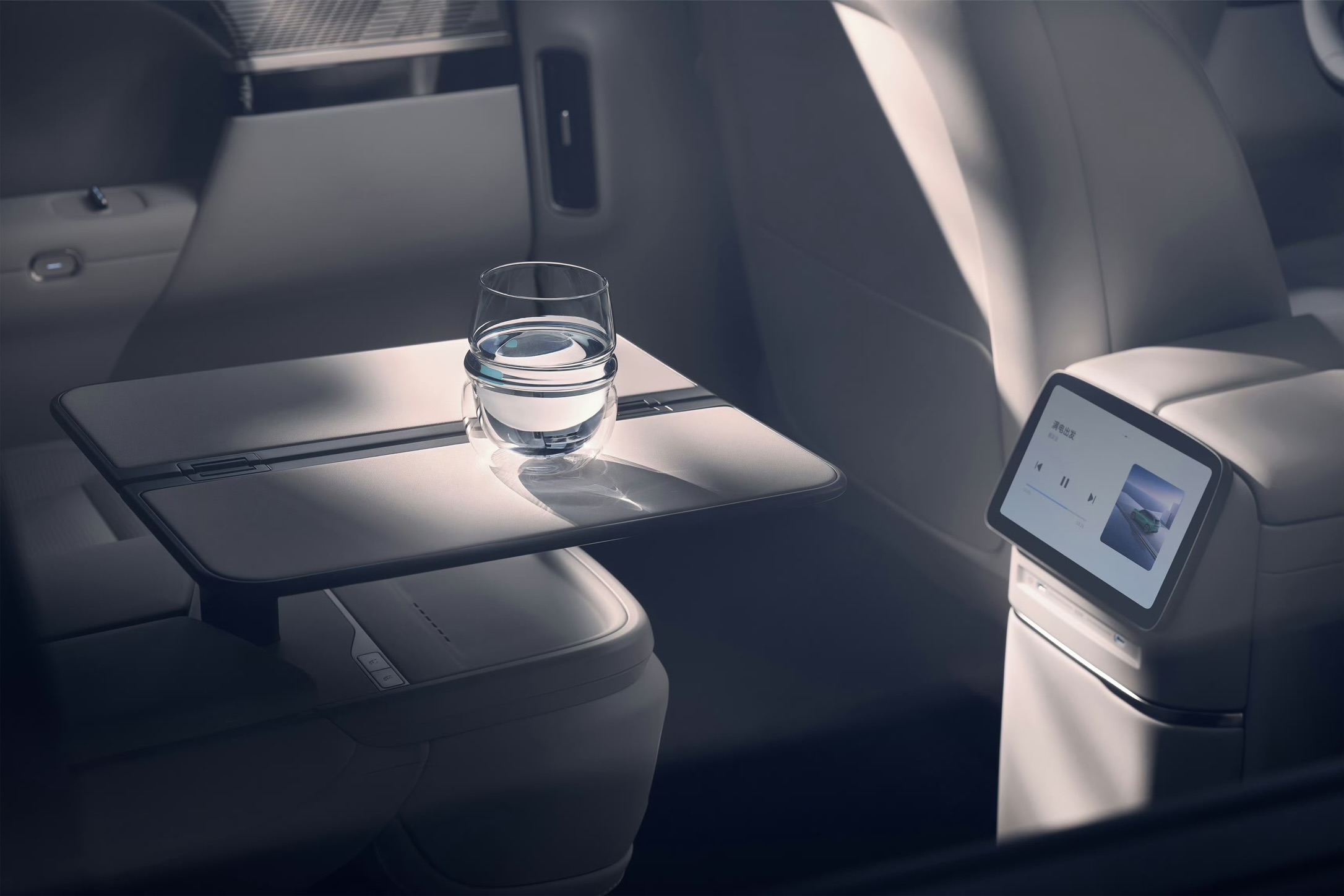
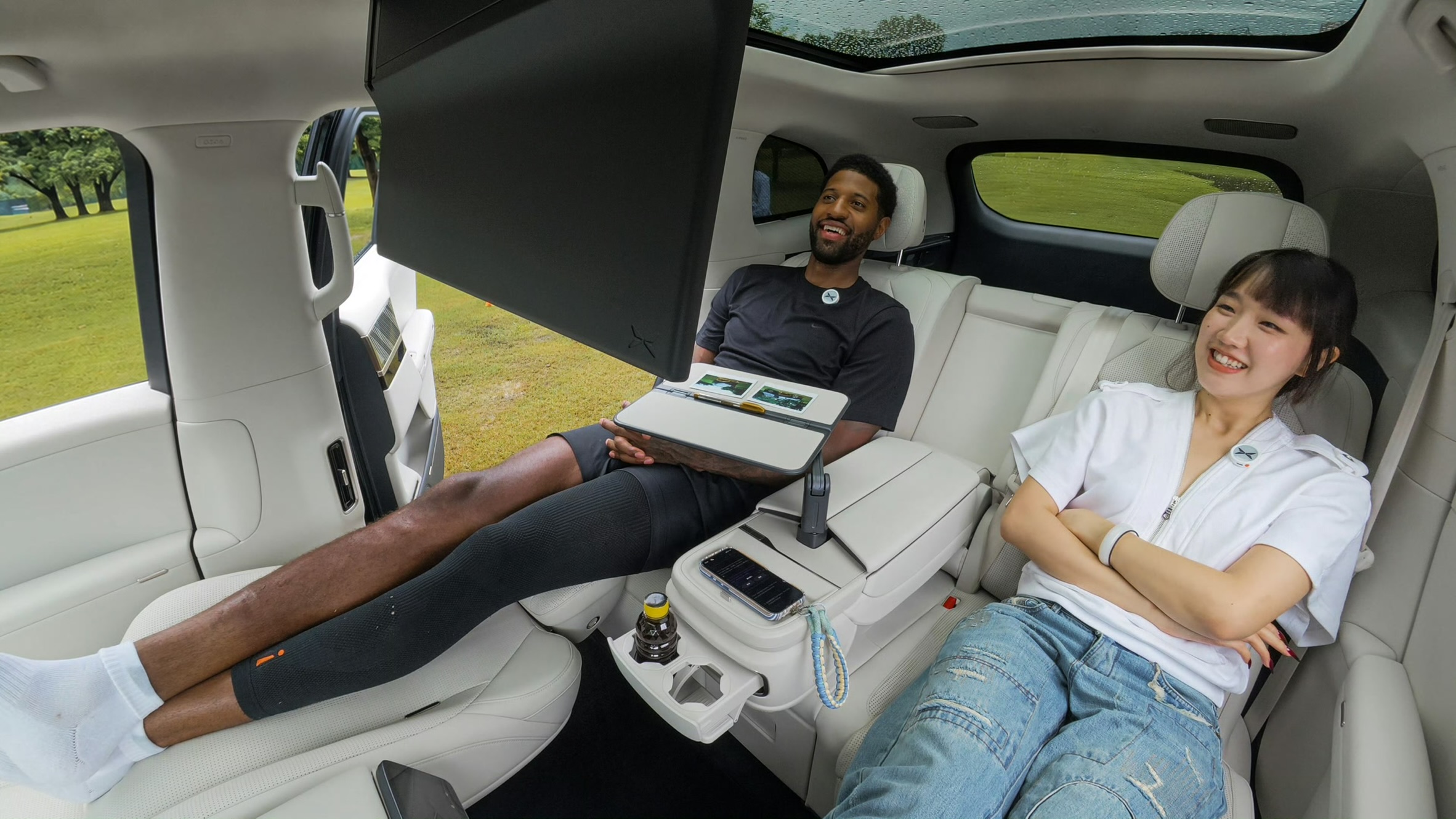
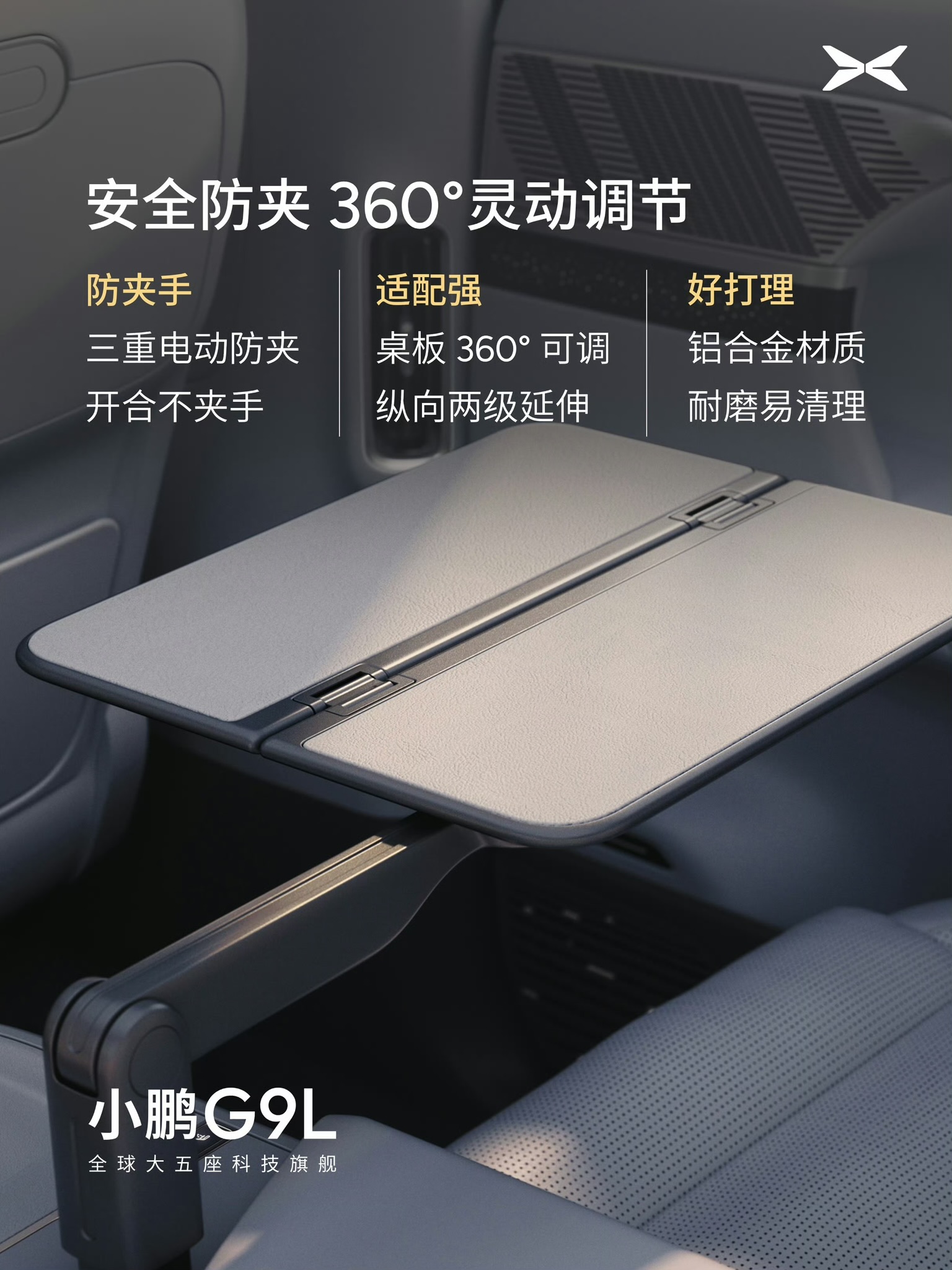
- Smart four-motor executive centre island - open via voice / button / screen; tray auto-levels with seatback; fits 1.3-2.0 m height; core parts 100% aluminium alloy; triple electric anti-pinch; 360° rotate (left / right / shared); dual-fold business-class style tray with lip to stop items under braking; vanity mirror; walkthroughs note the tray must return to a home pose before electric retract
- Life smart island: 50 W air-cooled wireless charge, dual hidden cup holders, phone stand + vanity mirror
- 220V AC outlet at 2.2 kW in the second row - appears to sit under the front seat, beside the fridge
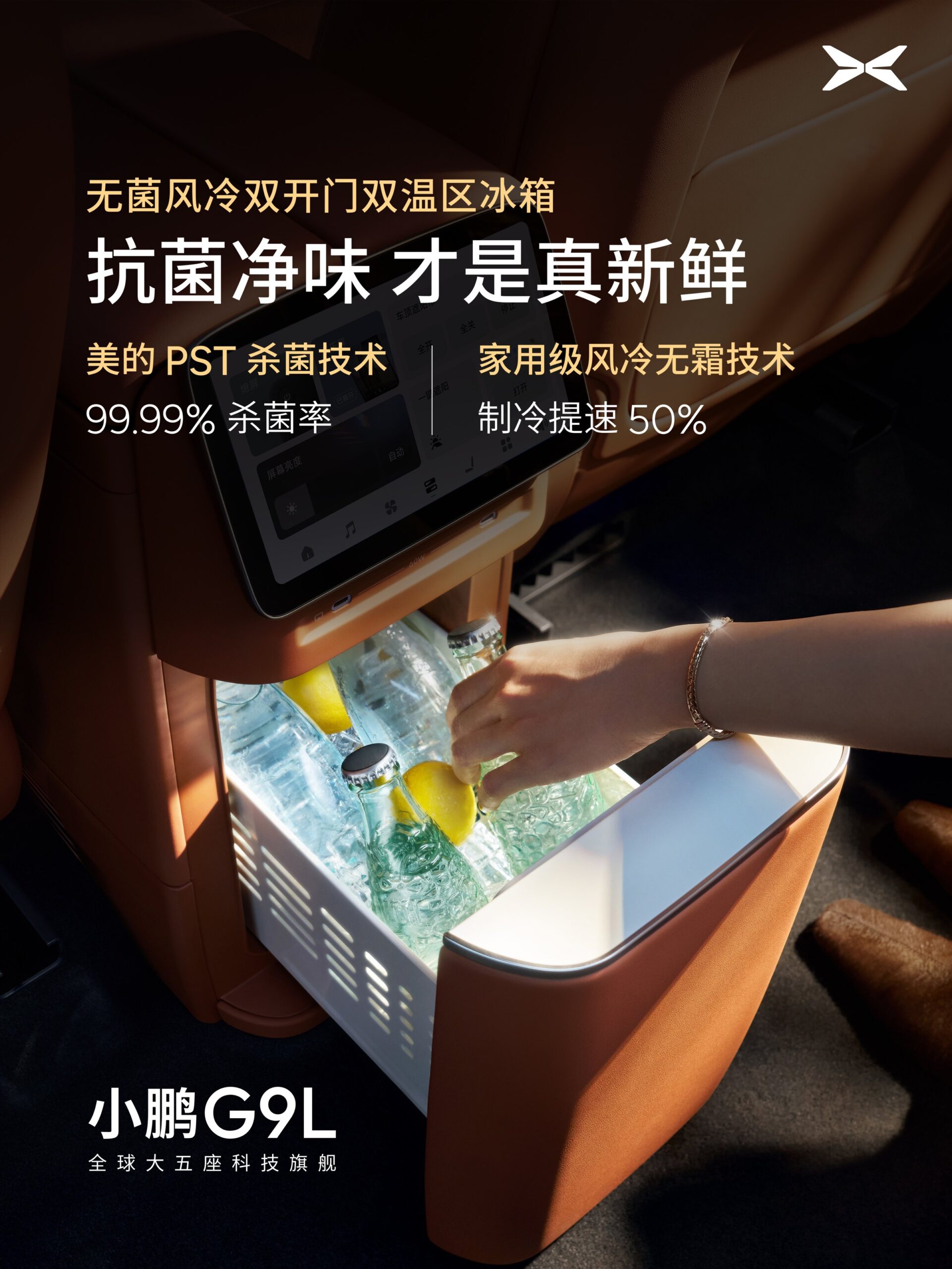
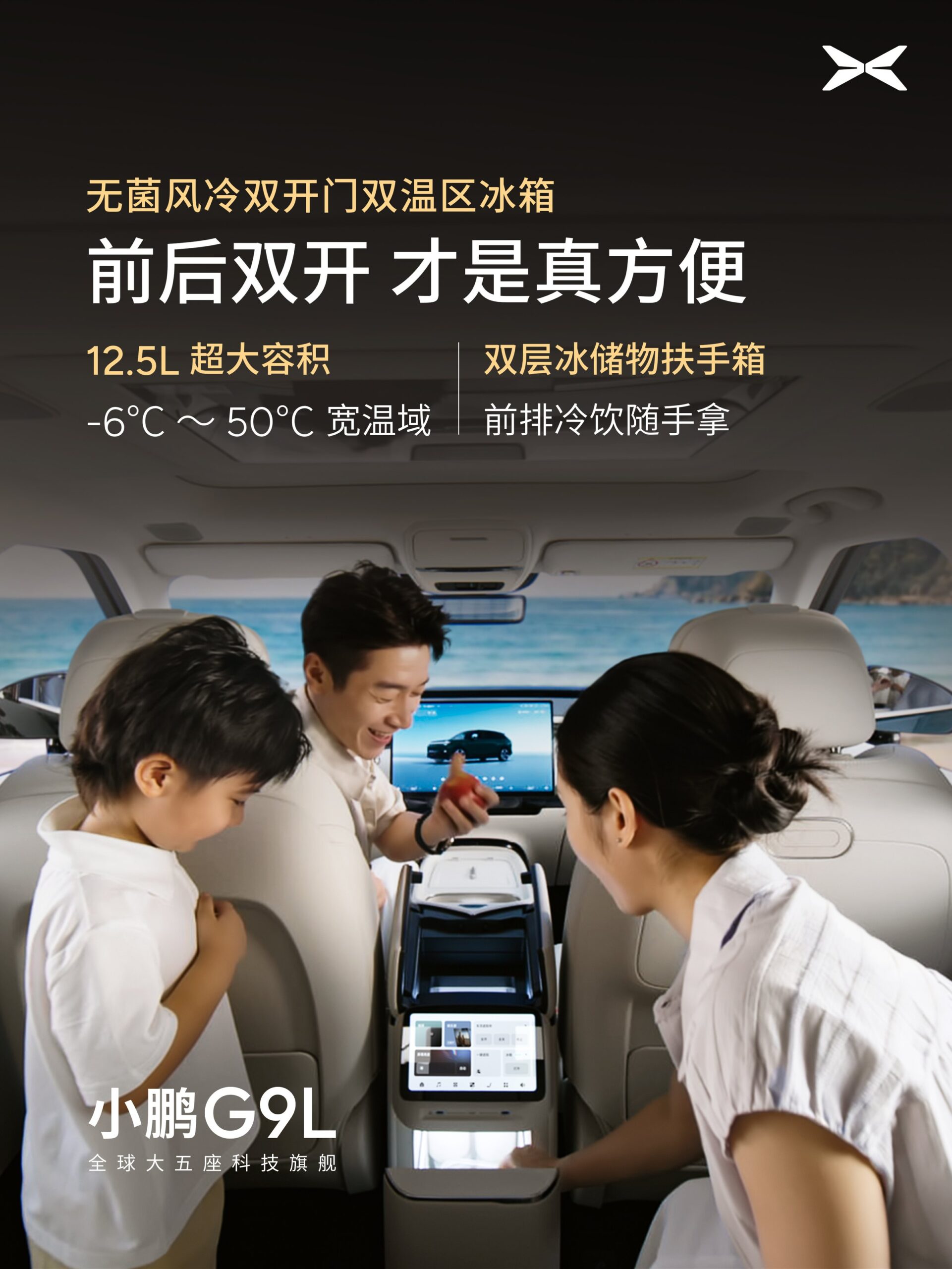
- Sterile air-cooled dual-door dual-zone fridge (same tech family as GX / Midea) - 12.5 L; −6°C to 50°C; frost-free; +50% cooling speed
- Midea PST sterilisation up to 99.99%; 9-minute rapid deodorise; capacity demo 32 × 200 ml cola cans; open via voice / touch from front or rear
- The cabin is marketed as formaldehyde-free. XPENG showed two certificates at the launch without naming who issued them or the threshold they were measured against
Seats and bed modes
Five in a 2+3 layout - the story is second-row luxury and space, not a third row.
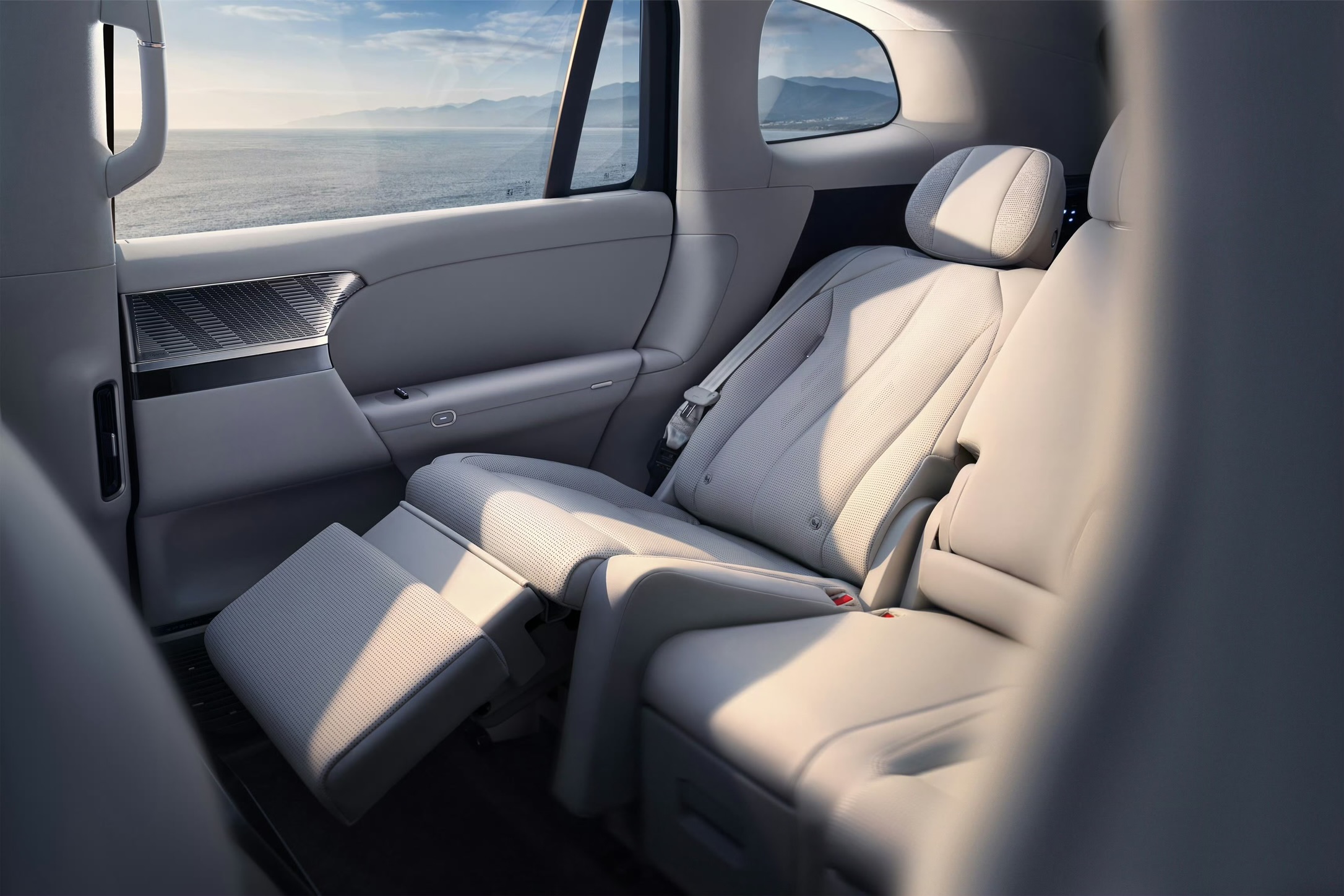
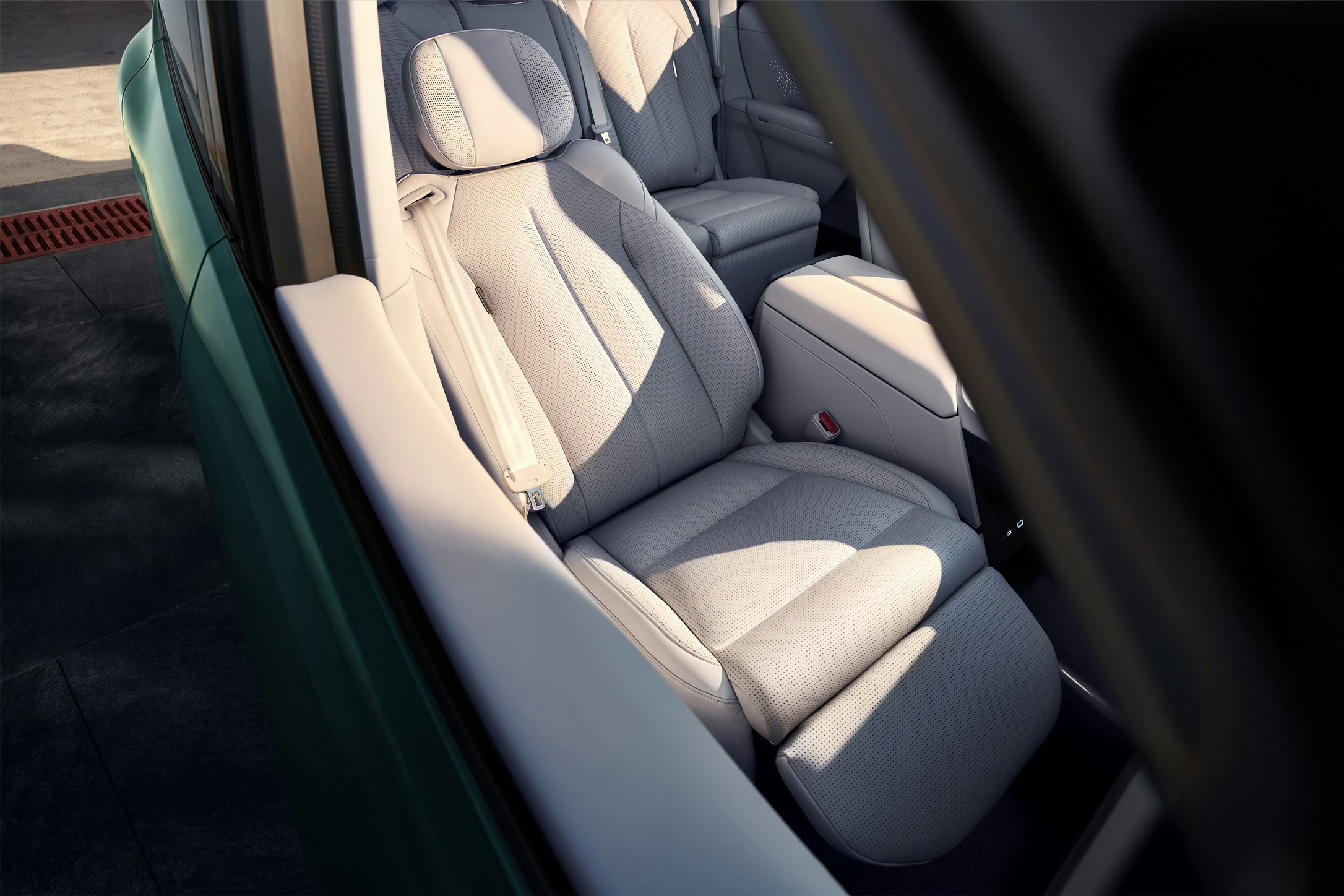
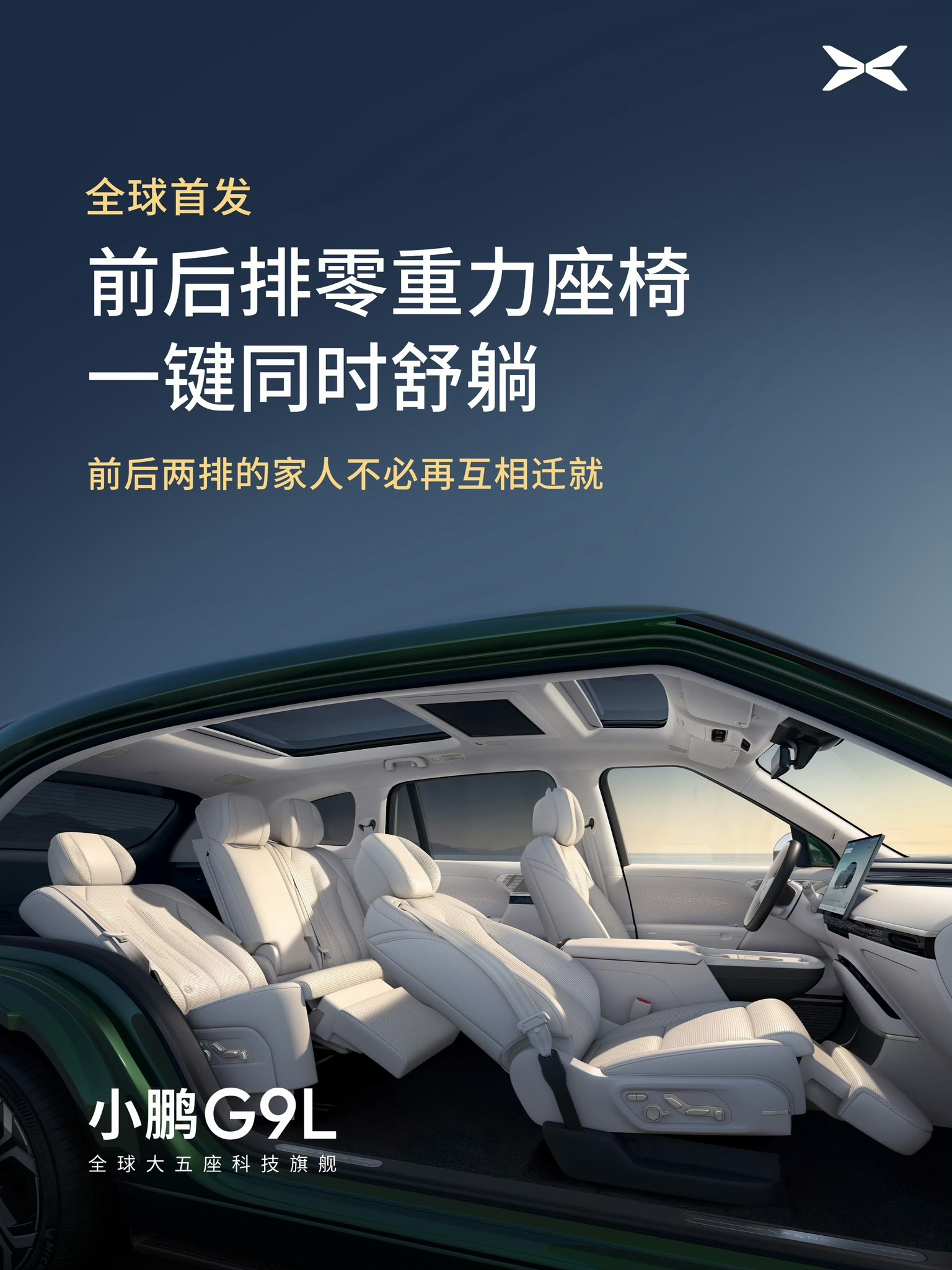
- Seat equipment: about 24-way electric adjustment · 3-level heating · 16-point massage. The configurator calls the seats Cloud Seats 3.0 (云感座椅3.0) and places the zero-gravity seat on the second row’s right side - the launch material speaks of both rows, the configurator specifies one seat
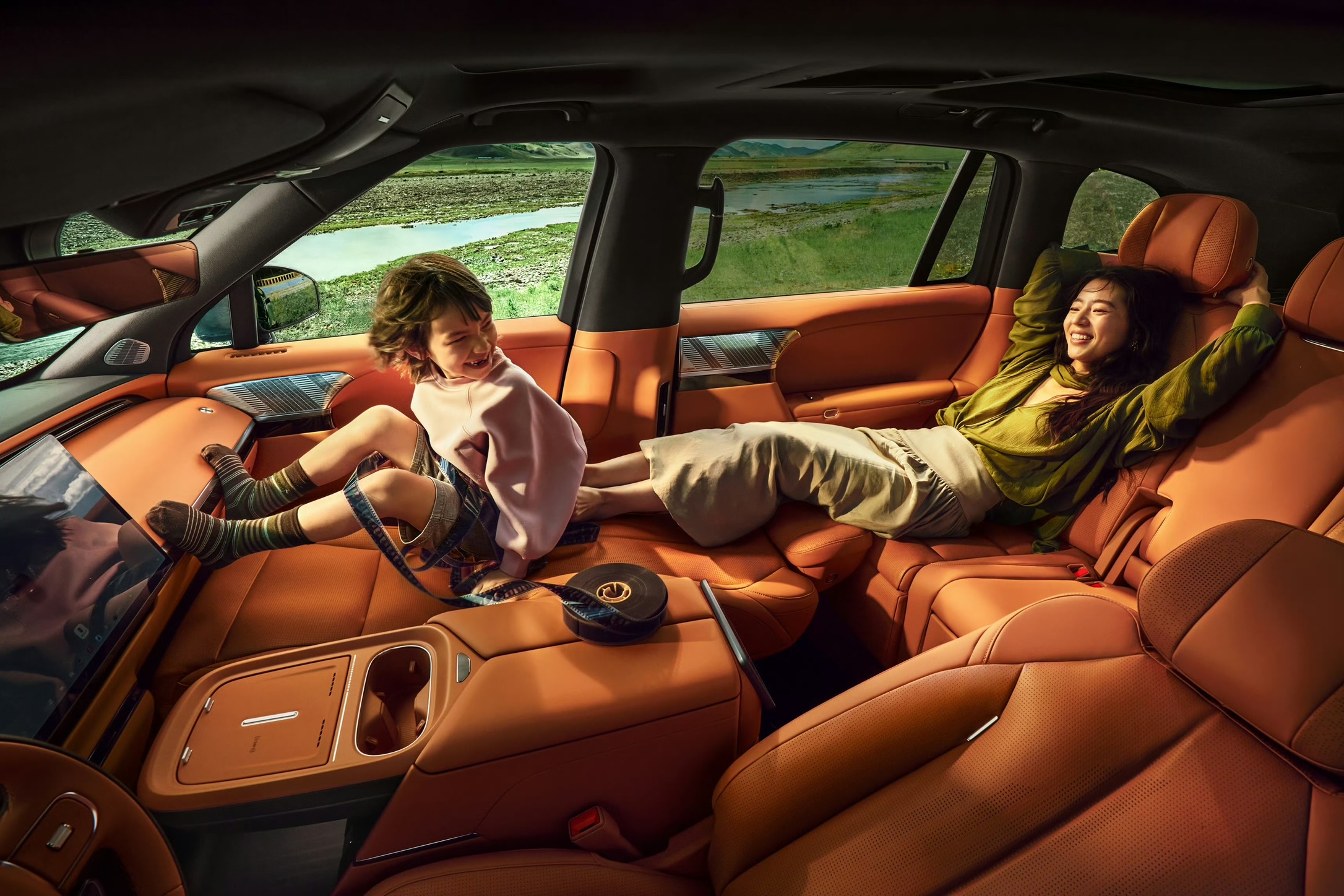
- Front + rear zero-gravity seats with one-click simultaneous recline (XPENG: world premiere / class-only); the launch slide puts the rear seats’ zero-gravity recline at 146°, and walkthroughs mention ankle angles of about 109° front / 102° rear
- AI Active Fit seats - support adjusts to body type and posture (announced with the car); the numbers sit in the sensing bullet below
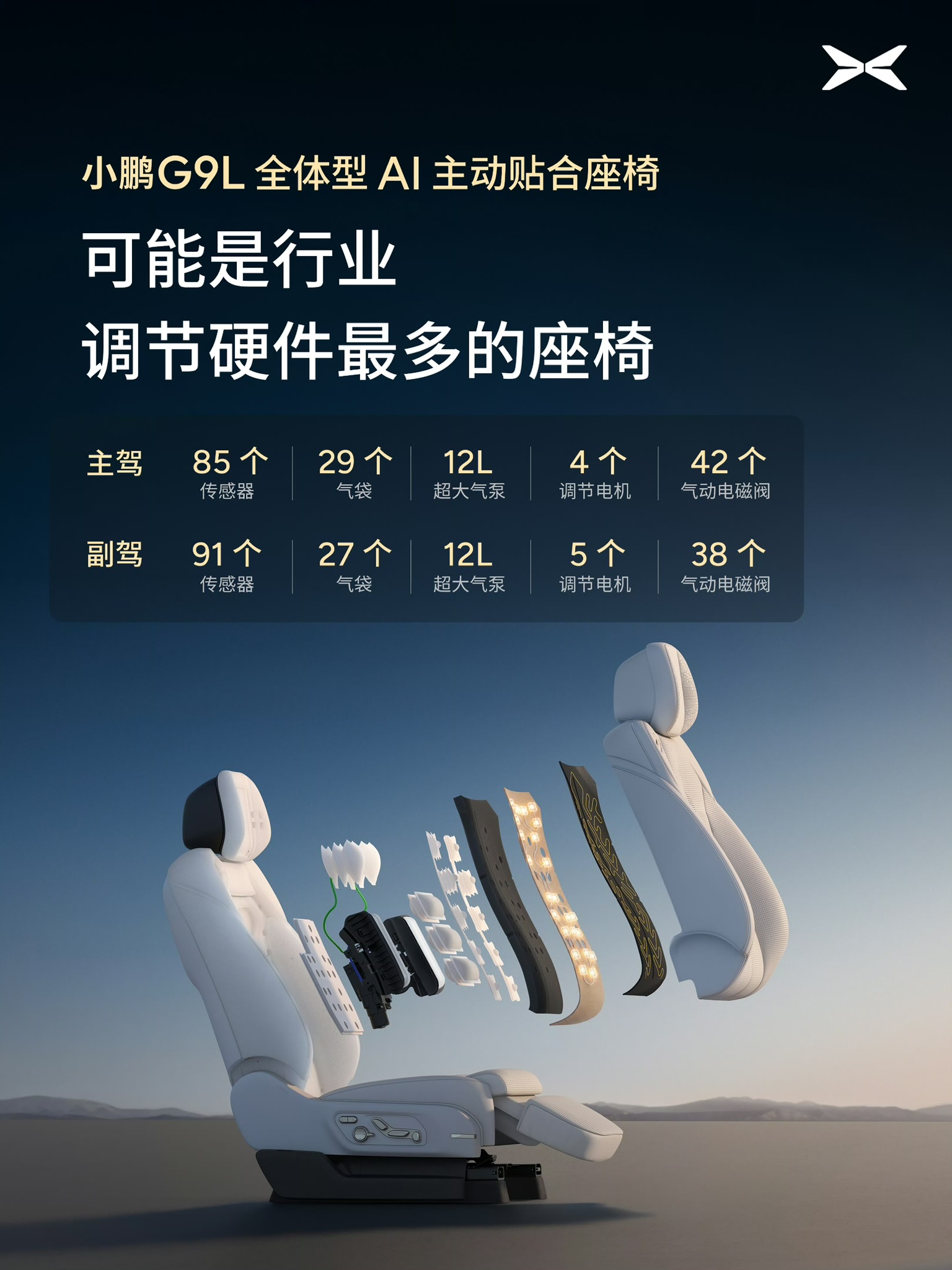
- Seat sensing: 2 g resolution · 2 ms response · 85 sensors (driver) / 91 (passenger) · 29 / 27 air chambers · AI trained on 300,000+ body datasets, fitting 98% of body types
- The adjustment hardware behind those figures, from XPENG’s own seat slide: a 12-litre air pump in each front seat · 4 adjustment motors (driver) / 5 (passenger) · 42 pneumatic solenoid valves (driver) / 38 (passenger). XPENG calls it possibly the seat with the most adjustment hardware in the industry - its own wording, not a measured comparison
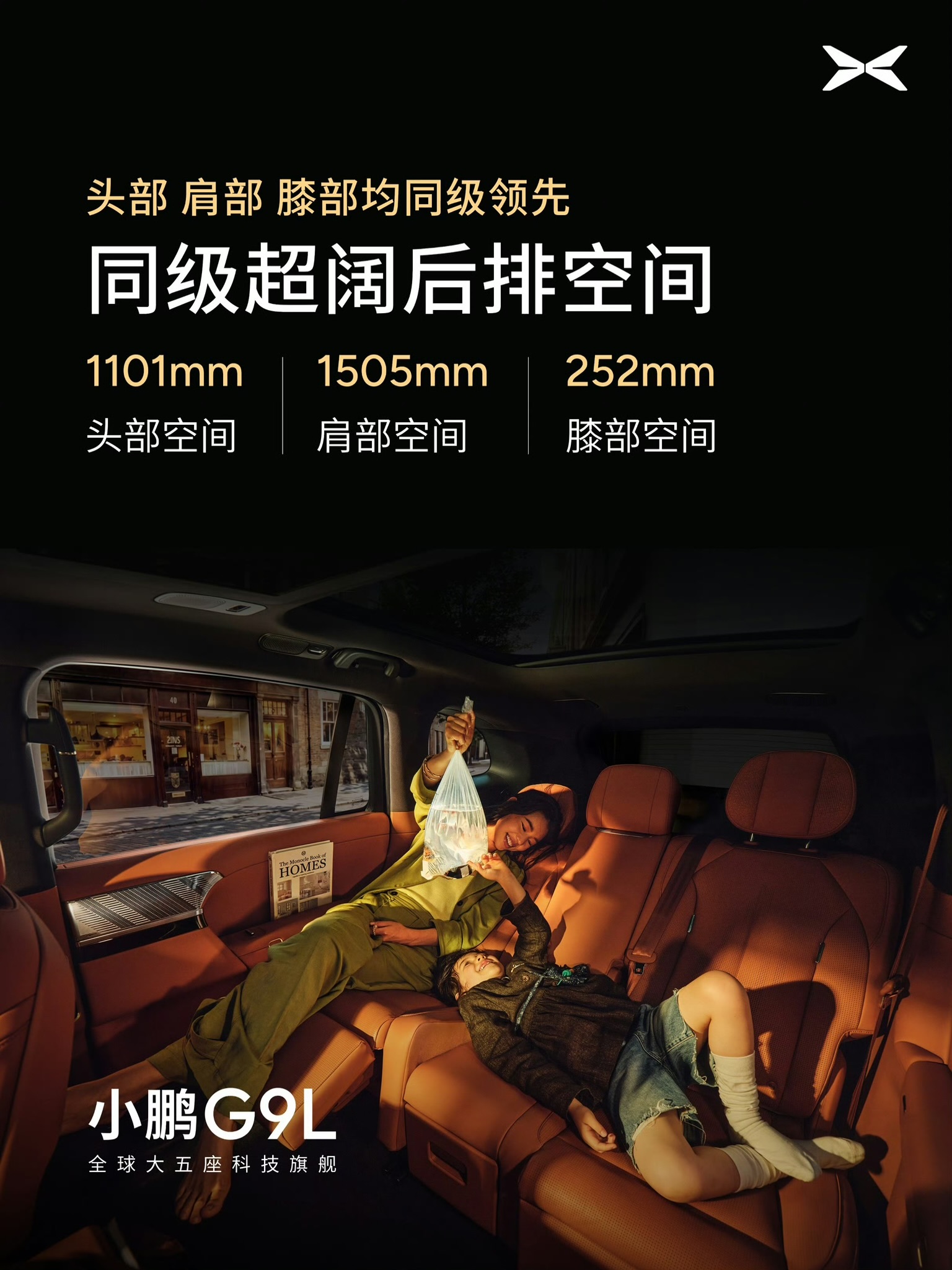
- Rear space: knee 252 mm · legroom 1,365 mm · shoulder room 1,505 mm · headroom 1,101 mm · cushion width 1,370 mm
- Five-seat one-key bed 1,865 × 1,505 mm; single bed 1,865 × 550 mm; no headrest removal; “beach-chair” one-click; single-sided front+rear bed mode also shown. In XPENG’s software the sleep feature is called XSLEEP - what many know as camping mode from other EVs
- The AI seat is specified to fit occupants from 140 to 195 cm and 40 to 140 kg (launch slide)
Audio
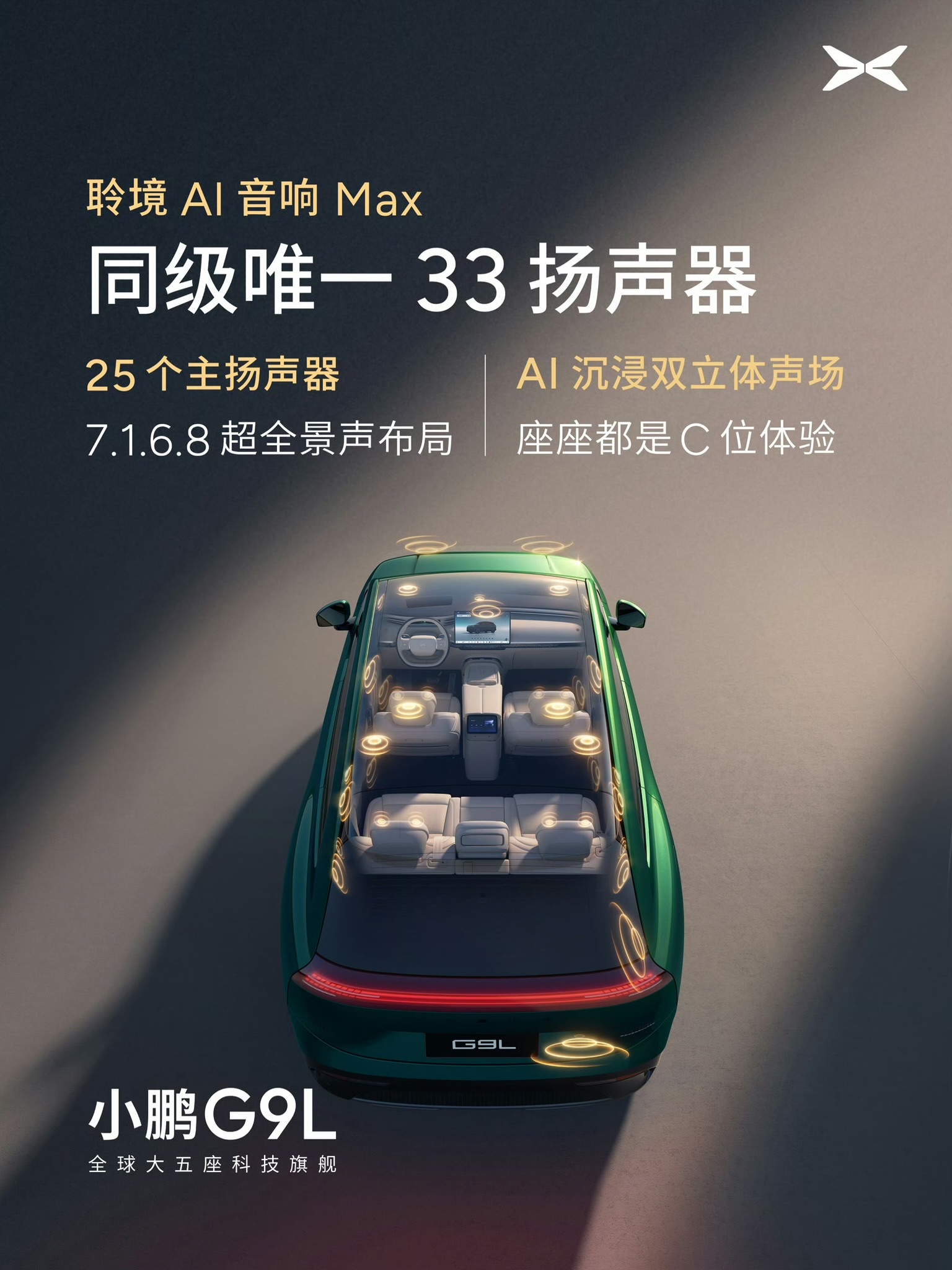
- Lingjing AI Sound Max: 33 speakers - 25 main + 8 independent headrest; 7.1.6.8 layout - the Flagship variant; the pre-sale configurator lists 23 speakers on the other variants
- Independent front/rear sound zones (e.g. music vs movie)
- Headrest speakers for private calls and clearer navigation
- Noise damping (NVH): sound-deadening material in 122 places in the body · 9 windows in laminated acoustic glass · RNC active road-noise cancellation; on the EREV, ENC holds the noise change to 0.5 dB at most when the range extender starts; active noise cancellation is listed on every variant in the configurator
Boot and storage
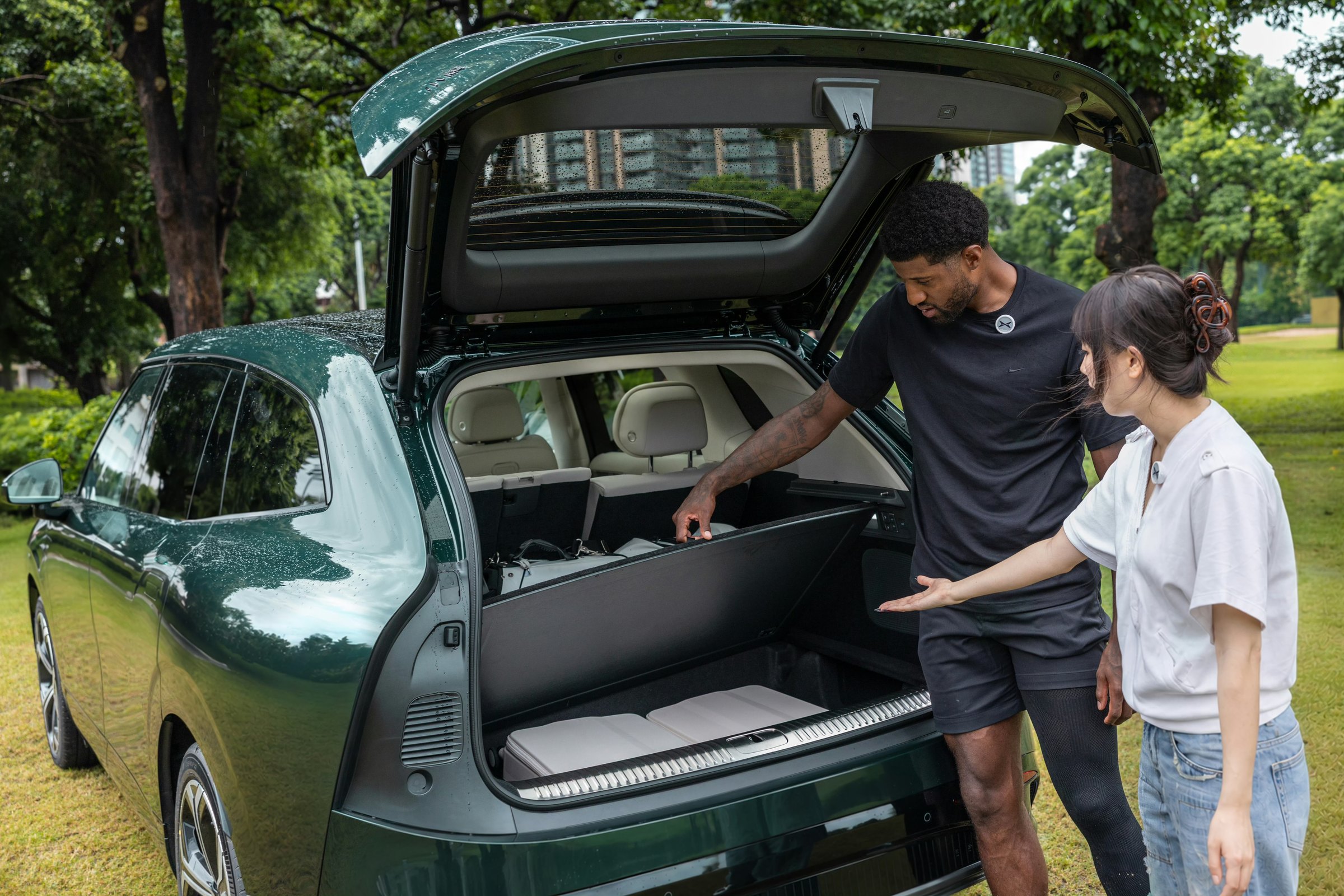
- Boot 1,152 L with the seats up - the largest in class according to XPENG. The configurator quotes room for 14 × 20″ suitcases without folding seats; XPENG’s demos show 5 × 24″ suitcases on the main floor
- The Guangzhou debut wall breaks it into four zones: 904 + 192 + 18 + 38 L (main floor / lower well / side box / under-floor) - see the gallery
- Sunken well of 230 L including the under-floor space - XPENG’s demo: 2 × 20″ suitcases and two backpacks
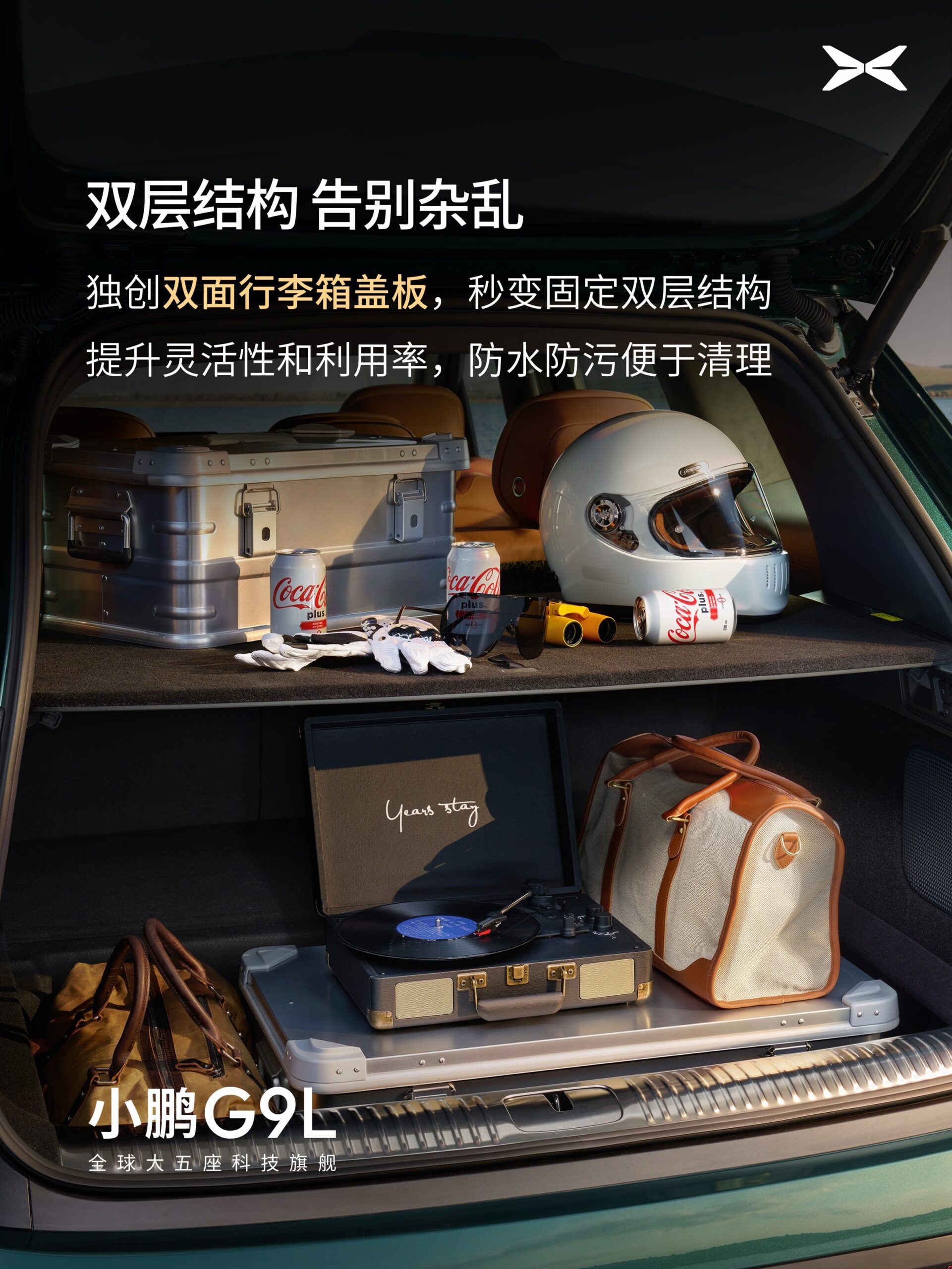
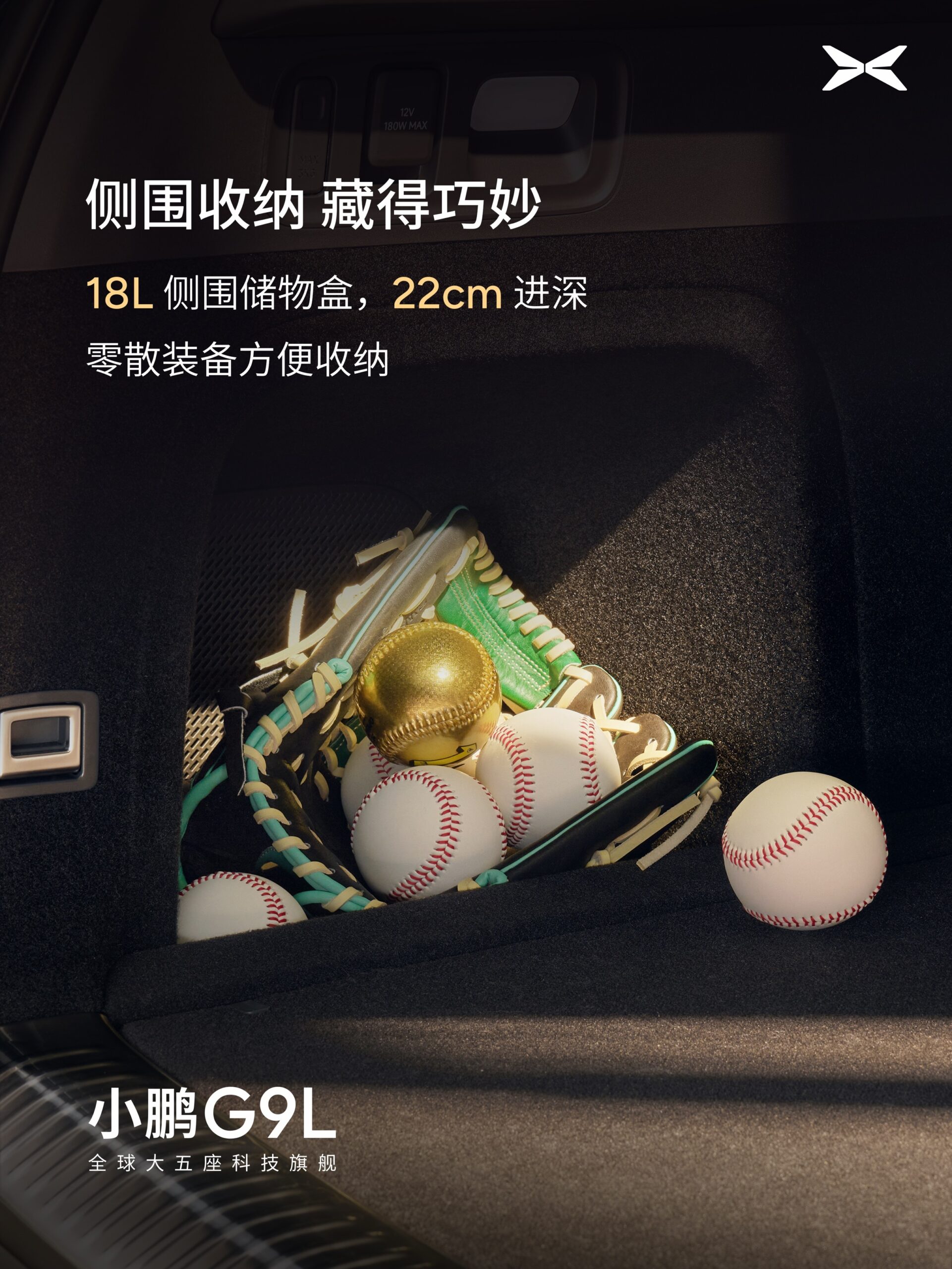
- Side storage box 18 L / 22 cm deep; dual-layer boot with double-sided waterproof cover board (the cover doubles as a shelf); wide opening + low sill; exterior voice open; side hooks and a larger left cubby
- Frunk 109 L on every Chinese BEV variant (pre-sale configurator)
- 12V · 180 W outlet in the boot
- Boot-area controls for air suspension height and electric rear-seat fold (shown on Chinese walkthrough cars)
Platform & chassis
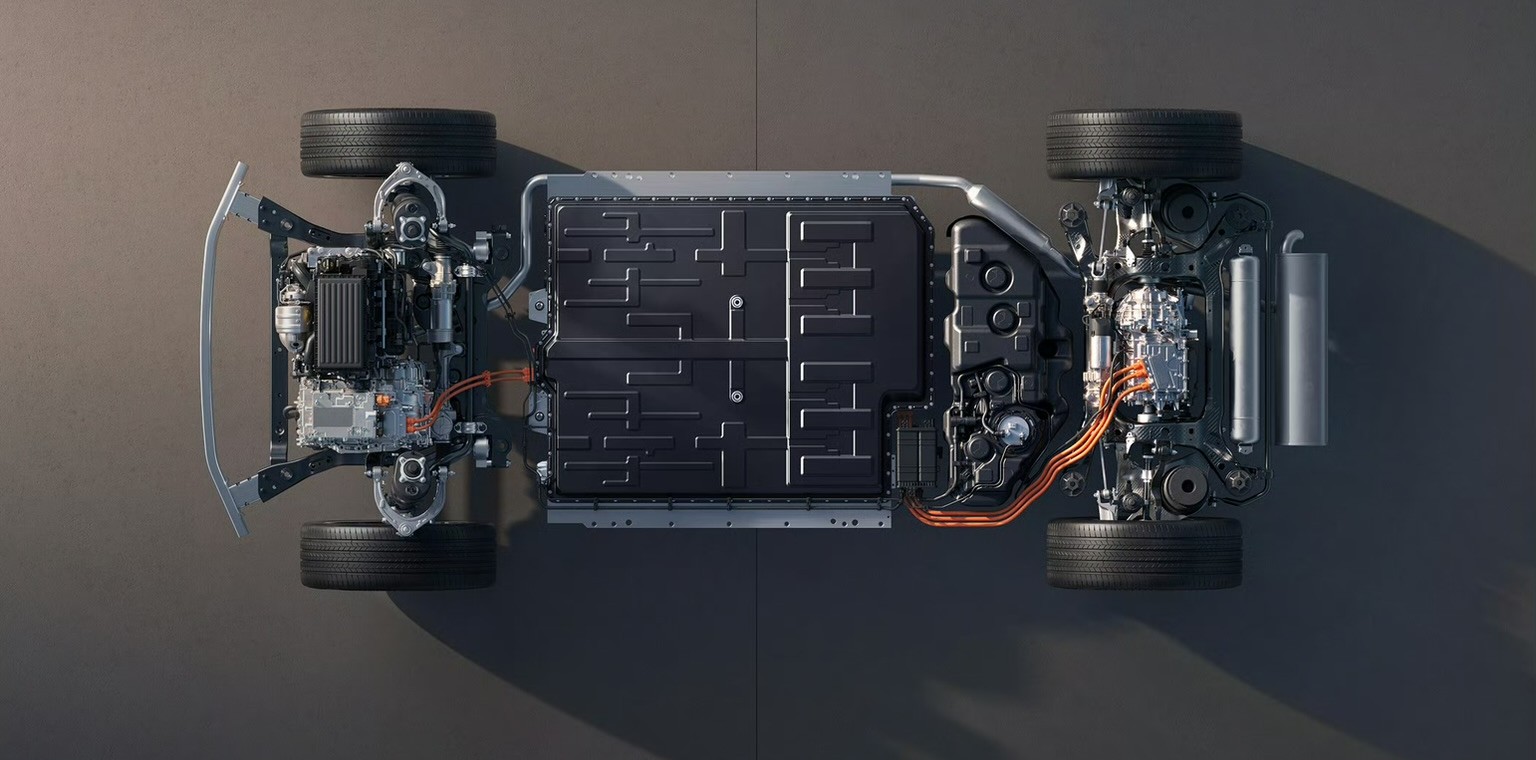
The G9L is one of the first cars on XPENG’s SEPA 3.0 architecture, after the GX, with which it shares its electric drivetrain and chassis - standard on every trim:
- Front double wishbone, rear H-arm multi-link - all-aluminium; XPENG quotes a weight saving of 35 kg
- Dual-chamber air suspension with adaptive variable-damping dampers - roll stiffness +39% with the chamber valve closed; ride height -30 to +40 mm with ground clearance up to 226 mm, and the dampers adjust up to 4,000 N, 50 times a second
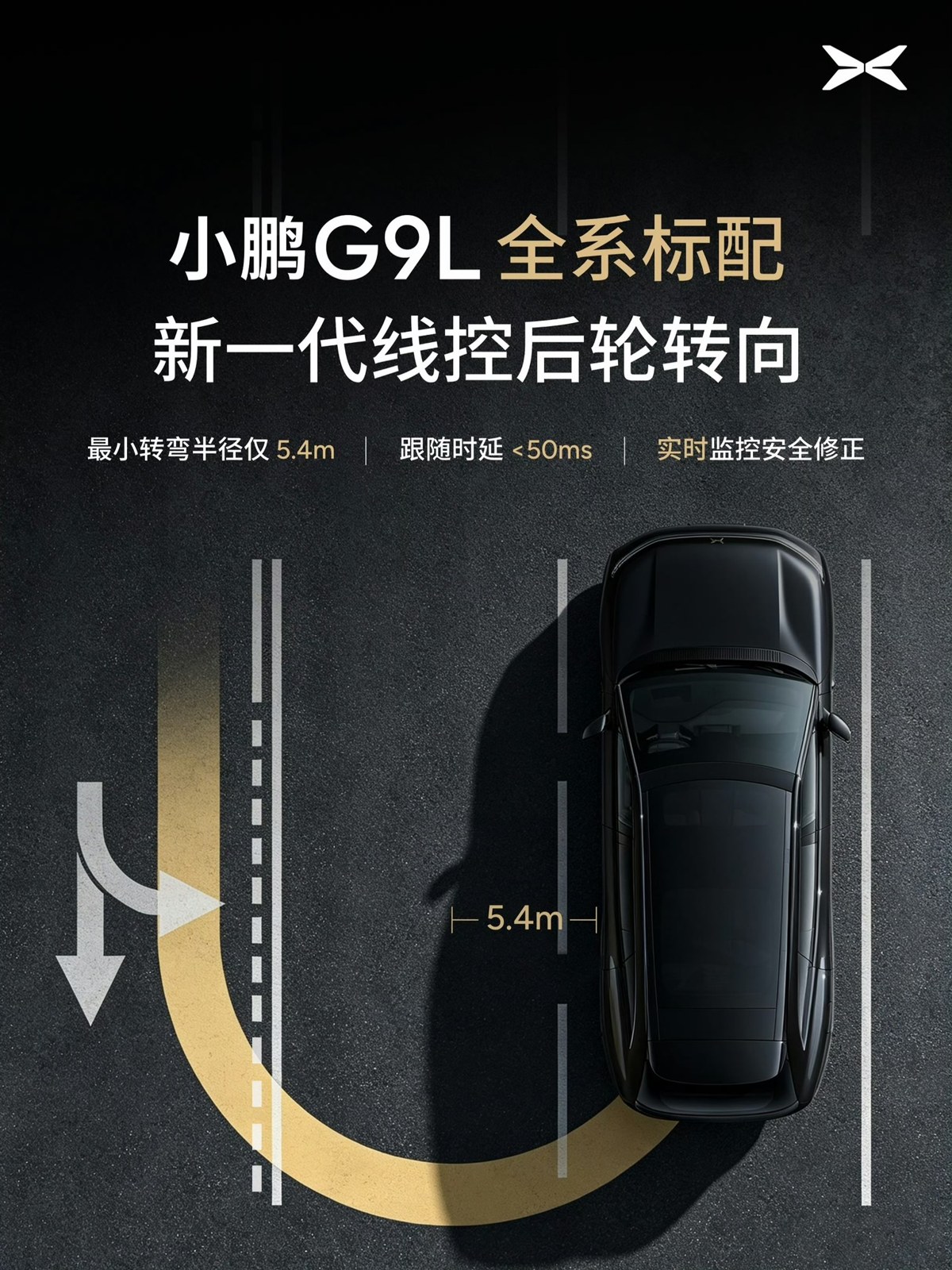
- Rear steer-by-wire standard - XPENG’s Europe road-test post (18 August 2026) confirms it for European test cars too; angles, turning radius and XPENG’s plates are under Rear-wheel steering
- X-VMC - XPENG’s in-house chassis motion control, fusing suspension, steering and braking inputs
- Tyres developed with Michelin - XPENG quotes 5% higher moose-test capability and 5-7% shorter braking distance; the comparison baseline is not stated. He Xiaopeng puts the moose-test pass speed above 80 km/h (17 August 2026). In XPENG’s own TOP G9L film a meter on the windscreen reads 78 km/h through the cones and 87 km/h as the session maximum
- 700 mm wading depth with two dedicated radars for wading as standard
Rear-wheel steering
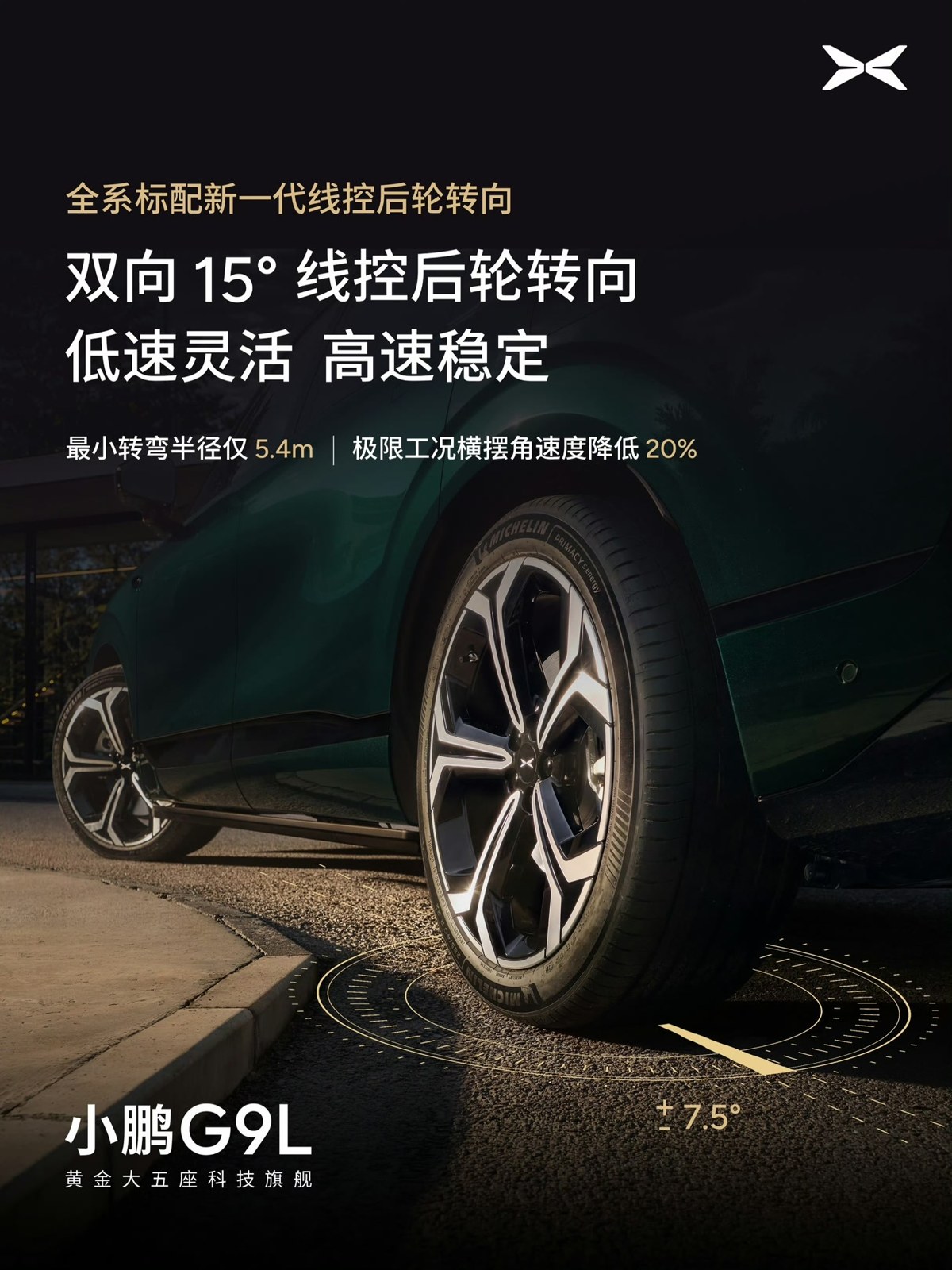
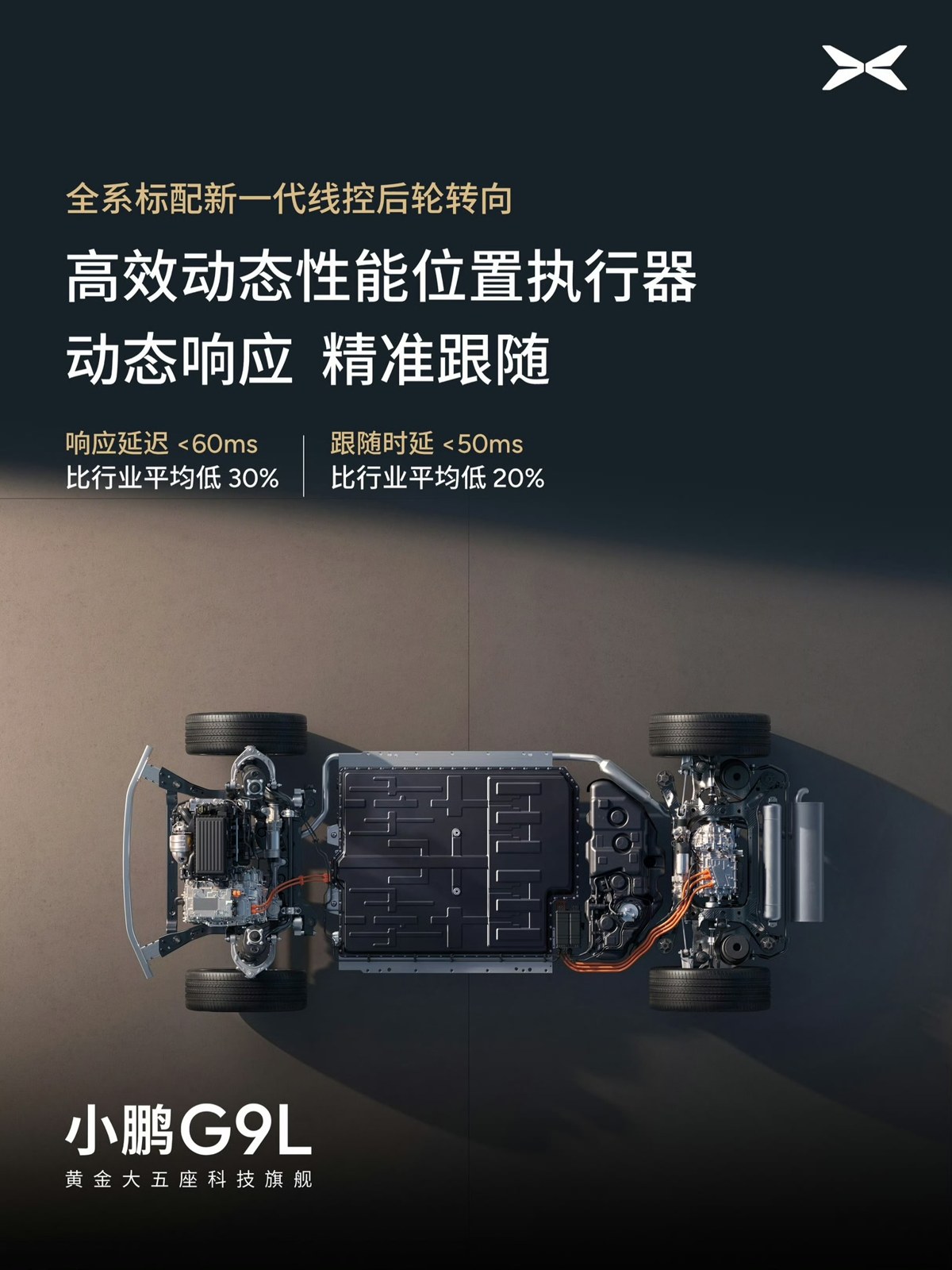
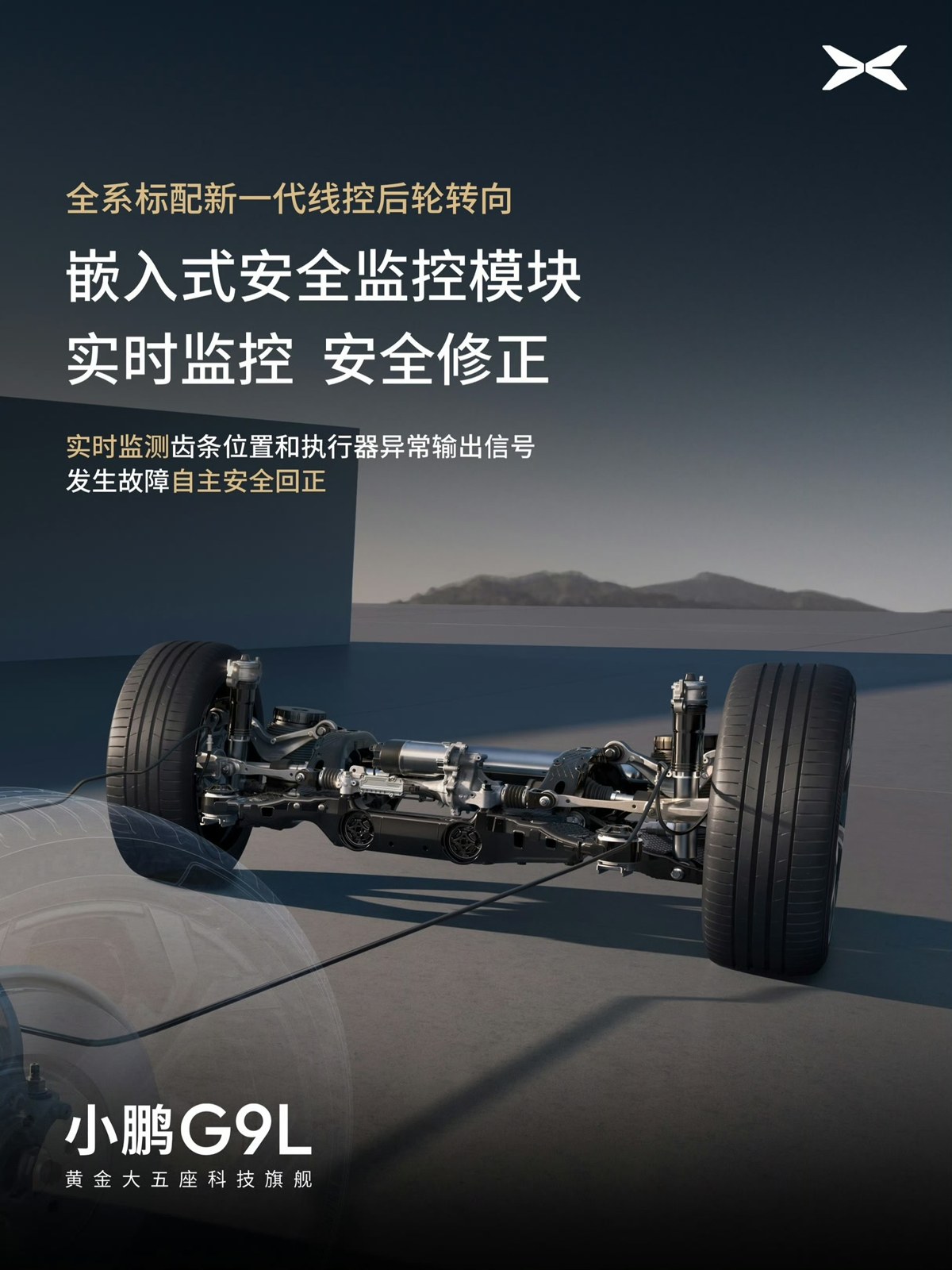
Every Chinese trim carries it as standard, and four spec posters on 31 August 2026 put numbers on it. The rear wheels turn up to 7.5 degrees each way, by wire with no mechanical link to the steering wheel, and that brings the turning radius down to 5.4 m, the figure XPENG also quotes for the X9; XPENG’s clip of a two-lane U-turn taken in one go is under Videos. At speed the rear wheels turn with the fronts to steady the car. A monitoring module watches rack position and actuator output and returns the wheels to centre by itself if something fails. The response and latency figures below are XPENG’s own, and the industry average it measures against is not named.
- Rear-wheel angle: 7.5 degrees each way, 15 degrees across the span
- Turning radius: 5.4 m
- Actuator: response under 60 ms, follow latency under 50 ms (XPENG: 30% and 20% below the industry average)
- Yaw rate at the limit: 20% lower (XPENG lab claim)
- Europe: confirmed on the European test cars in XPENG’s road-test post of 18 August 2026; the European trims and their figures are still open, see Open questions before Paris
- Braking - 34.2 m from 100 km/h, quoted at the launch keynote on 17 September 2026
Safety
The G9L inherits flagship safety capability from the GX programme (active and passive), comes standard with what XPENG calls aviation-grade safety redundancy, and is developed to five-star requirements from four major global assessment bodies. Independent crash and rating results are still pending - everything below is XPENG’s own programme, from the launch presentation and the official posts that followed (11-19 August 2026):
- Body - 16,000 T integrated die-casting front and rear (GX-shared) and 56,000 N·m/deg torsional rigidity; 11 airbags including a three-chamber far-side bag
- Battery protection - side structure rated for 36 t static crush (3.5 times the Chinese GB standard) and the underbody for 700 J impact (4.67 times); IP68 (1 m water for 24 h) and IP69K sealing; an EIS battery safety chip watching the cells in real time; XPENG also quotes the pack surviving over 1,000 °C surface heat and 24 hours with no fire after damage; a durability programme of 130 packs over 21+ million km equivalent
- Redundancy - brake-by-wire triple, drive motors dual, emergency communication dual and door unlocking quadruple, with mechanical emergency handles inside and outside
- Stability functions for extreme weather: rain up to 120 mm/h, crosswind up to force 12, emergency evasion (AES) at 130 km/h, ice at 100 km/h and a tyre blow-out at 180 km/h - the figures are operating limits, not test results
- 192 crash tests in development; designed to Euro NCAP 2027 (30 test items), ANCAP 2027 (30), C-NCAP 2024 (27) and C-IASI 2023 (26). Design targets: no rating exists yet, and the 2027 protocols are not yet in force
- The 720° seven-fold challenge - one car through a 5-minute full immersion, a 35 km/h underbody scrape, a 50 km/h spiral rollover, 100 km/h frontal, rear and side impacts, and a 150-second battery fire. XPENG’s own footnote says the challenge was run by a commissioned test agency under conditions XPENG set - a demonstration, not an independent assessment
Assisted driving & AI compute
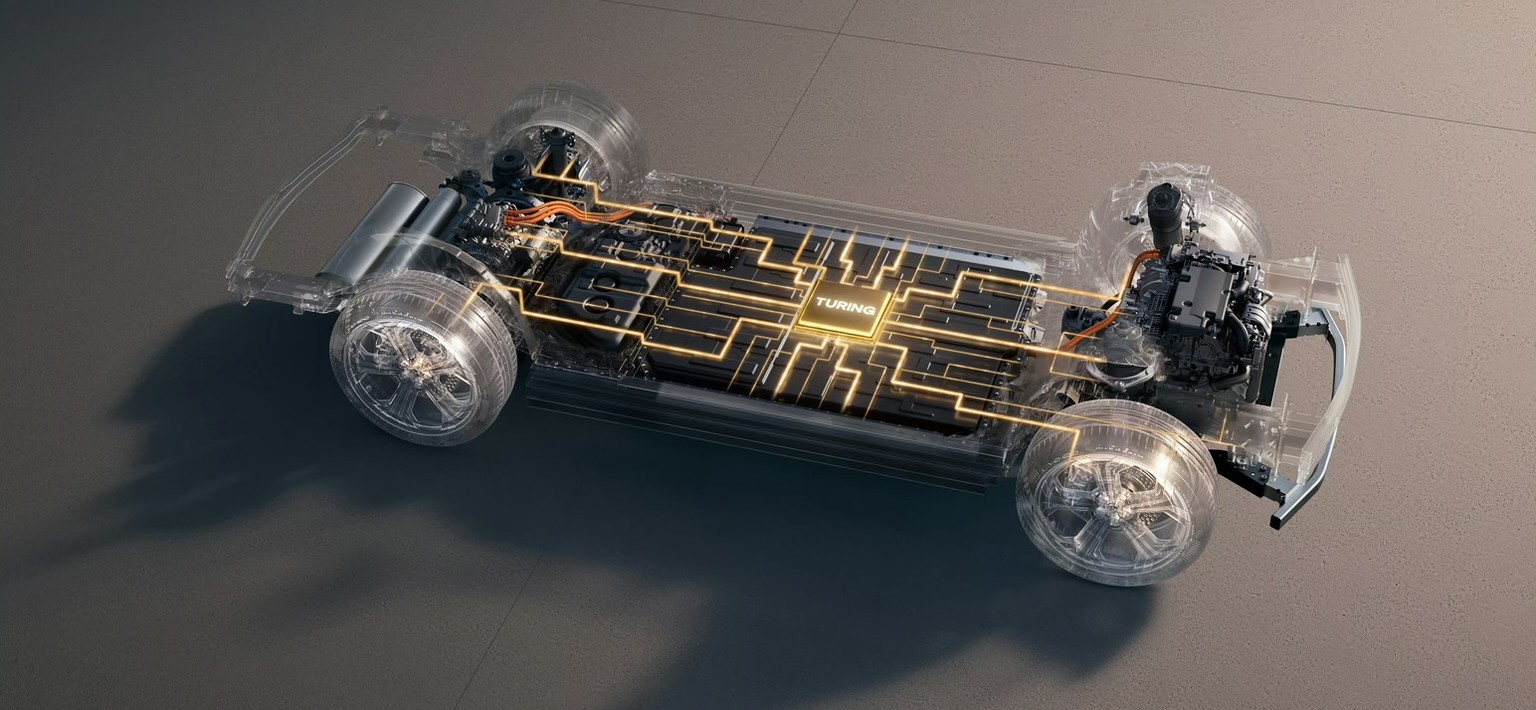
Every trim carries XPENG’s Turing AI chips. The configurator and XPENG’s own launch slide give the same ladder: one chip and 750 TOPS of effective compute on Max, two and 1,500 on Ultra SE, three and 2,250 on Ultra and the Ultra Flagship. On 27 August XPENG said the third chip on Flagship is now running and tied that line to VLA working with the cabin model (Master Agent). It has not published a slide that splits those three chips between driving and cabin, so the count is the fact; how the work is divided is not. The launch trim sheet lists the cabin model (VLM) on Ultra and the Ultra Flagship alone; Ultra SE is listed with the second-generation VLA and no VLM, and Max with the distilled Lite version.
- Second-generation VLA, version 6.3.0 - what XPENG’s posters call the 630 version. The G9L is the first car worldwide. In China the push starts in September 2026: the full model on Ultra and Ultra SE; VLA 2.0 Lite, a distilled copy for one Turing chip, on Max first. Max does not run the Ultra model
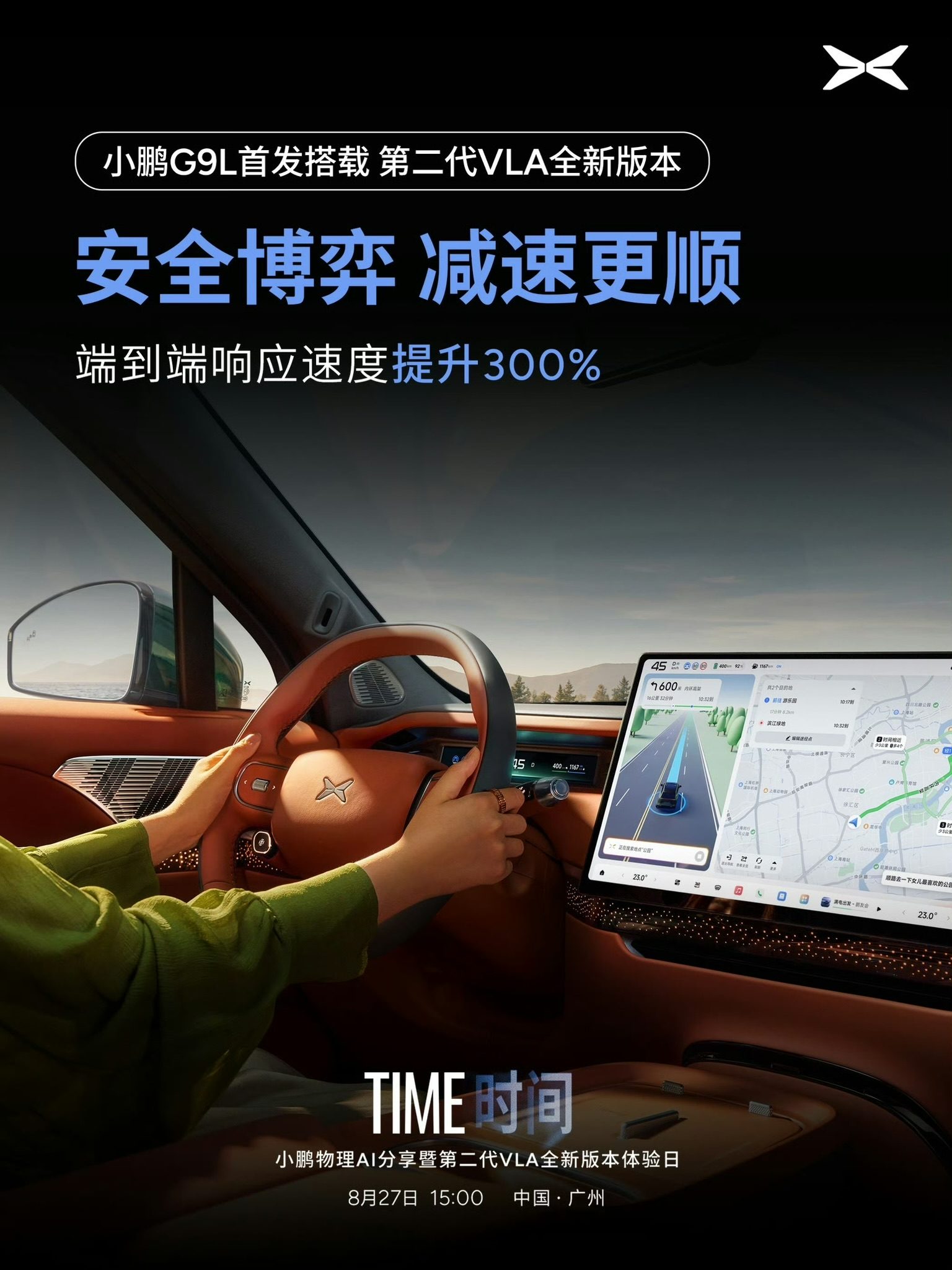
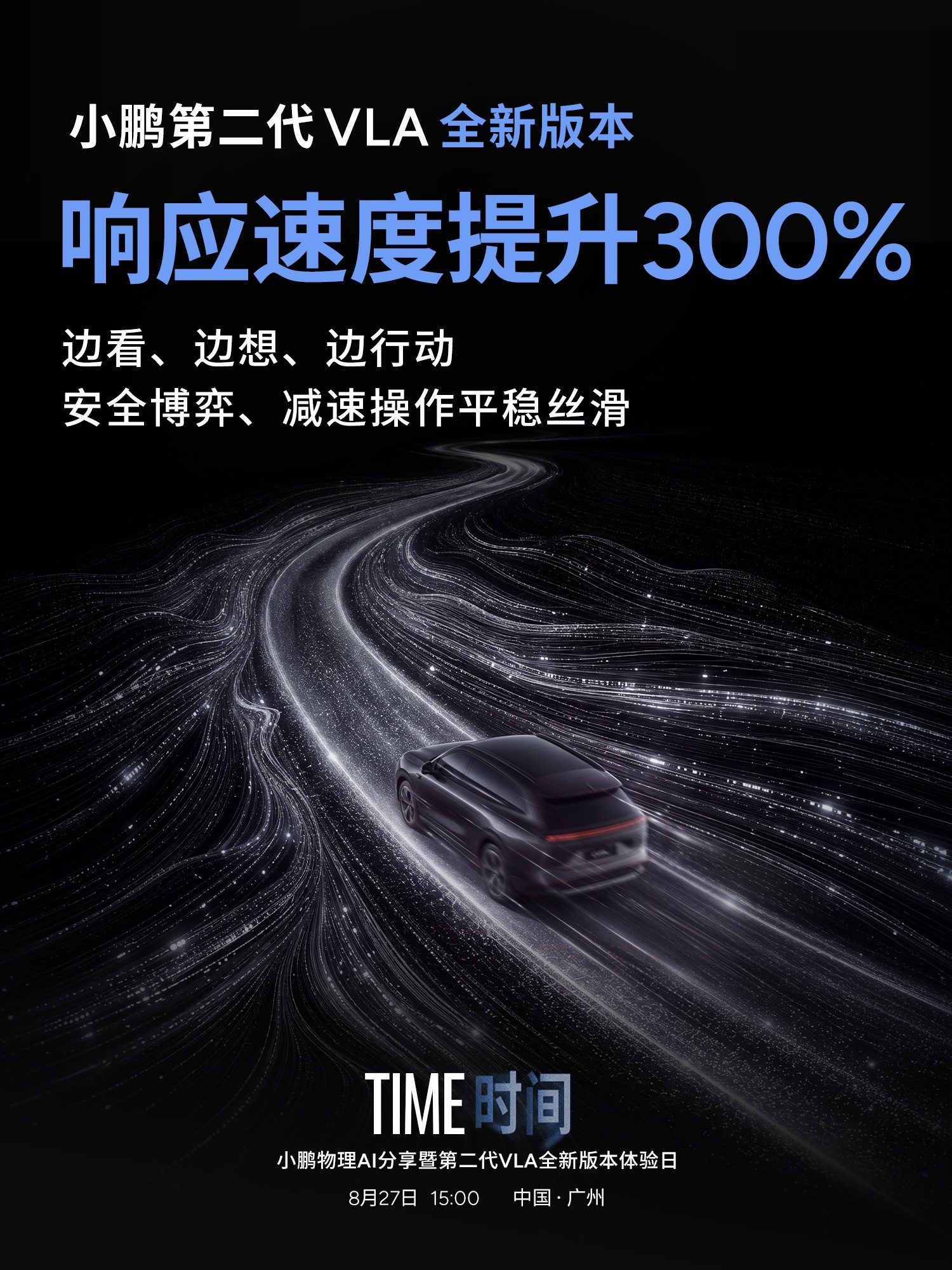
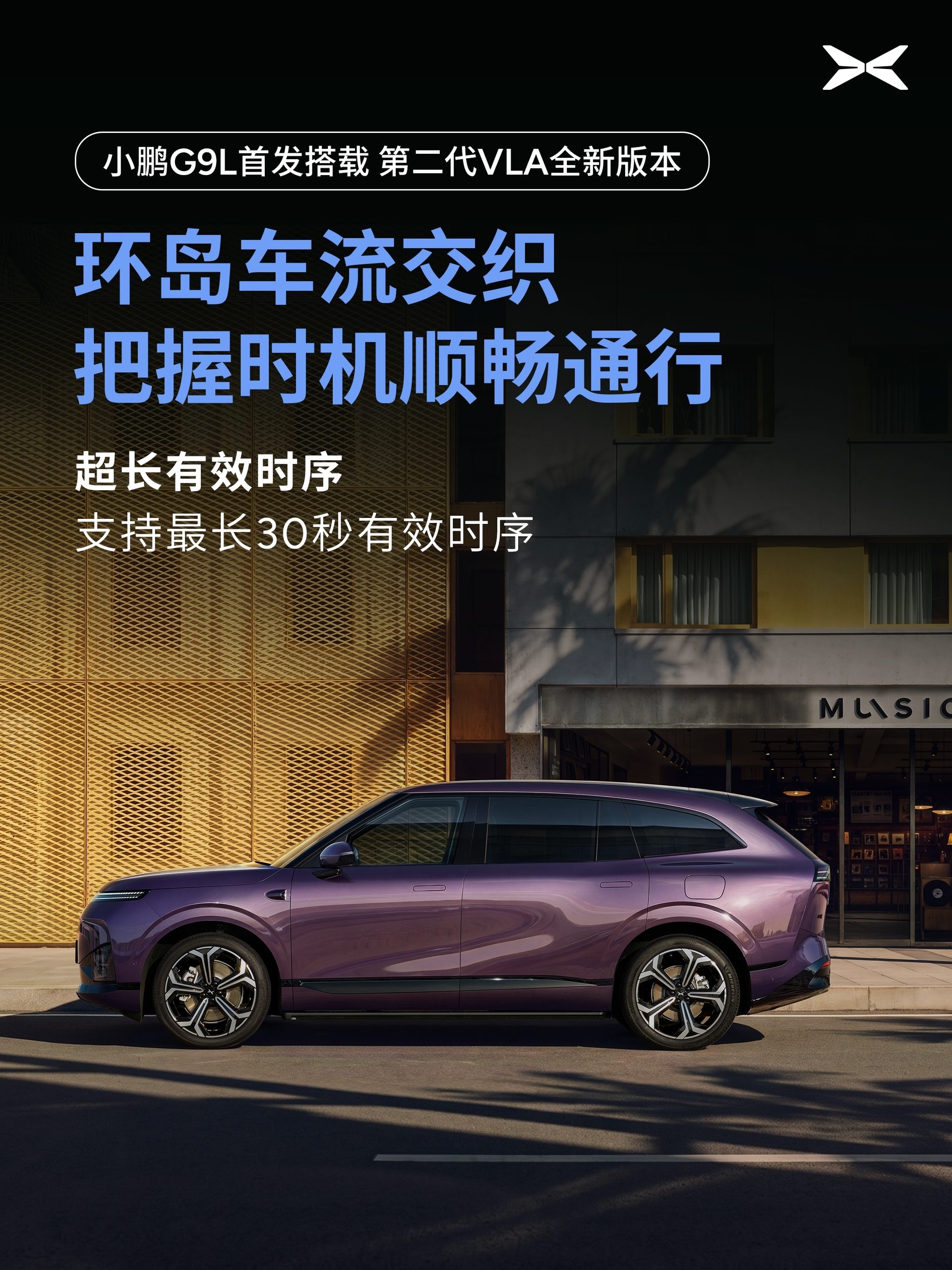
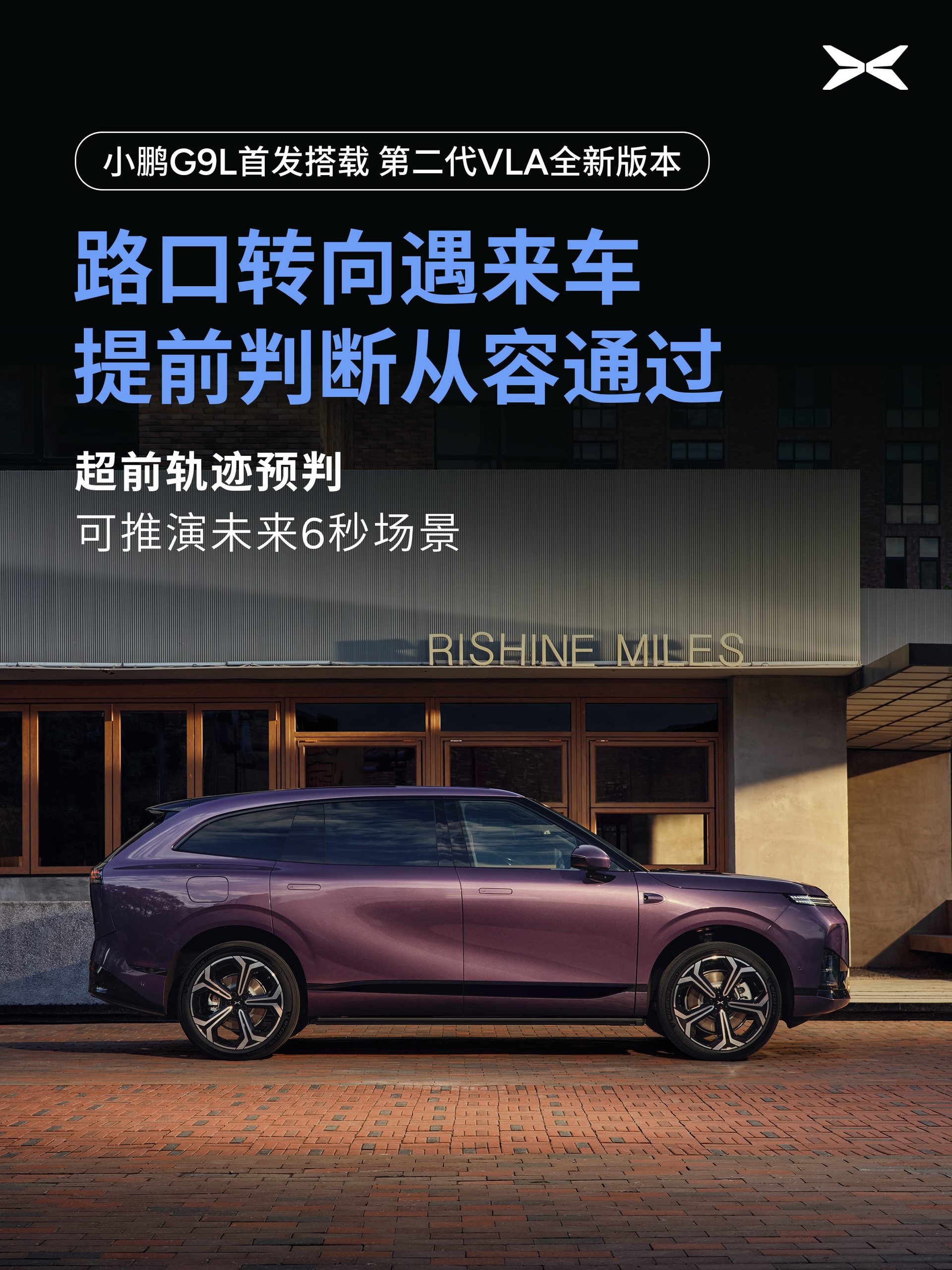
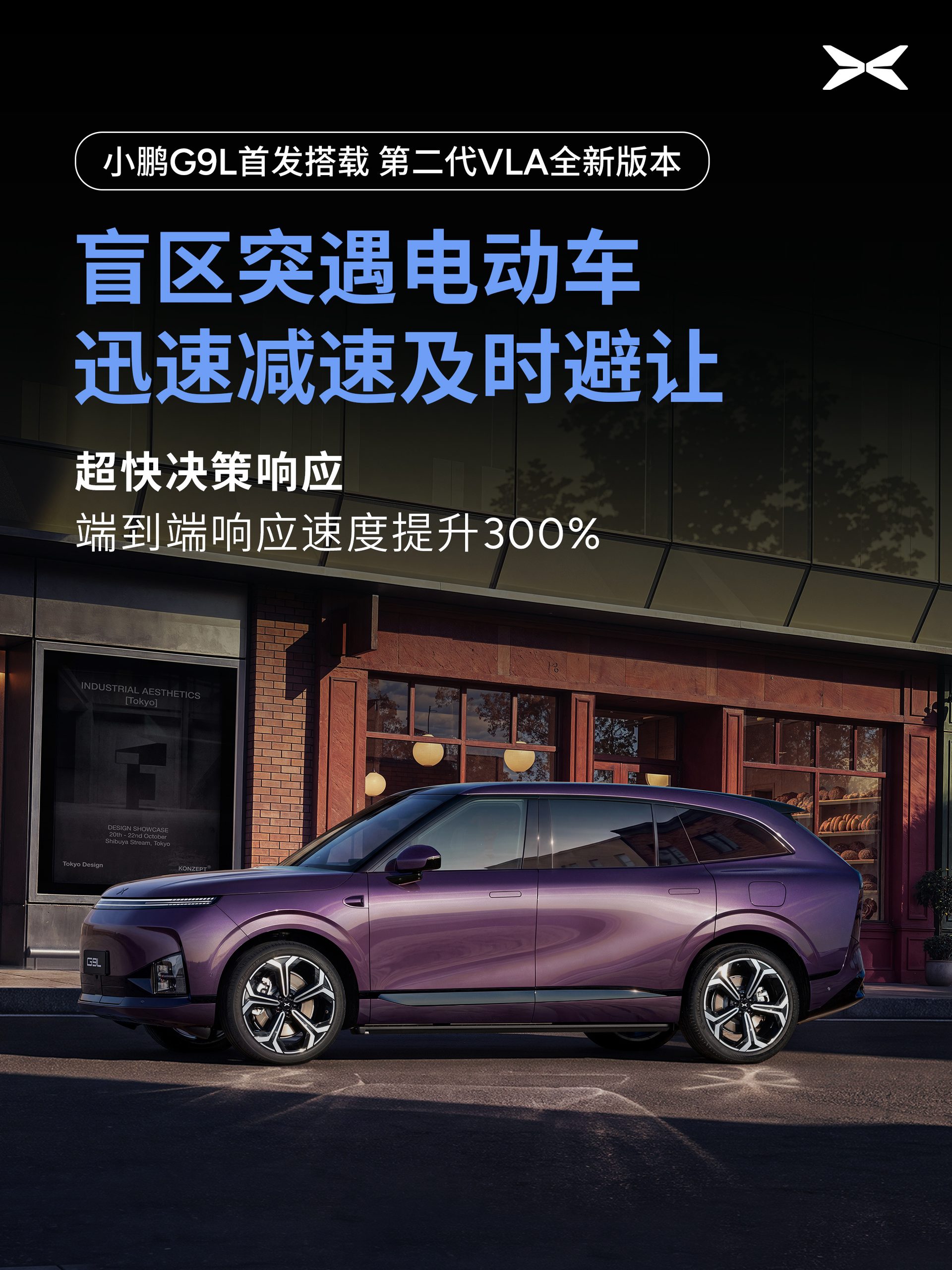
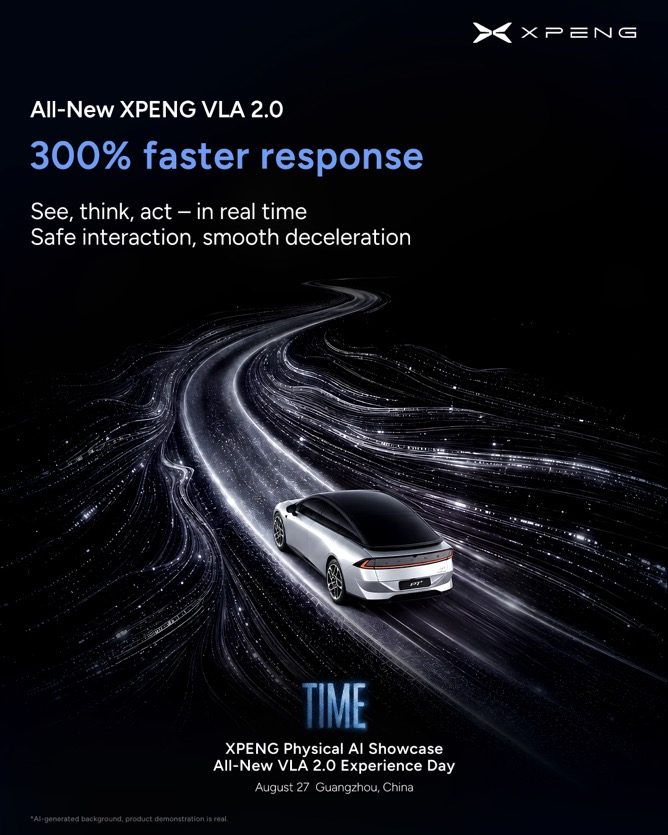
- Infini-VLA - up to 30 seconds of history in the driving decision, which XPENG frames as adding time to a spatial model. X-Foresight - an on-car world model that, XPENG says, can sketch other road users’ likely motion about six seconds ahead (Flow Matching is the name on the same slide). Streaming inference runs perception, reasoning and action together; that is the change XPENG quotes as 300% faster end-to-end. A Mixture of Tasks split (XPENG’s term) keeps jobs such as city driving and parking on separate “experts”
- Master Agent - VLA plus VLM, built on XPENG’s own Omni multimodal base. It reads an instruction, splits it into tasks and hands them to vertical agents for driving, chassis, cabin and body control - XPENG’s examples are an intention that turns into a kerbside stop or a hunt for the nearest space. It still calls the result a “Robotaxi-like L4-level experience”. That is marketing wording; no L4 approval exists
- Driver-incapacitation assist (GX-shared, standard on every Chinese trim) - under highway NGP, cabin vision and capacitive sensors detect a driver who stops responding; the car pulls over on its own and calls for help
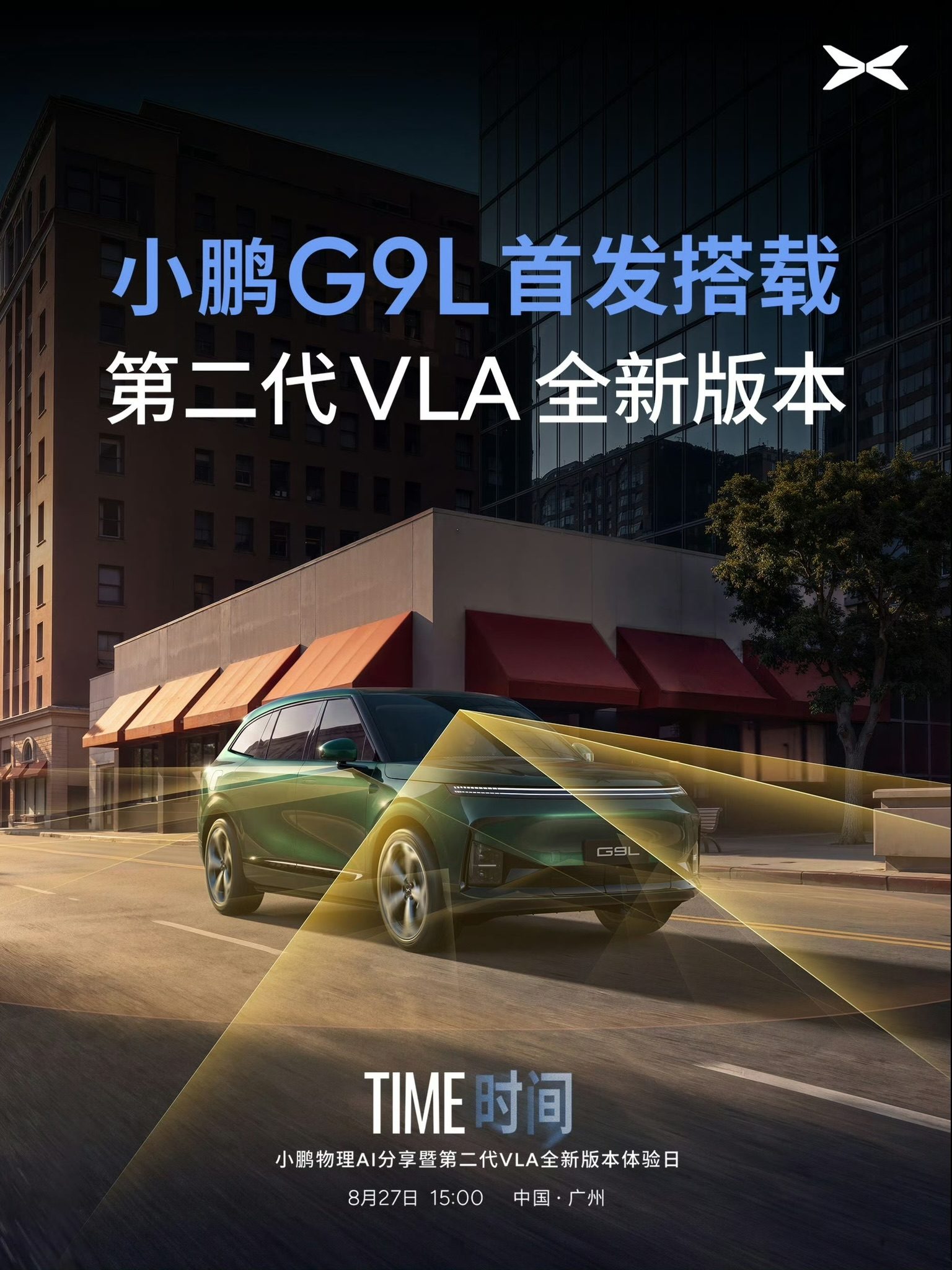
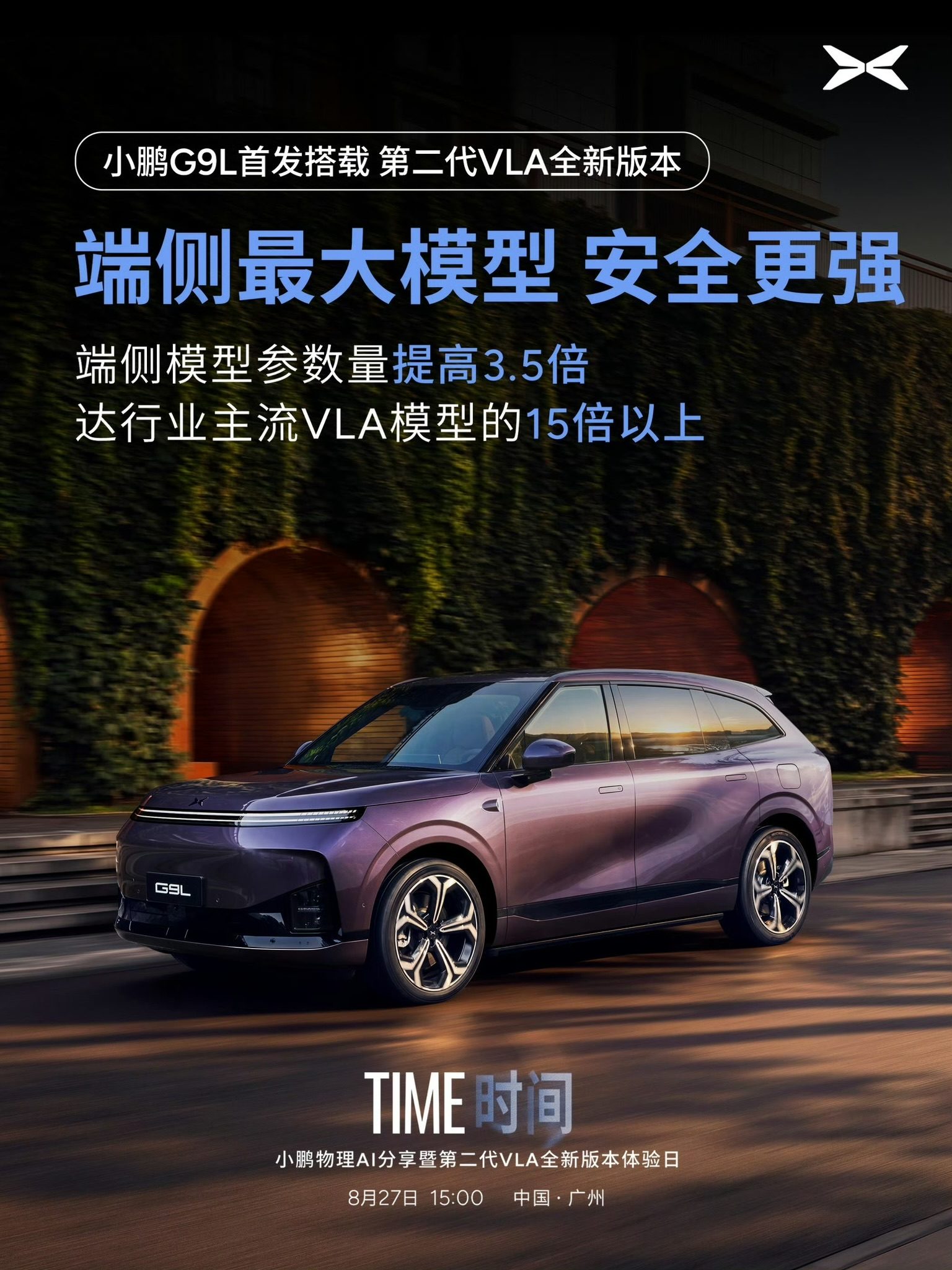
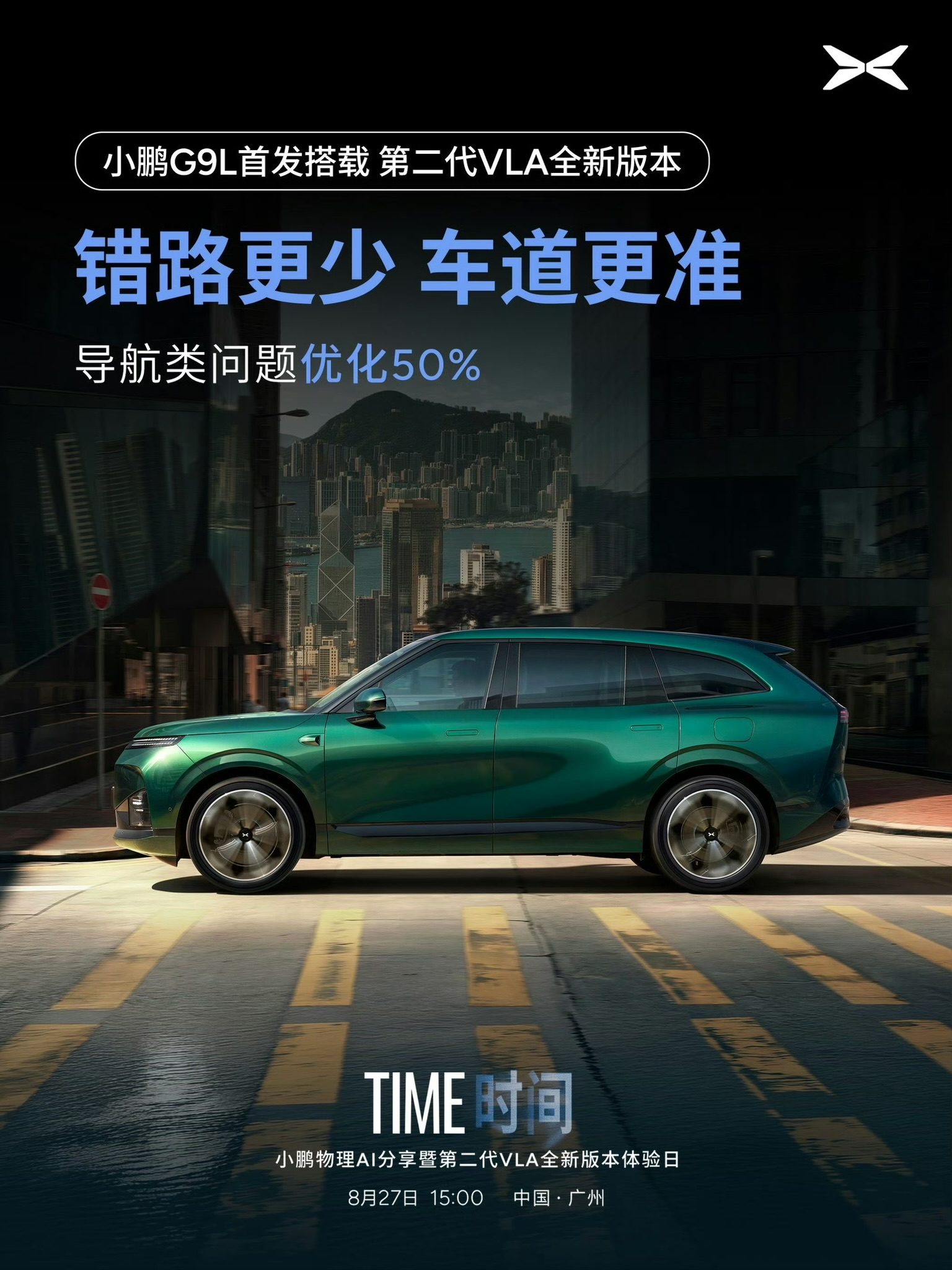
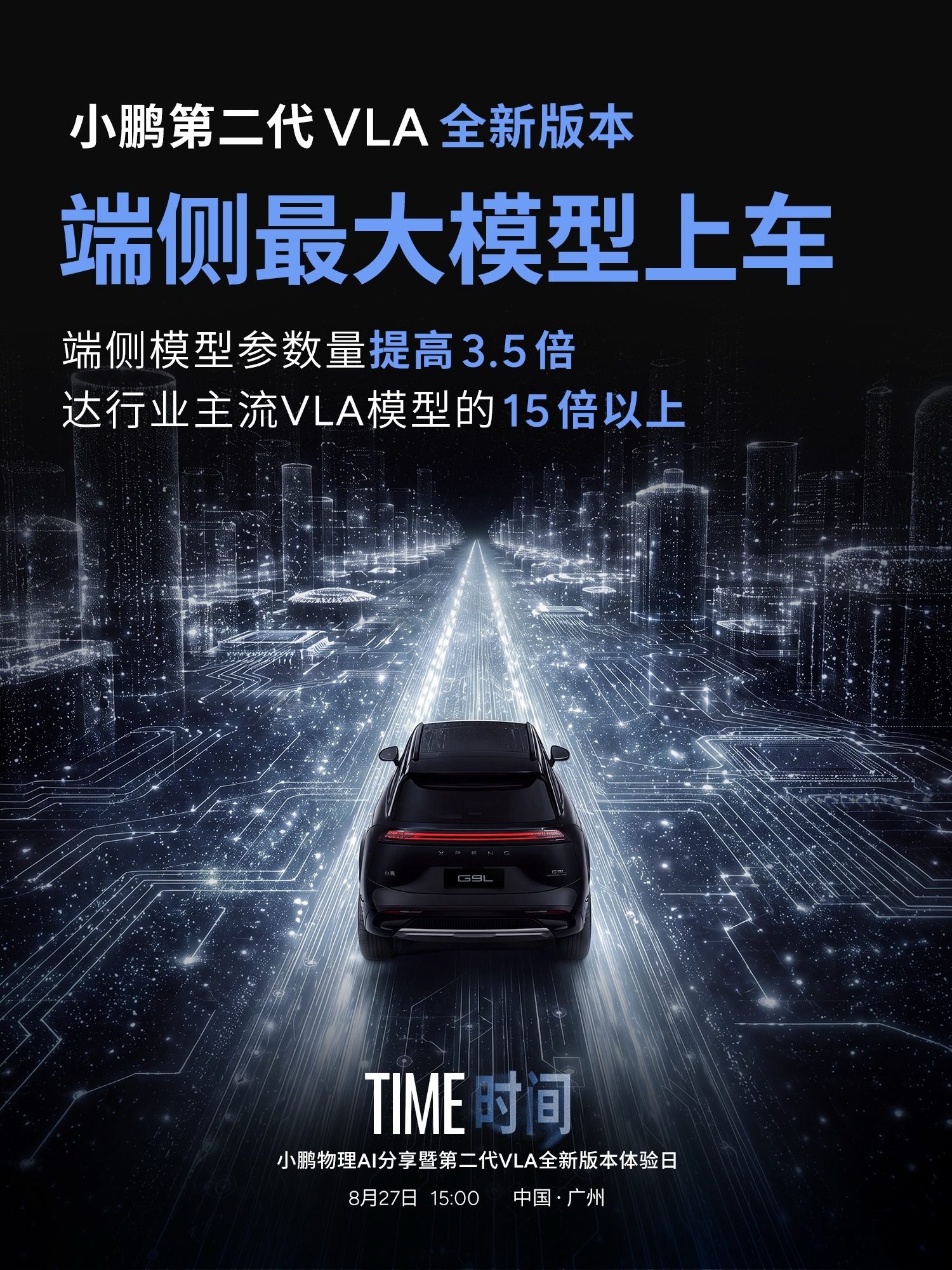
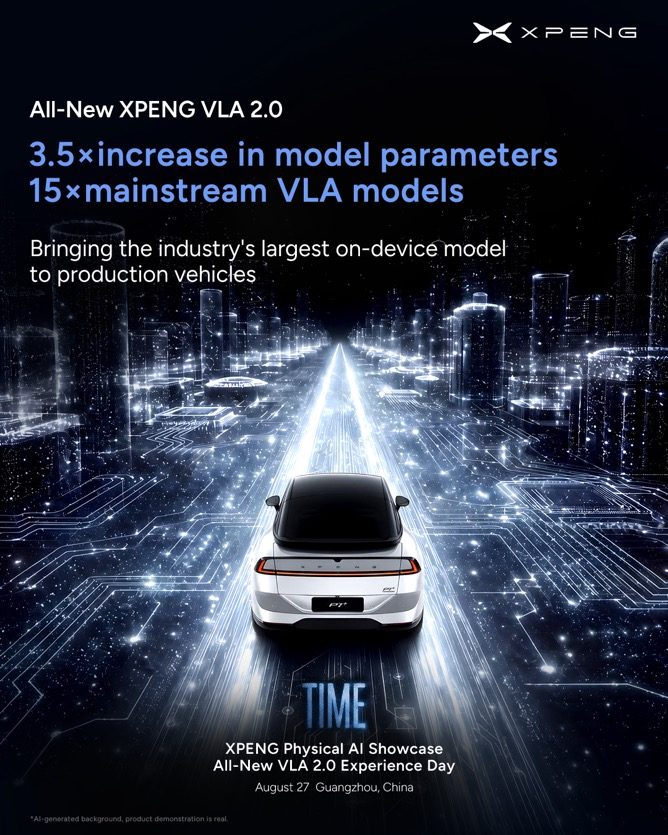
The 25 August posters already had the scale of the upgrade, the first major revision since the second-generation model reached customer cars in March: 3.5 times the on-device parameters of the shipping version, which XPENG scales at more than 15 times a mainstream VLA model, and navigation mistakes - wrong turns, the wrong lane through a junction - down 50%. The 27 August stage added a 20-fold lift in multi-dimensional safety. XPENG has not published a parameter count in billions. All of it is XPENG’s own measurement on the Chinese car.
At the TIME briefing on 27 August XPENG said it had already run local acceptance testing of VLA 2.0 in Germany, and that the China-trained model was close to the domestic result on little extra local data. The regulatory route now has a name: the stage slide pointed to UN Regulation No. 171 - Driver Control Assistance Systems (DCAS) - and showed internal-test footage under the flags of Germany, the Netherlands, France and Australia. European regulatory approval is still aimed at the first half of 2027, then delivery to overseas customers - the same window as the Q2 call. What hardware the first European G9Ls ship with is still open; see Open questions before Paris.
Timeline: from first trace to launch
Each entry is what came out on the day, from XPENG unless another source is named. Where a figure has since been settled, the specification sections above carry the current number.
February 2026 - the car turns up in traffic. The first spy shots of G02 reached Chinese media on Autohome on 18 February, showing GX design language on a smaller body and an active grille shutter for the range extender. GX (G01) already had official images and an MIIT filing by then; of G02 the same outlet wrote that very little was known.
25 February 2026 - named for Danish readers. FDM visited the Guangzhou headquarters and put numbers on the car: around five metres, a 3,100 mm wheelbase, six or seven seats for Europe, and Austrian assembly alongside G6, G9 and P7+. The Danish importer confirmed four new models for 2026.
May 2026 - the filing. G9L appeared in MIIT batch 407 as a five-seater, filed alongside the range-extended L03 and the L05. That filing is where the dimensions and motor outputs first became public record rather than estimate.
3 August 2026 - first images, and a press release for Europe. XPENG released the first official pictures in China and, through XPENG Denmark, told European media what Paris would bring: the six-seat model and the position above the G9. He Xiaopeng gave the domestic framing on Weibo the same day: “The global large five-seater tech flagship, the 300,000-yuan-class tech benchmark - XPENG G9L is here.” He dated the programme to three years earlier, with a brief to R&D: build a global five-seat flagship that beats “99%” of the CN¥300,000 class on safety, technology and looks. The CEO launch teaser belongs to that day.
7 August 2026 - Munich. He Xiaopeng posted about camouflaged cars road-testing in Munich with international media and guests - the July trip under From conversation to test drive. He credited the calm ride on narrow streets and Belgian cobbles to the smart chassis and rear-wheel steering.
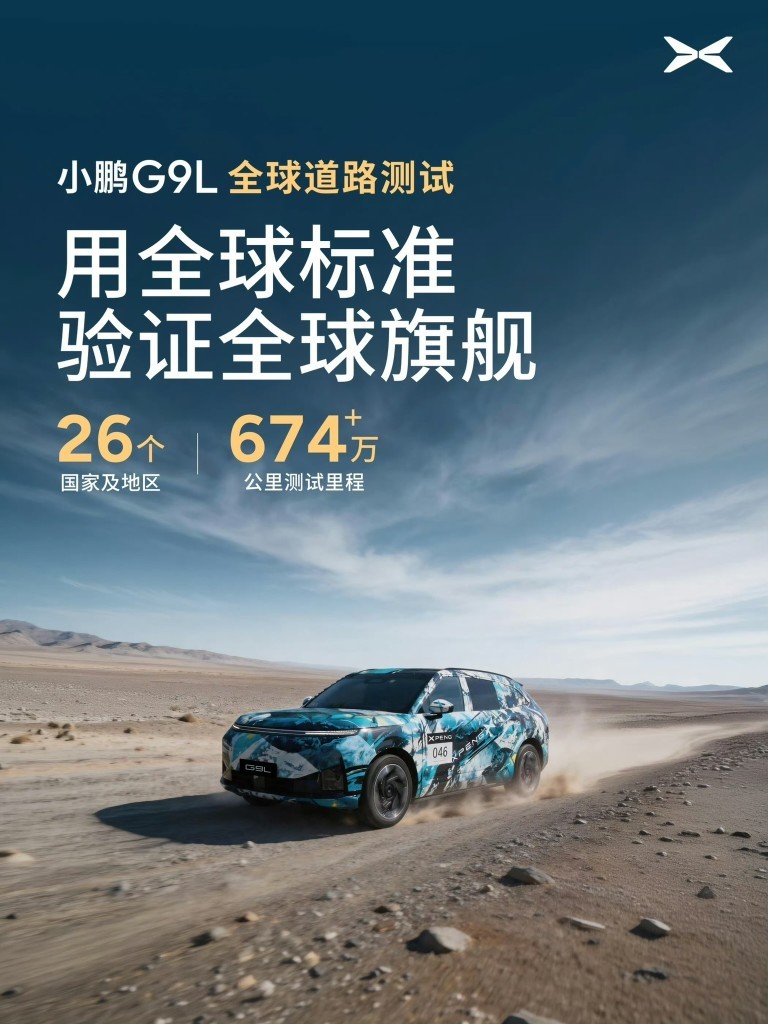
The official XPENG account posted the parallel global road test the same day: 26 countries and regions and more than 6.74 million km, a separate count from the 64 launch markets. “Building a global car has no shortcuts,” it said of a programme started three years ago. With it came a montage film and four quote posters on handling, chassis comfort and rear-wheel steering, quoting international and Chinese outlets. The posters are in the gallery.
11 August 2026 - Guangzhou debut, pre-sale open. Pre-orders opened from CN¥ 259,800, a Chinese-market price. The debut confirmed six named variants as BEV and Super EREV (Launch trims) under the “300,000-yuan-class tech benchmark” line, and the entry version sits below that mark. On stage He Xiaopeng repeated the programme figures from the press release and the road test, and added more than 3,000 regulatory requirements.
Limited-time China order perks (debut slides 11 August 2026), which required an order before 17 September 2026: CN¥ 1,000 deposit credited as CN¥ 3,000 toward purchase; free Fjord Grey paint (CN¥ 6,000 list) and Sahara Orange interior (CN¥ 3,000 list); 21″ Vortex wheels at CN¥ 3,000 (list 10,000), 22″ Petal sports wheels at CN¥ 6,000 (list 12,000) and the Black Gold package at CN¥ 10,000 (list 15,000). The deposit is refunded within three working days if the order is cancelled, and the perks follow whoever signs the purchase agreement and cannot be transferred. Only in China.
17-25 August 2026 - into the stores. The first display cars reached Chinese showrooms on 17 August. The pre-sale configurator opened on 19 August and settled the battery packs and the speaker counts (Powertrains, Audio). On 20 August XPENG listed 53 cities and 200 stores, with more cars due 25 August.
21-30 August 2026 - Chengdu. XPENG shows all five colours and presents the Black Gold Edition (黑金套件) for the first time - see the section.
25-27 August 2026 - the 630 version. XPENG published the upgrade figures on 25 August. The TIME Physical AI briefing on the 27th named Infini-VLA (up to 30 seconds of history), X-Foresight (about six seconds of predicted motion), streaming inference, VLA 2.0 Lite on Max, and local acceptance testing in Germany. China OTA from September. Figures under Assisted driving.
11 September 2026 - right-hand-drive production. The first G9L cars with the wheel on the right came off the line in Guangzhou, bound for Australia, XPENG said on Weibo. The model is coming to 64 countries and regions. Export production therefore started before the first Chinese customer deliveries; the news story has the detail.
14 September 2026 - Millbrook. XPENG posted a film of the British presenter Richard Hammond driving a right-hand-drive G9L at the Millbrook proving ground in England. The air suspension and the rear-wheel steering are tuned for British roads, in XPENG’s words. The film is the company’s own material, and the firmest thing in it comes from Hammond himself: the UK specifications are not set yet.
17 September 2026 - the China launch. Beijing, 7 pm China time, streamed on XPENG’s own event page. All six trims got a guidance price, CN¥ 241,800 to CN¥ 319,800, and all six were shown with an introductory offer (see Launch trims). The stage also settled where the car is built: in parallel in China and Europe, at Guangzhou and at the XPENG Magna plant in Graz. That evening the configurator swapped its price field from pre-sale price to guidance price, and a new set of option offers running to 15 November 2026 replaced the order perks above. The date itself came from XPENG’s Weibo post; see the news story on the date.
12-18 October 2026 - Paris Motor Show. European premiere, press day 12 October. What is still missing until then is under Open questions before Paris.
23-25 October 2026 - Oslo Motor Show. The Norwegian premiere, at NOVA Spektrum in Lillestrøm, eleven days after Paris. XPENG Norway shows the G9L alongside the L03, the Land Aircraft Carrier and the IRON robot. The news story has the detail.
Q&A
Gallery
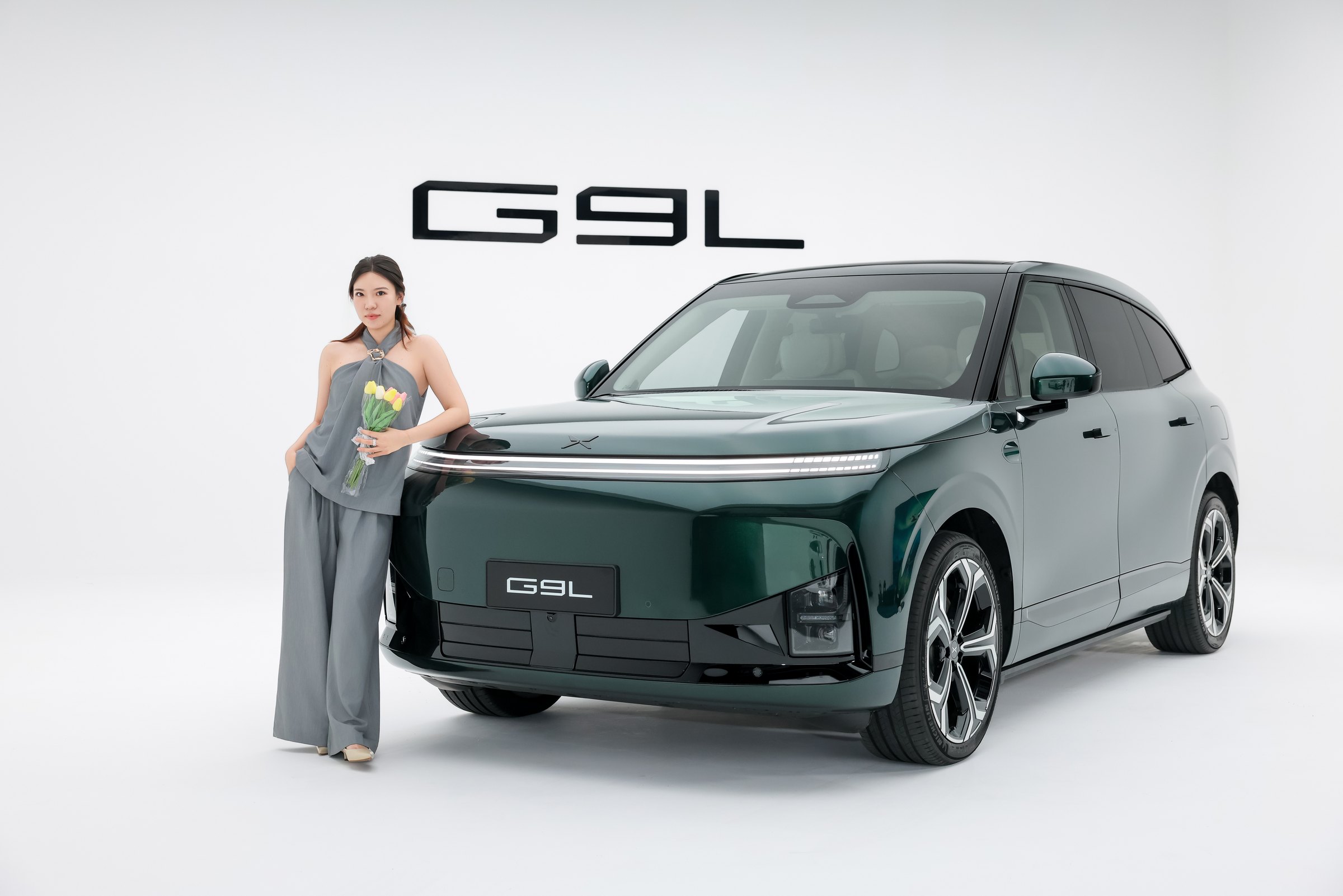
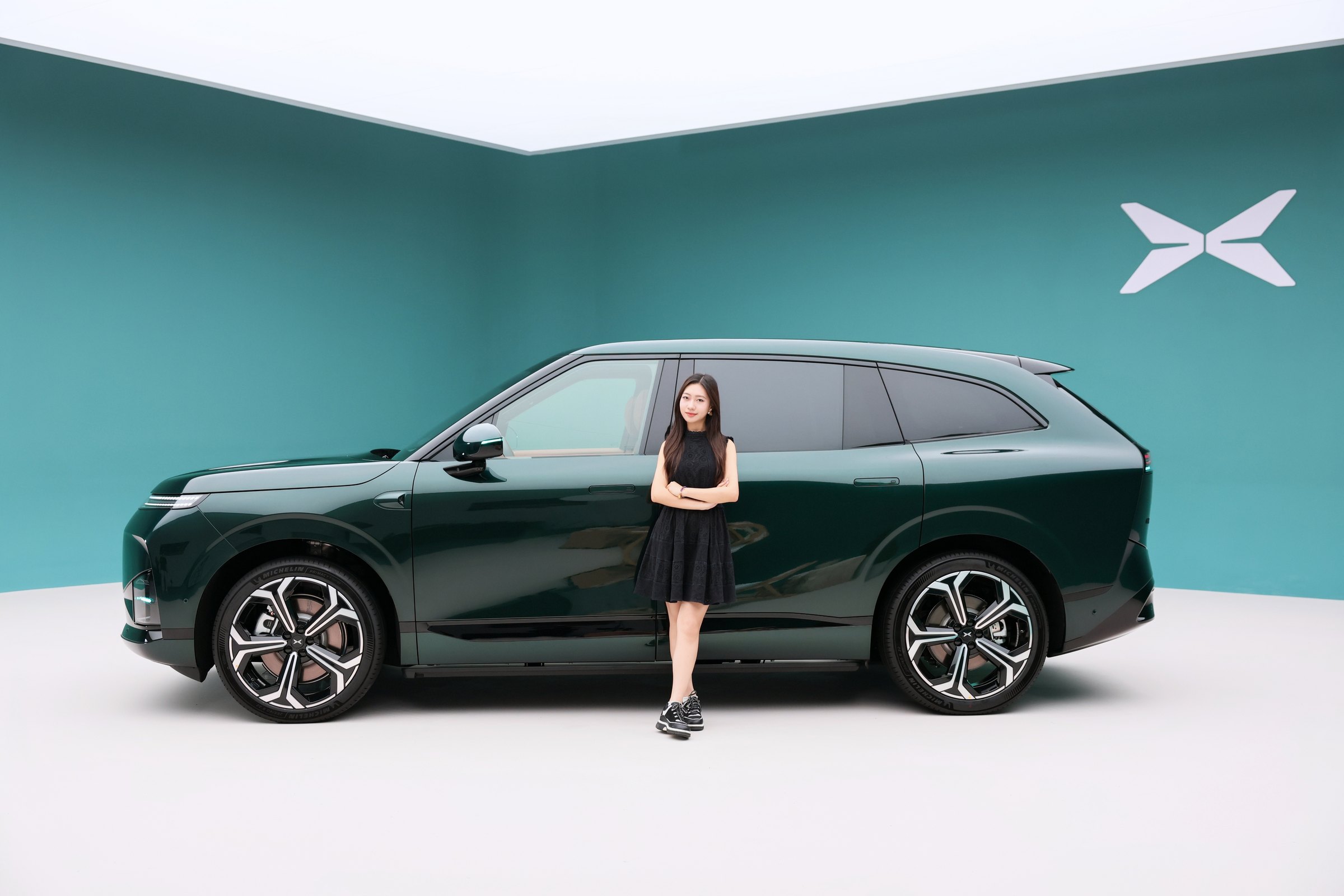
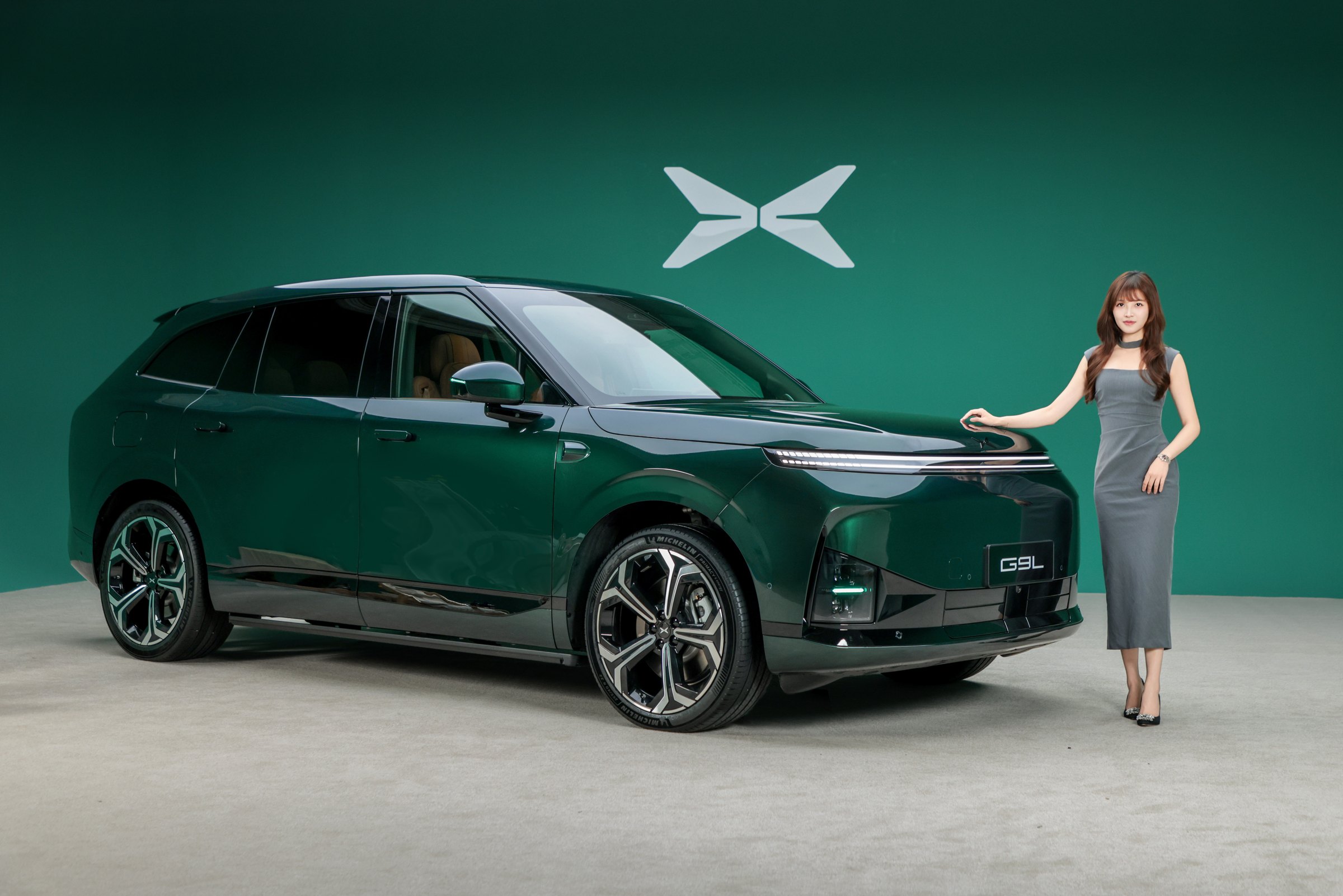
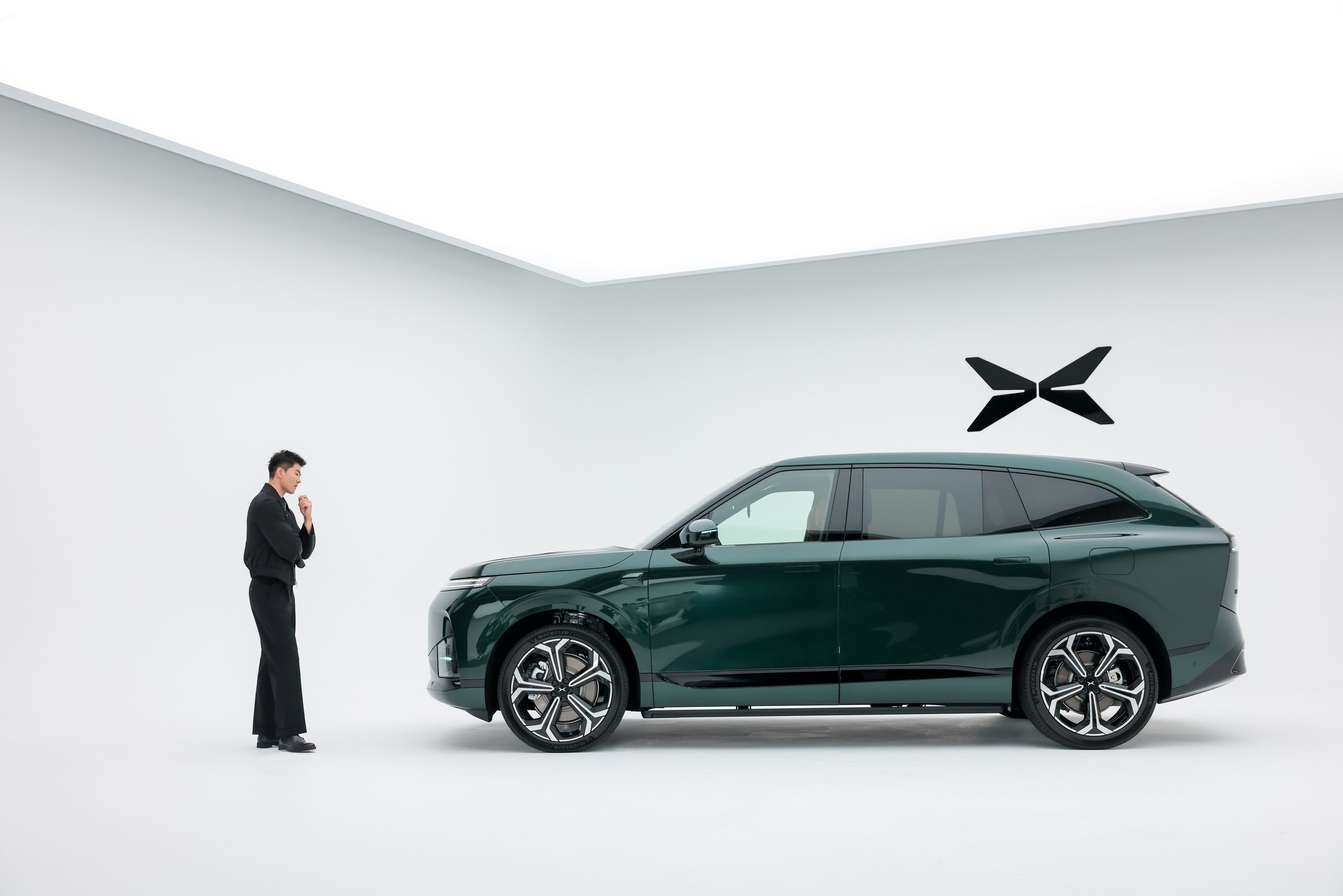
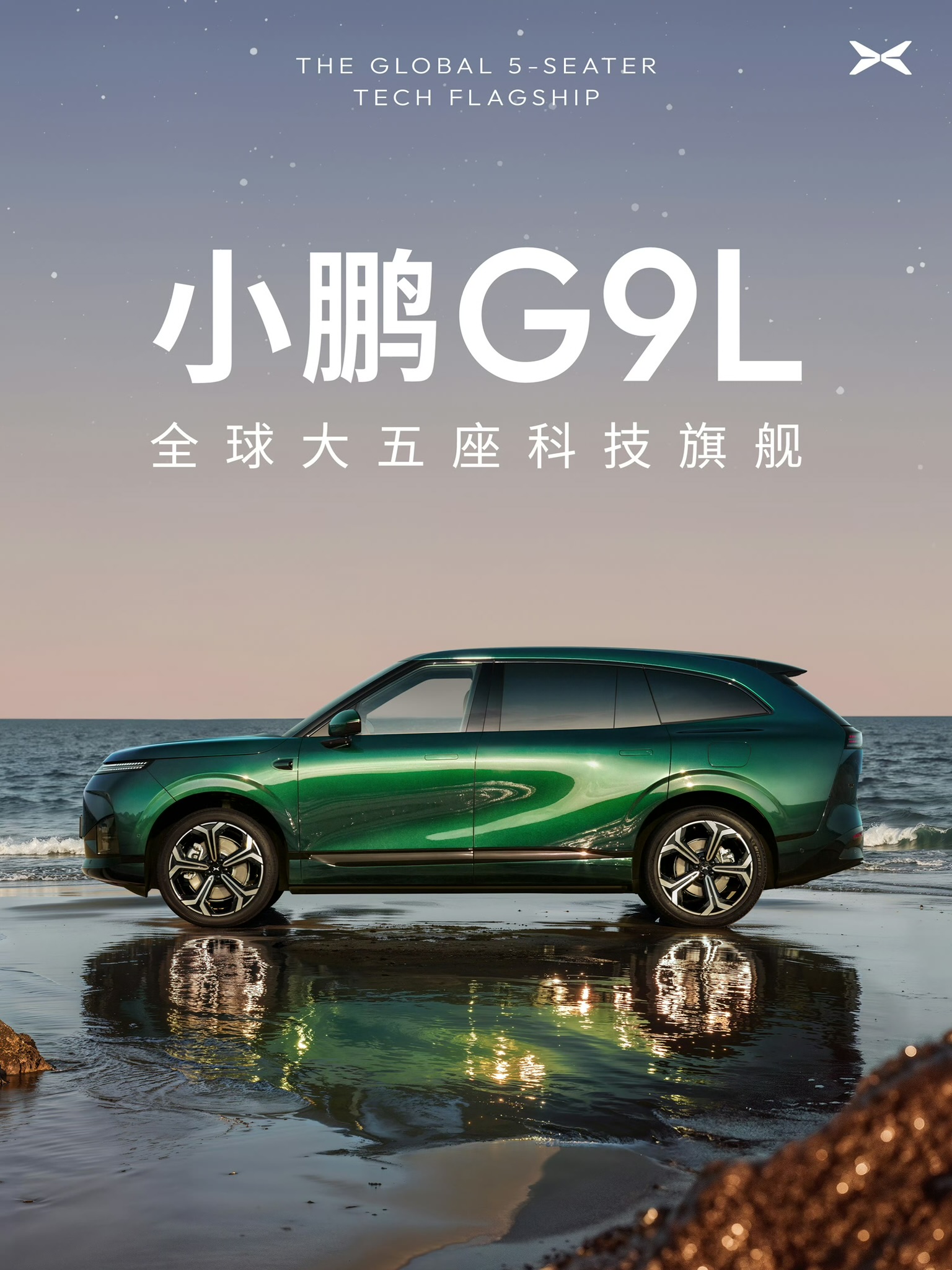
Press and launch stills from August 2026, plus the official VLA 2.0 / TIME plates. G9L is the first car in China on that version. Expand a category, and click any image to enlarge.
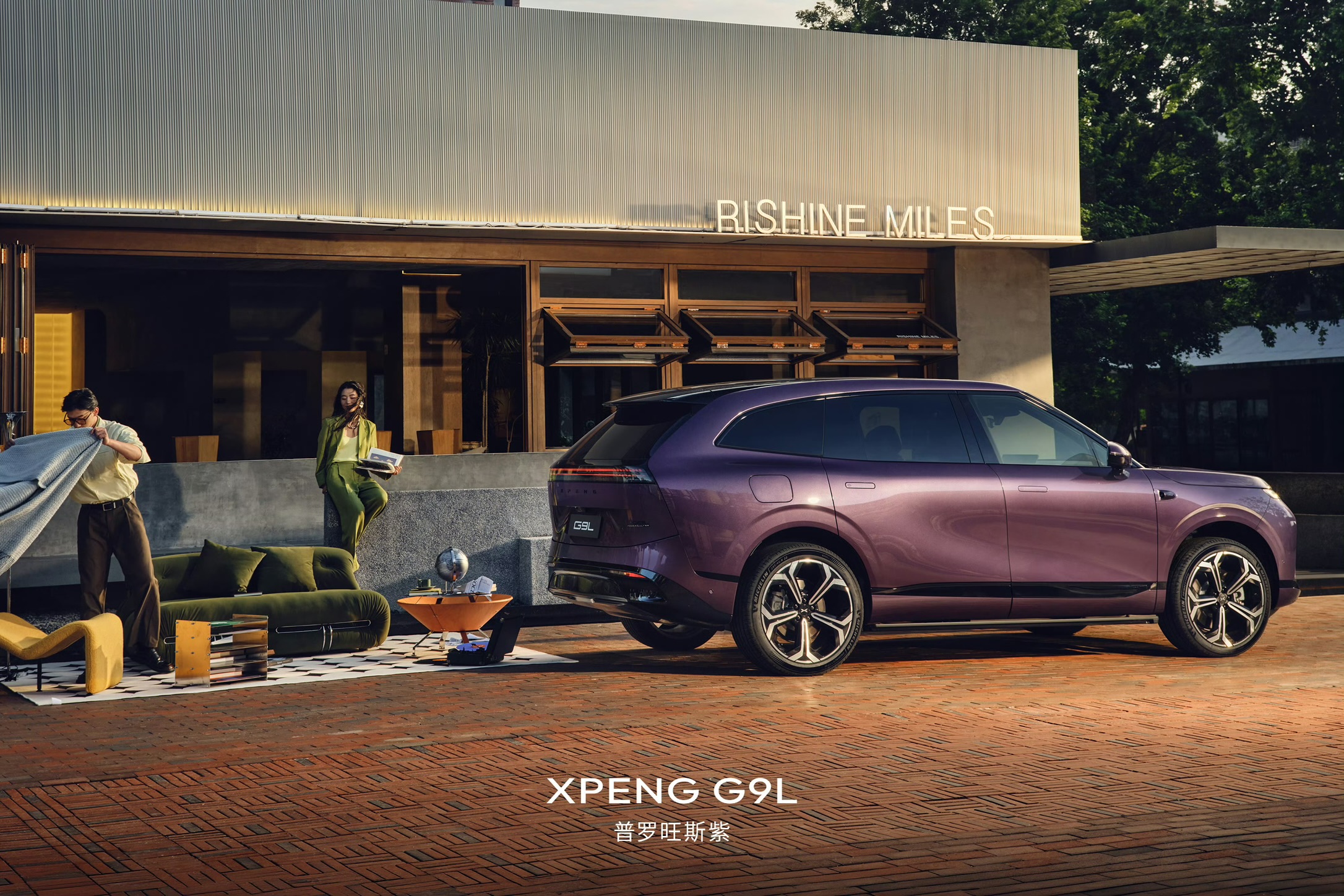
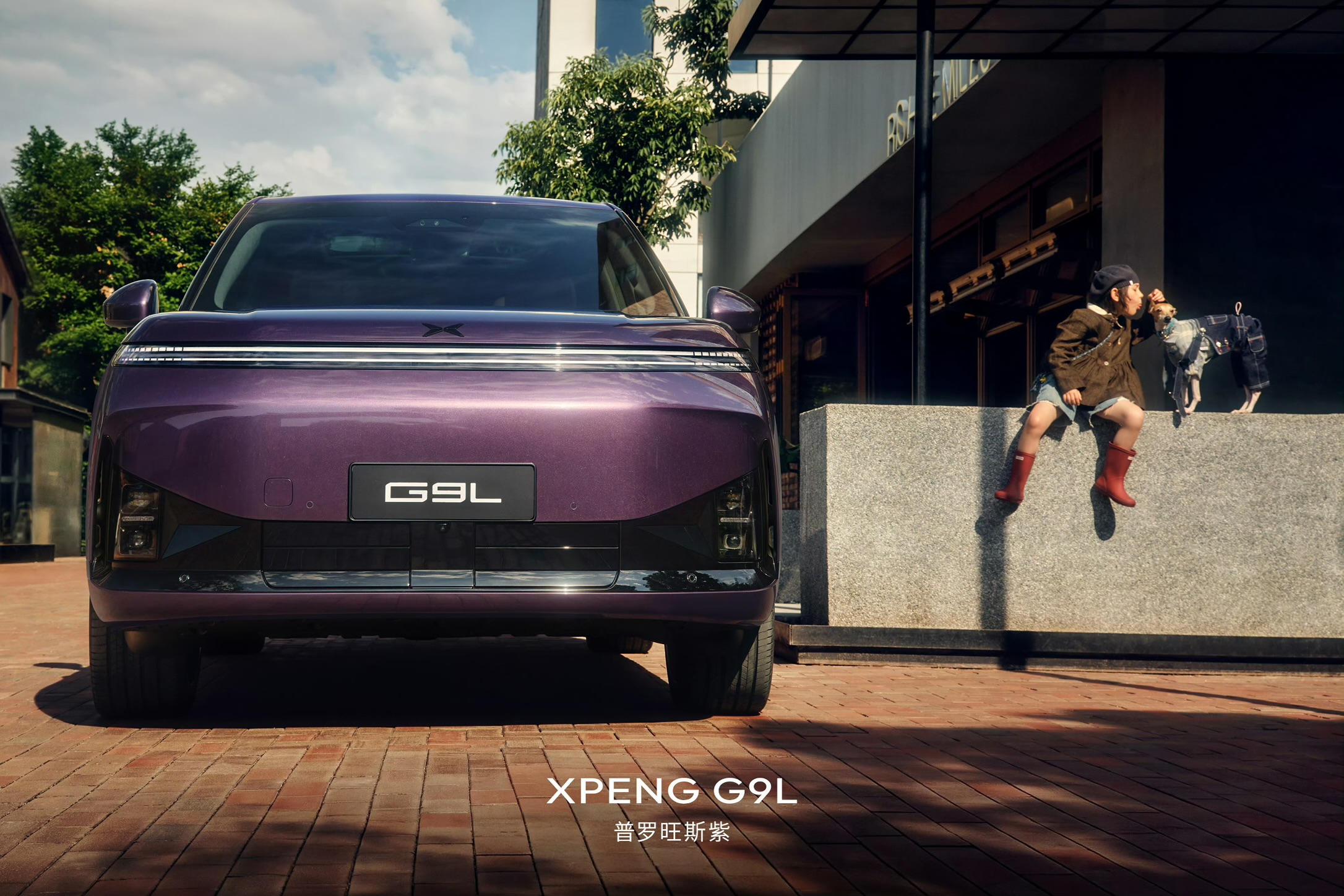
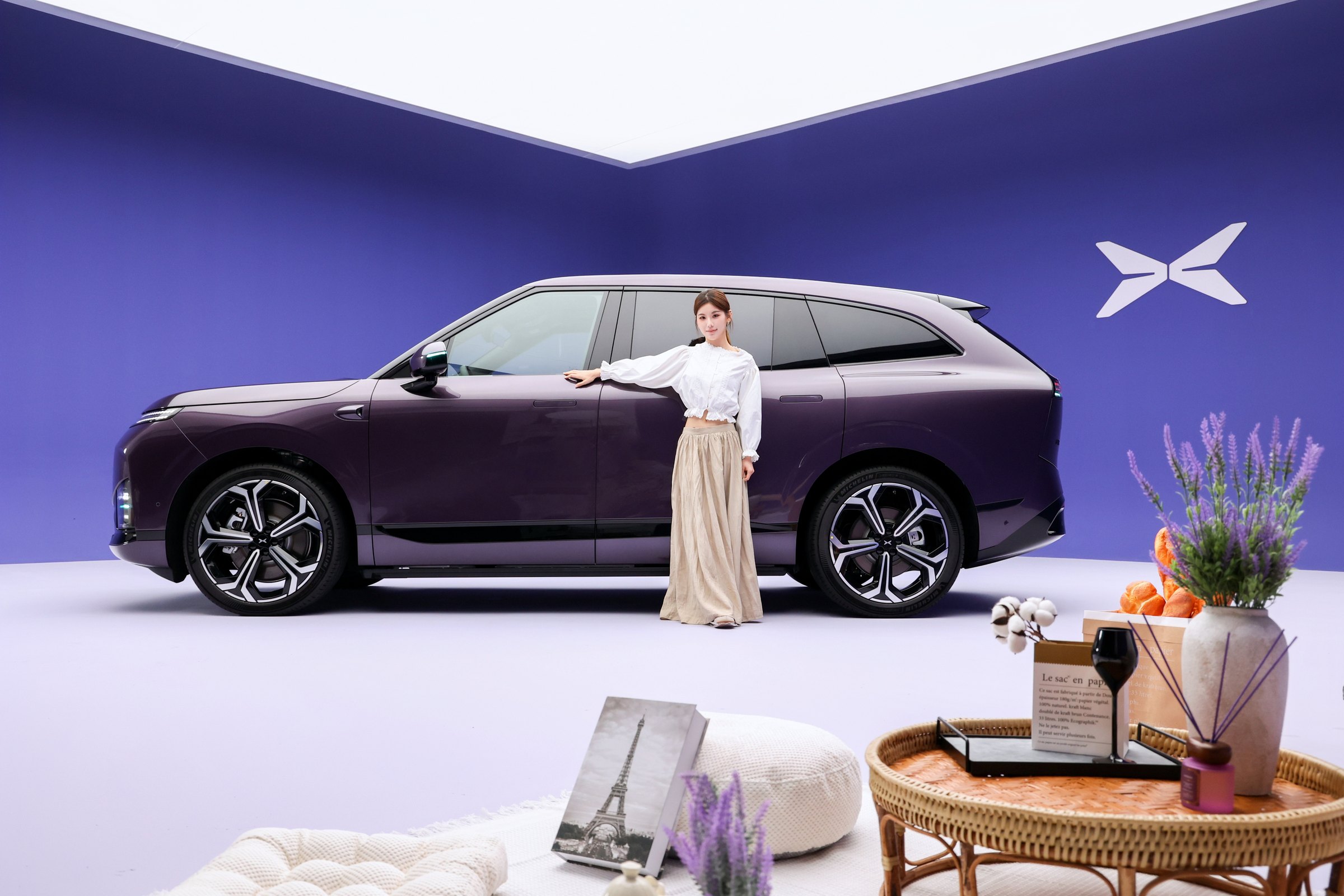
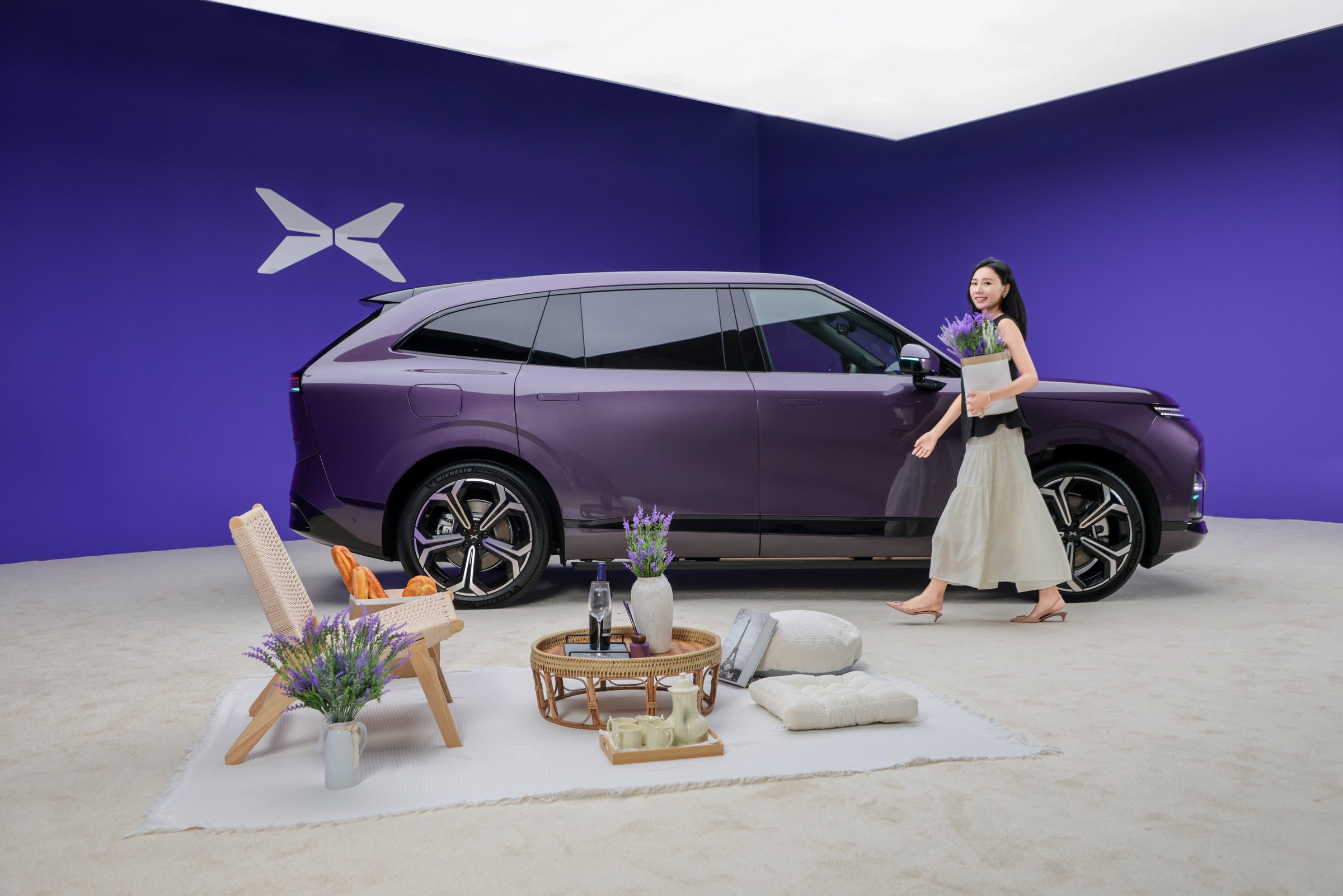
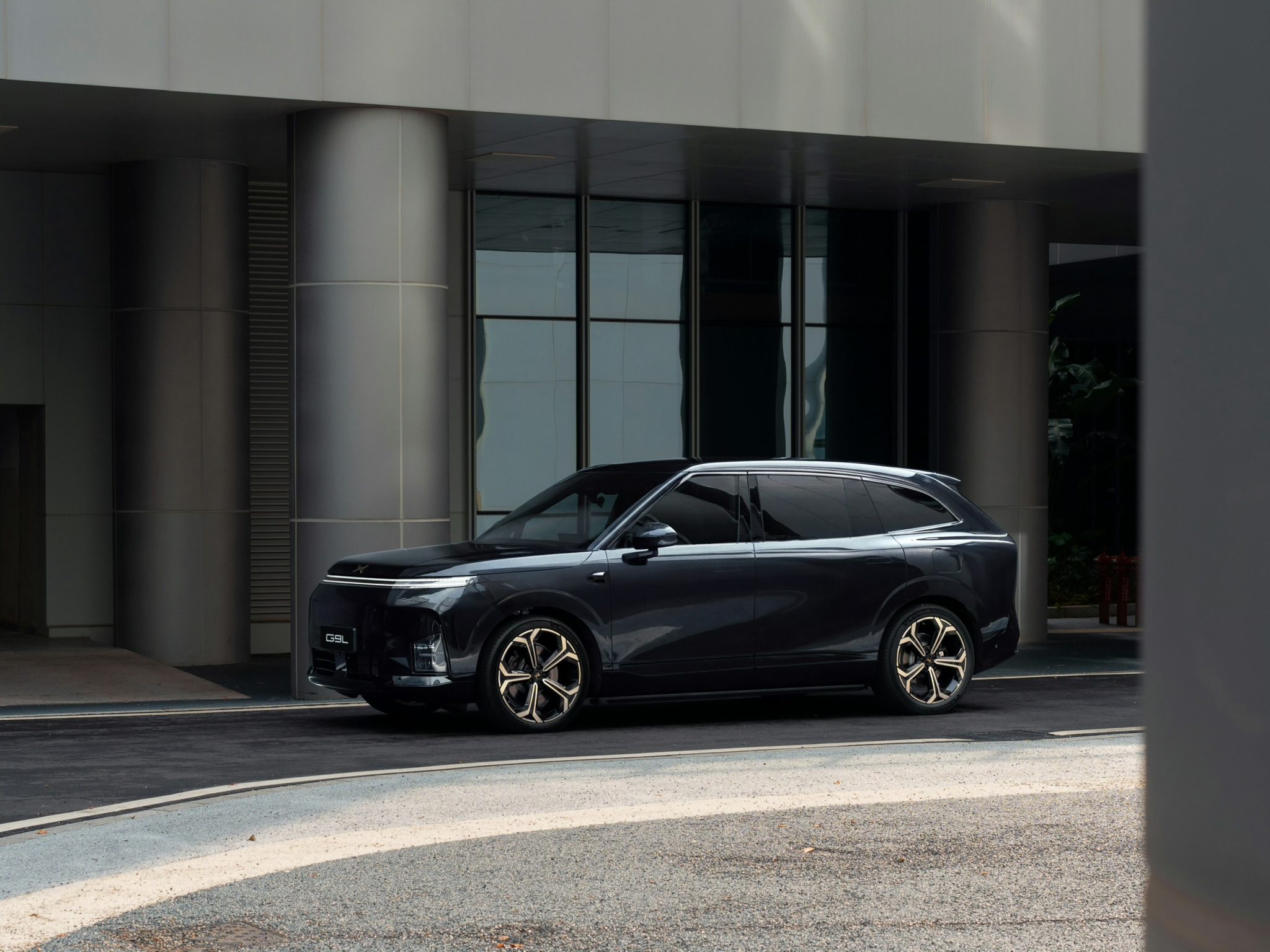
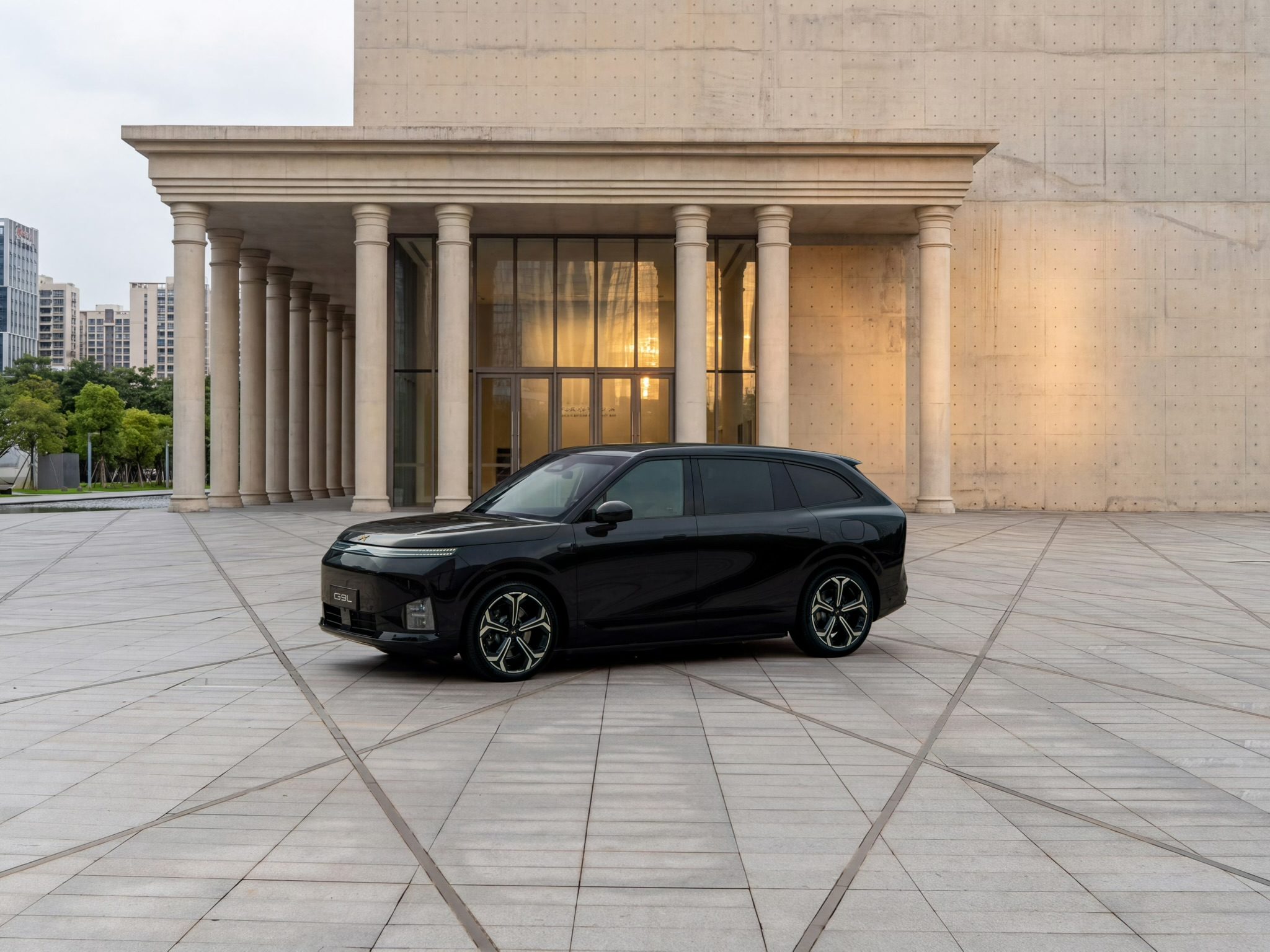
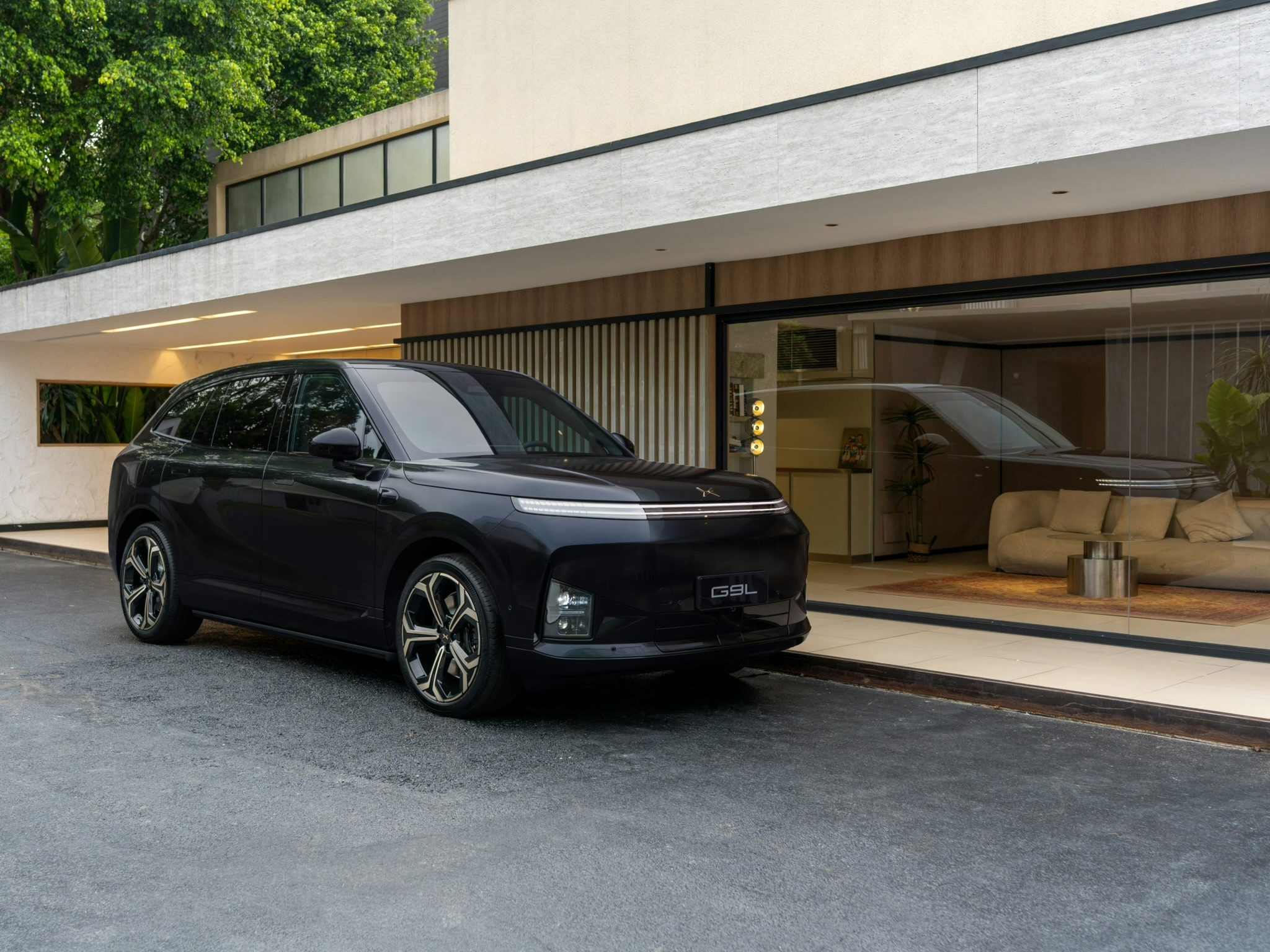
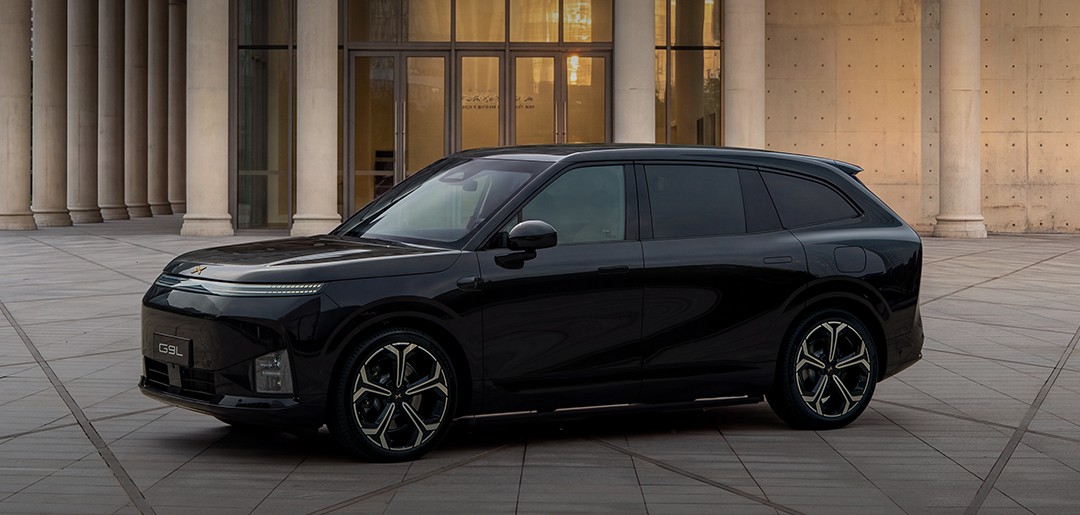






















Regulatory photos from the public MIIT filing (batch 407/409) - not marketing/press photography. The collage shows optional exterior details (side steps, lights, badges, wheels).
Crops from the China debut stage slide (11 August 2026). All three use Michelin Primacy 5e (silent-tyre branding on the 21″ and 22″ panels).
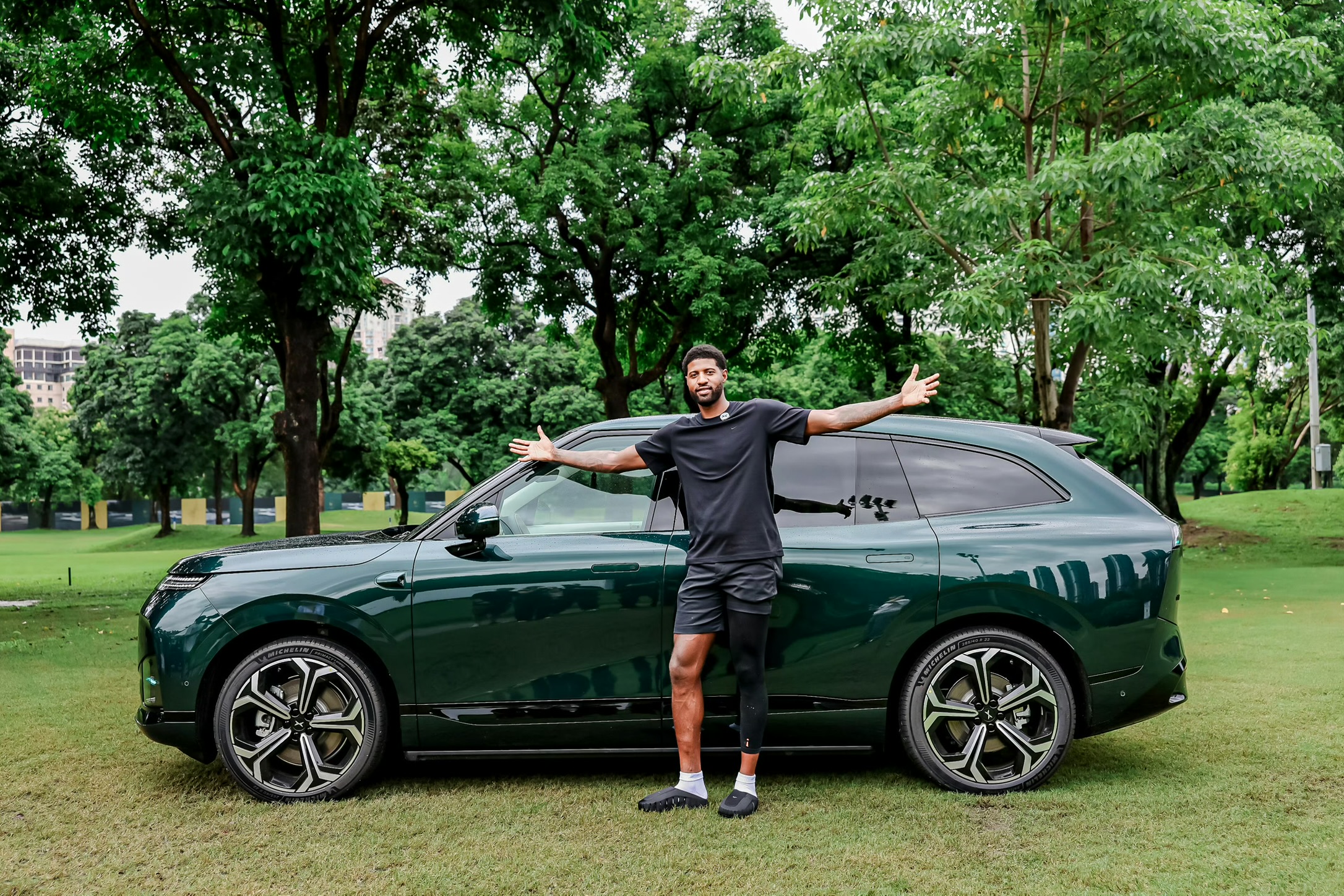
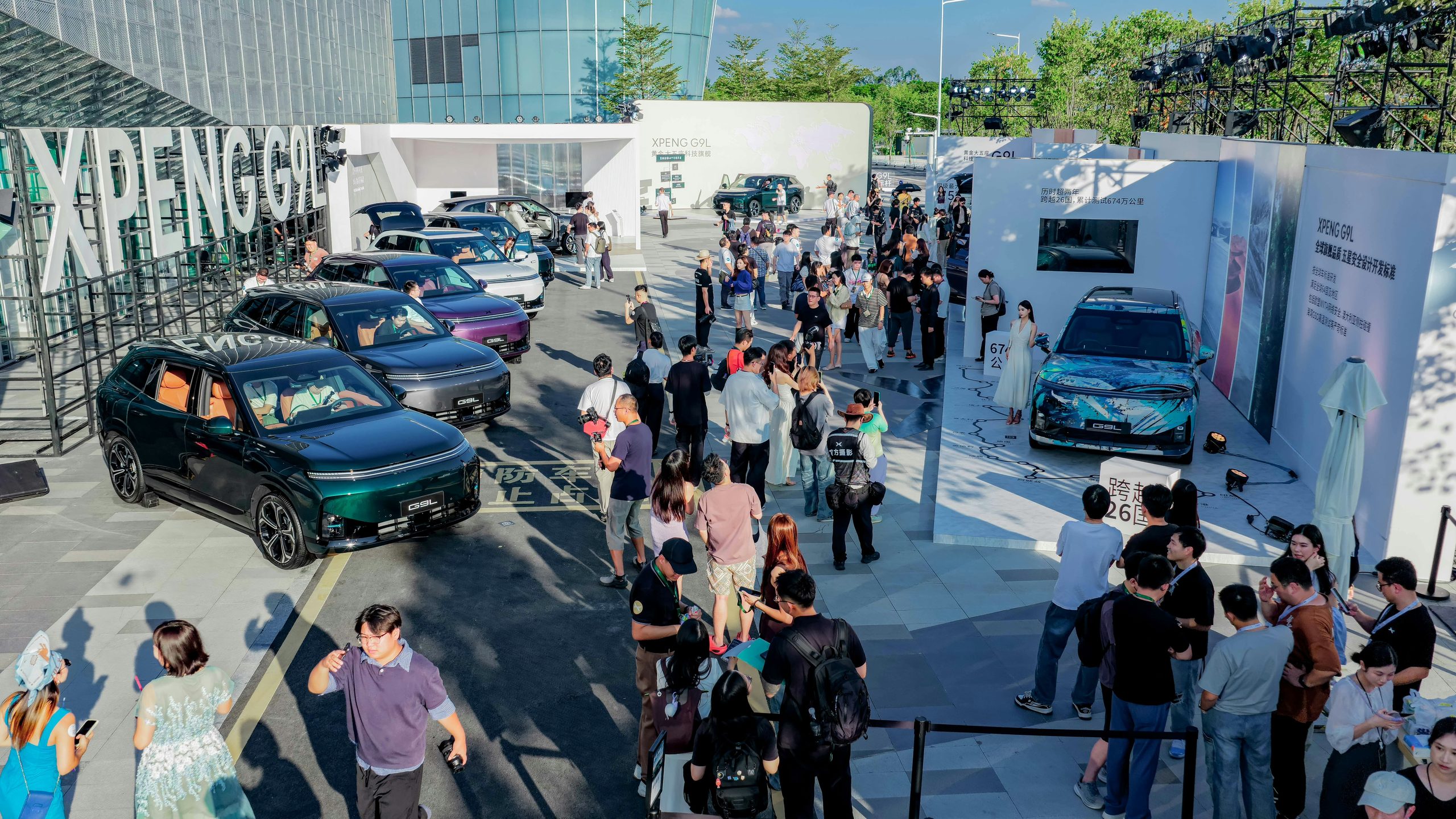
Outdoor Guangzhou debut / media-day stills (August 2026), including the boot wall with the four-zone breakdown.
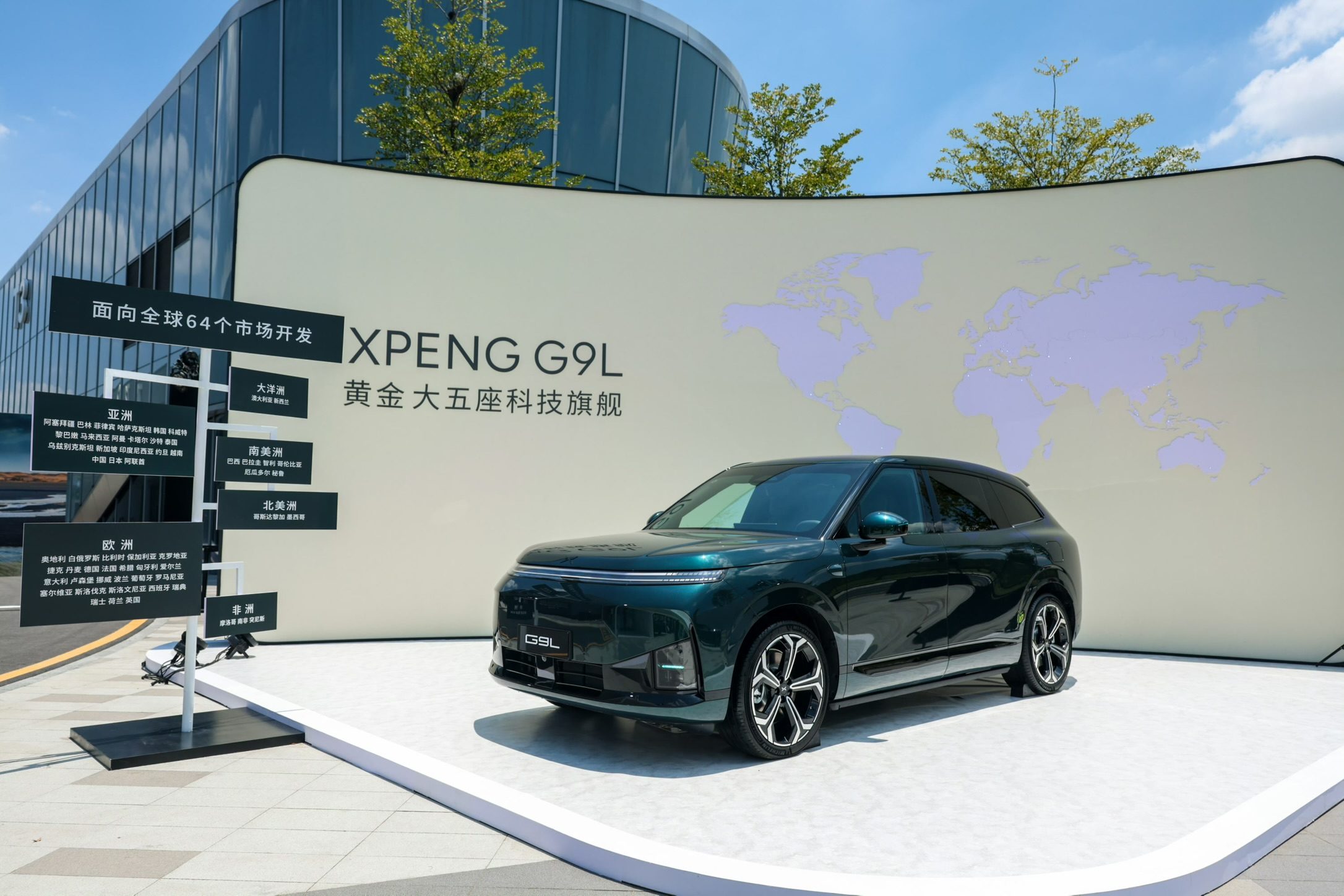
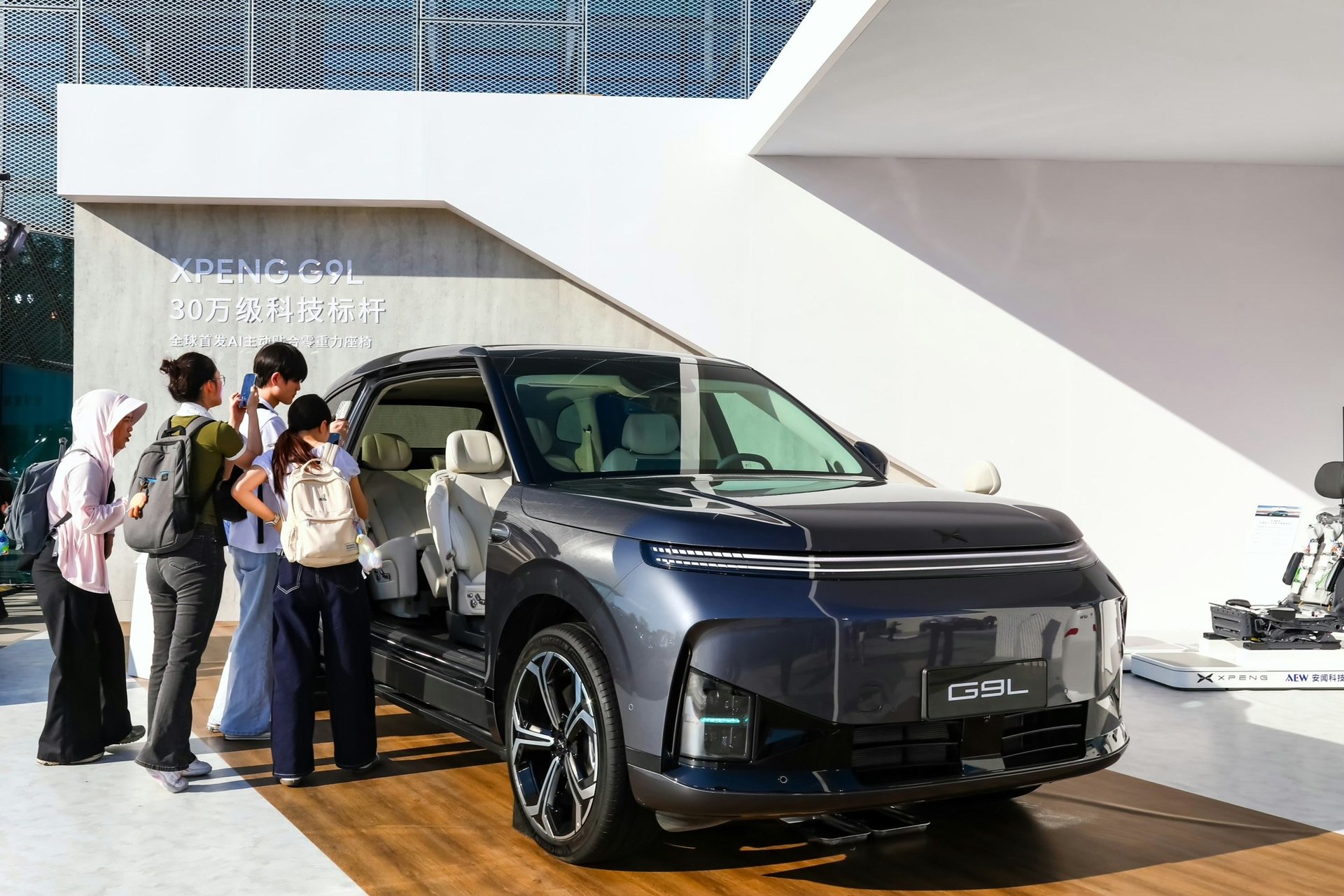
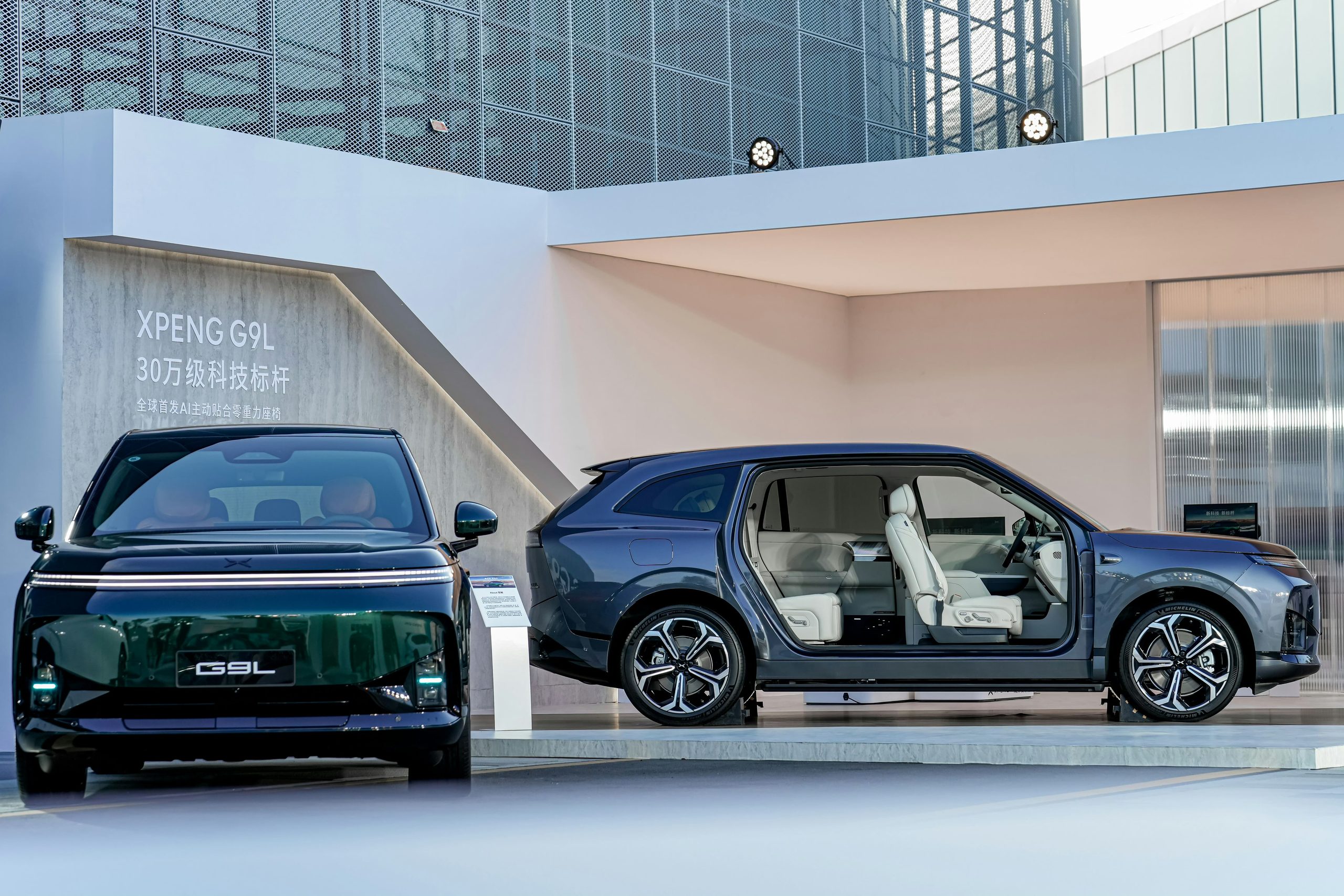
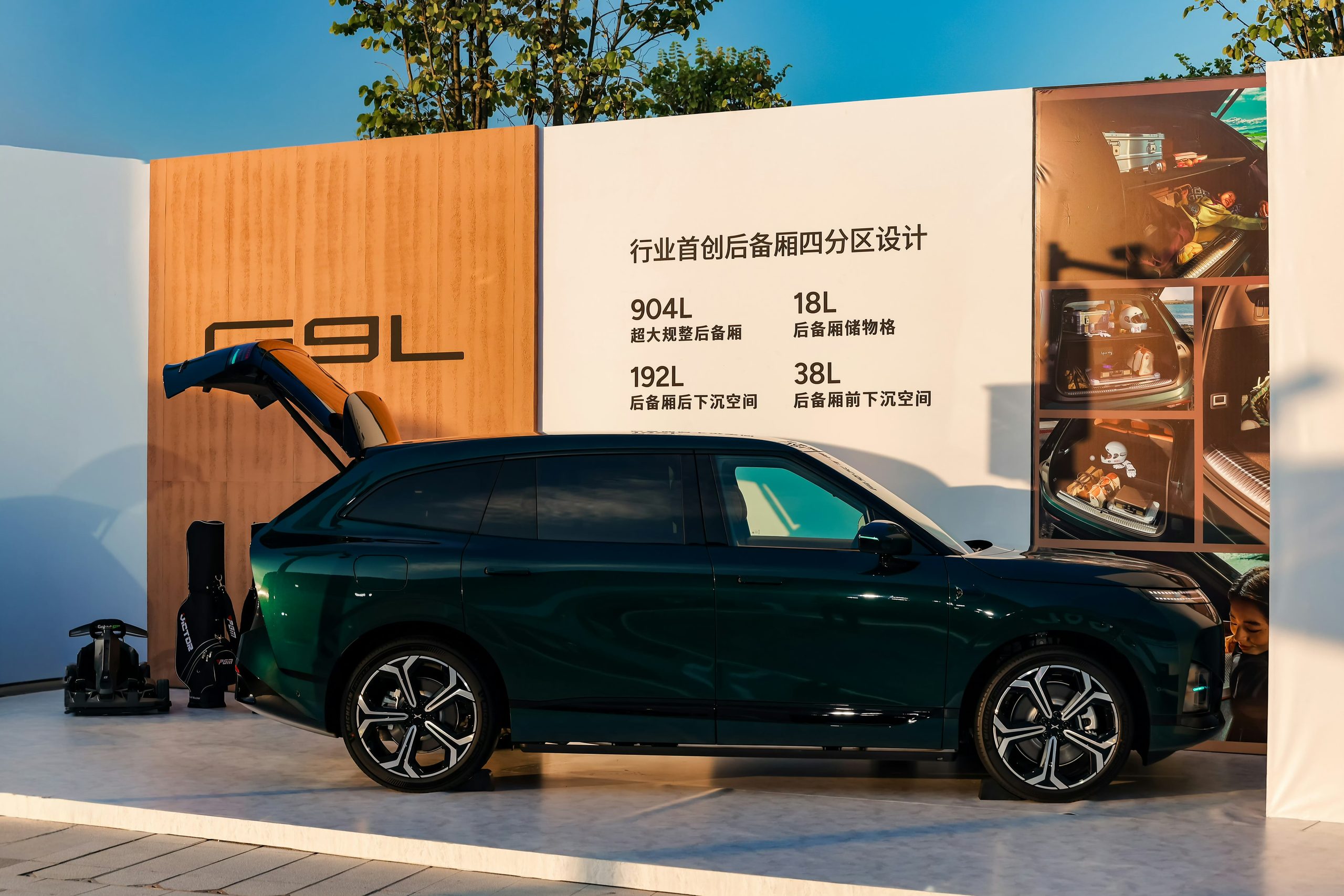
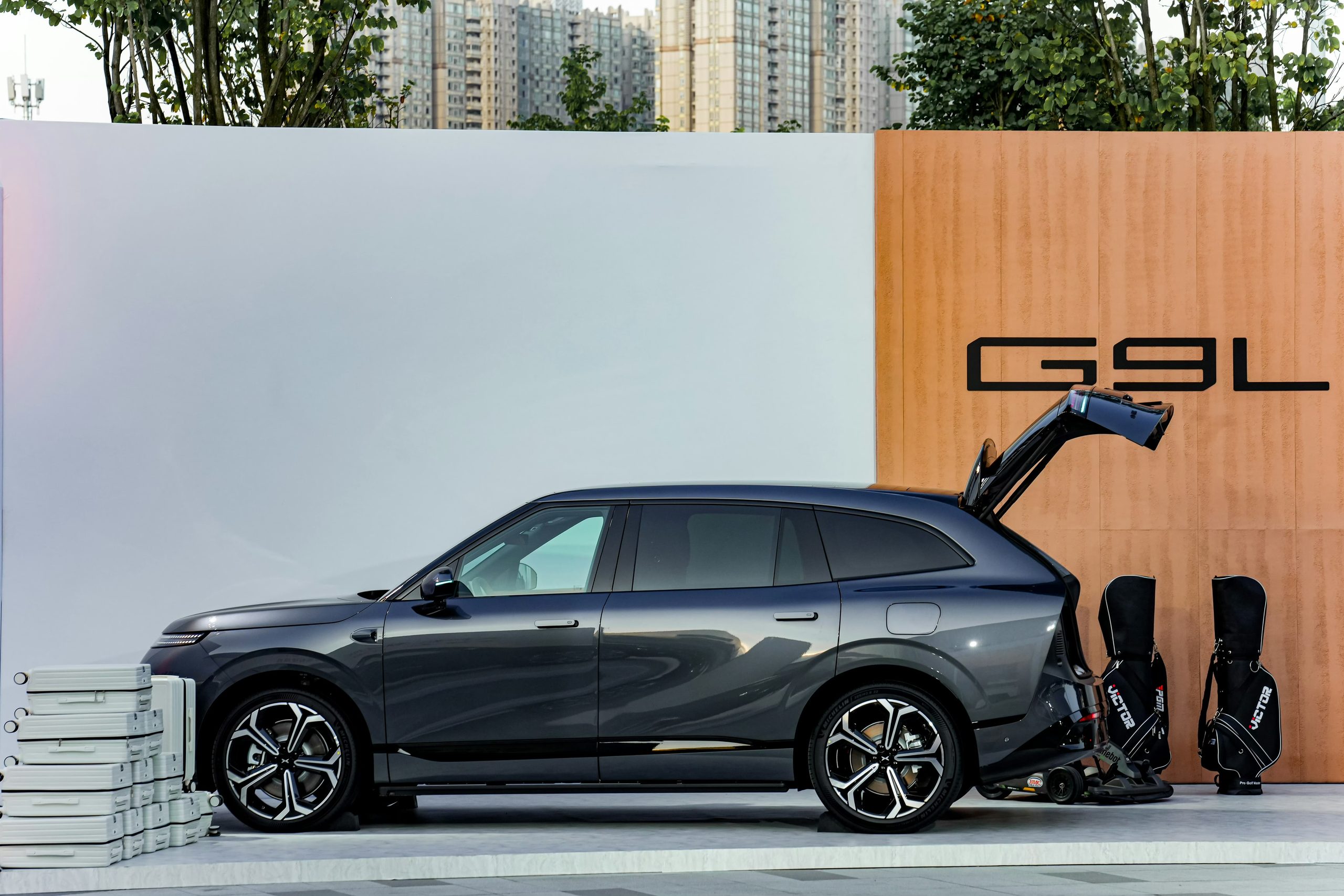
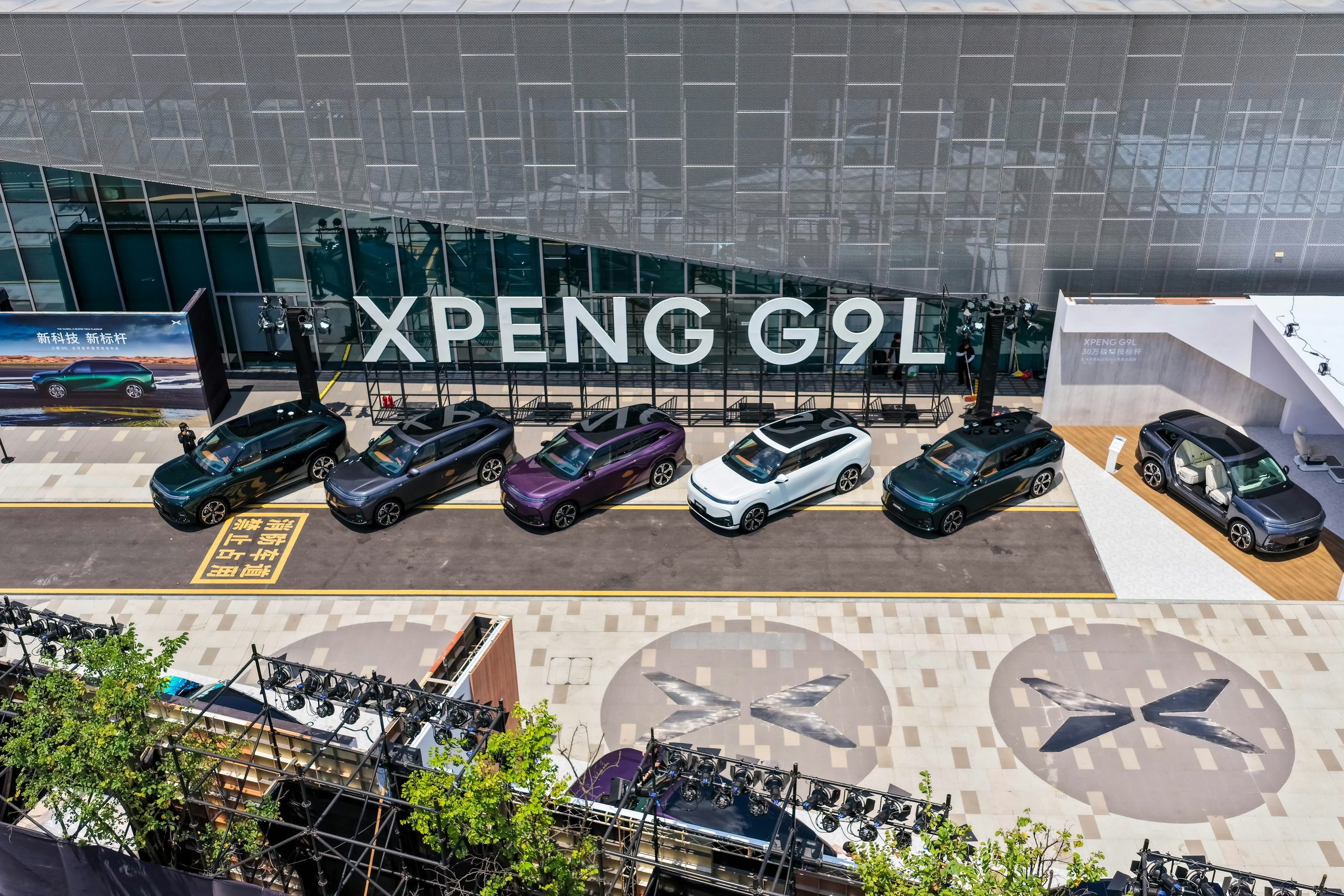
Press/launch stills: XPENG via official Chinese Weibo and WeChat posts (August 2026). Guangzhou display and wheel crops: debut event. MIIT: public filing.
Videos
Launch material from XPENG’s official Chinese Weibo posts. Expand to see every clip. The clips carry Chinese subtitles and watermarks.
Videos: XPENG via official Chinese Weibo posts (August-September 2026), plus Guangzhou debut display clip. Re-encoded for web playback.
Related
XPENG G9 · G9 Differences · XPENG GX · Compare specs · XPENG L03 · Lineup hub · Markets
Sources
Sources for this page: XPENG’s European press release (3 August 2026), CEO He Xiaopeng and XPENG Weibo posts (3-31 August 2026, including the launch presentation and the spec posters that followed), the Q2 2026 earnings call (24 August 2026), and the public MIIT filing.
- Official Chinese G9L model page (xiaopeng.com) - marketing figures, colours, section films
- Official Chinese G9L configurator (store.xiaopeng.com) - trims, prices, colours, per-trim equipment, 360 cabin view
- XPENG G9L global debut / pre-sale event in Guangzhou - slides (11 August 2026) - six-variant matrix (Max / Ultra SE / Ultra / Ultra Flagship); CLTC range; VLA gen 2 → version 6.3.0; SEPA 3.0 shared with the GX; hybrid SiC / IEEE efficiency figures; chassis (air / DCC / rear steer-by-wire); pre-sale benefits
- XPENG European press release - G9L (3 August 2026), via XPENG Denmark / PR
- XPENG Europe post (18 August 2026) - four-wheel steering angle ±7.5° and turning radius 5.4 m
- XPENG’s seat slide on Weibo (全体型 AI 主动贴合座椅, September 2026) - air pump, adjustment motors and pneumatic solenoid valves per front seat
- XPENG (小鹏汽车) on Weibo, 14 September 2026 at 05:00 (owner capture, no public address) - measured 5C charging test: 9 分钟补能 450km, peak power 619.6kW, 全系标配 800V 高压平台、5C 超充大电池
- XPENG (小鹏汽车) on Weibo, 14 September 2026 at 03:10 (owner capture, no public address) - countdown on the pre-sale perks: 9月17日前预订, six perks with list prices, and the small print on refunds within three working days and perks that cannot be transferred
- He Xiaopeng / XPENG early presentation video and Weibo posts (3 August 2026) - positioning, AI seats, 800V charging, moose test, VLA, compute; launch colours Toscana Green / Provence Purple / Fjord Grey / Everest White
- XPENG Weibo (5 August 2026) - the Polar Night Black colour launch; the gallery’s four photos
- He Xiaopeng Weibo (7 August 2026) - Munich media road test; 64 markets; chassis / rear-wheel steering on narrow streets and Belgian cobblestones
- XPENG Weibo (7 August 2026) - global road test (26 countries/regions · 6.74+ million km); quote posters (incl. xpeng.guru); global road-test montage video
- XPENG launch presentation and official Weibo posts (11-20 August 2026) - safety programme (crash-test count, assessment protocols, the 720° challenge), chassis hardware, rear space, VLA 6.3.0 and the Turing compute figure; 20 August display-car list (53 cities, 200 stores). The seven-fold challenge footnote credits a commissioned test agency; the launch films carry CATARC co-branding
- XPENG Weibo and the Chengdu show poster (21-22 August 2026) - the Black Gold Edition debut (photos, poster and clip) and all five colours at the show
- XPENG Weibo (26 August 2026, 09:00) - G9L first with the new second-generation VLA; 30-second temporal context, X-Foresight 6-second trajectory prediction, end-to-end response +300%
- XPENG Weibo (27 August 2026, 03:20) and @XPENG_Global the same day - third Turing chip “lit” / “now live”; VLA 2.0 + VLM cross-domain fusion; Master Agent on the car (pull over, park nearby, fuzzy navigation, complex planning); Infini-VLA 30 s and X-Foresight 6 s in English; 6.3.0 named as the version. He Xiaopeng on X: spatial modelling to spatiotemporal modelling. TIME stage slide: Infini-VLA / streaming inference / X-Foresight + Flow Matching; 20-fold multi-dimensional safety. TIME briefing also: VLA 2.0 Lite on Max, local acceptance testing in Germany, China OTA from September; driver-incapacitation assist as standard on every Chinese trim. The 28 August slide set adds UN R171 (DCAS) as the named route with internal-test footage from Germany, the Netherlands, France and Australia, and Master Agent on the Omni multimodal base with vertical agents
- XPENG official corporate release on second-generation VLA, 27 August 2026 (published 1 September 2026) - second-generation VLA upgrade for G9L; 4D spatiotemporal model, Infini-VLA, X-Foresight, Master Agent, Turing VLA 2.0 Lite on Max and local validation testing in Germany
- XPENG Norway / NTB Kommunikasjon (1 September 2026) - official confirmation of G9L as a luxury model above G9 with Paris premiere (October 2026) and exclusive 6- and 7-seat configurations in Norway
- XPENG Q2 2026 earnings conference call (24 August 2026) - He Xiaopeng: official China launch and deliveries in September; the VLA 2.0 upgrade rolling out in China from the end of August, European regulatory approval targeted for the first half of 2027 and overseas delivery after it. The written results release does not name the G9L date
- CnEVPost (24 August 2026) - English write-up of the same G9L date from the call
- XPENG (小鹏汽车) on Weibo, 14 September 2026 at 03:00 - 新科技旗舰,小鹏 G9L 中国上市发布会,定档 9 月 17 日 19:00。敬请期待! The launch poster in the post adds the venue, 中国·北京
- XPENG’s launch trim sheet (Weibo, 17 September 2026 at 21:12 Beijing time) - all six prices as limited-time prices including the CN¥ 10,000 in cash, chips and model per trim, the standard equipment and the full offer list running to 15 November 2026
- MIIT batch 407 - G9L filing
- NEV purchase-tax catalog (China) / secondary summaries (e.g. BitAuto, Jun 2026) - BEV 91.9 / 110 kWh, CLTC 672-805 km; EREV 63.3 kWh
- FDM (25 February 2026) - Guangzhou headquarters visit; G02 named with wheelbase, seat count and Austrian assembly; Danish importer on 2026 model timing
- Autohome (18 February 2026) - first G02 spy shots and the note that little was known about the car at that point
- CnEVPost (3 August 2026) - English summary of the Chinese reveal
- CnEVPost (9 May 2026) - English summary of the G9L filing
- China Auto Insider on YouTube / Silicon Wheels on YouTube - China five-seat cabin / boot walkthrough details (tray use, boot dual-layer / controls, AI projection marketing figures)
- Mondial de l’Auto / Paris Motor Show 2026 - official dates 12-18 October 2026
- XPENG Weibo, 31 August 2026 - four spec posters on the rear steer-by-wire (angle, turning radius, actuator, safety module) and the two-lane U-turn video; figures under Rear-wheel steering. The industry-average baselines are not named.
Changes to this page (26)
- Launch trims: XPENG's own launch sheet gives the introductory-offer price on all six trims, two further offers running to 15 November, and which of them run the VLM cabin model.
- Timeline: the 17 September entry gained XPENG's own live broadcast of the Beijing launch.
- Launch trims: the China launch set a guidance price for all six trims, from CN¥ 241,800 to CN¥ 319,800, each shown with an introductory offer.
- Assisted driving: corrected the Turing chip count - Ultra carries three chips and 2,250 TOPS, not two.
- Powertrains: the launch added the 12-minute fast-charge figures per trim, the EREV's electricity consumption and XPENG's 300,000 km battery-durability test.
- Europe & Denmark: a new section on where the car is built - Guangzhou and the XPENG Magna plant in Graz, in parallel.
- Platform & chassis: braking distance from 100 km/h.
- Interior: the cabin is marketed as formaldehyde-free, with what XPENG did and did not say about it.
- Open questions: AC charging joins the list - the range charges at 11 kW, and XPENG's Chinese tables give no AC figure for the G9L or the GX.
- Timeline: Hammond's drive of the right-hand-drive car at Millbrook on 14 September, and the Norwegian premiere at the Oslo Motor Show, 23-25 October.
- Range: eight Chinese outlets' measurements on a 755 Ultra, with city and highway figures for each.
- Moose test: XPENG's own film shows 78 km/h through the cones and 87 km/h as the session maximum.
- Two more films: the Millbrook drive and TOP G9L with five test disciplines.
- Pre-sale perks: the Black Gold package at CN¥ 10,000, and XPENG's terms on the refundable deposit and perks that cannot be transferred.
- Charging: XPENG's measured 5C test, peak power 619.6 kW, and the 5C large battery given as standard across the range.
- The China market launch now has a date and a venue: Beijing, 17 September 2026 at 7 pm China time, with a link to the news story about it.
- Timeline: the first right-hand-drive G9L rolled off the line in Guangzhou, bound for Australia.
- Seats: the adjustment hardware per front seat added from XPENG's own seat slide - air pump, motors and pneumatic valves.
- Gallery: XPENG's own AI active-fit seat poster added, the source for the new seat hardware figures.
- Q&A: what XPENG Denmark's loyalty programme is, with a link to the terms and my code under Support.
- Rear-wheel steering: 7.5 degrees each way, 5.4 m turning circle, XPENG's spec plate, the two-lane U-turn film under Videos and a Q&A pane.
- The European seven-seater joins the six-seater section.
- VLA 630 poster gallery grown from 8 to 20 images, including the TIME posters for VLA 2.0.
- VLA 630: the official figures from XPENG's 25 August release and a poster gallery.
- Cabin materials and centre island, seat comfort, Polar Night Black, and a Q&A with seven questions.
- Page rebuilt around the launch: the European six-seater, the Chinese version, launch trims, powertrains, platform and chassis, exterior and interior, a timeline from first trace to launch, videos and gallery.