


Roadmap for your XPENG
XOS 6, Google Maps, NGP and the new voice assistant: XPENG's announcements alongside my own hopes and expectations for European models.
XPENG has not published a complete roadmap for its European models. For more than two years, I have repeatedly suggested making its plans more visible to owners, but that has yet to happen. This article is therefore my cautious outlook on what the near future might bring, drawing on XPENG announcements, my own expectations and what I hope to see.
XPENG has announced XOS 6 and Google Maps for the L03 and G9L, with NGP planned from 2027, and the L05 comes to Europe in 2027. In October XPENG Denmark told me that Google Maps and Google Play are not planned at present for the models launched before the L03; XPENG Denmark says it has not yet reached a final answer on whether they can get XOS 6 as an interface. For existing cars, I hope every model from the MY23 G9 and P7 onwards gets some version of XOS 6. My concern is that XPENG may draw the line at the MY25 G6 and G9. I get the impression that XOS 6 and Turing are its priorities, so I expect cars from before the Turing generation to receive less attention.
Images: XPENG
Jump to: Overview · What XPENG has announced · What the six features require · What informs my assessments · Infotainment performance · Cabin AI: on board or in the cloud? · Development also takes people · Will hardware upgrades be offered? · What I expect from XOS 5 · Model by model · Sources
The table shows how likely I think each model is to get the six features. Only 5 is confirmed by XPENG or Apple; the rest is my take. The grey marker is the exception: it’s XPENG Denmark’s own answer from October 2026 that Google Maps and Google Play are not planned at present for models launched before the L03. Which cars in the table that covers is my reading. Cabin AI here means the new language-model voice assistant.
Overview
1 Unlikely2 Doubtful3 Possible4 Likely5 ConfirmedNot planned at present (XPENG)
| Model | XOS 6 | Google Maps | Google Play | NGP | Cabin AI | Apple CarKey |
|---|---|---|---|---|---|---|
| L05 Ultra | ||||||
| L05 (without Turing) | ||||||
| G9L | ||||||
| L03 Ultra | ||||||
| L03 (without Turing) | ||||||
| P7+ MY26 | Lite | |||||
| X9 MY26 | Lite | |||||
| G9 MY25 | ||||||
| G6 MY25 Long Range / Performance | ||||||
| G6 MY25 Standard Range | ||||||
| G6 MY24 | ||||||
| G9 MY23-MY24 | ||||||
| P7 MY23 | ||||||
| G3, G3i and the first P7 |
What XPENG has announced
XOS 6 has been announced for the international L03 and G9L; the G9L ships with XOS 6 on a Snapdragon 8295 and the L03 with XOS 6 on a MediaTek MT8676. For the other models, there are two hardware paths to consider. ADAS hardware sets the limits for driver assistance, including XPILOT, NGP and VLA. Infotainment hardware affects the screen experience, navigation and cabin AI functions.
A car may be better equipped for new features on one side than on the other. Sharing an XOS version number therefore need not mean sharing every capability. Hardware is only part of the picture: software adaptation and XPENG priorities also matter, while driver assistance depends on the relevant approvals.
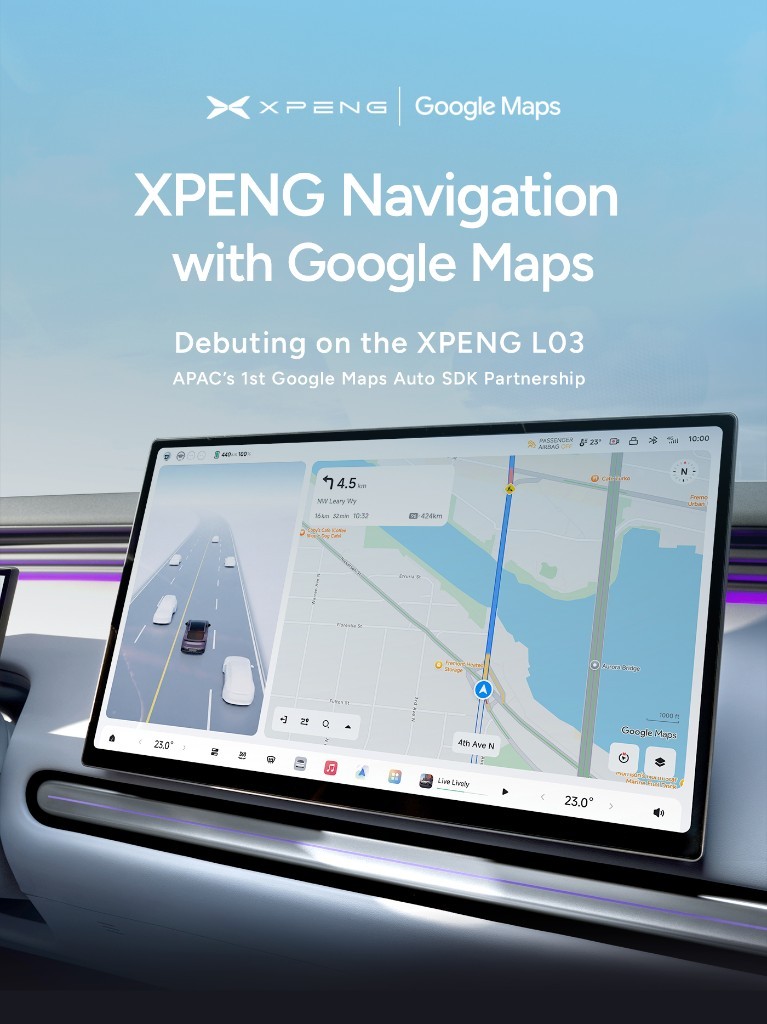
Google Maps is a separate development from the Google search data added to navigation in XOS 5.9.5, which only MY25 models and newer received (XOS 5.9.5 release note). The new navigation uses Google’s Auto SDK within XPENG’s own interface, with the L03 announced as the first model outside China to receive it; the G9L has it too. The Google Maps article covers the distinction.
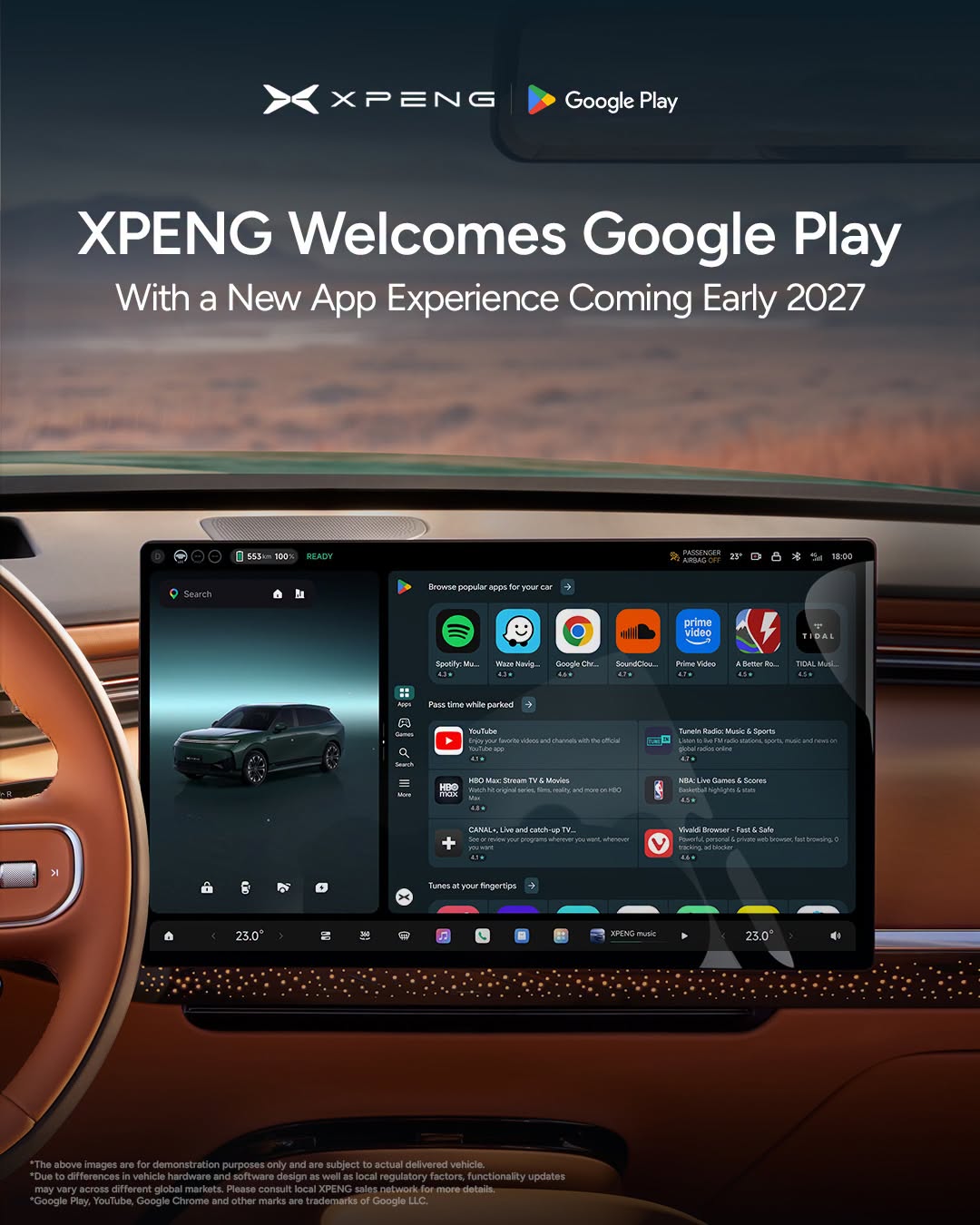
Google Play and Apple CarKey are two new parts of XOS 6. In its Weibo post on the G9L’s launch on 12 October, XPENG wrote that its work with Google covers Google Play as well as Google Maps, and that its cars already have more than 500 apps running natively in the car. According to the post, the selection can grow without a software update to the car, and the aim is to bring European users’ familiar digital life into the car. On 15 October, a press release put the store at early 2027: Google Play is built on Android Automotive OS, its apps can be opened with the voice assistant, the experience can evolve without major full-vehicle updates, and models and markets will be named later. XPENG Denmark has since confirmed to me that Google Play will be part of XOS 6 on the L03 and G9L (the Google Play story).
Cars launched before the L03 now have an answer. XPENG Denmark told me in October 2026 that Google Maps and Google Play are not planned at present for them. They run on a different software and hardware architecture from the new generation, so the services can’t be added with an ordinary software update. For the G6, G9 and P7+, according to XPENG Denmark, the cars can’t meet the requirements of Google’s compatibility test, and adding the services would take new hardware and a new software type approval. Type approval is the car’s EU approval, and when a manufacturer changes something the approval covers, the approval authority decides whether the existing approval can be amended or a new one is needed (EU Regulation 2018/858, Articles 33 and 34). Software updates for the existing models continue, each on its own platform. XPENG Denmark separates XOS 6 as an interface from the Google integration, and in a statement on 21 October it says it has not yet reached a final answer for every model on whether the older cars can get the interface. Each model needs its own assessment (the story on the answer).
For each Android release Google publishes the general compatibility rules, minimum hardware requirements for cars included, while Google Automotive Services, which brings Maps and Play into the car, comes under an agreement with Google. At chip maker Qualcomm, part of the software and documentation is open only to registered users who have accepted a licence, or to verified companies. Neither Qualcomm nor Google publishes a list of which Android releases each car chip can run, or which Android releases Google supports with Google Automotive Services. That is settled in the agreements between the carmaker, Google and the chip maker, so on this point I rely on XPENG Denmark’s explanation.
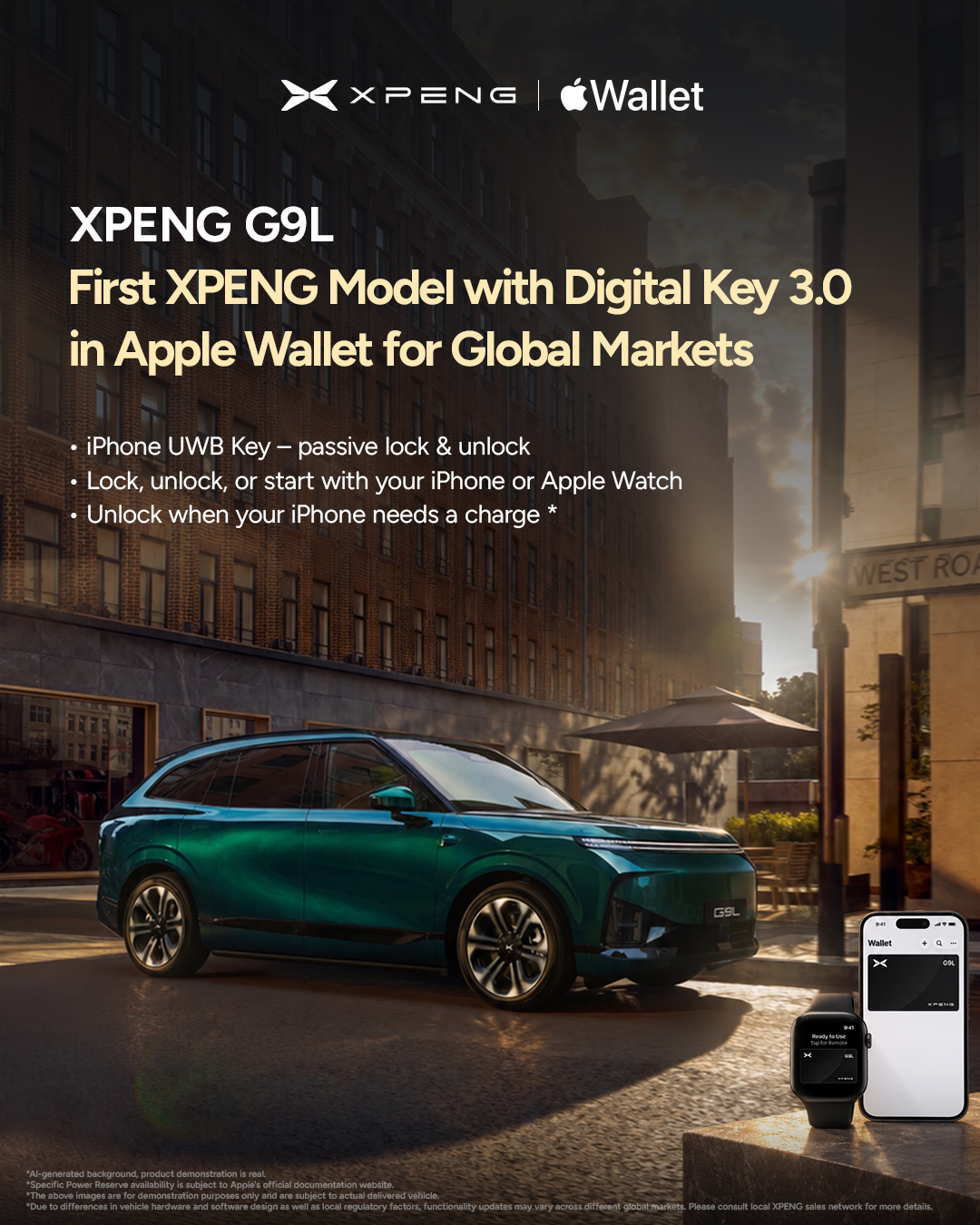
Apple CarKey arrived with the G9L on 13 October: an iPhone or Apple Watch becomes the car key, and with UWB the car unlocks while the phone stays in your pocket (the car key story). What the key and the other features need from the car is under What the six features require.
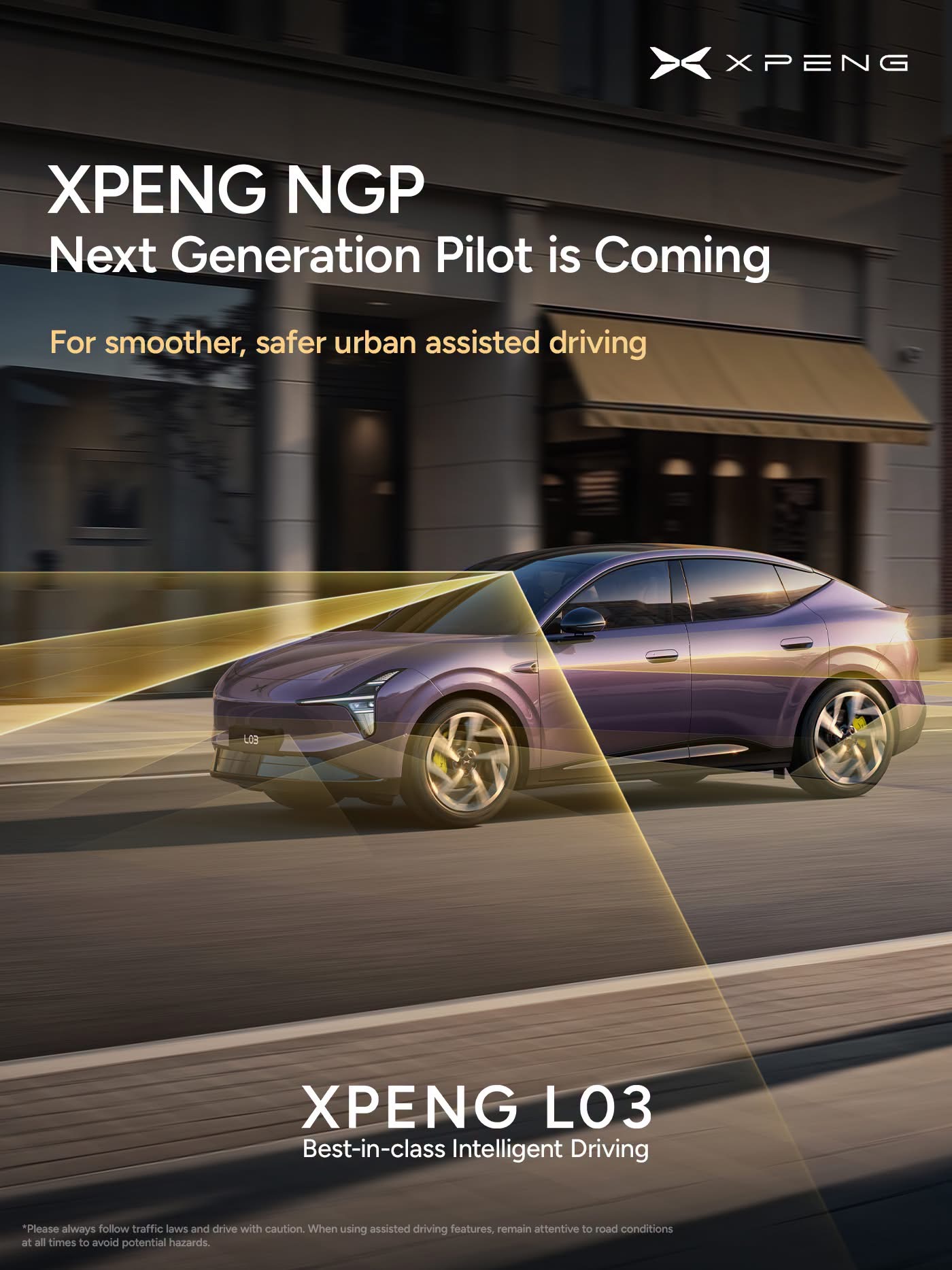
NGP is driver assistance that follows a navigation route. In July, XPENG described an ambition to begin its international rollout in early 2027, through gradual OTA updates in markets that meet the legal requirements. Its August results then set a target of European VLA approval in the first half of 2027. At the G9L’s launch in Paris on 12 October, XPENG said it aims to be the first carmaker certified under UN Regulation No. 171, Series 02, and XPENG Switzerland expects the regulation to become part of EU law by the end of 2026. Europe is part of the plan; regulatory approval and an update reaching your car remain separate steps. The VLA article explains the technology behind the new NGP.
XOS 5.4 voice control was announced in January 2025 with English, French, German, Cantonese and Thai. A month earlier, XPENG Denmark had said more local languages would follow. XPENG describes the new L03 voice assistant as more natural and multilingual, with new capabilities via later updates. In an interview at IFA in September, XPENG’s John Ma said it is based on a language model and named English, Mandarin, Cantonese, French and German, and possibly Spanish and Italian, for the new assistant. XPENG has given no date for Danish or other languages.
What the six features require
The table shows what each feature needs from the car and what has to be in place outside it. The sources are listed at the end of the article.
| Feature | Needs in the car | Needs outside the car |
|---|---|---|
| XOS 6 | An infotainment chip like the MediaTek MT8676 (L03) or Snapdragon 8295 (G9L); no minimum published | Not stated |
| Google Maps | XOS 6 and a car that passes Google’s compatibility test | Google’s map and navigation services and an agreement with Google |
| Google Play | XOS 6 and a car that passes Google’s compatibility test | An agreement with Google; from early 2027, other models to be named later |
| Apple CarKey | XOS 6; NFC, and UWB for unlocking with the phone in your pocket | Apple’s approval of the model |
| Cabin AI | XOS 6; a cabin Turing chip or an infotainment chip that can handle it | The cloud, if the chip cannot run it locally |
| NGP with VLA 2.0 | Two Turing chips (L03 Ultra, G9L); Lite for one chip only in China for now | Google’s map data and EU approval (target: first half of 2027) |
What informs my assessments
For each model, I consider both the ADAS and infotainment hardware. The chip is only part of that picture: Memory, sensors and the rest of the vehicle electronics may also impose limits. I also consider whether a feature needs to run inside the car or could use the cloud for part of the work.
The underlying software may also matter. I have not found official documentation identifying the Android version beneath XOS for each model. That leaves me unable to assess whether differences here require extra adaptation or limit particular new features.
Software then needs adapting and testing across models, languages and markets. Local approvals, data requirements and agreements with service providers may affect delivery too. Even a technically feasible feature needs people and funding.
That leads me to consider how much XPENG can reuse from its Chinese development, how many cars would benefit from an update and how new launches might affect priorities. In my view, supporting existing owners and retaining their trust should carry weight as well.
I do not know XPENG’s internal priorities or every technical constraint. These are the considerations I weigh as best I can when making the predictions below. They can pull in different directions: New hardware may simplify development, while a large population of existing cars can give XPENG a reason to keep developing for older hardware.
Infotainment performance
The 8155, 8295 and MT8676 run infotainment in the models discussed here. AnTuTu results offer a useful indication of the gap between generations, combining CPU, graphics, memory and user-experience tests. They do not test driver assistance or establish whether a car can run XOS 6.
In L03 Ultra, MT8676 remains the infotainment processor. A cabin Turing chip adds AI compute alongside it, with two further Turing chips assigned to driver assistance. Ultra therefore adds hardware rather than replacing MT8676. The Danish L03 configurator lists both cabin processors for Ultra.
Highest recorded score for each chip
| Chip | Test RAM / storage | Total score | Index: 8155 = 100 |
|---|---|---|---|
| Snapdragon 8155 | 12 / 128 GB | 525,686 | 100 |
| MediaTek MT8676 | 16 / 128 GB | 1,026,462 | 195 |
| Snapdragon 8295 (QNX + Android) | 16 / 128 GB | 1,223,060 | 233 |
AnTuTu chip ranking, checked 26 September 2026. This list uses the highest recorded total for each chip, from mainland China only. The index is calculated from those scores and rounded. These are different configurations, not a measurement of how much faster menus respond in a European XPENG.
How the same chip performs in different cars
| Car in the Chinese ranking | Chip | CPU score | Graphics score | Total score |
|---|---|---|---|---|
| XPENG G9 | 8155 | 133,851 | 154,628 | 447,573 |
| XPENG G6 | 8155 | 156,640 | 130,692 | 485,981 |
| XPENG P7i | 8155 | 159,065 | 174,905 | 525,686 |
| XPENG X9 | 8295 | 318,533 | 327,445 | 965,631 |
AnTuTu car ranking, checked 26 September 2026. No model year is given for these entries. These are Chinese cars, not a specification list for European models. AnTuTu notes that system design affects the resources available to the Android environment.
AnTuTu reported the MT8676 result on 22 April 2024, from an unidentified vehicle configuration with 16 GB RAM and 128 GB storage. It scored 293,832 for CPU and 382,425 for graphics. That puts it in the same broad performance class as the 8295 in these tests, without establishing how the European G6 Standard Range is optimised.
The spread between the 8155-equipped G9, G6 and P7i shows why a chip name cannot describe the entire experience. Memory and software matter too. None of these scores measures language-model performance or defines a minimum hardware requirement for XOS 6.
My take
These results give my concern about older cars a more concrete basis. Newer infotainment chips have a clear lead in these tests, and I can imagine XPENG prioritising new features for hardware with more capacity to spare. That fits my impression that XOS 6 and Turing receive most of the attention, although benchmarks cannot tell us how XPENG allocates development work.
I still hope MY23 cars receive XOS 6 with a selection of features. The scores do not rule that out. I would not expect the same version number to mean identical capabilities in every car.
The MT8676 result gives me no reason to consider a cloud voice assistant less plausible on the MY25 G6 Standard Range than on Long Range and Performance. It still depends on XPENG’s implementation and priorities. Driver-assistance hardware needs to be assessed separately.
Cabin AI: on board or in the cloud?
An on-board language model needs both compute capacity and memory. TOPS describes capacity for particular calculations, but cannot by itself tell us how quickly an assistant will answer. Memory bandwidth and how the model and software use the chip also matter. NVIDIA explains these compute and memory limits in its AI performance guide.
Reported AI compute capacity (TOPS)
| Chip | Reported capacity | Scope of the figure |
|---|---|---|
| Snapdragon 8155 | 8 TOPS | GWM: NPU in its Coffee OS 1/2 platform |
| MediaTek MT8676 | 20 / 23 TOPS | Autolink AL-M2: 20; CVTE P39: 23 |
| Snapdragon 8295 | 30 TOPS | GWM: NPU in its Coffee OS 3 platform |
| XPENG Turing | 750 effective TOPS | XPENG's official Turing figure |
Sources: GWM (March 2025). Autolink, CVTE and XPENG.
These are manufacturer figures and may use different measurement methods. The infotainment figures describe other manufacturers’ platforms using these chips, not measurements in European XPENG cars. The MT8676 figures are two separate supplier claims, not a measured range. XPENG describes its Turing figure as effective computing power. This table does not establish that an assistant runs 25 times faster on Turing than on 8295.
My take
I expect the additional cabin Turing chip in L03 Ultra to support more demanding local AI functions while MT8676 continues to handle infotainment. Some AI features could become less dependent on an internet connection. The processor combination alone does not establish how much of the assistant runs locally or how quickly menus and navigation respond.
MediaTek and Snapdragon also have AI capability, so I would not rule out local AI features on those chips. My prediction is that a cloud or hybrid implementation could let XPENG offer parts of the new assistant on other cars. We do not know the requirements of the specific model, and XPENG has not confirmed such a solution. In my view, some cabin functions can tolerate more delay than the continuous calculations needed for driver assistance. That makes cloud processing seem a plausible option for part of the work, although it would need an internet connection. This is entirely my own prediction; I have heard no official announcement of such a cloud version.
Development also takes people
When I visited the ADAS team in Guangzhou in November 2025, we discussed the difference in staffing between Chinese and international development. My travel diary recorded more than 1,200 people working on ADAS overall, with around 100 dedicated to the international version. Some worked across both programmes to share knowledge and solutions.
Those figures describe what I learned on that visit. I do not know how the allocation has changed since then. They concern ADAS, not staffing across XOS and infotainment development.
The hardware combinations in China are changing too. The Chinese MY26 G9 specification still lists an 8295 for infotainment, paired with Turing for driver assistance. The European MY25 G9 uses an 8295 with Orin-X. A chip can therefore remain in use while the hardware around it changes. The current Chinese G9 specification establishes that distinction; it does not establish whether dealers still hold older configurations in stock.
My take
I think the number of developers also affects how many software branches XPENG can maintain and improve at once. Even where the hardware can support a feature, people still need to adapt it and test it for the cars and markets that will receive it.
My expectation is that upcoming models, and hardware also used in the current Chinese range, will naturally take priority. I worry that older European combinations may need more separate development work and consequently receive fewer new features. That is my interpretation of a possible priority, not a decision XPENG has confirmed.
This also explains why I do not expect VLA for European cars with a single Orin-X. NVIDIA specifies up to 254 INT8 TOPS, numerically about a third of the 750 effective TOPS quoted for Turing. That is not a measured speed difference on the same VLA model. I think both the lower compute capacity and the work of developing a separate version count against it. I also assume this configuration represents a relatively small share of the overall audience for XPENG’s future VLA development; I do not have an exact figure. In my view, that makes it less likely to receive priority, but does not prove a smaller model is technically impossible.
The collaboration between markets also gives me hope that improvements can reach existing cars. I would like XPENG to make clear which models it continues to develop new features for and which it mainly maintains.
At the G9L launch in Paris, I met some of my contacts from Munich and China, and they seemed a little tired. Besides developing the software and systems, they also demonstrate the new systems to the press and other stakeholders at events like this, and right now new software and new cars are launching at the same time.
As far as I can see, the international XOS 6 is their top priority. Without it they cannot deliver the first L03 and G9L, because as far as I know XOS 5 was never made for them. Once the first version is delivered and, not least, stable, I hope they get the chance to work through their backlog.
I also see a challenge in XPENG not yet having delivered cars with XOS 6 to customers, so there are no external beta tests to get feedback from. I took part in testing XOS 5 while the cars otherwise ran XOS 4, and I think it helped that customers could test more widely than internal tests allow. I have not heard of external beta tests this time.
From what I hear, work on VLA Lite for current cars has not started yet, because the software for the new models and the 5.12 update have taken all the capacity. So I think current cars will come onto the agenda afterwards, perhaps with an XOS 6.
On Google Maps and Google Play, XPENG Denmark has now answered. Its reply doesn’t cover the other new features on existing cars, and that’s where my small hope sits now.
Will hardware upgrades be offered?
At AI Day in 2024, XPENG announced a chip-upgrade programme for existing customers. That announcement does not itself constitute a European offer. Work on earlier hardware continues in China too: in September 2026, XPENG described an adapted VLA model for two Orin-X chips undergoing internal testing. That configuration differs from a single Orin-X and offers no update guarantee for European cars.
My take
Unfortunately, I no longer expect a hardware-upgrade offer in Europe. XPENG has talked about it, but I haven’t heard anything further for roughly a year. My impression is that it has been set aside.
What I expect from XOS 5
At a minimum, I expect a new 5.12 beta soon. My guess is that it will be smaller than usual and probably the last 5.x update of 2026.
I still hope for 5.x updates in 2027, unless every model on 5.x moves to some version of 6.x.
Model by model
The requirements behind the tables are under What the six features require; here it is model by model.
L05
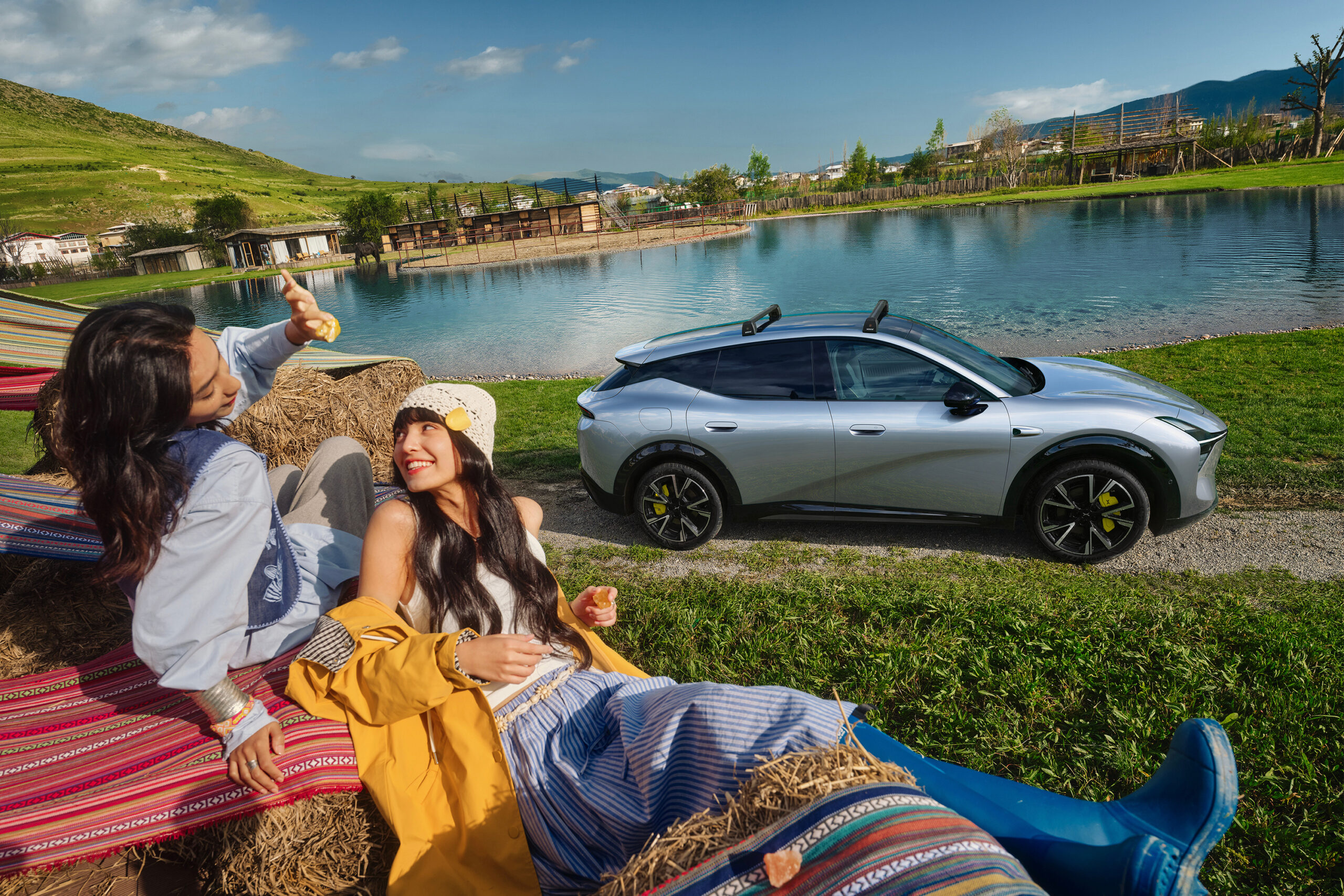
At Paris Night on 11 October, XPENG announced that the L05 comes to Europe in 2027 (the L05 story). European trims, chips and software have not been announced. In China, the car is on pre-sale with MediaTek MT8676 and one or two Turing chips depending on trim, which says nothing about what the European L05 gets. The L05 page collects what is known.
My take
I expect the L05 to get the same things as the L03, naturally. In my view, every new model from the L03 onwards gets everything new except what needs Turing chips or UWB. So Apple CarKey is confirmed on the G9L but not coming to the L03 and L05.
G9L
G9L launched in Europe on 12 October. China’s Max, Ultra SE and Ultra have different Turing configurations; the Danish Ultra name does not imply the three chips of China’s Ultra.
XPENG identifies Qualcomm Snapdragon 8295 as the processor for infotainment and the XOS 6.0 cockpit in the European G9L in its German launch release of 12 October 2026.
All three Danish G9L Ultra trims list two Turing AI chips for driver assistance; an additional cabin AI Turing chip as on the L03 Ultra is not listed. NGP and Full-Scenario VLA 2.0 await regulatory approval, so the cars are delivered with XPILOT. The Danish configurator lists a UWB key and a digital key on phone and watch on all three trims, and XPENG announced Apple CarKey for the G9L on 13 October (see the story). Google Play is confirmed from early 2027.

My take
The new voice assistant is confirmed for the G9L. Without a cabin Turing chip, it has to run either locally on the Snapdragon 8295 or via the cloud. The Danish specifications do not say which XPENG has chosen.
L03
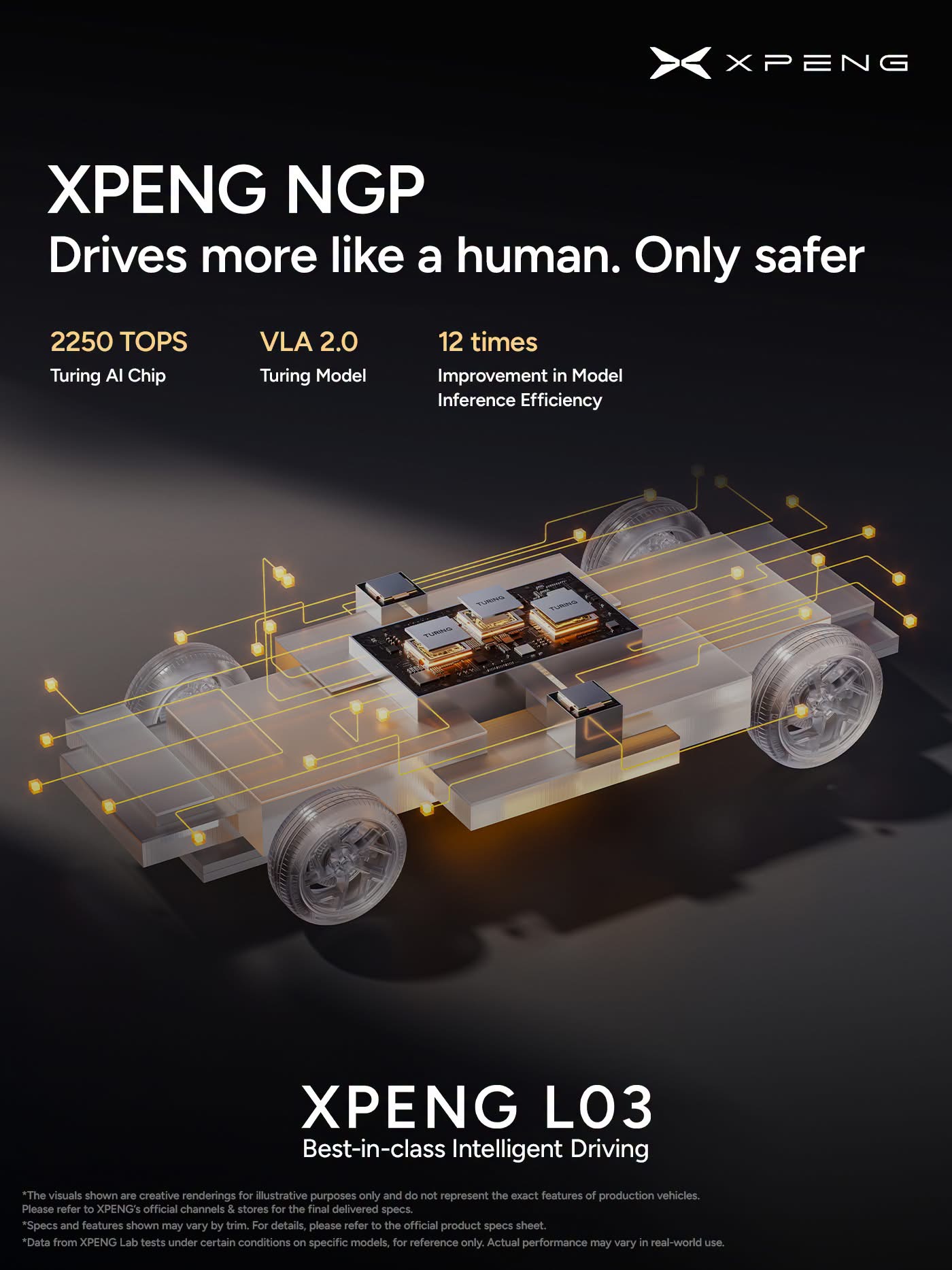
L03 has the clearest announcements: XOS 6 and Google Maps are confirmed, and the Danish equipment list schedules NGP with VLA 2.0 for the first quarter of 2027 on Ultra. Other trims list it as unavailable, as they do VLM (vision-language model). Ultra retains MT8676 alongside a cabin Turing chip, with two additional Turing chips for driver assistance. Google Play is confirmed from early 2027. The L03 page covers the trim differences.
My take
I expect XOS 6 and Google Maps at delivery, and I think the L03 will come with XOS 6.3. For NGP on Ultra, my estimate is Q2 2027, a little later than the equipment list suggests. I expect the other trims to retain XPILOT. I don’t expect Apple CarKey: according to XPENG Denmark, the L03 has no UWB, and the equipment list shows only the Bluetooth key.
My expectation is that Ultra gets the new voice assistant first and the other trims after it. I think Danish will arrive after the major languages.
P7+ MY26
The Danish P7+ configurator lists MediaTek MT8676 for infotainment and one Turing XP5 chip for driver assistance.
Google Maps and Google Play are not planned at present for the P7+, XPENG Denmark said in October. According to XPENG Denmark, the car can’t meet the requirements of Google’s compatibility test without new hardware and a new type approval.
My take
I expect XOS 6 during 2027. I also expect VLA 2.0 Lite, later than NGP on the L03 Ultra. I expect the new voice assistant, because the infotainment hardware matches the L03, G9L and L05 without Turing. Apple CarKey has so far only been announced for the G9L. The P7+ has the UWB and NFC hardware for the key, which could follow later with XOS 6, but XPENG has not mentioned the P7+.
X9 MY26
XPENG’s German X9 configurator lists Turing XP5 among the car’s equipment.
Google Maps and Google Play are not planned at present for models launched before the L03, XPENG Denmark said in October, because they run on a different software and hardware architecture. As I read it, the X9 is one of them.
My take
My outlook is similar to the P7+: XOS 6 in 2027, VLA 2.0 Lite after the L03 Ultra, and the new voice assistant. Apple CarKey depends, in my view, on XOS 6 arriving. The X9 has the hardware for the key.
G9 MY25
XPENG’s European New G9 announcement specifies Snapdragon 8295 for the cockpit and Orin-X for driver assistance. This puts it on a different hardware combination from both the earlier G9 and the new Turing models.
Google Maps and Google Play are not planned at present for the G9, XPENG Denmark said in October. Its explanation is that the G9 can’t meet the requirements of Google’s compatibility test, and that adding the services would take new hardware and a new type approval.
My take
I expect XOS 6 and the new voice assistant, because the infotainment hardware matches the G9L. I expect it to keep XPILOT rather than gain NGP. Apple CarKey depends, in my view, on XOS 6. The UWB and NFC hardware for the key is in the car.
G6 MY25
Trim matters here. Denmark’s configurator lists MediaTek MT8676 for Standard Range and Snapdragon 8295 for Long Range and Performance. It also explicitly excludes the other trims’ Orin-X chip from Standard Range. Long Range hardware therefore cannot stand in for every MY25 G6.
Google Maps and Google Play are not planned at present for the G6, XPENG Denmark said in October, with the same technical reason as for the G9 and P7+: without new hardware and a new type approval, the G6 can’t meet Google’s requirements. As I read it, that applies to all three versions.
My take
I expect XOS 6 and the new voice assistant on Standard Range as well as Long Range and Performance, because the infotainment hardware matches the L03 and G9L. I expect driver assistance to remain XPILOT. Here too, Apple CarKey depends on XOS 6 in my view. The Digital Key guide lists UWB and NFC in the New G6.
G9 MY23-MY24, G6 MY24 and P7 MY23
This generation uses Snapdragon 8155 for the cockpit. XPENG lists it in the 2024 Danish G6 specification sheet and in European equipment lists for the earlier G9 and P7. The G6 sheet also specifies Orin-X for XPILOT. These cars therefore belong to a different hardware generation from the new Turing models. The cited XPENG announcements do not yet provide a European XOS 6 schedule for them.
Google Maps and Google Play are not planned at present for this generation either. XPENG Denmark puts it down to the models launched before the L03 running on a different software and hardware architecture.
My take
I hope these cars get some form of XOS 6 too. My worry is that XPENG limits the upgrade to MY25 and newer. That is my concern, not a cutoff the company has announced.
The new voice assistant is doubtful on this generation; in my view it follows XOS 6. My forecast for NGP is still no, and the same goes for Apple CarKey: the G9 and G6 have neither UWB nor NFC, only Bluetooth, and although the P7 has NFC, I don’t think it will get the key when the others don’t. I have more hope for a new operating system than I have expectation of receiving every new feature.
G3, G3i and the first P7
The G3, G3i and pre-MY23 P7 belong to XPENG’s early launches in Norway. In 2022, XPENG described the P7 then on sale as available in China and Norway; the G3i also launched in Norway that year. I have limited information about future software development for these European versions, so I do not expect any of the six features to reach them.
Sources
Show 37 sourcesHide sources
XPENG’s Danish G9L configurator, checked on 15 October 2026 - two Turing AI chips under driver-assistance hardware on all three Ultra trims; NGP and VLA 2.0 await regulatory approval; UWB key, NFC key card, digital key on phone and watch, Google Maps and the “Hey XPENG” voice assistant.
These are my own assessments as of 21 October 2026. XPENG Denmark has answered on Google Maps and Google Play for the cars launched before the L03; the other open questions remain unresolved. If XPENG confirms or rules out anything discussed here, I will update the article.
- XPENG Germany on the G9L, 12 October 2026 - XOS 6.0 on the Snapdragon 8295, Google Maps and “Hey XPENG” from six zones
- XPENG’s G9L launch in Paris, 12 October 2026 - the aim of certification under UN Regulation No. 171, Series 02
- XPENG Denmark to xpeng.guru, October 2026 - Google Play will be part of XOS 6 on the L03 and G9L; the L03 has no UWB; Google Maps and Google Play not planned at present for models launched before the L03, with a technical explanation for the G6, G9 and P7+; statement of 21 October 2026 - no final answer yet for every model on the XOS 6 interface
- EU Regulation 2018/858 on type approval, Articles 33 and 34 - the approval authority decides whether a change can be handled by amending the existing approval or needs a new one
- Mobilsiden.dk, 21 October 2026 - XPENG Denmark’s written reply on XOS 6 with Google Maps and Google Play
- MereMobil.dk, 20 October 2026 - XPENG Denmark on Google Maps and XOS 6 for the G6 and G9
- Google on Android compatibility - a device must meet Google’s compatibility requirements and pass the tests to be eligible to license Google Play and Google’s services
- Google for cars - car makers contract with Google for services such as Google Maps
- Google on the compatibility requirements - one set of requirements per Android release, with a section on cars
- Qualcomm on access to software and documentation - part of it only for registered users who have accepted a licence or for verified companies
- XPENG on Google Play, 15 October 2026 - early 2027, Android Automotive OS, the voice assistant; models and markets later
- XPENG on Apple CarKey, 13 October 2026 - the G9L as the first model with Digital Key 3.0
- Apple on car keys in Wallet, phone requirements, unlocking with the phone in your pocket; the carmaker decides which cars are supported
- Apple Platform Security on car keys, 28 January 2026 - keys over NFC and over Bluetooth and UWB
- XPENG Denmark on the G9L, 12 October 2026 - XPILOT at delivery, NGP via updates from 2027
- Interview with XPENG’s John Ma, CleanTechnica, 7 September 2026 - languages and the Turing chip for the new assistant
- XPENG UK L03 launch, 22 July 2026 - XOS 6 and the new L03 assistant
- XPENG Google Maps partnership, 15 July 2026 - L03 first with the navigation
- XPENG Denmark OTA 5.9.5, 30 June 2026 - Google search data, without a model list
- XPENG Welcomes Google Play, 15 October 2026 - new app experience in early 2027, no models named; Google Play mentioned in XPENG’s Weibo post on the G9L launch, 12 October
- Global NGP launch plans, 17 July 2026 - early-2027 ambition and gradual OTA subject to local law
- XPENG Q2 results, 25 August 2026 - H1 2027 target for European VLA approval
- XOS 5.4 voice languages, 2 January 2025 - the five announced languages
- XPENG Denmark local language outlook, 14 December 2024 - plans for more local languages
- L03 Danish configurator, checked 15 October 2026 - Ultra equipment and Q1 2027 NGP plan; XPENG App Store and Bluetooth key on all trims
- XPENG Germany IFA, 27 August 2026 - three Turing chips on Ultra
- XPENG VLA event release 5591, 1 September 2026 - announced XOS 6.3 and Lite debut
- P7+ Danish configurator, checked 26 September 2026 - MT8676 and one Turing chip
- X9 German configurator, checked 26 September 2026 - Turing XP5
- European New G6 and G9 launch, 11 July 2025 - New G9 with 8295 and Orin-X
- G6 Danish configurator, checked 26 September 2026 - G6 hardware differences by trim
- Danish G6 specification sheet (2024), checked 26 September 2026 - 8155 and Orin-X on the original G6
- German earlier G9 configurator, checked 26 September 2026 - 8155 cockpit hardware
- Dutch P7 configurator, checked 26 September 2026 - 8155 cockpit hardware
- XPENG AI Day 2024, 6 November 2024 - announced chip-upgrade programme
- Liu Xianming on XOS 6.3.0, release 5593, 15 September 2026 - internal testing on dual Orin-X
Changes to this page (5)
- Added what is public about Android's compatibility rules and about access to Qualcomm's software and documentation.
- XPENG Denmark's answer is added: Google Maps and Google Play are not planned at present for the models launched before the L03, shown in the overview and explained model by model, with Google's requirements and new sources. The Google search from XOS 5.9.5 is now noted as MY25 models and newer only.
- A new table of what the six features require in hardware, software and approvals, the overview in one table with a 1-to-5 scale for all six features, the L05 added, Google Play confirmed for the L03 and G9L, updated G9L facts and my expectations for Apple CarKey model by model. Also my impressions from the Paris launch: XOS 6 as XPENG's top priority and no external beta tests this time. More XPENG images, including the images for Google Play and Apple CarKey. Apple CarKey lowered for the L03 and L05, because XPENG Denmark says the L03 has no UWB.
- Added Snapdragon 8295 as the European G9L infotainment processor.
- Replaced G9L hardware forecasts with Danish specifications: two Turing chips and NGP awaiting approval.