


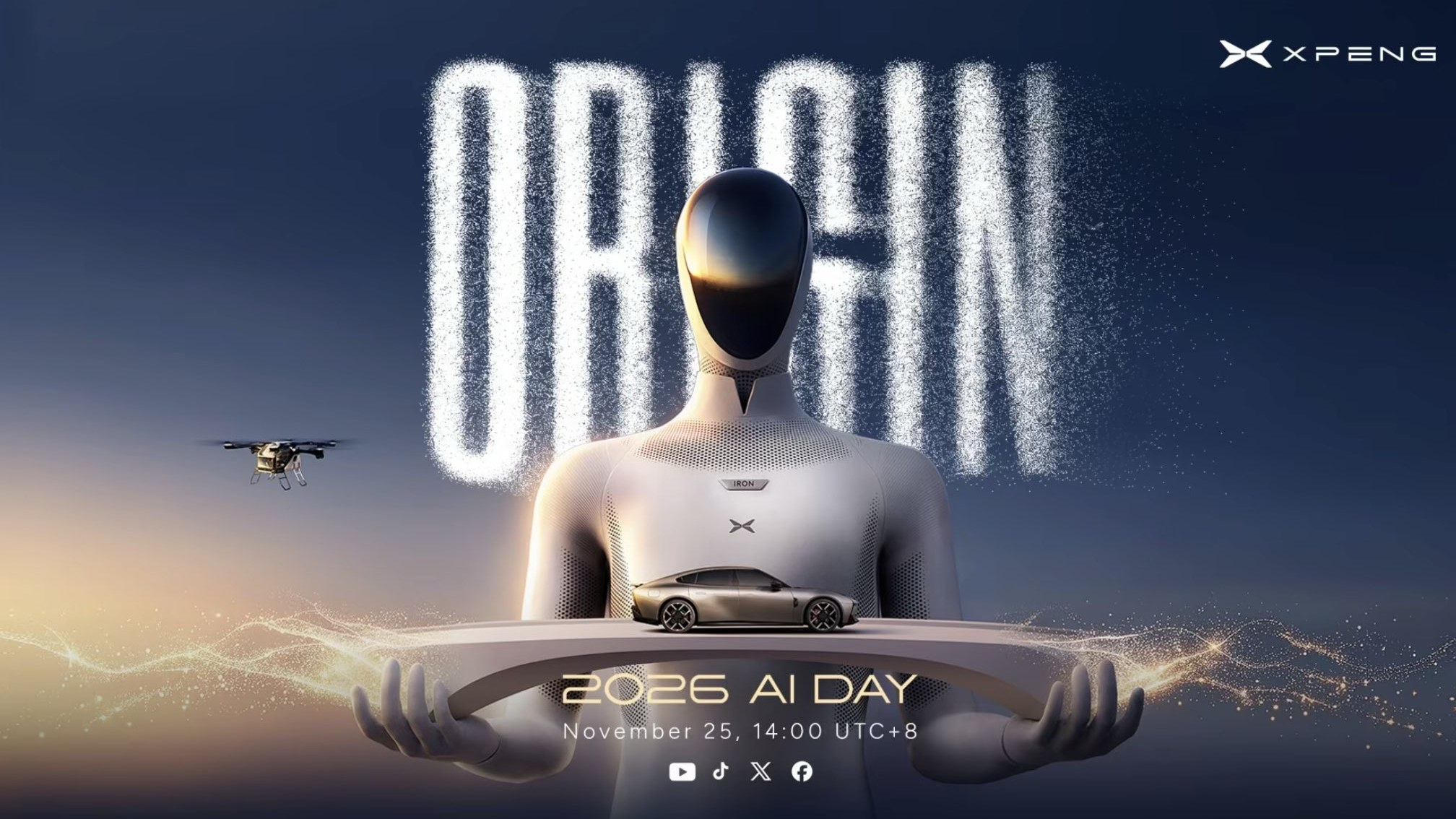
XPENG held AI Day in Guangzhou on 25 November. Two of the announcements reach European owners too: driver assistance becomes a subscription for new buyers, and cars with a 5C battery are to charge at 6C after a software update. Neither came with a price or a date for Europe. What XPENG teased beforehand is in the preview from 19 November.
Order before the start and keep the benefits
From the second quarter of 2027, XPENG will sell Turing AI Intelligent Driving, its name for the driver-assistance system, as a subscription to new buyers worldwide. Anyone who orders a car before the subscription starts keeps their driver-assistance benefits “for life”, He Xiaopeng said. His reason: a driver-assistance system has to keep being developed for as long as the car is on the road.
There was no price, and XPENG did not say which functions the subscription covers. Nor is it clear whether the benefits stay with the car or with the owner when the car is sold. In Europe, NGP is not yet switched on in customer cars; for now you can only try it as a passenger from XPENG’s store in Paris. XPENG did not say whether Turing AI Co-Driving, the help during manual driving, will also sit behind the subscription.
6C charging over the air
XPENG is lifting the 5C battery to 6C without changing the hardware. Charging from 10 to 80 % is to take 10.7 minutes instead of 12 today. The upgrade will reach all XPENG models with a 5C battery step by step over the air, but XPENG gave no date and named no markets.
The C figure is charging power relative to battery size: 1C can fill the battery in an hour, 6C in ten minutes. In Denmark, the 2025 G6 and G9 and the P7+ have a 5C battery, according to our charging guide. Whether the European versions are included, XPENG did not say.
XPENG has not given the power in kW at 6C. xpeng.guru worked it out from each car’s battery and today’s peak charging power:
| Car in Denmark | Battery (gross) | DC peak today | Average 10-80 % today | Average at 10.7 min | Peak at 6C, estimate |
|---|---|---|---|---|---|
| G6 Standard Range (2025) | 68.5 kWh | 382 kW | about 240 kW | about 270 kW | about 460 kW |
| G6 Long Range and Performance (2025) | 80.8 kWh | 451 kW | about 285 kW | about 315 kW | about 540 kW |
| G9 Long Range and Performance (2025) | 93.1 kWh | 525 kW | about 325 kW | about 365 kW | about 630 kW |
| P7+ | 74.9 kWh | 446 kW | about 260 kW | about 295 kW | about 535 kW |
The average is 70 % of the battery divided by the charging time. The peak estimate multiplies today’s figure by 6/5.
In practice the charger sets the limit. Most Danish high-power chargers deliver 300-400 kW, which already falls short of what a 5C G6 or G9 can take at its peak. At Clever’s site in Rødovre a G6 went from 10 to 80 % in 11.5 minutes, as covered in the story from Rødovre. 6C only starts to matter at megawatt chargers. XPENG’s first one is in Hong Kong, and the company plans to begin a global rollout of its charging stations in 2027.
Driver assistance outside China
XPENG has tested VLA 2.0 in Munich in July, Amsterdam in August and Paris in October. On stage it set a target for the first half of 2027: the first global deliveries of VLA 2.0. XPENG did not say in which countries, or whether that means new cars with the system switched on or an update for cars already on the road. The rollout still depends on approval, as covered in the story on NGP in 2027.
New for cars in China first
Turing AI Co-Driving helps the driver with speed and steering during manual driving. With the function VLA Adaptive Deceleration, the car decides how hard to brake with energy recovery when the driver lifts off the accelerator. In China both arrive in December on the G9L Ultra and Ultra SE and the Mona L05 Ultra SE, and from the second quarter of 2027 on the other cars with Turing chips. Cars with two Orin-X chips follow later. Europe was not mentioned.
The lighter VLA Lite arrives in December on the Chinese Max versions with two Orin-X chips, among them the 2025 G6, G9 and X9, and on the rest of those cars in the first quarter of 2027. The G6, G9 and P7 in Europe have one Orin-X and were not included. The difference is explained in the driver-assistance hardware guide.
Robotaxi and IRON
XPENG plans demonstration operations with no one in the driver’s seat in selected areas before the end of 2026. YOYO-01, its first car built as a robotaxi from the start, arrives in 2027. XPENG does not intend to run fleets itself but to supply the technology to partners, as described on the XPENG Robotaxi page.
The humanoid robot IRON is 170 cm tall and weighs 62 kg. Mass production of the hardware begins in January 2027, the robot starts an internship as a sales associate in XPENG’s stores in the first quarter of 2027, and the official launch is set for the second quarter of 2027. On 27 November IRON hosts XPENG’s press conference at the Guangzhou Auto Show.
XPENG also showed its world models. One of them, WorldGPT, is covered in the article on X-World.
The full presentation is on XPENG’s YouTube channel. This story will be updated when XPENG publishes its written material from the day.
More images


Images: XPENG
Sources
XPENG on Facebook, 25 November 2026: photos from AI Day 2026