


At AI Day on 5 November 2025 XPENG put December 2025 and the first quarter of 2026 on the rollout of VLA 2.0. Before the end of December pioneer users were to be invited to try the system and contribute to its development. The full rollout to Ultra models was planned for the first quarter of 2026, without XPENG stating which markets the timetable covered.
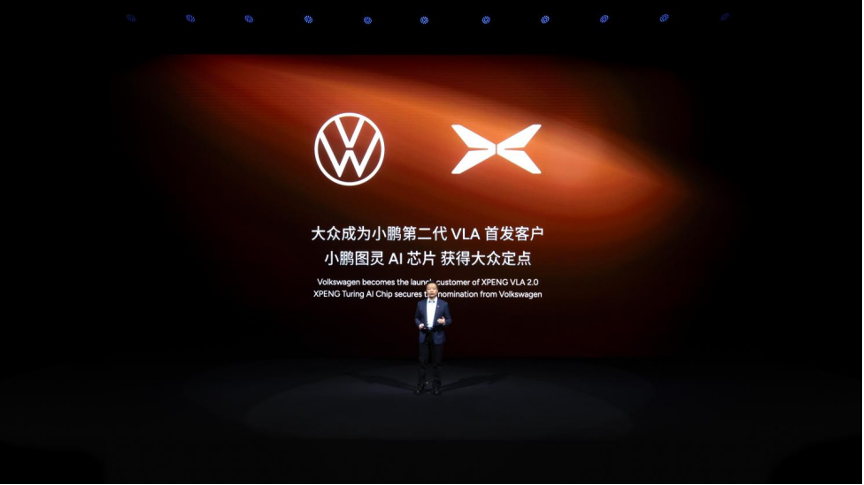
Volkswagen was presented at the same time as the launch customer for VLA 2.0, and XPENG said the Turing chip had been chosen by Volkswagen, without naming a car model, a market or a date.
72 billion parameters and a new model iteration every five days
XPENG describes VLA 2.0 as a path from vision to action with no translation into language along the way. The cloud model has 72 billion parameters, and the company states a cluster of 30,000 compute cards on Alibaba Cloud and a full model iteration every five days. The training material is nearly 100 million clips. XPENG compares the quantity to the difficult situations a human driver would meet in 65,000 years behind the wheel.
In the car the model runs with billions of parameters on the Ultra model’s 2,250 TOPS. On complex, narrow roads XPENG states 13 times more kilometres between driver takeovers, without naming the basis of comparison or the route.
Robotaxis and the Robo trim
XPENG planned three robotaxi models and the start of trial operation in 2026. The same year a new driver assistance trim called Robo was to share hardware, redundancy and functions with the robotaxi.
The robotaxi was specified with four Turing chips and up to 3,000 TOPS, without lidar and high-definition maps. XPENG described a pure camera approach and a hardware architecture with dual redundancy. Amap was presented as the first global ecosystem partner.
IRON and the flying cars
The next IRON robot gained 82 degrees of freedom in the body, a life-size hand with 22 degrees of freedom, three Turing chips and solid-state batteries. XPENG added a fourth law to robotics’ three: private data must not leave the robot. The goal was large-scale production of humanoid robots by the end of 2026.
ARIDGE’s flying-car plant began trial production on 3 November 2025 and built the first Land Aircraft Carrier aircraft. The planned annual capacity was 10,000 units, 5,000 of them in the first phase, and one aircraft every 30 minutes at full rate. XPENG reported more than 7,000 orders worldwide.
The story on the robotaxi in internal testing follows the trial operation, and the story on Master Agent gathers the Turing chip behind XPENG’s AI systems.
Image: XPENG
Sources
XPENG: VLA 2.0, robotaxi and IRON at AI Day · 5 November 2025