



XPENG won the ADAC e-Competition at the Hockenheimring on 26 and 27 October 2024 at its first attempt, taking both its class and the outright classification. The car was a P7 Long Range with rear-wheel drive, start number 19.
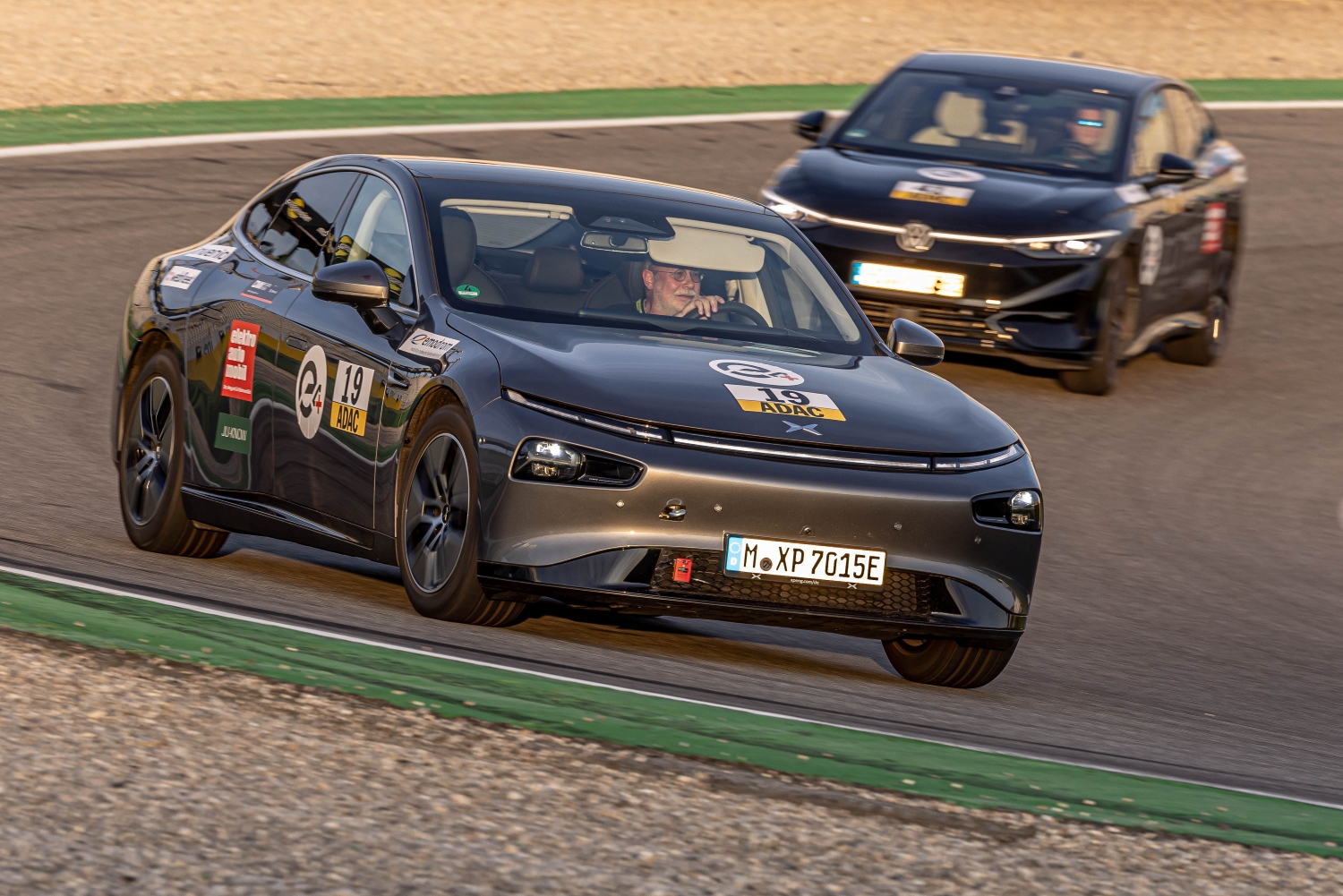
The format is what makes the result interesting. You cover as many laps and kilometres as you can inside an 18-hour window, and charging time counts inside that window. The balance between charging and driving counts as much as the speed. The cars are split into classes by battery size, and the P7 ran in class C for cars with at most 97 kWh net.
The result was 216 laps and 972 km, with 15 hours, 41 minutes and 58 seconds of pure driving time. The runner-up finished 6.8 seconds behind on the same lap, with the pass coming shortly before the end.
The crew was the journalist Daniel Krenzer, Gordon Krug from XPENG Germany’s marketing team, who drove the final stint, and press officer Bernhard Voß.
The consumption, read as kWh per 100 km
The release gives the average consumption as 15.8 kWh per hour. Ten months later XPENG’s German newsroom prints the same figure as 15.8 kWh per 100 km, and that is the unit the sum can be done in; it sits below the car’s own WLTP value of 16.8.
Work it through: 972 km at 15.8 kWh per 100 km comes to about 154 kWh. With a pack of at most 97 kWh that means at least one full recharge inside the 18 hours. Which is exactly what winning on charging strategy means.
Markus Schrick, head of XPENG Germany, called it a strong team effort in which the better energy strategy decided the win.
Why the result counts
Most of what survives about XPENG from those years is XPENG’s own numbers. This is not. A German federation put a series-production P7 against the field under rules that penalise long charging stops, and the car won. The XPENG P7 page has the car.
Images: XPENG
Sources
XPENG Germany: victory in the ADAC e-Competition at the Hockenheimring · 27 October 2024